A new ‘page’ is added

While I may be interested in all kinds of things, the most regular hits my blog gets is from people looking for advice and help in dealing with Aspergers’ Syndrome.

I have made no secret of it:  I am an Aspie!  My hubby is an Aspie!  And, predictably enough, our kids are Aspies!!!  It is therefore not too surprising that I have tried to share some of the more successful methods used by ‘us’ to successfully integrate into the social mainstream.  Not only am I proud of our successes, I am also motivated to help others who are experiencing similar things – as well as helping ‘the society at large’ learn to understand ‘us Aspies’.  Though I may not be one of the ‘exceptional ones’, many of the humans who DID change the course of human societies WERE Aspies…so the need for understanding runs both ways.

Therefore, I have written a bit about Aspergers and Aspies.  After a bit, even I was getting confused between what posts I had finished and published, and which ones I started and got distracted from….there are just so many distractions around!!!   Have I shown you the……

You get the picture.

So, I have made up a nifty page where I have listed my ‘Aspergers’ posts – with a little summary for each one.  It is not much, but I do hope it will serve as a useful tool for people who are seeking help and understanding.  I do hope to edit it often to include all future post on this topic, too (but, no promises – I am ADD, too….)

Anyhow, I do hope this page will prove useful.

Aspergers: not just ‘extreme male brain’ syndrome

If you have done some reading up on Aspergers, you have likely come across the description of it as ‘an extreme male brain’ syndrome.  It is a ‘quick and easy’, one-phrase explanation that ‘makes sense’ to some people.  I’ve often wondered if this theory is based more on the ‘men are bad at social skills, women are bad at math’ stereotype than on anything actually particular to Aspergers itself. 

It seems I am not alone in being a little uncomfortable describing aspergers as ‘extreme male brain’…to the contrary, many suggest that this description of Aspergers arose because it was only studied in males.  And only in a particular type of males, to boot!

Here is an extremely good rebuttal of that idea, written by Felinophile, a young woman who also happens to be an Aspie:


This theory that people with Aspergers have an extreme male brain is sexually-discriminatory, as it is based on studies of Aspergers males and people who fit the Asperger-male sterotype. It completely ignores the way Aspergers manifests in women, which is part of the reason it is seen as controversial.

Like a lot of Aspergers girls, though, I don’t fit the Asperger-male stereotype; while I have difficulty interpreting and expressing body language and facial expressions I have learnt over time to mimic others behaviour and responses, and to form a rough checklist for interpreting other people’s behaviour. While I have good spatial abilities, and do better than non-Aspergers girls in some areas of maths, I never had a gift for mathematics; instead, it was for language, as it is for some other Asperger girls


Read the rest here.

Aspergers and memory – part 2: rote memory vs. reasoning

In yesterday’s post, I explained that while I have not been writing about Aspergers, I have been reading up on it.  While I am interested in this topic (being an Aspie myself – and living with other Aspies), I am not an expert in this field in any way whatsoever.  What I write are personal observations and should not be taken as anything other than that.

So, in Aspergers and memory – part 1: ‘sequencing’, I described that some ‘memory’ studies found that Aspies had difficulty recalling the order in which words were placed on a list they were given to read/memorize, which lead me to wonder if the frequent occurrence of dyslexia and ‘hearing dyslexia’ (APD) might be related to some memory or brain proccessing bit that messes up ‘sequencing’. 

Other studies I looked at would also have a list of words (10, 20, or more) to read/memorize in a short period of time, then the person would be presented with a whole page of words. The goal was to identify the words from the original list – Aspie results were compared to those of their ‘neurotypical’ peers.  The Aspies also did not do as well on this test as others did.  Yet, there was something that more than one researcher found quite intriguing:  for every ‘list’ word the Aspie missed, he or she was very likely to identify another word with similar meaning!  As in, they replaced some ‘list’ words with their synonyms…

Now, that opens a whole new way of looking at things!

I even read one very interesting study (only one, but I am looking for more) which concluded that Aspies of similar IQ as their peers were much, much worse at ‘rote memory’, but much, much better than their peers at remembering things they had reasoned out. 

This study found that ‘rote learning’ was absolute torture for Aspies, and they, frankly, sucked at it.  Not that they were incapable of it – they could improve it with practice.  Yet, it was not one of those things that came easily to Aspies.   Most Aspies had better recall of things which were ‘explained’ to them, rather than simply memorized.  They slightly outscored their peers, while other Aspies were just as dismal at this as they were at rote learning.  Where all Aspies excelled far above their peers was in remembering things they had reasoned out for themselves. 

Consider the implications of this:  some Aspies will be dismal in ‘rote learning’ or even ‘comprehensive learning’ (not proper term, I mean things they were taught through ‘comprehension’), but they are extremely good at remembering things they had figured out on their own!

And I must admit, this makes sooooo much sense to me!!!

The things I remember best from school are the ones where the teacher would introduce the topic, set up what he was going to use to explain it, and – before he would even say the first sentence – I would ‘see’ the pattern and understand exactly what he was about to explain.  As in, if I reasoned it out by myself – I still remember it without any ‘time degradation’, while if I understood the teacher’s explanation, the whole things gets ‘fuzzy’ with time and I have to strain to remember it, even if at one time I understood it and knew it perfectly.

Please, consider what is seen as one ‘typical’ Aspie trait:  they acquire ‘ecyclopedic’ knowledge about some obscure subject which they become absorbed in.  Could this be related?  Perhaps not ‘an explanation’, but could this be another manifestation of the same, or very related, phenomena?  After all, their ‘encyclopedic knowledge’ is to a large degree ‘self-taught’….

What are the implications of this?

First, I think it means we have to approach teaching Aspie kids very differently.  Take spelling, for example.  Instead of teaching Aspie kids simply the sound of the letters, what letters make up the word, and so on….what if we started teaching them from a broader linguistic background?  It is what I did with my kids – and it really worked…but I did it because to me, it seemed ‘the only’ way to approach it….  It would go something like this:

“See this word?  Well, look here – this is the Latin word for …”

“Hey, they have a bunch of similar letters in them!”

“Why do you think that is?”

“Ah, this bit of the meaning is the same!  They just took a Latin word bit and stuck it to …!”

Spelling that word would never be a problem in the future!  (There would still remain the often difficult task to actually motivate and Aspie kid to look at the words in the first place…but that is a whole different topic!)

Mind you, I took this approach to teaching grammar to my older son, too.  Our school system is operating on the ‘whole language’ method, where kids are expected to ‘absorb’ the language from their surroundings.  This simply is torture for Aspies, who like very specific rules they can apply – especially with English, where the linguistic ‘rules’ of a sentence are extremely well masked!

So, I turned to Latin – no we did not memorize the vocabulary, but the words in Latin are ‘flexed’ very specifically based on the role they play in a sentence.  It is therefore easy to see the patterns of how sentences are constructed.  Just showing the rules to my older son and letting him figure out for himself how to then build a sentence with latin words ‘flexed’ properly had an incredibly positive impact on his ability to write in English. 

Perhaps this is only one example, and perhaps this may not work with other Aspies, because there are soooo many individual differences between us.  Yet, I would be curious to know if others’ experiences and observations are similar to mine…so, please, let me know!

Aspergers and memory – part 1: ‘sequencing’

During the past few months, I have not been writing about Aspergers because I have been doing a bit of reading up about it – there is so much ‘food for thought’ in the feedback to my earlier posts on Aspergers (thank you all) that I just had to check some things out.  Of course, not all my curiosity has been satisfied – but I think that I have learned things that have helped me make a little bit of sense of some ‘Aspie patterns’.

The one thing I have read about the most is memory.  And if you Google it, there actually are quite a few studies about Aspergers and Memory out there – so I, an Aspie (and definitely NOT an expert) am not the only one to suspect that one of the ways Aspies differ is in the way our memory works.

The conclusions of the studies were unsurprising:  Aspie memory works slightly differently. 

Yes, there were IQ tests as part of many of these studies to ensure that Aspies and ‘others’ of ‘similar’ intelligence were compared.  Some looked at adults, others at kids or teens.  (Many studies I read looked at Aspies vs. Autistics, but  that is a different story.)  (Frank admission:  while I read some studies completely, others I only read the ‘hypothesis’, the ‘methodology’ and ‘conclusions’ sections.  This was not from slacking or taking shortcuts, but because I really wanted to read many different studies, from different areas, looking at different age groups, run with different goals, so as to get a glimpse of the ‘big picture’ and the patterns within it. )

Here is where I must warn you:  the scientific studies I read made observations and conclusions.  Various studies, various observations and conclusions.  What follows here is my interpretation of the conclusions of several of these studies.  It is NOT any opinion (as far as I know) of a professional in this field.  These are my higly subjective ideas, so, please, treat them as nothing more than such.

Several of the studies had (with variations) presented a list of words which the people had a chance to read several times (or, variously, study for a given time period), and then had to repeat in the same (or reverse) order.  The Aspies usually remembered fewer of the words from the list than their peers.  Now, here is the intereseting bit:  they were absolutely terrible at putting the words into the proper order!

This immediately made me think of the very high incidence of dyslexia and ‘hearing dyslexia’ (Auditory Processing Disorder (APD)) in Aspies.  I may have it backwards, but it sounds to me like this difficulty in ‘putting things into order’ is a pattern:  sounds, letters and words cannot be ‘remembered’ in the ‘right order’….  But with APD, the science tells us it is a problem in ‘perception’. 

So, I reasoned, perhaps this is a general ‘processing’ difference of the brain itself.  Perhaps this is not a simple ‘memory’ function.  Perhaps this is telling us something about the overall processing that the brain does – and how an Aspie brain does it differently.

Or it could be a memory function – but the memory fails very, very early on. 

Let’s consider hearing:  our ears sense vibrations, which are translated into a neural impulse.  This impulse travels into the bit of the brain which makes sense of the sound, and sends the ‘translated’ information to other bits of the brain, as required.  For example, if it determines a sound to be ‘words’, it might send the message to the ‘language’ section of the brain.  But, is all of this instantaneous?

In many people it is.  But I don’t think this is in any way universal.  For example, I know several people who can hear me say something and completely fail to react to it.  When I ask them what I said, they look thoughtful and then repeat word for word what I had said.  Yet, until they were requested to repeat the words, they were completely unaware that they had even heard them.

It’s as if the phrase were held in some sort of a ‘buffer’, completely preserved and perfectly remembered, but not deciphered by the brain.  Only when this ‘buffer’ was consciously accessed did the brain actually get access to the information in it.  This suggests to me that in-between the different ‘processing’ stages, the brain must hold the information in some sort of a memory slot. 

And if the Aspie memory has a predisposition to ‘jumbling up’ the order of sounds (or pictures) it is holding on to, it could explain all of these.  Jumbled up sounds, pictures, order of words.  All of it.

Or, it could be something completely different.  Yet, I have received so many messages from people, asking for more of my observations about Aspergers – as well as offering me their perspectives about what I wrote – that I thought that even though I really am not sure what it all means, putting this observation ‘out there’ might be a good idea.

This way, I hope, many of you will share your own experiences in this and together, perhaps, we can make more sense of this!

If a tree falls in the forest….

Having spent time in such serene surroundings like this:

Canada has magnificent trees.  This one looks like it's in the thralls of a wild, primal dance!

Canada has magnificent trees.

…is it not surprising that my mind had taken a break from the ‘everyday’ and slipped into a bit of philosophising?

If a tree falls in the forest, and no-one is there to hear it, would it make a sound?

In the past, when discussing this with my kids and husband, we have invariably fallen into the pitfalls like, for example, trying to define what does ‘sound’ mean:  is it simply the movement of air molecules in a particular way, or does it have to be ‘perceived’ by human ears?  (If it is recorded, then the sound we hear is made by the recorder, not the tree…and endless possibilities along these chains of thoughts.)

This year, I began so see it from a different perspective…

Richard Feynman is perhaps my favourite genius of the 20th century – and I am convinced he is an ‘Aspie’ to boot! ( Just reading his most awesome book, ‘Surely You’re Joking, Mr. Feynman!’, is an excellent lesson in how an ‘Aspie’ mind organizes thoughts and commits them onto paper – plus it is fun and curiously comforting to read).  In his Lectures (available as podcasts, and ideal for relaxing with while ‘away from it all’), specifically, in the ‘Quantum Mechanics’ lecture, he also visits this question about the proverbial tree falling in the forest… 

Dr. Feynman gives some very specific qualifications regarding this issue:  he would not be a physicist had he not done that.  He states that in the real world, even if there is no observer when the tree falls, there are still unmistakable physical signgs that it had, indeed, made a sound.  These signs, perhaps as minute as little scratches from vibrating leaves/needles as the sound energy is transferred to them, could then be observed after the event itself and the presence of such sound would be conclusively demonstrated.  Thus, he concludes that ‘in a real world, of course, a tree falling in a forest makes a sound‘.

He is, of course, absolutely correct – given the qualifications he does.  

Yet, listening to him made me think that perhaps his ‘after the fact observer’ – as our familial discussions from the past – were really missing the whole point of the question!

Whether during the act of the tree falling, or afterwards; directly or through recording devices of some sort (even leaves and needles) – this introduces an observer.   And the fact remains that if an observer is present, and the original condition (or, rather, its intent) is breeched.

Yes, I’ll gladly concede that in the real world, it might be impossible to have a ‘no observer’ scenario – but that is not the point.  The question asks us about a hypothetical situation, where no observation (during or after the event) occurred (even had it been possible). 

Let us imagine an observer who makes a direct observation that 999 trees, as they fell, indeed did make a sound.  Then the observer leaves, and our proverbial tree falls.  No observation as to the sound of any kind had been made during the event.  The scene has since been altered so much that no additional evidence can be gathered.  How can we answer the question now?  Did our proverbial tree make a sound, or not?

And this, in my never-humble-opinion, is the crux, the core, of this principle:  one can only say that one does not know.

It would be reasonable to predict that it is highly likely that the tree had made a sound, based on previous observations.  But one would not know !

This is the difference between direct observation and a guess.  Perhaps it might be an ‘educated guess’ (based on the previous 999 observations) , but it is still only a guess.  And that is the whole point:  to get us to stop and think, to learn to recognize that difference between what we know and what we are making educated guesses about (or a semi-educated guess about).

One of my sons thought this simply reduced the question to the ‘Schrodinger’s Cat’ scenario, but I think there is a difference.  This is not about probability curves and their collapses, this is about learning to recognize the blinders we all wear which let us treat guesses (whether ors or those of others) as equally valid to observed facts. 

And it is about time that some of these blinders statred coming off! 

After all, guesses, even educated ones, are not facts – and we must not fall into the easy trap of treating them as such.  Especially in cases where the guess is not based on 999 direct observations of this very event…or not on even one such event having ever happened!

Which leads me to the next question:  If the global temperatures change by 0.6 of a degree, and no well-financed lobby group is there to use it as a pretext to organize a scare-mongering, funds-transfering campaign, would anyone notice?

Perspective - we all need it!

Perspective - we all need it!

‘Motivating Asperger kids’ – a tutor’s story

A HUGE obstacle in teaching Aspie kids is engaging their interest and motivating them.  Unless motivated, these kids will simply not retain learning.  And since these kids tend to be have problems reading ‘social cues’, usual motivation techniques, which involve some forms of ‘social pressure’ will fail to motivate them.

This can lead to frustration on all sides!  Teachers/tutors, parents and the kids themselves!

Following is an excellent account Lorraine has sent in, about her experiences of tutering two Aspie boys and SUCCEEDING by MOTIVATING them.  Please note:  the story is as Lorraine had written it, with only minor editing.  The emphassis, however, is my addition.

It was very interesting to read the mail posted on his site.  I am tutoring spelling to a 10 and an 11 year old boy with Aspergers.
Until I met these boys at the beinning of 2007, I had never heard of the condition.  I am amazed at how intelligent these boys are compared to other ‘normal’ children. They love facts and tell me things that outstand me, that a young boy of his age could know those things.

The reason these boys are coming to me is that they have problems with reading and writing. They were at the very bottom of their classes at first and have now come to second top, and fourth from the top.
One teacher commented to the parent, “How can she teach him 10 words in one hour and I can’t teach him one word in a week.”

I hope my crazy methods will work for others as well, and that is why I have decided to post here.  Who knows, maybe the ideas might be helpful to someone else!

We don’t do spelling when they are here in the way that you would expect. We invent things we are going to do the week before, so that they know what we are doing before they come here.  This seems to be pretty important, planning ahead.

The boys come here on different days to each other.

With one boy, we made a coffee table that his mother is so proud of she nearly cried. Another time he did a lovely painting in oils using my good oil paints and a big canvas. On this he painted a dragon, it was beautiful. Next he got to use real tools and made a four piece candle holder complete with candles in little dishes. The list goes on.

Back to the table. We went to the local op-shop and bought a “daggy coffee table” for three dollars. Then we bought a pile of plates, about 20, in his favourite colours. He chose the plates himself, not me. The plan was to use tools and sander to refresh the table, and break the plates to use as tiles to do a mosiac on top.

Each step was pre-planned and fun motivation to learn.

Each step was pre-planned and fun motivation to learn.

We went back to my place and for every word he spelled correctly three times, he got to go outside, place a plate in the bag and break it with a hammer. It wasn’t too long before he had enough smashed china to make the top of the table. He spelt a lot of words, had a lot of fun and laughter, and overall enjoyed himself. That part took two visits each for one hour.

The following week, he got to work on the wood with with my small electric sander. Same thing, spell the word and get to do a section of the table. That took a couple of weeks. The exciting thing for him then was to be able to do a drawing on the table.

The folowing week, he worked out his design and the pieces he would put in the places he chose. The week after that he glued his pieces where he thought they would belong.  However that was a slow process and it took two weeks also.

The following week, he got to grout his tiles. That took a long time and we had arranged to ring his Mum when it was finished. He had done a beautiful job on it. This also had a dragon. He had chosen his own colours and I was a bit dissapointed when he chose the colours he did, but I didn’t say so, and it was just as well I didn’t because his table is wonderful.

The project took a whole term, he learnt all his words, wrote several sentences each day, gained confidence in the class room. He became a bit more friendly with his teacher and so the tantrums and frustration have lessened.

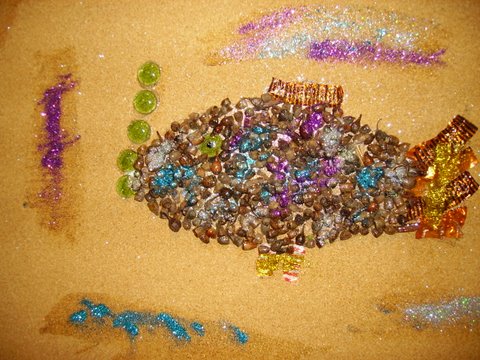
Other things we did were collecting a bucket full of gumnuts, putting them through a polisher and used the colourful little things to make a fish statue, he did a beautiful job.

What comes through to me is that if there is a reason or a reward that appeals, he ceases to find study to be so painful. It works well.

I have only two students with aspergers, but I have found them both to be very interested in making things that they can use, being very creative as they do, and if not interferred with will do a very good job.

Motivating kids to learn - a truly creative method!

Motivating kids to learn - a truly creative method!

The important thing is to plan ahead so that when they get here, they know what to expect. If I slip up on that aspect of it they don’t seem to emit the same enthusiasm. They seem to feel let down and I get guilty.

Of course as everyone will know, thay are not too keen on instruction, so drawing and planning ahead eliminates the need for further instruction.

Well I hope you don’t mind my sticking my beak in here, but I am so enthusiastic about the results and at how pleased the mothers and fathers are, I just wanted to share this.

Thank you.

And, thank you, Lorraine, for sharing this wonderful story and your insights!

Aspergers and writing – sentences

Writing a sentence seems like a simple thing – just figure out who is doing what, and write it!  Right.  Except it is not that simple for an Aspie

This seems incomprehensible to many teachers, parents, and any ‘outside observers’.  How come an Aspie is fully capable of presenting a coherent, detailed explanation of something without any preparation, but when asked to write a sentence or two on that same topic, they are unable to produce one?  How come that when asked a question, an Aspie student can speak for 15 minutes, giving exhaustive, accurate answer, but will only put down a single word as a response to the same question on a written test?

It does not seem credible – to the teachers or parents – that this could be possible.  ‘Just write down what you said!’ tends to be the response/command/advice, but it just does not work like that.  I do not know how or why, but I have seen it and experienced it.  Needless to say, this only leads to very high levels of frustration among both sides…

Many professionals in this field are studying this, and doubtlessly, there are many excellent theories about why or how this occurs.  I do not attempt to address that here – I just hope to look at the mechanics of how this can be overcome… at least, a tiny little bit!

First, the way language is taught is terribly important.  It can mean the difference between practical illiteracy (at least, in the ‘output’ phase) on the one hand, and ‘functionality’ on the other.  How can this be so?

Aspies tend to like to follow rules.  Perhaps not everyone’s rules, perhaps they have a lot of difficulty decoding social rules, but – once a rule is understood and accepted, Aspies tend to derive comfort from adhering to them.  This is true for language.

It is unfortunate that the current ‘model’ for teaching English (as a first language) in much of North America is the ‘whole language’ approach:  this is the hairebrained idea that children will simply ‘absorb’ the rules of English when they are ‘exposed’ to them.  Perhaps this may work for a small minority of kids.  It certainly makes the teaching less laborious, because the teacher does not have to actually teach grammar, correct grammatical errors in written work (we are looking for substance, not grammar…).  And, much more often than I would have liked, I have come across teachers who are not even able to follow simple rules of grammar themselves!

This is a major problem for Aspies:  the rules are difficult to ‘absorb’ – especially when the teacher does not use proper grammar….  Constructing a proper sentence then becomes quite bewildering.  Yet, many Aspies can master written language quite well, so there must be something else going on here.

Perhaps there is a different part of the brain that controls verbal and written expression.  Or, perhaps many Aspies consider things that are ‘written’ to be ‘permanent’ – and therefore there is a much higher level of perfection that is required.  I have asked many adult Aspies who have tremendous difficulties writing things, and there seem to be striking similarities among most of them.

First, the idea.  That is the easy part.  In other words, the Aspie knows what he (the friends I questioned were all men) wants to write.  The problem comes in the how to write it:  they will put a word down, wonder if it is the most accurate one – and start ‘googling’ it. Wikipedia probably has some pretty good definitons of this – you should check it…. 
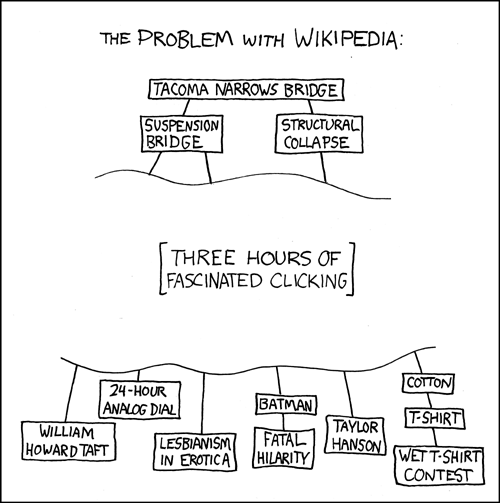
The problem with Wikipedia

OK, refocus.  Now you have the correct word.  So, how do you fit it into the sentence correctly?  Is that the right grammar?  Perhaps you should ‘google’ that….


OK, refocus.  You now have a noun and a verb, most likely in the proper grammatical structure.  But it is nowhere near sufficient to capture the meaning…  Perhaps it is time for lunch.

And so it goes.  Not very productive, but, eventually, some semblance of a sentence will be produced.

So, how can one help a child learn to overcome this?

My personal exerience gave me some insight.  I was lucky enough to be able to reproduce patterns – sound patterns and picture patterns.  This helped me get selected for a language school when I was 8 years old… and while I was struggling to write basic sentences in my native tonngue, miraculously, I did not experience the same problem in the new languages.

Perhaps advice from a teacher helped: 

‘Do not write what you want to say, write what you are able to say!’

With a limited vocabulary of less than 50 words, and only a rudimentary rules of how to construct a sentence according to the new language’s rules, the prospect of ‘writing a sentence’ became more managable!  With only a limited number of permutations possible, selecting the best possible combination of them which most effectively gets the point across became easy!

When my older son got to a point in his schooling where he was expected to construct more than just simple sentences, he started having a problem.  Trying to help him, I realized that he only had a very basic (and somewhat flawed) idea of how English grammar works….

Solution?

Basic textbook of Latin!

The reasons for selecting Latin were many:  from loan words down.  But the most important reason was that the Latin grammar was very explicitly spelled out – and that the endings of the words would change, depending on what role in the sentence that word played.  This is very key – it reinforces the rules of grammar, and helps figure out how to use them to construct a sentence.

My goal was not to teach my son Latin.  As a matter of fact, we spent no effort on memorizing vocabulary – we only focused on learning the rules for ‘flexing’ the words:  what does a particular ending mean – and what it tells us about the role this word plays in the sentence.  This skill was then easy to transpose into English sentence composition.

Yes – sentence composition.  Because that is how it has to be approached – this word is the subject.  This word describes the subject.  This word is the verb.  This word describes the verb….  and so on.

For younger kids, it might help to use tools:  on small, rectangular pieces of card paper, print a limited number of words related to the topic the child needs to write a sentence about.  Depending on the kid, start with 20-30.  Separate them according to their role in the sentence – it migh be very helpful to colour code them.  Nouns in one colour, verbs on another, pronouns, adverbs…so on.  Or, just separate them into piles. 

Then, when the child needs to write a sentence, let her/him pick out the right words and ‘build’ the sentence out of the ‘card words’.  Since only a very limited number of words are available, the child must be told the task is not to ‘answer the question’ – because that might seem impossible!  Explain to the child that the goal is to ‘build the best possible answer out of these words.  It will not be perfect – and it is not expected to be! Make it a game to try to create the best ‘best fit’ that could be done from this set of ‘card words’.

Once the sentence is created, the child can copy it – and use it as the answer. 

The word-pool can be altered, based on the topic. It can be increased or decreased, based on the child’s needs:  the more difficulties, the fewer words to pick from.  It is a tedious process, but it does work – or, at least, it worked in several instances when I have used it (not just with my own kids). 

My personal opinion is that it teaches several things: 

  • By limiting the pool of words, it makes ‘finding the right word’ easier – by making it OK to settle for the ‘best available word’.
  • By forcing the use of ‘different types’ (as signified by colours/piles of words, based on role played in the sentence) of words, the Aspie reinforces the proper use of grammar
  • This exercise builds one’s confidence in their ability to form sentences – which is much more important than most educators acknowledge.
  • Perhaps most importantly, it creates the habit to ‘write what you can, not what you want to’

It is not perfect, but this might help overcome the obsessive need to only write an ‘impossibly perfect’ sentence…

Learning to write is not easy for people with Asperger syndrome.  There are many obstacles in  their way:  from mechanical difficulties, to ‘holding onto their thought long enough to write it down’.  Add the desire for perfectioninsm in written expression…. 

Following the suggestions of professionals who know the child is the best way to help him or her learn to overcome the difficulties which are part and parcel of Aspergers.  Yet, if nothing seems to work, frustration levels are building, the child is unhappy… I know there were times when I would have tried just about anything!  And letting the child help sort the words just might take an edge off the frustration.

Aspergers and ‘painting music’

Over the last few decades, there have been very big changes in classroom attitudes – at least, in this part of the world.  Many teachers are of the opinion that academic rigour stifles self-expression, and in an attempt to foster creativity in their students, they have systematically dismantled structured teaching.

This might work for some students.  Yet, many students do not do well in this new environment, do not learn well using this new method.  Yes, I do focus on kids with Aspergers, but they are not the only ones who are having difficulties.  Many ‘normal’ kids find this ‘unstructured’ method of teaching makes learning more difficult.  The Aspie kids get completely lost in it.

Let me give you an example:

During a series of grade 3 art classes, the teacher played different types of music.  The assignment was to ‘paint’ the music while the students were listening to it.  I thought this was the height of idiocy:  no skills were being taught, and precious school time was being wasted.  But it was explained to me that I was being boorish, that this ‘exercise’ is scientifically designed to stimulate different areas of the brain to synthesize information, which is what kids at this age need more than anything else.

Please, do not misunderstand me.  I don’t have anything against art classes in general:  to the contrary.  My mother teaches art, and I have a deep love for it.  However, I think that kids actually get more enjoynment out of art if they are actually taught about it.  They will derive pleasure from drawing if some of the rules of proportion, or different  fun techniques are broken down into steps for them, so they can master the skills.  Once they have understood the rules, it will be more fun to ‘bend’ them to express their own artistic talents (and no, I don’t mean after years of study….rather, teach a specific skill, rules that govern it, and how to bend them and have fun with art).

Well, my son was in this particular art class.  He was in it because that teacher had gone to receive specific training on how to teach kids with Aspergers.  And then she got angry with an Aspie kid for ‘not being able to paint the music’ he was listening to????? 

Of course, what she was expecting was just non-sensicals colourful swirls – but she would never tell the students that.  With a prim smile, she insisted they ‘paint what the music makes them see’.  Questions of ‘How?’ were met with ‘That is up to YOU!’

Just before setting marks onto the report card, she called me to warn me that my son is about to fail art…  Let’s just say that I found it somewhat difficult to keep my temper.  (The problem was the frustration he experienced in being asked to complete a task he did not have the tools to perform, asking for help and being denied it, then penalized for failing by a bad mark.)

I explained to her that in that case, by her own standard, my son should have received an A+ for his artwork:  the music did not make him ‘see’ anything, so that is what he painted.  Or did not paint.  Either way, the result was accurate, and that he made a bold artistic statement by leaving the page blank.  Quite literally, he ‘drew a blank’!  In other words, I tried to ‘out-pretentious’ her.  It did not work – I’ve never been very good at it. 

However, the teacher said that if my son does 3 of these paintings and hands them in by Monday, he will not fail art.  So, we were left with the task to ‘paint music’.  My son and I talked about it, and it became clear that his frustration level was higher than usual.  But I came up with a solution I am still proud of!

Selecting a Physics textbook which had a good, simple explanation of ‘sound waves’, we read it over together and I explained all the diagrams to him.  Now, here was ‘sound’, represented visually!!!!  We were making progress.  Yet, many Aspies are sticklers for rules – my son could not paint the different types of music the same way!!!  And I was ready…

Rummaging around in the basement, I dusted off our old logic analyzer and brought it up.  Then I set up the display to emulate an oscilloscope, and we played the different types of music.  It worked!  The different sound waves made the oscilloscope display different curves.  Lifting his brush, and dipping it into the green paint (the display was green), my son went and happily painted the different types of music!

His teacher was thrilled!  She told him she knew that if he tried, he could paint music!  He told her they were ‘music waves’ and that he saw them.  I did not tell her that he saw them on an oscilloscope screen – somehow, I did not think that would please her.  Why spoil her pleasure? 

Aspergers, drawing and art

Many kids with Aspergers do not enjoy drawing and colouring.  This could be due to the fact that many have less ‘handedness differentiation’ – neither hand has better developed control, so drawing (and eventually writing) is more difficult.  But there could be more to it than that.

Just as there seems to be a difficulty in translating thoughts into a written form, some Aspies experience a similar difficulty in translating visual images into a drawing.

This is strictly my own observation, and I am not aware of a connection between these two aspects in any professional literature, but I cannot but wonder if this is a different expression of one underlying problem.  Let me describe it a little bit.

My dad has never been diagnosed with Aspergers – nor has he ever sought an opinion on the topic.  However, I do see some similarities between the way he, my sons and I processes information – at least, in some instances.  When we were trying to figure out this whole ‘Aspergers’ thing, he shared with me something that happened to him, when he was about 10 years old.

Standards and teaching methods in school were a little differen in his days, and teachers were more authoritarian.  During an art class, a substitute teacher said they were to draw a picture of a pig and hand it in at the end of the class.   A simple assignment – right?  Except that nobody had ever taught him how to go about drawing a picture of a pig… and my dad simply could not figure out how to even start.

He sat there, for the whole period, without making a single mark on his sheet of paper.  The teacher was not pleased.  As a matter of fact, he got very angry.  My dad was smart and had high marks, but he was not the most compliant of students.  The teacher would not believe him when my dad said he did not know how to do draw a pig, and concluded this was simply defiance…  and to report to him after school for detention.

The detention?  My dad was to sit at his desk until he drew the picture of a pig, then he was to bring it to the teacher’s office.  Once that was done, he could go home.  But try as he might, he simply could not resolve the image of a pig into its componenet parts, which he could then draw.  So, he sat at his desk, for several hours.  Finally, the janitor took pity on him. 

He, too, found it hard to believe a kid could not figure out how to draw a pig, but when he saw my dad just sitting there, for hours, he took a plain piece of paper and a pencil, drew a rectangle for a body, a triangle with a dot for the head and an eye, four sticks coming out of the bottom of the rectangle for legs and a curly spring on the back for tail.  “Here” he said.  “A pig!”

This was a revelation to my dad!  He easily reproduced the simplified ‘pig’ onto his sheet of paper, brought it to the teacher, and was allowed to go home.  

I have since met several people who do not naturally have an ability to break down a visual image into subsets, individual lines, which could then be put onto paper.  However, they can be shown how to go about it, and learn the process – just that to be effective, this process of learning needs to take place when they are older than when most kids learn to draw. 

Similarly, many Aspies do not have a natural ability to break a thought into constituent parts that can be written down – we start looking up words, checking spelling and grammar, wonder about better ways of saying it…. and end up producing very few actual words…  Yet, like with drawing, this process can also be learned – and it, too, will only be effectively learned at a later age than that of non-Aspie peers.

Could it be the same ‘prioritization’ or ‘orderig’ of ‘stuff’ that is causing both effects?

Another connection between them:  once Aspies ‘learn’ this process, they do not simply ‘learn’ it, they often ‘master’ it, and become better at it than most other people.  And yes, some do become successful writers or artists… Eccentric, yes, but successful.

Is this simply ‘overcompensation’?  Or is there something else at play here?

Aspergers and writing – holding on to that thought!

Different people are affected by Asperger Syndrome differently, and to varying degrees – it is more of a ‘continuum’ than an ‘on/off switch’.  I am by no means an expert – but I have some experience in living with it, and raising kids who are also Aspies.  The following will not work for everybody, but it did work for one of my kids.  Perhaps it may help another family, too – if not to improve skills, then at least to build an understanding.

Many Aspies are quite capable of speaking their mind, but have difficulty writing.  Previously, I have noted several factors that could be at play.  Here, I would like to look at only one of these:  how to hold on to that thought long enough to write it down.

Whether it is some problem with short-term memory, a non-differentiation in the prioritization of our 7-or-so ‘attention slots’, or if it is due to different causality, the practical result is that many Aspie kids say: ‘there are so many ideas swirling in my head, I cannot hold on to one thought long enough to write it down’. 

This problem could be related to ADD – a condition which often occurs along with Aspergers.  And it is something that can be incredibly frustrating.  The child knows the answer, but there is some kind of a breakdown in the communication between the brain and the hand…  To an outside observer, it looks like nothing less than obstinance!

The earlier it is discovered that a child has this aspect of Aspergers, the easier it is to correct.  As is so often the case, the smarter the child is, the longer they can ‘mask’ the problem by ‘leveraging their core competencies’.  (Ooooh, I do love it when I talk bureaucreteese – while I don’t have to!  I amuse easily.)  This can be a good thing:  if the problem is mild, this can be a way the child ‘owns’ the problem and develops perfectly tailored coping mechanisms.

My son’s problem, however, was not mild.  Even though he did well, hiding his problem for quite a long time, half way through grade 2 he simply ‘got stuck’.  And even when we discovered it, it was completely new to us.  Nobody seemed to understand why he would sit at a desk for an hour and manage to write less than 3 words.

In grade 1, he tackled his inabiltiy to learn to read – and leapfrogged his peers, reading ‘The Lord Of The Rings’ on his own during the summer.  He had mastered the mechanics of forming letters – this also had been a struggle in grade 1.  (He had gone to a Montessori pre-school, where he learned to iron washcloths instead.)  So, we had been optimistic that we were ready for grade 2!

And now, this – to us – unprecedented and inexplicable inability to write even the siplest sentences.  The teacher was great, and even took a seminar to see if she could learn about this – but by this point, we had never even heard the word ‘Aspergers’, or what it means.  It took us a long time, but we finally worked out a way to get written work done.

  1. My son and I would sit at the table, he would read the question, and say the answer out loud.   
  2. I would write the answer in large, clear letters on a notepad. 
  3. I would place the notepad on the table, and he’d get ready to write his answer.
  4. Now I asked:  “What is the question?”  – He’d read it out loud again.
  5. “What is the answer?”  –  He’d say the whole answer again.
  6. “What is the first word?”  –  He’d repeat it.
  7. “What is the first letter?”  –  He’d repeat it and write it.
  8. “What is the second letter?”  –  He’d repeat it and write it.
  9. “What is the third letter?”  –  He’d repeat it….

And so on.

Except that, at the beginnig, by the second letter, he would forget what it was.  And what the word was.  And what the question was.  So, we’d go back to reading the question, answering it, reading what he had written, and forcing him to realize what the next letter was.  

It was hard, and it took a long time.  Especially in the beginning – it could easily take us an hour to write 4 sentences.  But, he was doing it!  And over time – long time – he built up the capacity to hold on to more and more information, before needing to go back and re-checking it.

At first, on the advice of the teacher, we had instituted a ‘reward system’.  She was one of those teachers who really care – and I don’t know if I could have done it without her.  And, because I did not give my kids too many sweets – she suggested that some very small candies or raisins could be used as ‘earned rewards’ – say once a sentence or a particularly long word is completed.

The reward system was working.  Not that it would make the work easier, or that it would motivate him to write faster.  It did not work in that way.  But, as hard as all this was on me, it was even harder on my son:  he had just spent a full day at school – good and bad – and now we were sitting at the table for hours, working.  That is a lot for a 7-year-old!  The ‘reward’ was exactly that – it allowed him to graphically see his progress!  As my pre-measured ‘pile’ of ‘rewards’ on the table was shrinking, so was the amount of work still ahead of him.

That is something neat:  Aspies like rules.  They are much more likely to reach their potential in a highly structured environment, where the expectations are very, very clear.  In a way, the ‘rewards’ were a little bit of ‘structure’, a measure of how much work is still expected from him.  Anyhow, he seemed calmer, and more ‘focused’.

Soon, I started finding the ‘rewards’ in his pockets when I would do laundry.  This puzzled me – so I asked him about it.  His answer?  “Well, I don’t really like to eat when I’m doing my work, but you looked so happy giving me the treats that I did not want to spoil it for you!”

After this, we switched from edible rewards to other non-edible ‘markers’:  marbles, poker chips, pebbles, or even coins from his piggy bank.  He got to pick what we would use that day, and helped count out the ‘markers’.  Once he had earned them all, we would put them back into their baggie, and into the ‘marker box’.  He liked that.

It was slow going.  After about a week of this, we both noticed that we would almost fall into a rhythm of question-answer-write.  And that really was the point when we both noticed beginnings (very, very beginnings) of progress!  Just to vary it – for fun – we started calling it out in the rhythm of that song soldiers sing to keep beat, with the question-answer called out loudly. 

My son loved it, and called it ‘writing with shouting’.  He explained to me that when we were ‘writing with shouting’, the sound scared away the other thoughts, so he could sometimes hold on to three or even four letters before needing to go back to see what word it was he was writing!  He would be excited by this, and ask for us to ‘do the writing with shouting’.

Excited by this progress, I reported back to the teacher how well we were doing.  Perhaps I was a bit hahazard in how it all tumbled out of me, but I was very excited and happy to tell her.  I did not get the reaction I expected.  She looked aghast, and started crying.  When I asked why, she said: 

“The poor child!  He’s trying so hard!  And you took away his treats and are shouting at him instead!”

I explained better.  So, why exactly does ‘relief’ make people want to punch my arm?

In conclusion, it did work – but it was a long, hard road.  The performance level at school rose faster than my son’s skills, so it could be downright discouraging at times.  But, we stuck with it – there was about a 3 week period when we worked 3-4 hours a day at it, and there was not a single day when we did not spend at least 2 hours ‘writing’ – without or ‘with shouting’!  And we beat it! 

Eventually, we would not need to go letter by letter.  Instead, we went word by word.  We got there during grade 3….  But the habit of having me write the answers down, and then writing them down himself with the notepad in front of him ‘for when he needed it’ – we continued that until the end of grade 5.  And, if the schoolwork really piled up, I would sometimes (with the teachers’ permissions) script for him.  One needs to be flexible when the workload is greater… and other learning must not be neglected.  Eventually, his writing skills have caught up with the amount of work required of him at school.   

It took a ‘few’ years, but we beat it!  It was not the last problem with ‘writing’ that we encountered, but it was by far the most effort-intensive to overcome.  But it was worth it!