Aspergers and writing – sentences

Writing a sentence seems like a simple thing – just figure out who is doing what, and write it!  Right.  Except it is not that simple for an Aspie

This seems incomprehensible to many teachers, parents, and any ‘outside observers’.  How come an Aspie is fully capable of presenting a coherent, detailed explanation of something without any preparation, but when asked to write a sentence or two on that same topic, they are unable to produce one?  How come that when asked a question, an Aspie student can speak for 15 minutes, giving exhaustive, accurate answer, but will only put down a single word as a response to the same question on a written test?

It does not seem credible – to the teachers or parents – that this could be possible.  ‘Just write down what you said!’ tends to be the response/command/advice, but it just does not work like that.  I do not know how or why, but I have seen it and experienced it.  Needless to say, this only leads to very high levels of frustration among both sides…

Many professionals in this field are studying this, and doubtlessly, there are many excellent theories about why or how this occurs.  I do not attempt to address that here – I just hope to look at the mechanics of how this can be overcome… at least, a tiny little bit!

First, the way language is taught is terribly important.  It can mean the difference between practical illiteracy (at least, in the ‘output’ phase) on the one hand, and ‘functionality’ on the other.  How can this be so?

Aspies tend to like to follow rules.  Perhaps not everyone’s rules, perhaps they have a lot of difficulty decoding social rules, but – once a rule is understood and accepted, Aspies tend to derive comfort from adhering to them.  This is true for language.

It is unfortunate that the current ‘model’ for teaching English (as a first language) in much of North America is the ‘whole language’ approach:  this is the hairebrained idea that children will simply ‘absorb’ the rules of English when they are ‘exposed’ to them.  Perhaps this may work for a small minority of kids.  It certainly makes the teaching less laborious, because the teacher does not have to actually teach grammar, correct grammatical errors in written work (we are looking for substance, not grammar…).  And, much more often than I would have liked, I have come across teachers who are not even able to follow simple rules of grammar themselves!

This is a major problem for Aspies:  the rules are difficult to ‘absorb’ – especially when the teacher does not use proper grammar….  Constructing a proper sentence then becomes quite bewildering.  Yet, many Aspies can master written language quite well, so there must be something else going on here.

Perhaps there is a different part of the brain that controls verbal and written expression.  Or, perhaps many Aspies consider things that are ‘written’ to be ‘permanent’ – and therefore there is a much higher level of perfection that is required.  I have asked many adult Aspies who have tremendous difficulties writing things, and there seem to be striking similarities among most of them.

First, the idea.  That is the easy part.  In other words, the Aspie knows what he (the friends I questioned were all men) wants to write.  The problem comes in the how to write it:  they will put a word down, wonder if it is the most accurate one – and start ‘googling’ it. Wikipedia probably has some pretty good definitons of this – you should check it…. 
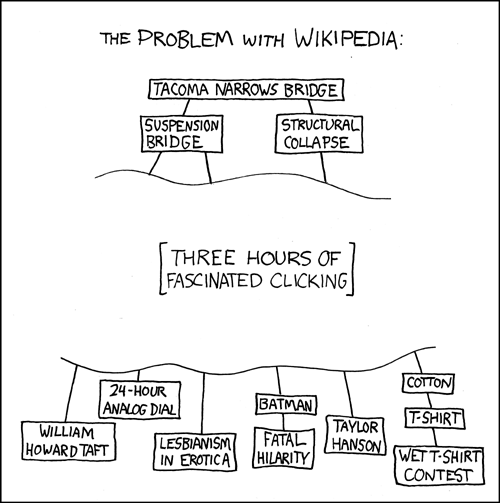
The problem with Wikipedia

OK, refocus.  Now you have the correct word.  So, how do you fit it into the sentence correctly?  Is that the right grammar?  Perhaps you should ‘google’ that….


OK, refocus.  You now have a noun and a verb, most likely in the proper grammatical structure.  But it is nowhere near sufficient to capture the meaning…  Perhaps it is time for lunch.

And so it goes.  Not very productive, but, eventually, some semblance of a sentence will be produced.

So, how can one help a child learn to overcome this?

My personal exerience gave me some insight.  I was lucky enough to be able to reproduce patterns – sound patterns and picture patterns.  This helped me get selected for a language school when I was 8 years old… and while I was struggling to write basic sentences in my native tonngue, miraculously, I did not experience the same problem in the new languages.

Perhaps advice from a teacher helped: 

‘Do not write what you want to say, write what you are able to say!’

With a limited vocabulary of less than 50 words, and only a rudimentary rules of how to construct a sentence according to the new language’s rules, the prospect of ‘writing a sentence’ became more managable!  With only a limited number of permutations possible, selecting the best possible combination of them which most effectively gets the point across became easy!

When my older son got to a point in his schooling where he was expected to construct more than just simple sentences, he started having a problem.  Trying to help him, I realized that he only had a very basic (and somewhat flawed) idea of how English grammar works….

Solution?

Basic textbook of Latin!

The reasons for selecting Latin were many:  from loan words down.  But the most important reason was that the Latin grammar was very explicitly spelled out – and that the endings of the words would change, depending on what role in the sentence that word played.  This is very key – it reinforces the rules of grammar, and helps figure out how to use them to construct a sentence.

My goal was not to teach my son Latin.  As a matter of fact, we spent no effort on memorizing vocabulary – we only focused on learning the rules for ‘flexing’ the words:  what does a particular ending mean – and what it tells us about the role this word plays in the sentence.  This skill was then easy to transpose into English sentence composition.

Yes – sentence composition.  Because that is how it has to be approached – this word is the subject.  This word describes the subject.  This word is the verb.  This word describes the verb….  and so on.

For younger kids, it might help to use tools:  on small, rectangular pieces of card paper, print a limited number of words related to the topic the child needs to write a sentence about.  Depending on the kid, start with 20-30.  Separate them according to their role in the sentence – it migh be very helpful to colour code them.  Nouns in one colour, verbs on another, pronouns, adverbs…so on.  Or, just separate them into piles. 

Then, when the child needs to write a sentence, let her/him pick out the right words and ‘build’ the sentence out of the ‘card words’.  Since only a very limited number of words are available, the child must be told the task is not to ‘answer the question’ – because that might seem impossible!  Explain to the child that the goal is to ‘build the best possible answer out of these words.  It will not be perfect – and it is not expected to be! Make it a game to try to create the best ‘best fit’ that could be done from this set of ‘card words’.

Once the sentence is created, the child can copy it – and use it as the answer. 

The word-pool can be altered, based on the topic. It can be increased or decreased, based on the child’s needs:  the more difficulties, the fewer words to pick from.  It is a tedious process, but it does work – or, at least, it worked in several instances when I have used it (not just with my own kids). 

My personal opinion is that it teaches several things: 

  • By limiting the pool of words, it makes ‘finding the right word’ easier – by making it OK to settle for the ‘best available word’.
  • By forcing the use of ‘different types’ (as signified by colours/piles of words, based on role played in the sentence) of words, the Aspie reinforces the proper use of grammar
  • This exercise builds one’s confidence in their ability to form sentences – which is much more important than most educators acknowledge.
  • Perhaps most importantly, it creates the habit to ‘write what you can, not what you want to’

It is not perfect, but this might help overcome the obsessive need to only write an ‘impossibly perfect’ sentence…

Learning to write is not easy for people with Asperger syndrome.  There are many obstacles in  their way:  from mechanical difficulties, to ‘holding onto their thought long enough to write it down’.  Add the desire for perfectioninsm in written expression…. 

Following the suggestions of professionals who know the child is the best way to help him or her learn to overcome the difficulties which are part and parcel of Aspergers.  Yet, if nothing seems to work, frustration levels are building, the child is unhappy… I know there were times when I would have tried just about anything!  And letting the child help sort the words just might take an edge off the frustration.
Blue Planet in Green Shackes

Finally, there is a release date for the much-awaited English version of Czech President’s Vaclav Klaus’ book,

‘BLUE PLANET IN GREEN SHACKLES 

What is endangered:  Climate of Freedom?’

President Klaus will be presenting it on May 27th, 2008 at the National Press Club in Washington D.C..

Thanks to Lubos Motl from ‘The Reference Frame’ for the tip!

Yet another reason to skip the Beijing Olympics

As if continuing to opress its population were not enough!

As if forcing women to undergo ‘abortions’ against their will were not enough! 

As if China’s continuous disregard for the environment were not enough!

As if its exploitation of Africa were not enough!

After all – all these things could not possibly outweigh our desire to ‘not dissapoint our athletes – or so we have been told by so many apologists…. 

Now, we have another reason for not going to the Olympic games in Beijing.  And this one actually poses danger to the athletes – and all the spectators – themselves!  No, not just the smog, or something equally long-term.  We are talking about real, immediate, physical danger.  And not just to them alone, but to everyone back home when they return, especially the kids.

What, do you say, could this be?

The National Post has an interesting article about the outbreak of the infectious hand-mouth-foot disease (HMFD) in China!  According to CDC, HMFD can be caused by several different viruses, some of them mild, some potentially deadly, especially to children.  The National Post article says this outbreak is caused by EV71, of which the CDC says:

“Another cause of HFMD, EV71 may also cause viral meningitis and, rarely, more serious diseases, such as encephalitis, or a poliomyelitis-like paralysis. EV71 encephalitis may be fatal. Cases of fatal encephalitis occurred during outbreaks of HFMD in Malaysia in 1997 and in Taiwan in 1998.”

This disease can be spread by such innoculous means as cutlery not washed in hot enough water (CDC).  It is usualy only serious for children and people with weakened health, but strong adults (like, say, athletes) can become infected without becoming symptomatic, and spread the virus for several weeks (like, say, when they return home to their kids).

In other words, the athletes and millions of Olympic spectators could become infected, without being symptomatic.  Most visitors and athletes would likely fly home – and airplanes, with their re-circulated air, are perfect incubators for infectious pathogens… ask any nurse! Once home, all these people will celbrate, hug and kiss their kids, relatives, friends….get together to show photos and talk….

This sounds like an ‘ideal’ way to spread this disease!

Oh, but China would take all precautions to contain the infection, right?  Ask world’s leading experts to help them do all it takes to protect its own citizens as well as Olympic athletes and visitors?  Right?

As luck would have it, Taiwan is seen as having some of the best expertise in containing this disease – they have successfully done it two times recently!  Nice and close – except that…  China is not willing to accept help! 

Not only has it refused Taiwanese experts entry, it has also banned Taiwanese journalists.  Its own official newspapers are not exactly forthcoming with information on the epidemic…  Nice to see how well they are handling it…their traditional way of deny, deny, deny!  No problem here!  Yeah, and you expect us to trust any assurances after this, too?  Some track record!

It would be foolish to allow people to attend the Olympics in the midst of a deadly epidemic (and children in China have died during this outbreak already).  Or, in the least, governments which allow its citizens to travel to the Beijing Olympics MUST, as a matter of national health policy, establish quarantine areas where anyone returning from Beijing will have to be detained for several weeks, until any danger of spreading the disease has passed (both athletes and visitors).

Now, this is a thoroughly NON-POLITICAL reason not to go to this Olympics! 

It would not be a political boycot.  Rather, it would be a prudent and responsible policy to prevent the worldwide spread of a disease that kills children.

Will THIS be enough to make the world do the right thing?

Aspergers and ‘painting music’

Over the last few decades, there have been very big changes in classroom attitudes – at least, in this part of the world.  Many teachers are of the opinion that academic rigour stifles self-expression, and in an attempt to foster creativity in their students, they have systematically dismantled structured teaching.

This might work for some students.  Yet, many students do not do well in this new environment, do not learn well using this new method.  Yes, I do focus on kids with Aspergers, but they are not the only ones who are having difficulties.  Many ‘normal’ kids find this ‘unstructured’ method of teaching makes learning more difficult.  The Aspie kids get completely lost in it.

Let me give you an example:

During a series of grade 3 art classes, the teacher played different types of music.  The assignment was to ‘paint’ the music while the students were listening to it.  I thought this was the height of idiocy:  no skills were being taught, and precious school time was being wasted.  But it was explained to me that I was being boorish, that this ‘exercise’ is scientifically designed to stimulate different areas of the brain to synthesize information, which is what kids at this age need more than anything else.

Please, do not misunderstand me.  I don’t have anything against art classes in general:  to the contrary.  My mother teaches art, and I have a deep love for it.  However, I think that kids actually get more enjoynment out of art if they are actually taught about it.  They will derive pleasure from drawing if some of the rules of proportion, or different  fun techniques are broken down into steps for them, so they can master the skills.  Once they have understood the rules, it will be more fun to ‘bend’ them to express their own artistic talents (and no, I don’t mean after years of study….rather, teach a specific skill, rules that govern it, and how to bend them and have fun with art).

Well, my son was in this particular art class.  He was in it because that teacher had gone to receive specific training on how to teach kids with Aspergers.  And then she got angry with an Aspie kid for ‘not being able to paint the music’ he was listening to????? 

Of course, what she was expecting was just non-sensicals colourful swirls – but she would never tell the students that.  With a prim smile, she insisted they ‘paint what the music makes them see’.  Questions of ‘How?’ were met with ‘That is up to YOU!’

Just before setting marks onto the report card, she called me to warn me that my son is about to fail art…  Let’s just say that I found it somewhat difficult to keep my temper.  (The problem was the frustration he experienced in being asked to complete a task he did not have the tools to perform, asking for help and being denied it, then penalized for failing by a bad mark.)

I explained to her that in that case, by her own standard, my son should have received an A+ for his artwork:  the music did not make him ‘see’ anything, so that is what he painted.  Or did not paint.  Either way, the result was accurate, and that he made a bold artistic statement by leaving the page blank.  Quite literally, he ‘drew a blank’!  In other words, I tried to ‘out-pretentious’ her.  It did not work – I’ve never been very good at it. 

However, the teacher said that if my son does 3 of these paintings and hands them in by Monday, he will not fail art.  So, we were left with the task to ‘paint music’.  My son and I talked about it, and it became clear that his frustration level was higher than usual.  But I came up with a solution I am still proud of!

Selecting a Physics textbook which had a good, simple explanation of ‘sound waves’, we read it over together and I explained all the diagrams to him.  Now, here was ‘sound’, represented visually!!!!  We were making progress.  Yet, many Aspies are sticklers for rules – my son could not paint the different types of music the same way!!!  And I was ready…

Rummaging around in the basement, I dusted off our old logic analyzer and brought it up.  Then I set up the display to emulate an oscilloscope, and we played the different types of music.  It worked!  The different sound waves made the oscilloscope display different curves.  Lifting his brush, and dipping it into the green paint (the display was green), my son went and happily painted the different types of music!

His teacher was thrilled!  She told him she knew that if he tried, he could paint music!  He told her they were ‘music waves’ and that he saw them.  I did not tell her that he saw them on an oscilloscope screen – somehow, I did not think that would please her.  Why spoil her pleasure? 

Aspergers, drawing and art

Many kids with Aspergers do not enjoy drawing and colouring.  This could be due to the fact that many have less ‘handedness differentiation’ – neither hand has better developed control, so drawing (and eventually writing) is more difficult.  But there could be more to it than that.

Just as there seems to be a difficulty in translating thoughts into a written form, some Aspies experience a similar difficulty in translating visual images into a drawing.

This is strictly my own observation, and I am not aware of a connection between these two aspects in any professional literature, but I cannot but wonder if this is a different expression of one underlying problem.  Let me describe it a little bit.

My dad has never been diagnosed with Aspergers – nor has he ever sought an opinion on the topic.  However, I do see some similarities between the way he, my sons and I processes information – at least, in some instances.  When we were trying to figure out this whole ‘Aspergers’ thing, he shared with me something that happened to him, when he was about 10 years old.

Standards and teaching methods in school were a little differen in his days, and teachers were more authoritarian.  During an art class, a substitute teacher said they were to draw a picture of a pig and hand it in at the end of the class.   A simple assignment – right?  Except that nobody had ever taught him how to go about drawing a picture of a pig… and my dad simply could not figure out how to even start.

He sat there, for the whole period, without making a single mark on his sheet of paper.  The teacher was not pleased.  As a matter of fact, he got very angry.  My dad was smart and had high marks, but he was not the most compliant of students.  The teacher would not believe him when my dad said he did not know how to do draw a pig, and concluded this was simply defiance…  and to report to him after school for detention.

The detention?  My dad was to sit at his desk until he drew the picture of a pig, then he was to bring it to the teacher’s office.  Once that was done, he could go home.  But try as he might, he simply could not resolve the image of a pig into its componenet parts, which he could then draw.  So, he sat at his desk, for several hours.  Finally, the janitor took pity on him. 

He, too, found it hard to believe a kid could not figure out how to draw a pig, but when he saw my dad just sitting there, for hours, he took a plain piece of paper and a pencil, drew a rectangle for a body, a triangle with a dot for the head and an eye, four sticks coming out of the bottom of the rectangle for legs and a curly spring on the back for tail.  “Here” he said.  “A pig!”

This was a revelation to my dad!  He easily reproduced the simplified ‘pig’ onto his sheet of paper, brought it to the teacher, and was allowed to go home.  

I have since met several people who do not naturally have an ability to break down a visual image into subsets, individual lines, which could then be put onto paper.  However, they can be shown how to go about it, and learn the process – just that to be effective, this process of learning needs to take place when they are older than when most kids learn to draw. 

Similarly, many Aspies do not have a natural ability to break a thought into constituent parts that can be written down – we start looking up words, checking spelling and grammar, wonder about better ways of saying it…. and end up producing very few actual words…  Yet, like with drawing, this process can also be learned – and it, too, will only be effectively learned at a later age than that of non-Aspie peers.

Could it be the same ‘prioritization’ or ‘orderig’ of ‘stuff’ that is causing both effects?

Another connection between them:  once Aspies ‘learn’ this process, they do not simply ‘learn’ it, they often ‘master’ it, and become better at it than most other people.  And yes, some do become successful writers or artists… Eccentric, yes, but successful.

Is this simply ‘overcompensation’?  Or is there something else at play here?

Aspergers and writing – holding on to that thought!

Different people are affected by Asperger Syndrome differently, and to varying degrees – it is more of a ‘continuum’ than an ‘on/off switch’.  I am by no means an expert – but I have some experience in living with it, and raising kids who are also Aspies.  The following will not work for everybody, but it did work for one of my kids.  Perhaps it may help another family, too – if not to improve skills, then at least to build an understanding.

Many Aspies are quite capable of speaking their mind, but have difficulty writing.  Previously, I have noted several factors that could be at play.  Here, I would like to look at only one of these:  how to hold on to that thought long enough to write it down.

Whether it is some problem with short-term memory, a non-differentiation in the prioritization of our 7-or-so ‘attention slots’, or if it is due to different causality, the practical result is that many Aspie kids say: ‘there are so many ideas swirling in my head, I cannot hold on to one thought long enough to write it down’. 

This problem could be related to ADD – a condition which often occurs along with Aspergers.  And it is something that can be incredibly frustrating.  The child knows the answer, but there is some kind of a breakdown in the communication between the brain and the hand…  To an outside observer, it looks like nothing less than obstinance!

The earlier it is discovered that a child has this aspect of Aspergers, the easier it is to correct.  As is so often the case, the smarter the child is, the longer they can ‘mask’ the problem by ‘leveraging their core competencies’.  (Ooooh, I do love it when I talk bureaucreteese – while I don’t have to!  I amuse easily.)  This can be a good thing:  if the problem is mild, this can be a way the child ‘owns’ the problem and develops perfectly tailored coping mechanisms.

My son’s problem, however, was not mild.  Even though he did well, hiding his problem for quite a long time, half way through grade 2 he simply ‘got stuck’.  And even when we discovered it, it was completely new to us.  Nobody seemed to understand why he would sit at a desk for an hour and manage to write less than 3 words.

In grade 1, he tackled his inabiltiy to learn to read – and leapfrogged his peers, reading ‘The Lord Of The Rings’ on his own during the summer.  He had mastered the mechanics of forming letters – this also had been a struggle in grade 1.  (He had gone to a Montessori pre-school, where he learned to iron washcloths instead.)  So, we had been optimistic that we were ready for grade 2!

And now, this – to us – unprecedented and inexplicable inability to write even the siplest sentences.  The teacher was great, and even took a seminar to see if she could learn about this – but by this point, we had never even heard the word ‘Aspergers’, or what it means.  It took us a long time, but we finally worked out a way to get written work done.

  1. My son and I would sit at the table, he would read the question, and say the answer out loud.   
  2. I would write the answer in large, clear letters on a notepad. 
  3. I would place the notepad on the table, and he’d get ready to write his answer.
  4. Now I asked:  “What is the question?”  – He’d read it out loud again.
  5. “What is the answer?”  –  He’d say the whole answer again.
  6. “What is the first word?”  –  He’d repeat it.
  7. “What is the first letter?”  –  He’d repeat it and write it.
  8. “What is the second letter?”  –  He’d repeat it and write it.
  9. “What is the third letter?”  –  He’d repeat it….

And so on.

Except that, at the beginnig, by the second letter, he would forget what it was.  And what the word was.  And what the question was.  So, we’d go back to reading the question, answering it, reading what he had written, and forcing him to realize what the next letter was.  

It was hard, and it took a long time.  Especially in the beginning – it could easily take us an hour to write 4 sentences.  But, he was doing it!  And over time – long time – he built up the capacity to hold on to more and more information, before needing to go back and re-checking it.

At first, on the advice of the teacher, we had instituted a ‘reward system’.  She was one of those teachers who really care – and I don’t know if I could have done it without her.  And, because I did not give my kids too many sweets – she suggested that some very small candies or raisins could be used as ‘earned rewards’ – say once a sentence or a particularly long word is completed.

The reward system was working.  Not that it would make the work easier, or that it would motivate him to write faster.  It did not work in that way.  But, as hard as all this was on me, it was even harder on my son:  he had just spent a full day at school – good and bad – and now we were sitting at the table for hours, working.  That is a lot for a 7-year-old!  The ‘reward’ was exactly that – it allowed him to graphically see his progress!  As my pre-measured ‘pile’ of ‘rewards’ on the table was shrinking, so was the amount of work still ahead of him.

That is something neat:  Aspies like rules.  They are much more likely to reach their potential in a highly structured environment, where the expectations are very, very clear.  In a way, the ‘rewards’ were a little bit of ‘structure’, a measure of how much work is still expected from him.  Anyhow, he seemed calmer, and more ‘focused’.

Soon, I started finding the ‘rewards’ in his pockets when I would do laundry.  This puzzled me – so I asked him about it.  His answer?  “Well, I don’t really like to eat when I’m doing my work, but you looked so happy giving me the treats that I did not want to spoil it for you!”

After this, we switched from edible rewards to other non-edible ‘markers’:  marbles, poker chips, pebbles, or even coins from his piggy bank.  He got to pick what we would use that day, and helped count out the ‘markers’.  Once he had earned them all, we would put them back into their baggie, and into the ‘marker box’.  He liked that.

It was slow going.  After about a week of this, we both noticed that we would almost fall into a rhythm of question-answer-write.  And that really was the point when we both noticed beginnings (very, very beginnings) of progress!  Just to vary it – for fun – we started calling it out in the rhythm of that song soldiers sing to keep beat, with the question-answer called out loudly. 

My son loved it, and called it ‘writing with shouting’.  He explained to me that when we were ‘writing with shouting’, the sound scared away the other thoughts, so he could sometimes hold on to three or even four letters before needing to go back to see what word it was he was writing!  He would be excited by this, and ask for us to ‘do the writing with shouting’.

Excited by this progress, I reported back to the teacher how well we were doing.  Perhaps I was a bit hahazard in how it all tumbled out of me, but I was very excited and happy to tell her.  I did not get the reaction I expected.  She looked aghast, and started crying.  When I asked why, she said: 

“The poor child!  He’s trying so hard!  And you took away his treats and are shouting at him instead!”

I explained better.  So, why exactly does ‘relief’ make people want to punch my arm?

In conclusion, it did work – but it was a long, hard road.  The performance level at school rose faster than my son’s skills, so it could be downright discouraging at times.  But, we stuck with it – there was about a 3 week period when we worked 3-4 hours a day at it, and there was not a single day when we did not spend at least 2 hours ‘writing’ – without or ‘with shouting’!  And we beat it! 

Eventually, we would not need to go letter by letter.  Instead, we went word by word.  We got there during grade 3….  But the habit of having me write the answers down, and then writing them down himself with the notepad in front of him ‘for when he needed it’ – we continued that until the end of grade 5.  And, if the schoolwork really piled up, I would sometimes (with the teachers’ permissions) script for him.  One needs to be flexible when the workload is greater… and other learning must not be neglected.  Eventually, his writing skills have caught up with the amount of work required of him at school.   

It took a ‘few’ years, but we beat it!  It was not the last problem with ‘writing’ that we encountered, but it was by far the most effort-intensive to overcome.  But it was worth it!

Animal-speak: squirrels

Believe it or not, I used to wear a hat like this!

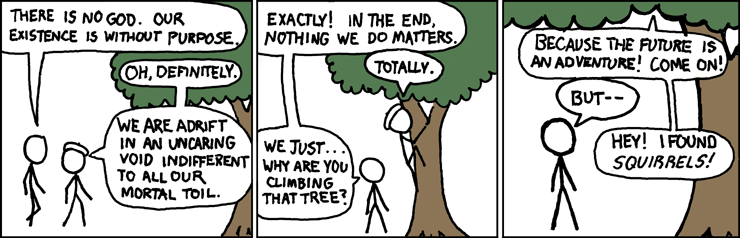
nihilism - xkcd

I also am a bit of a nihilist.  And I love squirrels!!!

Yet another character shamelessly based on me…

Ego-aggrandizing jokes aside, I do love watching squirrels.  They are an easy animal to see in the city, and I love nature way too much to spoil it by stomping through it. So, urban wildlife is it for me.

Perhaps because I am not naturally good at reading people’s facial expressions and body language (as is common with Aspies), I have learned the habit of really paying attentinon these – or, at least, trying to.  But, only used it with Humans and pets, not really giving other critters too much credit.

I was quite young when I realized how mutually incompatible the ‘natural’ body language of cats and dogs is.  Yet, cats and dogs who lived together (especially if they did so from an early age) are quite capable of learning each other’s language.  Well, if cats and dogs could learn another species’ language, I should certainly be able to ‘learn’ this elusive body language of humans!!!

As I have argued before, kids with Aspergers who are having trouble discovering the ‘key’ to human communication can often decode the somewhat ‘simpler’ (or, perhaps, less complex) body/expression language of animals.  …sort of like learning to crawl before one attempts the marathon of nuances in human ‘non-verbal communication’.

Back to my main point!  As the trees matured in our neighbourhood, we began to see more and more squirrels who came to our bird feeders.  One winter, we were especially touched by ‘The Twins’.  Late in the summer, they started coming with their mom.  We suspect they must have been born later in the season, because they were very tiny.  And, before the first snow came, we stopped seeing the mom…

Yet, ‘The Twins’ stuck together.  They were very, very affectionate to each other, touching and reassuring each other often.  The smaller, bolder one would climb up the birdfeeder and throw food to the other Twin!  (  The Twins stuck together until late next summer, always together.)  Well, that winter, I started putting out food specifically for the squirrels….

Several years have passed, and one of the twins has returned here with three separate litters of her own!!!  Two of these litters were after she had become blind in her right eye, too.  Now I call her ‘One-eyed Jackie’, and she is the matriarch of the ‘Bruno’ (they are much browner than most our visitors) clan of squirrels. 

Besides the ‘Brunos’, we have two other ‘clans’ that come here.  One is called ‘Fuzzy-wuzzies’, because they have incredibly fuzzy fur, especially on their ears.  These are closely related to the ‘Brunos’, and they often mix.  The third ‘clan’ that comes here are called the ‘Zekes’ – and do not get along with the other two clans at all.  Curiously enough, they get their name from the Blue Jays that come here….

Yes, last summer, we had a family of Blue Jays come regularly, too.  And one of the adults was not at all shy!  If I was late putting our their breakfast, or if I the food I put out was not her favourite (I am guessing here that it was the female – we are more discriminating…), she would sit on a branch directly in front of the door, and in a loud, incredibly annoying voice, screech ‘Zeeeeeeke!!!’ – over and over, until she woke me up and I put out the approved food.

Believe it or not, the matriarch of the ‘Zekes’ learned to immitate that call!!!

Many times did I come out, looking for the Blue Jays that were not there, only to see her sitting on ‘the branch’.  It was not until I heard her actually make that call that I realized that it was she who was making it!  Obviously, I had underestimated the squirrel’s linguistic skills.  She has since also learned to perfectly immitate the neighbour’s little dog’s bark.  I began to pay more attention.  (It would probably have been faster to just read up on it, but I had fun watching them.) 

Soon, I identified that the clicking sounds they made were not random.  If I immitated the ‘clicks’, starting at the back of the mouth and moving forward, the squirrels took it as a ‘all safe’ sign, and would come down from the tree.  Even if the dog was nearby.  (It’s ok, he does not hunt them – he is a watchdog, so he just likes to watch!  When a squirrel once fell out of the tree and landed right in front of his nose, he started crouch-jumping up like he does when he is trying to get another dog to play with him.)

a dog who likes to watch squirrels

If I reversed the order of clicks, increasing the volume, the squirrels would panick and run!  Even if there were no danger anywhere about!  Then, seeing all was safe, they would flick their tails a lot and come back down.

Over that summer, I learned about 5 different ‘sets’ of clicks, each of which would be understood by ‘my’ squirrels.  Now I had a question:  did I really learn something of ‘their’ language, or have they learned to simply interpret my behaviour?  This was something I had to test, and an opportunity soon presented itself.

My son and I went to an event in a park about 5 km away from our house – far enough, I hoped, that I would not encounter ‘my guys’.  We were sitting in our lawnchairs, listening to some music, when a squirrel started hopping from one tree to another.  I saw my chance!

I started with my ‘all safe’ set of clicks – it was the first one I learned and I was most comfortable with it.  Plus, it is rather quiet – there were people about… 

The squirrel stopped in its tracks, as if frozen, and just listened.  Encouraged, I repeated the clicks, and added a second set (I think this one means ‘food is present’).  The poor little squirrel perked up its ears, and started looking about.  Actually, it looked a bit paranoid.  I kept up the soft sets of clicks. 

Suddenly, and with great incredulity, the squirrel realized that I was the source of this jibberish!

Well, this became one confused squirrel.  It resumed its original journey to the tree, but now, very, very slowly – and never taking its eyes off of me.  It kept turning its head, side to side, as if to confirm that it really was that human that was chatting with it.  I suppose I must have had an atrocious accent – and I fervently hope I did not say anything bad about its mother!

I guess you can predict how this story ends….  The squirrel was on a direct path to the tree, but was too shocked at the stuff coming out of my mouth to pay attention to where it was going….  Yes.  The squirrel hit the tree!

Hopped straight into it!

This was the only time ever that I saw a squirrel run into a tree.  So, I shut up.  Anyhow, I had to go and help my son up – he laughed so hard, he tipped over his lawnchair!

XKCD – Aspie Humour

Many people claim that Aspies do not have a sense of humour.  NOT TRUE!!!

We certainly do enjoy humour.  Some of us naturally find some things funny, others need to learn the rules of humour – but we certainly enjoy it.

In my never-humble opinion, teaching kids with Aspergers the rules of humour may be helpful with overall social skill development.  I have done this, and seen the improvement in their ability to interact with their peers and the resultant increased comfort level with themselves.

Here is how I might go about ‘explaining humour’:

There are several things that constitute ‘humour’ and different people will find different things funny – so there is no need to feel bad when you understand a joke, without thinking it is funny.  Some people think that anything to do with bodily functions is funny – and they will laugh when someone farts, or of they burp.  Other people think this is gross and not at all funny.  So, it is normal that not everyone finds every joke funny.

Many poeple laugh when they find themselves in situations which either do not go as expected, or when some danger is lifted.  This is done to release tension which people experience in such situations, and which is unpleasant.  It demonstrates to others that either the danger has passed, or that even though things are unexpected, the new course of actions is acceptable.

Perhaps that is why so many jokes are ‘funny’ because of an ‘unexpected’ or surprising ending.  It might even tie in with why ‘strange’ or ‘different’ or ‘unexpected’ is sometimes called ‘funny – but not as in ha-ha’.  Puns are an excellent example:  the correct (or correctly sounding) word is used, but in with an unexpected meaning.

It is not easy for Aspie kids that many cartoons rely on facial expressions to convey humour.  That is why I was so entertained when I came across this (not aimed at kids) comic, XKCD.  To me, it screams ‘Aspie Humour’!

And since along with a sense of humour, many people incorrectly describe Aspies as lacking feelings or empathy, I have selected, for your viewing pleasure, these few XKCD comics:

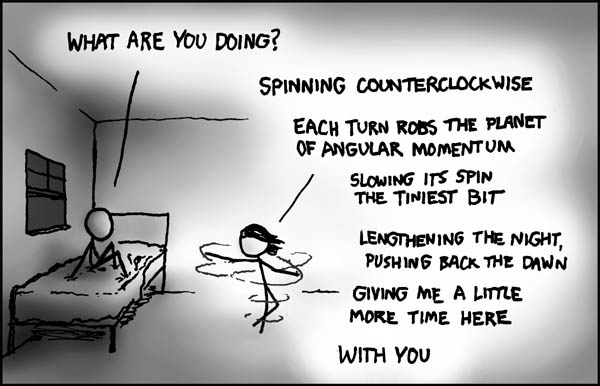
We like to spend time with our loved ones.

We love to spend time with our loved ones - XKCD


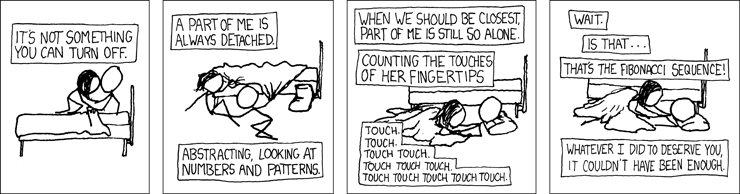
Passion reaches new levels for us!

Sharing thought - XKCD


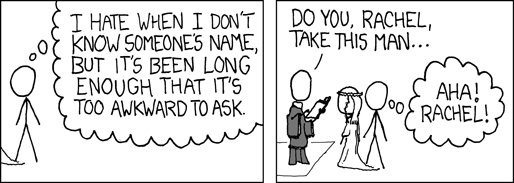
 Of course, we may have a hard time remembering names….  Nothing personal!

forgetting names - XKCD


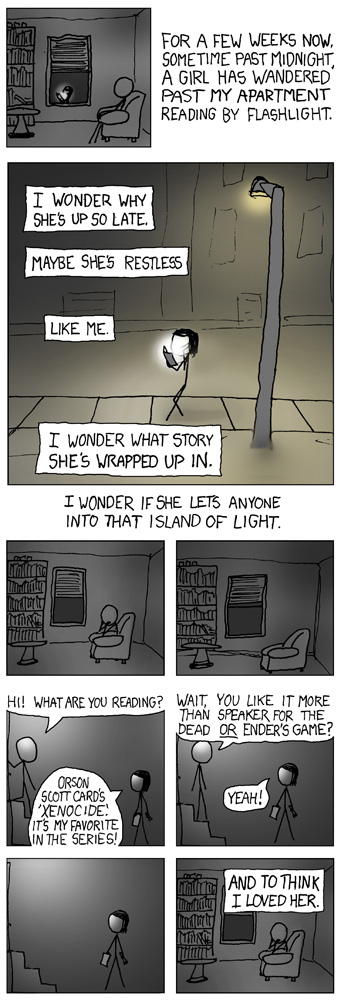
 Yet, we can be very particular in whom we select as potential mates:

xenocide - XKCD

Personally, I could not date someone who did not thing ‘Ender’s Shadow’ was the best book in this series.  Ok, if he were cute, I might settle for ‘Shadow of the Hegemon’.  But ‘Xenocide’??? Really!

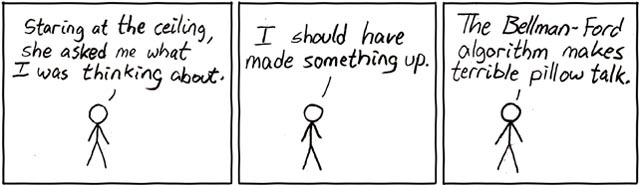
And ‘pillow talk’ is much easier if both of you are Aspies….

pillow talk - XKCD


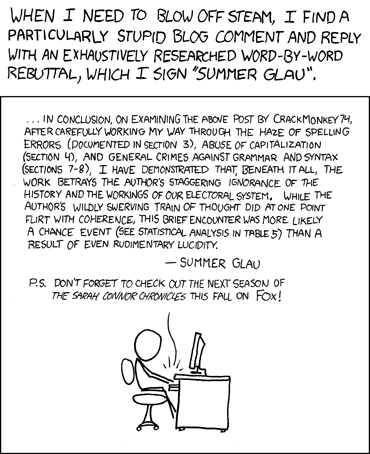
And many of us fully appreciate the advantages of online interactions with others (my husband claims this ‘has to be’ taken from one of my online comments….):

venting - XKCD


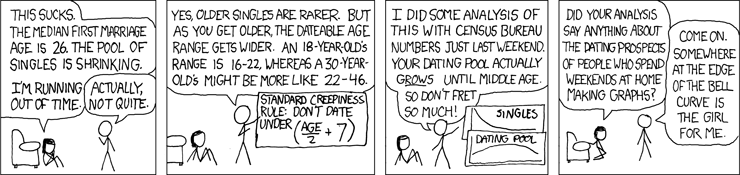
Here is a good example of how not everyone ‘gets’ every joke.  For example, in the following one, I do not understand why the characters are implying this practice is unusual.  Surely, it is the norm!  (See my posts on Old Men in the Bible)

graphs - XKCD


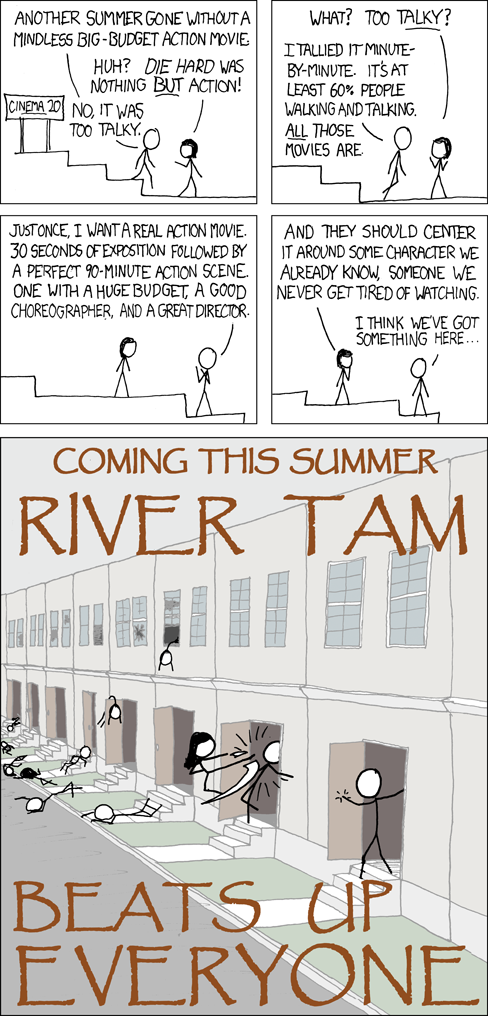
But we all enjoy good quality entertainment!  (And no, this is NOT just a cheap ploy to get ‘Papyrus font’ onto my blog!  Though, who could resist the allures or ‘Papyrus Font’???  It’s even better intelic…)

 River Tam - XKCD

 EVERYONE loves River Tam!!!

add to del.icio.usDigg itStumble It!Add to Blinkslistadd to furladd to ma.gnoliaadd to simpyseed the vineTailRank

Aspergers and accurate words

School!  It can be a testing place at the best of times!

For people who need to use ‘precise’ and ‘accurate’ words to describe things as those of us with Aspergers do, it can be baffling.  After all, one becomes used to the vocabulary and expectations at home – but at school, the rules are different.  And people just do not communicate clearly.  In the words of the immortal Inigo Montoya, “I don’t think that word means what you think it means.”

Let me give you an example.

Schools are filled with many kind and caring people who truly have the best intentions towards our kids.  They are dedicated.  At times, they will even enter ‘uncomfortable’ situations, if they think the ultimate result will help one of ‘their’ kids.  I admire that.

One year, at the beginning of winter – just as it was time to start wearing hats and mits etc. – I got a phone call from one of my kids’ teachers.  Even though I am pretty thick at picking up on such clues, I could tell she was very uncomfortable.  She spoke in a little soft voice and picked her words very carefully.

The school, as it turns out, gets some free ‘stuff’ from the milk people, through the milk program.  Yes.  And it there are some families, which – at some times, and through no fault of their own – needed a little help, they could give these things as ‘prizes’ to their kids.  Since it is a ‘prize’, there is no stigma…

I was really beginning to wonder what this was about.  We were not in any financial difficulties – at least, I thought I would notice if we were.  So I made a non-commital sound, to show I was listening…

The teacher, kindly and gently, continued.  The promotional items they had included hats.  Since the weather was getting kind of cool, it was important that kids should wear hats.  And, today, during recess, my son had told her that he does not own a hat, and that he does not think we’re planning to buy him one.  So, if it would not cause offense, they could give him a hat from the milk programme…

Whatever reaction she was expecting, laughter was not it.  But, I just could not help myself!  I burst our laughing.  You see, my son was absolutely correct!!!  Yet, I owed the teacher an explanation…

The previous weekend, we had indeed gone shopping for a new winter hat.  My son became intrigued by these ‘hat and neckwarmer in one’ contraptions.  It looked just like a winter hat that was attached to the ‘neck’ part of a turtleneck.  It had a nice round opening for the whole face, but covered more skin than a ‘hat’ would.  That is what he chose to get instead of a regular hat.

And what did he wear the previous winter (to be used as a spare)?  A tuque!  If many people think that ‘tuque’ and ‘hat’ are the same, they should be corrected:  if they were the same, they would not have different names!!!

So, with puppy-dog eyes, solemnly and truthfully, my son told his teacher that he does not onw a hat!  And when she asked if we were just slow at getting ready for the winter, he truthfully said that we were not planning to get him one…instead of simply saying he forgot his new headwarmer.

The teacher was amused and greatly relieved! I suspect the story was used as a source of amusement at the teacher’s lounge. 

But this is a very real example of how people with Aspergers do not understand what they are being asked, unless the accurate word is used.  The terms used must be specific, precise and accurate, because Aspies do not ‘make leaps of faith’ or read things into stuff.  If we don’t know, we don’t know – we are not likely to jump to unsupportable conclusions.  The teacher would likely have received a different answer had she asked him if he owned something to wear on his head to keep it warm.

Another example of ‘crossed communications’ occurred when my other son was very, very young – certainly under 2 years old.  He absolutely loved watching ‘Bill Nye the Science Guy’, and absorbed much of his early vocabulary from that show.

One time, my mom was over, and was in the livingroom with my son.  When I came into the room, she was frustrated:  “I told him to stop picking his nose, but he just stares back at me as if I just fell off the moon!  What is wrong with him?!?!?”

I told her he just did not understand what she meant.  He already had a nose, so how could he pick another one?

Turnning to him, I said:  “Stop touching your mucuous membranes.”

He took his finger out of his nose, looked at me and said:  “Ah, spread germs!”  And went to wash his hands…

These may be funny incidents, but they do illustrate the difficulties Aspies have trying to understand people who use language sloppily.  Just imagine how impenetrable the meaning of many test questions is to them!!!  No wonder they often score very poorly on school tests – many questions do not really ask what they think they ask…

(This is ALWAYS the hardest part of writing a post:  how to end it!  I could go on talking about this endlessly…)

Aspies can, and do, learn to search the speech patterns of others for ‘similar concepts’ – this way, many Aspies learn to ‘decipher’ common speech.  And when we do, we are often so delighted, we drive others mad by playing with it!  Yet, this is not an easy skill to acquire, and it would not be realistic to expect young kids to ‘pick it up’.  This will lead to frustration – not just of the child, but also of educators, parents and others who interact with Aspie kids.

And, Aspie kids usually experience very high levels of frustration, even if they do not communicate this (or display the ‘typical’ signs of frustration, until it builds up into uncontrollable anger).  Making all these people aware of the need for accurate, precise and non-ambiguous use of language (and what that actually is – in the mind of an Aspie) would go a long way towards making life easier for everyone involved. 

If we could only teach the rest of the world to communicate accurately!

Climate Change Tales

The whole ‘Global Warming’ – under whatever name one chooses – issue is a mess.  Unmitigated, tangled up and muddled mess.

So, how can a person make sense of it all?

Frankly, I don’t know.  What I do know, however, is that we are actively being presented with only a very small part of the story through the main stream media (MSM).  And I also know that reasonable points raised by bonafide scientists from the field of climate change are being shouted down or smeared before their ideas are even listened to.

That is not how scientific debate occurs.  It is anathema to science itself!  In true scientific community, people are willing to listen to dissenting points of view – provided these are scientific and  testable hypothesies (using the term in the narrow, scientific sense).  Why?  The reason for this is very simple:  sometimes, even what appear to be ‘crackpot’ ideas may indeed turn out to be better models of reality than the original theories.

Scientists are only human.  Yes, as much as this is contrary to some opinions, they are only human.  Many times in the past, the ‘current scientific consensus’ was just silly in rejecting even the consideration of ‘things’ that we now regard as integral tools of science: 

“… my dear Kepler, what do you think of the foremost philosophers of this University? In spite of my oft-repeated efforts and invitations, they have refused, with the obstinacy of a glutted adder, to look at the planets or Moon or my telescope.”

                                                                                        –     Galileo Galilei

Today, most scientists are careful to not have the ‘obstinacy of a glutted adder’, and tend to seriously examine ideas which run contrary to mainstream opinions.  How far are they prepared to go?  Well, consider the case of Dr. Peter Duesberg:  he came out with not just one, but two controversial theories. 

In the first one, he proposed that while there is a co-occurrence of the HIV virus and AIDS, he thought the causality had not been established with sufficient scientific rigour.  (I am not particularly versed in his theory – if I am misrepresenting it, I apologize.  The point is not his theory as such, but the scientific community’s reaction to it.) 

The reaction? 

Scientists actually went and checked his data, looked over his studies, and found where he had made mistakes.  Even so, his views are often referred to in scientific publications on HIV/AIDS, in order to ensure that the scientific basis for refuting them is easily available.

Long after this, he proposed another very controversial scientific hypothesis:  this time on the nature of cancer.  Even though he was one of the researchers to have identified one of the ‘cancer genes’, he now proposed that cancer may be more due to chromosomal abnormalities than to problems within individual genes.  Again, the details of his hypothesis are less important than the reaction it received.

Even though his first hypothesis has been flatly rejected, scientists listened when he proposed this one.  In May 2007, Scientific American published his controversial theory in an article called ‘Chromosomal Chaos and Cancer’.  Earlier in the same issue, the editor’s page was titled ‘When Pariahs Have Good Ideas’, where the editors explain that even though Dr. Duesberg’s ideas on HIV/AIDS have been discredited, he might have a good point here and that scientific ideas ought to be judged on thier merit

So, what was my point in bringing up Dr. Duesberg? 

To show how scientists tend to evaluate ideas, even from scientists who have been proven wrong in the past:  they tests them, then – right or wrong – they reference them.  One thing they certainly do not do is try to shut each other up.  That would be unscientific! 

“In questions of science, the authority of a thousand is not worth the humble reasoning of a single individual.”

                                                                                       –     Galileo Galilei

Sadly, this is not happening in the field of Climate….

Scientists who do not subscribe to the ‘bad humans making Earth too hot and this will be a disaster’ point of view have systematically been insulted, bullied, their reputations smeared and jobs threatened, and more than one has received threats of bodily harm.  As Dickens might say:  “What the Sheakespeare is going on here?!?!?!?’ 

Oh, but I have made some general accusations here:  I had better support them! 

Here is one article from the Wall Street Journal by Richard Lindzen, a scientist who had been threatened, and who has seen others under similar pressure.  In this April 2006 article, he also charges scientific publications ‘Science’ and ‘Nature’ with bias and underhanded tactics.  He also names several other scientists who have faced threats.

If the Wall Street Journal is not your cup of tea, here is an article from ‘Telegraph’ from the UK about the death threats received by scientists who publicly question the ‘global warming catastrophy’ dogma.  But this is only a small sample of a large body of scientists who are speaking up.

Sadly, most people don’t realy get to hear what these scientists have to say.  Their views are not often published.  Why?  I don’t know.  However, here is an article from ‘The Australian’ about how journalists at ‘The Age’ (an Australian publication) had been ordered to not write anything negative about the ‘Earth Hour’ earlier this month:

“Reporters were pressured not to write negative stories and story topics followed a schedule drafted by Earth Hour organisers.”

All right, ‘Earth Hour’ is just fluff – what about real climate stories?

It seems that we may not be getting the true story there, either.  Earlier this month, BBC (yes, THE BBC) had done a big ‘no-no’:  they totally changed the story, without noting it!!!

When a story is edited or changed, this is supposed to be noted.  However, BBC ran a story on the topic of climate, was bullied by a ‘climate activist’, and changed the whole meaning of the story WITHOUT NOTING THE CHANGE!!!  That is not very nice at all.

Thankfully, wee have access to the full email exchange of the activist’s bullying and the BBC reporter giving in.  It is a little long, but here is a telling phrase the activist used:

“I would ask : please reserve the main BBC Online channel for emerging truth.

Otherwise, I would have to conclude that you are insufficiently
educated to be able to know when you have been psychologically
manipulated. And that would make you an unreliable reporter.”

EMERGING TRUTH???

What about ‘documented truth’?

And ‘PSYCHOLOGICALLY MANIPULATED’

I cannot help but feel that we, the ‘unwashed masses’, are being manipulated here…  It seems certain that we are not getting an accurate picture of what scientists are truly finding out about these processes which might significantly impact us all.