Groundhog Day – What does it mean?

If you live in North America, you are likely ‘familiar’ with ‘Groundhog Day’:  on the 2nd of February, ‘The Groudhog wakes from winter slumber and sticks hear head out of her den.

If it is sunny enough for the groundhog to cast a shadow, the sleepy gal will get startled and run back into her den to continue napping.  This will cause the cold winter weather to continue for 6 more weeks.  If it is cloudy, there will be no shadow to startle her and she’ll wake up nice and slowly.  She will then stay awake, causing the winter weather to recede and the spring weather to come early.

So, what is this quaint little legend all about?

Perhaps there is a reversal of causality:  this could simply be a weather pattern observation, set into a quaint little story.  After all, during the coldest winter temperatures, the sky is cloud-free and sunny.  Clouds act like a blanket that traps heat, so cloudy winter days tend to be warmer.  That is why it never snows when the temperatures are cold.  (We are talking relative winter temperatures here….as in, -40 degrees (Celsius and Fahrenheit ‘meet’ this point) is ‘chilly’, -10 degrees Celsius is ‘warm’.  Remember, I am writing from Canada.)  When it gets that cold, one could not even drive a groundhog out of its den!

It is conceivable that, over generations, people observed that if this time period was particularly cold – it was likely to signal that the winter weather would drag on for a bit.  Conversely, if the temperature at this time was mild, it would be followed by more mild weather, bringing the spring in earlier.  So, the co-relation.

Plausible.  Or, the roots of ‘Groundhog Day’ may lie somewhere else….

There are several things which are significant:

  1. The date – 2nd of February (plus or minus a day or two)
  2. 6 more weeks of winter
  3. The Groundhog herself
  4. The Groundhog affects the weather

1.  The date:  2nd of February

It is the halfway point between the Winter Solstice and the Spring Equinox:  this makes it a ‘cross-quarter day’.

From earliest historical records of human civilizations, we have seen that the solstices and equinoxes had been noted and celebrated by our ancestors.  These 4 ‘easy to define’ (through simple observation) markers of the Earth’s annual cycle are called ‘quarter days’.  The midpoints between them – when that season is most ‘intense’ – are also marked: these are called ‘cross-quarter days’.

Many cultures have described this ‘cycle’ as the ‘Wheel of the Year’:

http://www.midnightmoonchild.com/images/wheelx.gif

This image is from the names of the ‘marker days’ reflect the one of traditions descended from the British isles.  The ‘Pagan’ belief systems which accompany the annual cycles associate various Gods and Goddesses with specific parts of this cycle.

The 2nd of February is Candlemas, often also called Imbolc.  When considering the roots ‘Groundhog Day’, its date would suggest that we are not discussing simple long-term weather pattern observation.

2. ‘6 more weeks of winter’

This is also closely connected to the Wheel of the Year:  the period between each of the 8 ‘markers’ along the wheel is 6 weeks.

Let us consider the ‘season’ of ‘winter:

Astronomically, Winter Solstice marks the first day of winter and the darkest day of the year – after this point, daylight periods: begin to lengthen.   Astrologically, this marks the ‘Rebirth of the Sun’:  still too ‘young’ to bring warmth, but his strength is growing.

Even though the Sun had been ‘reborn’ and the days are now getting longer, the momentum of the ‘cooling’ takes 6 weeks to ‘ripen’.  That is why, 6 weeks after the beginning of a season, its’ ‘weather characteristics’ are the ‘strongest’.  And, winter is usually most bitter around the beginning of  February… just as we approach the ‘height of the season ‘holiday’:  Candlemas.

Accordingly, following Candlemas, winter begins to recede.  It is still there – but overall, the temperatures begin to warm, the sun is more visible and begins to slowly but surely melt the snow… and it will only be 6 weeks before the day is longer than the night!

Is it only co-incidence that the ‘Groundhog Day’ tradition cites this identical time period of 6 weeks?


3.  The ‘Groundhog’ herself

Spring is the time when things begin to grow.  Accordingly, Pagans associated growth and fecundity with spring and anthropomorphised the principle into the Goddess of Spring and Renewal:  Eostera (also spelled Ostara, and about 8 other ways, like ‘Easter’).

What is interesting about this goddess is that she is said to ‘awake’ on the winter cross-quarter day, Candlemas.  As she awakens, she adds her own magic to strengthen the growing Sun and because of her effort, the winter begins to recede.

Her power is greatest at the full moon following the Spring Equinox:  that is how we derive the timing of our Easter celebrations even today.  (Yes, there is a ‘detour’ through the Judeo-Christian tradition, but their ‘timimng’ of these festivals in Judaism and Christianity ultimately leads to the same archetype, even if through Ishtar and Isis.)

Since chickens only lay eggs when the day is longer than the night, the Spring Equinox marked the return of this cherished source of nutrition:  it became one of the symbols of the Goddess Eostera.  With their renown fecundity – and the timing of giving birth to their babies – rabbits also became symbols of Eostera.  And yes, that is why the ‘Easter Bunny brings eggs’.

Yet, there was another shape Eostera is said to take on when appearing to humans:  Groundhog.

So, is it co-incidence that it is Groundhog, as opposed to another hibernating animal, day?


4. The Groundhog affects the weather

Our little modern myth of Groundhog Day specifically states that it is the groundhog who changes the weather – not the other way around.  Why should the groundhogs ‘going back to sleep’ cause the weather to be colder, while ‘staying awake’ would cause it to warm up?

Curiously enough, it is when Eostera awakens and lends a helping hand to the Sun that the Pagan myths say winter begins to recede…  Co-incidence?  I think not!

In Conclusion

Today, ‘Groundhog Day’ is in no way a ‘religious celebration’.  Not in the least!  It is nothing more than a bit of fun to liven up chilly winter days.

Yes, it contains an echo of its roots in old Pagan traditions.  And that’s great!  Just as ‘inheriting your mother’s smile’ does not make one the same person as one’s mother, having fun with Groundhog Day does not mean one is inheriting its ancient religious significance.

Yet, just as looking at an old family photo album is fun, allowing one to trace certain characteristics they inherited from various ancestors, it is also fun to trace our today’s fun little customs, to see which echos of our ancestor’s traditions we have inherited!  It’s just a different kind of a ‘photo album’…

add to del.icio.usDigg itStumble It!Add to Blinkslistadd to furladd to ma.gnoliaadd to simpyseed the vineTailRank

Aspergers and learning: understand, not memorize

We, Aspies, each have our own, individual way of learning.  However, in my online searches of how the Aspie brain differs from others, I have come across a few things that might be helpful when designing a learning strategy for an Aspie.

These things create an environment that helps Aspies learn:

  • CLEAR GOAL – having a plan worked out (especially with the Aspie’s help) with very clear, specific goals to be achieved in each learning session and in the overall plan clearly posted or otherwise available for the Aspie to see.
  • CLEAR EXPECTATIONS before a learning session is started, the Aspie knows what will be the task, what goal will be achieved and how it will be achieved.  This is very important to Aspies – no surprises, changes in routine, and so on – even if other people cannot understand why.
  • CLEAR PROGRESS –  clearly indicating progress within each session, as well as the progress each session makes towards the overall goal is very, very comforting and motivating for us, Aspies.
  • CONSISTENT ENVIRONMENT – it may be corny, but having a ‘special place’ with ‘special tools’ used only for learning – even if it is just a simple tray with the ‘special tools’ that gets brought out for the study session and put onto the dining room table or coffee table, etc. – can be comforting and help an Aspie get into the ‘right frame of mind’ for learning.  It is the ‘little ritual’ of ‘getting down to studying’ which helps the Aspie mind ‘settle’.
  • ENGAGEMENT -whatever motivator is used, the Aspie must want to succeed – or the whole exercise is pointless.

Yet, no learning environment will be effective if the method of learning is one that the Aspie cannot master.

Many of the studies I have read have found that Aspies have very poor memory – as in, rote memory.  We are much, much worse at it than our peers of comparable intelligence.  We are even worse at remembering things ‘in order’.  (As in, if a person is shown a list of words, objects or numbers and is then requested to repeat or identify them in the same order as originally presented – Aspies rate so low, it is unbelievable.)

(Aside:  this does not mean that an Aspie cannot benefit from improving their rote memory – to the contrary!  But, that will have to be a separate post of its own…  What it does mean is that forcing an Aspie to rely on memory for learning is setting him/her up for failure, with all the emotional baggage this carries.)

Therefore, any system of learning which will rely on memorizing or sequencing or any such thing is setting an Aspie up for failure.  Be it multiplication tables or spelling/reading/writing or vocabulary or history dates – using this approach will only lead the Aspie to conclude that they are stupid and that there is no point in trying….and the Aspie will work hard to avoid these tasks, or simply refuse to perform them altogether.  This is because the internal pain of having it reinforced that ‘they are incompetent’, ‘not performing up to expectations’ and so on is so great, no amount of punishment would be worse for the Aspie.  The Aspie will either appear unwilling or unable…

This can be frustrating!  For everyone involved. 

However, there is a light at the end of the tunnel!

These same studies show that Aspies are much better than their peers at remembering things they ‘figure out on their own’.  This is very, very important – and supports the whole ‘Aspies like rules’ thing!

This is just my little hypothesis, no more than that.  Yet, I think the facts fit…  One major ‘coping mechanism’ Aspies develop to compensate for poor ‘reteniton’ using ‘memory’ is to use ‘understanding’ instead. 

And what a coping mechanism!  By understanding, instead of remembering, Aspies do not learn about a subject, they learn the subject!

Aspies like rules because when we analyze something, breaking it down into small components ‘according to rules’ helps us ‘figure it out’.  That is when ‘understanding’ (or ‘comprehension’) happens.  It has certainly been my personal experience:  I went to study Physics, because it was the only subject where I did not have to remember anything!  I could (and usually did) derive each and every equation I needed from first principles – which I understood, and therefore did not have to remember.

Many Aspies (especially male Aspies) are attracted to the science and technology fields, because this is one area of learning where ‘understanding’ is much more important to success than ‘memorizing’.  Here, the ‘coping mechanism’ gives Aspies an edge over others!

Everyone is familiar with the description of the ‘young Aspie’ as ‘a little professor’, where large amounts of information are absorbed and retained.  How can this be achieved without a good memory?  

As the Aspie learns new information, it is ‘figured out’ – what each bit means, how it fits into this ‘field’ or ‘subject-matter’.  It is not so much ‘memorized’ as it is ‘absorbed into the framework of understanding’ of that subject matter.  So, it is not ‘memory’ but ‘understanding’ that the Aspie uses to learn so much about so little!

Test it for yourself.  If an Aspie were to be simply ‘memorizing’ new information about a favorite subject, they will only be able to answer the questions that are directly answered by quotes from the new information.  Yet, I am willing to bet that if you do try this little experiment, the Aspie will have – after a single read – integrated all that is contained in the new information into everything else they know about the subject. Their young mind will have cross-referenced, catalogued and analyzed all the new information as it is being read.  The answers they’ll give will be at a much deeper level of understanding than simple memorization would permit.  (Aside:  this also explains why Aspies often have a difficulty citing their source for specific facts – all the information is ‘fused’ into the common ‘understanding’ as it is absorbed and not really ‘stored’ separately.)

This suggests that ‘figuring out’/’understanding’/’comprehension’ are essential to a successful learning strategy of an Aspie.

add to del.icio.usDigg itStumble It!Add to Blinkslistadd to furladd to ma.gnoliaadd to simpyseed the vineTailRank

Aspies: if I know it, everyone knows it

One of the most difficult things for a young Aspie to grasp is that not everyone has access to the same information, nor is everyone taught the same rules for everything.  Even a mature Aspie, who is aware and tries to be mindful of it, can easily fall into this ‘trap’ and leave out bits of information that are ‘obvious’…

Let me back up a little:

Aspies, especially young ones, have difficulty understanding that not everyone reasons from the same baseline, has access to exactly the same information, using the same ‘rules’ as they do. 

It is hard to understand that ‘available’ information would be denied or inaccessible to others.  The corollary also holds true:  many young Aspies have a hard time understanding that information beyond what they know may be available to others…as in, that they do not have all the available information.

Predictably, this may lead to confusion – and frustration, misunderstandings, resentment, self-doubt…. 

I remember reading that one of the very early childhood tests for Aspergers is to take a candy box and ask the child what is inside.  The child will answer ‘candy’.  Then, the therapist (person administering the test) opens the candy box to reveal that there is a crayon inside instead of candy.  Now – this is the tricky bit – if the therapist were to ask the child at this point:  ‘If your mom came in and I asked her where the crayon is, where do you think she’d start looking for it?’

While many children would understand ‘the joke’ (it’s not really a joke, as it only satisfies the ‘unexpected’ or ‘secret knowledge’ aspect, which alone is insufficient to constitute a joke, but many ‘neurotypicals’, especially children, often mistake it for one),  the Aspie kids expected their mom to go directly towards the candy box to find the crayon

This is an illustration of the Aspie ‘if I know this, then everyone knows this’ blindspot.  It is becauseof this very inability of young Aspies to differentiate between ‘I know’ and ‘everyone knows’ that many ‘specialists’ do not consider us capable of ‘higher abstract reasoning’. 

Predictably, I think them stupid (this was the mildest word I could bring myself to use) for this patronizing, self-centered presumption:  Aspies are capable of extremely abstract reasoning!  Plus, most Aspies do learn this differentiation – perhaps using a different part of the brain than ‘average’ people, but we do learn it.  Perhaps we learn it at a higher age, and some of us learn it more easily than others.  Perhaps some of us learn it at an intellectual level, but still have a difficulty applying it at a mundane, practical lever… but this is NOT an indication of an inability to self-conceptualize, to ‘differentiate’ between ‘the self’ and ‘others’, as many misguided ‘specialists’ condescendingly and erroneously attempt to suggest!

So, having (hopefully) established that this ‘blindspot’ is not what many ‘experts’ pretend it is, it is still very important for Aspies and for people interacting with Aspies to be aware of this.

Many times, people think Aspies ‘arrogant’ for presuming that everyone ‘ought to’ hold the same views.  The corollary is that the Aspie may view the failure of other people to gather the same information, follow the same reasoning process (at this has ‘definite rules’) and arrive at the same conclusion to be a sign of inferior intelligence in other people.  After all, the Aspie followed this process without any difficulty – why couldn’t everyone else?  Or, perhaps more accurately, why wouldn’t everyone else do the same? 

It is not an attempt at being ‘haughty’ or putting other people down – the Aspie may simply not understand why other people would not follow the rules of reasoning to arrive at the same conclusion as they had.  So, either the person has chosen not to follow the rules of reasoning – and Aspies like to stick to their rules – or that person is unable to follow the process….  You can see how that could cause the Aspie to ‘appear haughty’.

It may alienate peers, care-providers or educators and make them not want to help the Aspie.  After all, they are trying to help this person, and getting this attitude in return! It may make the Aspie appear ‘arrogant’ and to ‘lack empathy’ – something that has also often been erroneously asserted about us by ‘specialists’ who do more harm than good  by misunderstanding their observations of Aspies and than basing great, sweeping theories on these misunderstandings.  If you ask me, they have failed to follow the reasoning process correctly!

I am not saying that adult Aspies should be excused for not properly compensating for this known aspect of ‘Aspieness’.  However, when kids are young, it would be unreasonable to expect them to have developed coping mechanisms to deal with this, as they may be too young to even understand that this is happening, or that it is something they should try to compensate for….  So, understanding the root of this attitude is important in order to not discourage people from helping – and also in teaching the young Aspie what is happening and how to compensate for it.

If the Aspie is not taught (or does not learn on their own) this lesson, they will never understand why it is that their ‘reasoning’ is ‘always out of step’ with everyone else’s.  This is not a healthy way to grow up. 

Either the Aspie will ‘learn’ that they are an ‘idiot’ whose ‘reasoning’ cannot be trusted.  After all, everyone else came to a different conclusion – and either the Aspie thinks, or someone close to them pointedly tells them that ‘it is higly unlikely that the Aspie is right and the rest of the world is wrong’.  In this case they will spend the rest of their life always doubting themselves and thinking their ‘reasoning’ skills to be faulty and untrustworthy. 

Or it might set up an expectation that the ‘rest of the world’ cannot be trusted and one must hide their opinions from it.  After all, every time you tell people your opinions, you are told you are being rude and then are ostracized.  Either way, speaking your mind causes people to be angry at you – so you learn not to.

Or, it may breed a complete contempt for the rest of the world in the young Aspie.  Or something similarly self-isolating…

Either way, it is not going to lead to the development of a  ‘healthy’ sense of ‘self’ for the young Aspie.  I do not know what the ideal solution to this is – or what the best ‘compensating behaviour’ would be, as these tend to differ from one Aspie to another.  The right age at which the Aspie is ready to deal with it may also differ greatly.   But, the ‘frustration levels’ of both the Aspie and the Aspie’s caretakers, educators and friends may all be reduced if this ‘blindspot’ is understood and addressed.

Are we delving into dark matter?

Here is an exciting bit of news from the Fermilab’s old (and therefore not as sexy as the new Large Hadron Collider) Tevatron particle accelerator.  Apparently, some rather unusual muons have been detected – ones that were not exactly expected.  (Please, refrain from ‘leptoning’ to any ‘mesonic conspiracy theories’!)

However, (and this is the exciting bit) these muons conform rather well to some theoretical predictions about dark matter… (dramatic music, please).

Of course, the experiment has to be repeated and the same data has to be gathered for this to be conclusive, so it is too soon to tell what it is that has popped up.  However, whether it turns out to be the elusive dark matter (dramatic music, please), or if it turns out to be some sort of an error, I am guessing that science will have learned something new, either way!

Fighting opression through education: ‘hole in the wall’

The best way to make this world a better place for everyone, in my never-humble-opinion, is to make good education so accessible, everyone gets some.

The more, the better.  Why?

It may be naive on my part, but I have always thought that many injustices throughout the world are not opposed because it simply does not occur to people that they could be opposed.  One good thing that results from education is the broadening of one’s perspectives, learning about different places where things are done differently, and the realization that it is possible to ‘question stuff’

Education also teaches us how to reason.  It does not matter what we are learning, we cannot escape acquiring some formal reasoning when we ‘learn stuff’.  That is also good.

But, perhaps one of the best reasons for making education available to everyone is that it will open horizons for kids and open up possibilities for them that they never dreamt of before.

That is why I think that efforts like ‘One Laptop per Child’ are so important – and why every child, male or female, should become educated.

But many people question how children would benefit from simply having an internet-connected laptop.  What would they do with one?  How would they learn?  Many of them do not even speak English – or any of the other languages dominating the internet!  What use would such a computer be to them?

A little while ago, one of my sons came across an interesting article about a brilliant study done by a physicist named Sugata Mitra in New Delhi, India.  It was called ‘Hole in the Wall’:

An Indian physicist puts a PC with a high speed internet connection in a wall in the slums and watches what happens. Based on the results, he talks about issues of digital divide, computer education and kids, the dynamics of the third world getting online.

The results were brilliant!  The computer, connected to high-speed internet, had a touch-screen interface.  It ‘mysteriously’ appeared, cemented into a wall, in a New Delhi slum… no instructions, no manual, no rules, no help.  What happened next was, well, enlightening!

What he discovered was that the most avid users of the machine were ghetto kids aged 6 to 12, most of whom have only the most rudimentary education and little knowledge of English. Yet within days, the kids had taught themselves to draw on the computer and to browse the Net. Some of the other things they learned, Mitra says, astonished him.

If you have the time to read the whole interview with Dr. Mitra, I would greatly suggest it.  If not, here are some of the highlights:

  • Children aged 6-12 were the most avid users of the computer
  • without any instruction, they taught themselves to use a paint program and to access sites with games
  • Dr. Mitra played an mp3 file for them – a capability of the computer that had not occurred to them.  In several days, Dr. Mitra says, they knew enough about mp3 files and music online ‘he could have learned a thing or two from them’.
  • If children think something is worth learning, it is not necessary to use formal instruction (expensive in the developing countries) to teach kids – instead, it ought to build on knowledge kids can self-teach

But there was more to Dr. Mitra’s curiosity…he wondered how effective self-directed learning would be in more formal subjects…like, say, physics…

Well, I tried another experiment. I went to a middle-class school and chose some ninth graders, two girls and two boys. I called their physics teacher in and asked him, “What are you going to teach these children next year at this time?” He mentioned viscosity. I asked him to write down five possible exam questions on the subject. I then took the four children and said, “Look here guys. I have a little problem for you.” They read the questions and said they didn’t understand them, it was Greek to them. So I said, “Here’s a terminal. I’ll give you two hours to find the answers.”

Then I did my usual thing: I closed the door and went off somewhere else.

They answered all five questions in two hours. The physics teacher checked the answers, and they were correct. That, of itself, doesn’t mean much. But I said to him, “Talk to the children and find out if they really learned something about this subject.” So he spent half an hour talking to them. He came out and said, “They don’t know everything about this subject or everything I would teach them. But they do know one hell of a lot about it. And they know a couple of things about it I didn’t know.”

That’s not a wow for the children, it’s a wow for the Internet. It shows you what it’s capable of. The slum children don’t have physics teachers. But if I could make them curious enough, then all the content they need is out there. The greatest expert on earth on viscosity probably has his papers up there on the Web somewhere. Creating content is not what’s important. What is important is infrastructure and access … The teacher’s job is very simple. It’s to help the children ask the right questions.

This makes so much sense!

And, please, consider that many universities and colleges have started putting their undergraduate courses online – accessible for free!!!

Here are some examplesMIT Open Courseware, Carnegie Mellon open learning initiative, John Hopkins open courseware, and many, many more!!!  So, with a laptop, an internet connection and a healthy dose of curiosity and desire, a kid in Africa or Sri Lanka or anywhere else in the world can access world-class education.  There is still the question of accreditation, but that is only necessary to getting a job – not to actually using the education on their own! 

Just think how empowering it would be for young people, all over the world, to gain access to this kind of education!  If Dr. Mitra is correct, then self-directed learning is the most effective way to educate our children.  So, let us put the tools into their hands – and let’s watch them grow!

Of course, education is not the answer to ending oppression – but it is an important step.  It is much more difficult to oppress a society of people who are well educated and internet literate than it is to control people who don’t know how to call out for help!

Aspergers: paying attention

Paying attention at school can, at times, be trying for anyone.  It can be even harder for kids with ADD.  Yet, for Aspie kids, there can be an additional thing at play!

I am an Aspie, married to an Aspie, raising a couple of kids who are Aspies – not a professional in this field!  For a ‘boilerplate explanation’, please see my ‘Guide to my Aspie posts’ page.

One of the ‘things’ that define Aspies’ is the inability to innately read and comprehend body language.  However, many of us (especially ‘girl Aspies’, or ‘Aspiettes’, if you’d like) tend to realize we have this ‘blind spot’ and we try to compensate for it.

This often involves becoming more ‘observers’ than ‘doers’.  It means an Aspie trying to ‘decipher’ this is more likely to choose to be present for a lot of ‘social’ situations, but not actually actively participate.  Yet, the Aspie will keenly observe everything that happens in order to try to analyze the situation for behaviour patterns which would give us our personal ‘rosetta stone’ to non-verbal communication.

This process, by itself, is enough to alienate (‘creep out’) many ‘neurotypicals’ who are our peers – resulting in more ‘shunning’ and greater social isolation….which leads to more ‘Aspie frustration’!  After all, you are only trying to learn the patterns in non-verbal communication:  with your usual OCD intensity…  Yet, THAT is not the point of this post!  The point here is to point out how many Aspies’ attempts to pay attention are really misunderstood.

Let me use myself as an illustratory example:

I was raised in Central Europe – with a somewhat different schooling system.  50% of our mark was based on written tests – just as 100% of it is in North America now.  The other 50% was based on ‘oral/verbal testing’:  the person ‘being tested’ gets called up, stands in front of the class and the teacher, and is asked a question they must answer.

There IS quite a lot of merit to this form of testing.  For one, many of us (especially Aspies) are WAY better at demonstrating our knowledge verbally than in writing.  Also, if we have concerns about the question (often, test questions are so vague as to be meaningless), we can ask the teacher for clarification.

The other – and often unnoticed – benefit of this form of testing is that no two people will explain the same material in exactly the same manner and wording.  So, when a student is being tested, the whole class is being presented with a repeat lecture presenting the material, but in a slightly altered manner.  The teacher conducting the test will correct any incorrect statements by the student – and this is really key in helping other students correct their own misconceptions and learn!

Thus, testing students by calling a student to the front of the class and asking them to demonstrate their understanding of the material taught acts to both reinforce the lesson to the rest of the students, as well as correcting misconceptions and presenting alternate explanations of the material.  To me, this seems like a win-win-win situation…as it also helps people overcome fear of speaking in front of an audience.

Usually, there is several days of ‘study time’ between the time new material is presented to students and when their testing on it begins.

Sorry for the long explanation – but it is important to ‘set the stage’, if you will.

I was in grade 6 when I became most acutely aware of the whole ‘facial expression/body language’ method of conveying ‘colouring’ to one’s statements.  Predictably, I became completely fascinated by this weird and counterintuitive phenomenon!  When someone would speak, I would begin to obsessively ‘superfocus’ on their ‘non-verbal’ message, so that I could relate the two to each other later, when I ‘replayed’ the experience (in my memory) for analysis.

Except that there was one tiny-little problem:  when I would superfocus, I would – wanting to or not – block ALL other stimulations!  Unfortunatelly, this meant that if I focused on ‘non-verbal communication’, I could not help but block out all sounds…  Yes, it kind of defeated the purpose.

Well, this one day, I was in a history class.  The teacher (who had issues with my Aspieness – without understanding it was Aspieness) was actually presenting an extremely interesting lecture!  I was totally fascinated by it, and did not want to miss a single word!  I was determined to pay full attention and not miss a single word, no matter what!

Yet, I knew that if I started looking at the teacher, I would ‘skip’ into the ‘superfocus’ mode, where I would ‘record’ every bit of her body language and facial expression nuance – but I would loose everything she said!  And I was too interested in the lesson to want to miss what she was saying!!!

So, I did EVERYTHING I COULD to pay attention to what my teacher was saying!

To keep myself from ‘getting stuck watching my teacher’, I forced myself to pointedly stare out of the window.  When that started failing, I looked at the ground under my desk.  Then I stretched my arms out on my desk and tried to burry my head in them – as aggressively as I could – so that I could prevent any visual stimulation which would distract me from listening to my teacher!  However, the temperature in the classroom was pretty cold, so even this was difficult.  So, I started hitting my head on my desk – just a little bit – to force myseld not to look at my teacher – just enough to keep focus so that I could pay attention to what she was saying.

I got told off for disturbing the class!

You must understand, back then and there, NOBODY knew (or was allowed to know) about Aspergers.  Even migranes – which I suffered terribly from since early childhood – were not a ‘legal’ diagnosis….  My mom, who got me to see a doctor at the hospital (not an easy task in a socialist country where the medicare is ‘free’ – she had to call in a bunch of ‘favours’ and give out a number of non-monetary ‘gifts’ to get me to be seen by a specialist) was told that my symptoms ‘would be’ a textbook example of migranes, except that officially (read ‘political correctness dictating medical diagnosis’), migranes were ‘something upper-class, bored ladies pretended to get to make themselves more interesting’ – and as such, ‘migrane’ was not a permissible diagnosis in a progressive, socialist country that did not have ‘bored rich ladies’…  It was CERTAINLY not an acceptable diagnosis for a little school-girl! The doctors would loose their jobs…

IF Aspergers had even been part of either the educator or medical training, it would still have been stigmatized, along the lines of ‘migranes’….but, it most definitely was NOT taught or mentioned at all!

Predictably, in the classroom, my many attempts to pay attention were greatly misunderstood!

I got into trouble for NOT paying attention!

Frankly, there was nothing I could do to pay attention more!  Yet, my teacher seemed (as usual) extremely angered by  my behaviour… 

And she did something unusual and unexpected!  (I knew it was unusual, because I had not witnessed this before.  I realized it was unexpected by analyzing the surprised and shocked noises and (YES! I had learned this much!) facial expressions of my classmates:  my teacher called me up to the front of the class to test me on the material she had just finished presenting!!!

Frankly, I think I shocked her.

I could repeat everything she said, every date she presented, understood and could explain every ‘reasoning’ she had presented to us in her lecture!  As she gave me an ‘A’, she said she was shocked because she ‘saw’ I was ‘totally not paying attention’ during the whole class, and this was meant to ‘discipline me’!  Looking back, I think she thought me defiant when I truthfully said I had NEVER tried to pay attention as hard as I had that day!

So, what is the point of this post?

When Aspies look like they are doing everything NOT to pay attention – they might truly be escaping into their own world of interests….OR, they might be doing their best to truly and honestly listen to what the teacher is saying!!!  Just because their behaviour does not conform to that of other children who are paying attention does NOT mean that Aspies are not paying attention, nor does it mean that they are not TRYING to pay attention!

Just as Aspies ‘suck’ at ‘reading’ body language, there are times when we just as much ‘suck’ at PRESENTING body language!  We are VERY BAD at emulating the ‘cultural norm’ external body language ourselves (especially when we are young and before we have learned to emulate/fake it).

Yet, just as WE are bad at ‘reading’ the body language of ‘nerotyoicals’, the ‘neurotypicals’ are eaqually as bad at reading OUR body language!

This may lead to ‘Aspergers’ so called ‘specialists’ of the past (hopefully not the present) to put inappropriate emotive labels on Aspies:  claiming we are lacking in empathy, social belonging, inability to sympathize, stunted emotions and so on.  Nothing could be further from the truth!

These false charges and many misunderstandings only hurt young Aspies and further undermine our regard for our abities, our self-confidence.  It is one of the many ‘drops of poison’ which causes many Aspies to shut themselves away from ‘the world’ and limit ourselves to our ‘internal worlds’, where such hurtful undermining of us is not a daily reminder of our inadequacies.

So, the next time you see a person whose body language you think inappropriate, please, consider the possibility that you are simply unable to understand THIS person’s non-verbal communications – just as much as that person is unable to understand yours.  Respecting this difference – and learning from it – is constructive.  Rejecting or ridiculing such a person – well, this is not so nice…and can ruin a person’s ability to EVER truly believe in themselves again.

Aspie sense of ‘fair play’: kids and ‘rules of the game’

One of the characteristics that many people notice about us Aspies is that we tend to have an overdeveloped sense of ‘fair play’.  This is the first look at how this may manifest itself.

Often – especially during childhood – this takes the shape of very rigid adherence to ‘rules’.  I remember the genuine tears of my kids as other children would play a game ‘wrong’ or ‘with the wrong rules’.  I also remember the arguments of ‘you can’t change that – it’s a rule of …. ‘!

This can lead to difficulties in many social settings.  Aspie kids can be very good at board games or card games, so this is an excellent way to have them interact with other kids.  However, it is important to make sure that everyone agrees to the rules of the game exactly the way the Aspie had learned it…..or the Aspie ‘inflexibility’ and ‘obstinance’ will start a temper tantrum will end the game and result in further ostracism of the Asperger child.

Of course, I do not think of it as ‘inflexibility’ or ‘obstinance’ at all.  Instead, I see it as an issue of ‘right’ and ‘wrong’.  But then again, I am an Aspie…  Whatever the cause, however, the problem – this barrier to social interaction – is still there.

So, how to handle it?

Aspie kids can handle ‘different rules’ in variations of games IF things are presented in the correct perspective.  The key is recognizing WHY they are so opposed to ‘changing rules’.

Imagine yourself living in among a group of people whose language you did not understand.  Then, you begin to discern some ‘patterns’ in behaviour.  If you would indulge me in a personal story to help draw a parallel:

Two friends and I went down to visit another friend in a Spanish-speaking country.  None of the three of us spoke Spanish, but we were staying with our bilingual friend and her family, so we were not worried.  Except…through series of circumstances, our friend had to go to a different town and we were left with her non-English speaking family. 

Much to their credit, they took awesome care of us.  They took us places, showed us things, treated us extremely well.  Except that when they would come and tell us we are going somewhere in the car, we had NO idea whether we were going out for lunch to a fancy restaurant, to a tourist attraction, to a beach, or – as happened once – for a 3-day stay at a beach villa.  We had no idea how to dress, what to bring with us, when we’d be back.

After a bit, I began to notice some patterns – and these were my lifeline!  It set up some ‘rudimentary rules’ we could go by.  We clung to these – when you don’t know what is happening all the time, you feel very vulnerable!

Similarly, an Aspie child has a lot of difficulty understanding social communication.  We take it for granted that people can read and understand our body language and facial expressions (even tone of voice) – and so we do not comprehend just how much we do not actually say when we communicate.  We presume that much is understood from how we say something, not just the words we use to say it.

But Aspies cannot do this.  It is difficult to explain just how difficult it is to comprehend ‘communication’ – one even often questions one’s ability to understand the spoken language.  After all, ‘bad’ means ‘bad’ – but here it means ‘good’….  Without the ability to add body language, facial expressions and tone of voice to the word itself, the ‘rules’ of social interaction and even language can become incomprehensible.  Add to this that for very long time, many Aspie kids do not even know that there is such a thing as ‘body language’ which others understand and they have to learn to look for!

It is like pointing to a picture while talking about an apple – and expecting a blind person to know we are talking about the red apple in the picture.  The blind person does not even know there is a picture…..and does not understand how come everyone else knows the apple in question is red! 

Perhaps this is only one of the ‘contributing factors’, but it is one that is easy to explain as to why Aspies cling to rules they actually know they understand!

And that is they key:  understanding.

Activities like board and card games have very explicitly stated rules – rules that everyone understands before the game begins.  Aspies and therefore not handicapped and can participate on an equal footing with everyone else.  That means a lot.

So, starting to change the rules – that can bring up the whole overwhelming frustration right up!  It’s as if the Aspie is being robbed of the one glimmer of understanding of how things are supposed to be.  No wonder it upsets us to no end.

So, what is the solution?

When you teach an Aspie a game and explain the rules, make sure you explain these are the rules for THIS version of THAT game.  Explain there are MANY versions – we play version …. (name it something the Aspie child can relate to).  Then, you can say there can be versions of the game which have ALMOST identical rules, with just little variations – and that if they go to play the other version, everyone will make sure to teach them the NEW GAME!  Because that IS what it is:  each ‘variation’ is really a different game, with different rules:  they are called the same thing because they are a ‘family of games’ that has ‘similar rules’.  (You can even relate it to family name and first name – different people in the same family…)

This releases the tension of ‘changed rules’!

Instead, you are setting up the expectation of different rules because one is learning a ‘NEW’ (though similar/related) game.  This is a completely different situation – and usually quite acceptable.  Yes, there will be the inherent insecurity by the Aspie, wondering if he/she understands the rules of the new game sufficiently well to play with the others (and the Aspie may select to watch for several turns, precisely to make sure of the rules), but it is not turning the Aspie’s world upside down by negating their rare and precious understanding of at least some rules.

It is important to set this expectation up before encountering the situation, because once that meltdown has started, it is difficult to stop it.  Release of ‘pent up frustration’ is difficult to get back under control, especially in a young child.  So, making sure that the situation is properly framed before it occurs is very helpful.

No, this is not a magic wand that will make it 100% perfect every time – the Aspie may wish to get everyone to play by the rules they are familiar with, because they are more secure when dealing with the understood rules.  But when parents, educators and caregivers understand this, it may affect the way they approach the resolution, so it is more successful. 

My personal experience is that this approach usually results in a positive interaction with other kids and builds an Aspie child’s confidence in their ability to learn the rules of interacting with others.  And as they become more confident in their ability to play successfully with other children, more social skills can be built – and this is a good step towards a successful and happy Aspie child.

Aspergers and memory – part 2: rote memory vs. reasoning

In yesterday’s post, I explained that while I have not been writing about Aspergers, I have been reading up on it.  While I am interested in this topic (being an Aspie myself – and living with other Aspies), I am not an expert in this field in any way whatsoever.  What I write are personal observations and should not be taken as anything other than that.

So, in Aspergers and memory – part 1: ‘sequencing’, I described that some ‘memory’ studies found that Aspies had difficulty recalling the order in which words were placed on a list they were given to read/memorize, which lead me to wonder if the frequent occurrence of dyslexia and ‘hearing dyslexia’ (APD) might be related to some memory or brain proccessing bit that messes up ‘sequencing’. 

Other studies I looked at would also have a list of words (10, 20, or more) to read/memorize in a short period of time, then the person would be presented with a whole page of words. The goal was to identify the words from the original list – Aspie results were compared to those of their ‘neurotypical’ peers.  The Aspies also did not do as well on this test as others did.  Yet, there was something that more than one researcher found quite intriguing:  for every ‘list’ word the Aspie missed, he or she was very likely to identify another word with similar meaning!  As in, they replaced some ‘list’ words with their synonyms…

Now, that opens a whole new way of looking at things!

I even read one very interesting study (only one, but I am looking for more) which concluded that Aspies of similar IQ as their peers were much, much worse at ‘rote memory’, but much, much better than their peers at remembering things they had reasoned out. 

This study found that ‘rote learning’ was absolute torture for Aspies, and they, frankly, sucked at it.  Not that they were incapable of it – they could improve it with practice.  Yet, it was not one of those things that came easily to Aspies.   Most Aspies had better recall of things which were ‘explained’ to them, rather than simply memorized.  They slightly outscored their peers, while other Aspies were just as dismal at this as they were at rote learning.  Where all Aspies excelled far above their peers was in remembering things they had reasoned out for themselves. 

Consider the implications of this:  some Aspies will be dismal in ‘rote learning’ or even ‘comprehensive learning’ (not proper term, I mean things they were taught through ‘comprehension’), but they are extremely good at remembering things they had figured out on their own!

And I must admit, this makes sooooo much sense to me!!!

The things I remember best from school are the ones where the teacher would introduce the topic, set up what he was going to use to explain it, and – before he would even say the first sentence – I would ‘see’ the pattern and understand exactly what he was about to explain.  As in, if I reasoned it out by myself – I still remember it without any ‘time degradation’, while if I understood the teacher’s explanation, the whole things gets ‘fuzzy’ with time and I have to strain to remember it, even if at one time I understood it and knew it perfectly.

Please, consider what is seen as one ‘typical’ Aspie trait:  they acquire ‘ecyclopedic’ knowledge about some obscure subject which they become absorbed in.  Could this be related?  Perhaps not ‘an explanation’, but could this be another manifestation of the same, or very related, phenomena?  After all, their ‘encyclopedic knowledge’ is to a large degree ‘self-taught’….

What are the implications of this?

First, I think it means we have to approach teaching Aspie kids very differently.  Take spelling, for example.  Instead of teaching Aspie kids simply the sound of the letters, what letters make up the word, and so on….what if we started teaching them from a broader linguistic background?  It is what I did with my kids – and it really worked…but I did it because to me, it seemed ‘the only’ way to approach it….  It would go something like this:

“See this word?  Well, look here – this is the Latin word for …”

“Hey, they have a bunch of similar letters in them!”

“Why do you think that is?”

“Ah, this bit of the meaning is the same!  They just took a Latin word bit and stuck it to …!”

Spelling that word would never be a problem in the future!  (There would still remain the often difficult task to actually motivate and Aspie kid to look at the words in the first place…but that is a whole different topic!)

Mind you, I took this approach to teaching grammar to my older son, too.  Our school system is operating on the ‘whole language’ method, where kids are expected to ‘absorb’ the language from their surroundings.  This simply is torture for Aspies, who like very specific rules they can apply – especially with English, where the linguistic ‘rules’ of a sentence are extremely well masked!

So, I turned to Latin – no we did not memorize the vocabulary, but the words in Latin are ‘flexed’ very specifically based on the role they play in a sentence.  It is therefore easy to see the patterns of how sentences are constructed.  Just showing the rules to my older son and letting him figure out for himself how to then build a sentence with latin words ‘flexed’ properly had an incredibly positive impact on his ability to write in English. 

Perhaps this is only one example, and perhaps this may not work with other Aspies, because there are soooo many individual differences between us.  Yet, I would be curious to know if others’ experiences and observations are similar to mine…so, please, let me know!

Aspergers and memory – part 1: ‘sequencing’

During the past few months, I have not been writing about Aspergers because I have been doing a bit of reading up about it – there is so much ‘food for thought’ in the feedback to my earlier posts on Aspergers (thank you all) that I just had to check some things out.  Of course, not all my curiosity has been satisfied – but I think that I have learned things that have helped me make a little bit of sense of some ‘Aspie patterns’.

The one thing I have read about the most is memory.  And if you Google it, there actually are quite a few studies about Aspergers and Memory out there – so I, an Aspie (and definitely NOT an expert) am not the only one to suspect that one of the ways Aspies differ is in the way our memory works.

The conclusions of the studies were unsurprising:  Aspie memory works slightly differently. 

Yes, there were IQ tests as part of many of these studies to ensure that Aspies and ‘others’ of ‘similar’ intelligence were compared.  Some looked at adults, others at kids or teens.  (Many studies I read looked at Aspies vs. Autistics, but  that is a different story.)  (Frank admission:  while I read some studies completely, others I only read the ‘hypothesis’, the ‘methodology’ and ‘conclusions’ sections.  This was not from slacking or taking shortcuts, but because I really wanted to read many different studies, from different areas, looking at different age groups, run with different goals, so as to get a glimpse of the ‘big picture’ and the patterns within it. )

Here is where I must warn you:  the scientific studies I read made observations and conclusions.  Various studies, various observations and conclusions.  What follows here is my interpretation of the conclusions of several of these studies.  It is NOT any opinion (as far as I know) of a professional in this field.  These are my higly subjective ideas, so, please, treat them as nothing more than such.

Several of the studies had (with variations) presented a list of words which the people had a chance to read several times (or, variously, study for a given time period), and then had to repeat in the same (or reverse) order.  The Aspies usually remembered fewer of the words from the list than their peers.  Now, here is the intereseting bit:  they were absolutely terrible at putting the words into the proper order!

This immediately made me think of the very high incidence of dyslexia and ‘hearing dyslexia’ (Auditory Processing Disorder (APD)) in Aspies.  I may have it backwards, but it sounds to me like this difficulty in ‘putting things into order’ is a pattern:  sounds, letters and words cannot be ‘remembered’ in the ‘right order’….  But with APD, the science tells us it is a problem in ‘perception’. 

So, I reasoned, perhaps this is a general ‘processing’ difference of the brain itself.  Perhaps this is not a simple ‘memory’ function.  Perhaps this is telling us something about the overall processing that the brain does – and how an Aspie brain does it differently.

Or it could be a memory function – but the memory fails very, very early on. 

Let’s consider hearing:  our ears sense vibrations, which are translated into a neural impulse.  This impulse travels into the bit of the brain which makes sense of the sound, and sends the ‘translated’ information to other bits of the brain, as required.  For example, if it determines a sound to be ‘words’, it might send the message to the ‘language’ section of the brain.  But, is all of this instantaneous?

In many people it is.  But I don’t think this is in any way universal.  For example, I know several people who can hear me say something and completely fail to react to it.  When I ask them what I said, they look thoughtful and then repeat word for word what I had said.  Yet, until they were requested to repeat the words, they were completely unaware that they had even heard them.

It’s as if the phrase were held in some sort of a ‘buffer’, completely preserved and perfectly remembered, but not deciphered by the brain.  Only when this ‘buffer’ was consciously accessed did the brain actually get access to the information in it.  This suggests to me that in-between the different ‘processing’ stages, the brain must hold the information in some sort of a memory slot. 

And if the Aspie memory has a predisposition to ‘jumbling up’ the order of sounds (or pictures) it is holding on to, it could explain all of these.  Jumbled up sounds, pictures, order of words.  All of it.

Or, it could be something completely different.  Yet, I have received so many messages from people, asking for more of my observations about Aspergers – as well as offering me their perspectives about what I wrote – that I thought that even though I really am not sure what it all means, putting this observation ‘out there’ might be a good idea.

This way, I hope, many of you will share your own experiences in this and together, perhaps, we can make more sense of this!

‘Motivating Asperger kids’ – a tutor’s story

A HUGE obstacle in teaching Aspie kids is engaging their interest and motivating them.  Unless motivated, these kids will simply not retain learning.  And since these kids tend to be have problems reading ‘social cues’, usual motivation techniques, which involve some forms of ‘social pressure’ will fail to motivate them.

This can lead to frustration on all sides!  Teachers/tutors, parents and the kids themselves!

Following is an excellent account Lorraine has sent in, about her experiences of tutering two Aspie boys and SUCCEEDING by MOTIVATING them.  Please note:  the story is as Lorraine had written it, with only minor editing.  The emphassis, however, is my addition.

It was very interesting to read the mail posted on his site.  I am tutoring spelling to a 10 and an 11 year old boy with Aspergers.
Until I met these boys at the beinning of 2007, I had never heard of the condition.  I am amazed at how intelligent these boys are compared to other ‘normal’ children. They love facts and tell me things that outstand me, that a young boy of his age could know those things.

The reason these boys are coming to me is that they have problems with reading and writing. They were at the very bottom of their classes at first and have now come to second top, and fourth from the top.
One teacher commented to the parent, “How can she teach him 10 words in one hour and I can’t teach him one word in a week.”

I hope my crazy methods will work for others as well, and that is why I have decided to post here.  Who knows, maybe the ideas might be helpful to someone else!

We don’t do spelling when they are here in the way that you would expect. We invent things we are going to do the week before, so that they know what we are doing before they come here.  This seems to be pretty important, planning ahead.

The boys come here on different days to each other.

With one boy, we made a coffee table that his mother is so proud of she nearly cried. Another time he did a lovely painting in oils using my good oil paints and a big canvas. On this he painted a dragon, it was beautiful. Next he got to use real tools and made a four piece candle holder complete with candles in little dishes. The list goes on.

Back to the table. We went to the local op-shop and bought a “daggy coffee table” for three dollars. Then we bought a pile of plates, about 20, in his favourite colours. He chose the plates himself, not me. The plan was to use tools and sander to refresh the table, and break the plates to use as tiles to do a mosiac on top.

Each step was pre-planned and fun motivation to learn.

Each step was pre-planned and fun motivation to learn.

We went back to my place and for every word he spelled correctly three times, he got to go outside, place a plate in the bag and break it with a hammer. It wasn’t too long before he had enough smashed china to make the top of the table. He spelt a lot of words, had a lot of fun and laughter, and overall enjoyed himself. That part took two visits each for one hour.

The following week, he got to work on the wood with with my small electric sander. Same thing, spell the word and get to do a section of the table. That took a couple of weeks. The exciting thing for him then was to be able to do a drawing on the table.

The folowing week, he worked out his design and the pieces he would put in the places he chose. The week after that he glued his pieces where he thought they would belong.  However that was a slow process and it took two weeks also.

The following week, he got to grout his tiles. That took a long time and we had arranged to ring his Mum when it was finished. He had done a beautiful job on it. This also had a dragon. He had chosen his own colours and I was a bit dissapointed when he chose the colours he did, but I didn’t say so, and it was just as well I didn’t because his table is wonderful.

The project took a whole term, he learnt all his words, wrote several sentences each day, gained confidence in the class room. He became a bit more friendly with his teacher and so the tantrums and frustration have lessened.

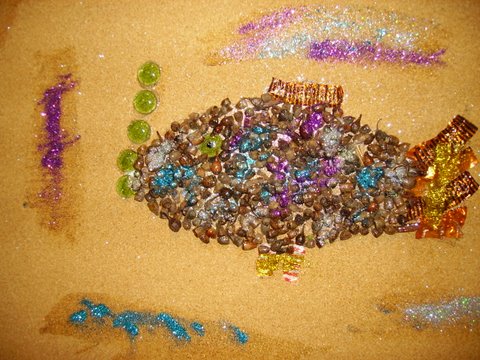
Other things we did were collecting a bucket full of gumnuts, putting them through a polisher and used the colourful little things to make a fish statue, he did a beautiful job.

What comes through to me is that if there is a reason or a reward that appeals, he ceases to find study to be so painful. It works well.

I have only two students with aspergers, but I have found them both to be very interested in making things that they can use, being very creative as they do, and if not interferred with will do a very good job.

Motivating kids to learn - a truly creative method!

Motivating kids to learn - a truly creative method!

The important thing is to plan ahead so that when they get here, they know what to expect. If I slip up on that aspect of it they don’t seem to emit the same enthusiasm. They seem to feel let down and I get guilty.

Of course as everyone will know, thay are not too keen on instruction, so drawing and planning ahead eliminates the need for further instruction.

Well I hope you don’t mind my sticking my beak in here, but I am so enthusiastic about the results and at how pleased the mothers and fathers are, I just wanted to share this.

Thank you.

And, thank you, Lorraine, for sharing this wonderful story and your insights!