Aspergers: paying attention

Paying attention at school can, at times, be trying for anyone.  It can be even harder for kids with ADD.  Yet, for Aspie kids, there can be an additional thing at play!

I am an Aspie, married to an Aspie, raising a couple of kids who are Aspies – not a professional in this field!  For a ‘boilerplate explanation’, please see my ‘Guide to my Aspie posts’ page.

One of the ‘things’ that define Aspies’ is the inability to innately read and comprehend body language.  However, many of us (especially ‘girl Aspies’, or ‘Aspiettes’, if you’d like) tend to realize we have this ‘blind spot’ and we try to compensate for it.

This often involves becoming more ‘observers’ than ‘doers’.  It means an Aspie trying to ‘decipher’ this is more likely to choose to be present for a lot of ‘social’ situations, but not actually actively participate.  Yet, the Aspie will keenly observe everything that happens in order to try to analyze the situation for behaviour patterns which would give us our personal ‘rosetta stone’ to non-verbal communication.

This process, by itself, is enough to alienate (‘creep out’) many ‘neurotypicals’ who are our peers – resulting in more ‘shunning’ and greater social isolation….which leads to more ‘Aspie frustration’!  After all, you are only trying to learn the patterns in non-verbal communication:  with your usual OCD intensity…  Yet, THAT is not the point of this post!  The point here is to point out how many Aspies’ attempts to pay attention are really misunderstood.

Let me use myself as an illustratory example:

I was raised in Central Europe – with a somewhat different schooling system.  50% of our mark was based on written tests – just as 100% of it is in North America now.  The other 50% was based on ‘oral/verbal testing’:  the person ‘being tested’ gets called up, stands in front of the class and the teacher, and is asked a question they must answer.

There IS quite a lot of merit to this form of testing.  For one, many of us (especially Aspies) are WAY better at demonstrating our knowledge verbally than in writing.  Also, if we have concerns about the question (often, test questions are so vague as to be meaningless), we can ask the teacher for clarification.

The other – and often unnoticed – benefit of this form of testing is that no two people will explain the same material in exactly the same manner and wording.  So, when a student is being tested, the whole class is being presented with a repeat lecture presenting the material, but in a slightly altered manner.  The teacher conducting the test will correct any incorrect statements by the student – and this is really key in helping other students correct their own misconceptions and learn!

Thus, testing students by calling a student to the front of the class and asking them to demonstrate their understanding of the material taught acts to both reinforce the lesson to the rest of the students, as well as correcting misconceptions and presenting alternate explanations of the material.  To me, this seems like a win-win-win situation…as it also helps people overcome fear of speaking in front of an audience.

Usually, there is several days of ‘study time’ between the time new material is presented to students and when their testing on it begins.

Sorry for the long explanation – but it is important to ‘set the stage’, if you will.

I was in grade 6 when I became most acutely aware of the whole ‘facial expression/body language’ method of conveying ‘colouring’ to one’s statements.  Predictably, I became completely fascinated by this weird and counterintuitive phenomenon!  When someone would speak, I would begin to obsessively ‘superfocus’ on their ‘non-verbal’ message, so that I could relate the two to each other later, when I ‘replayed’ the experience (in my memory) for analysis.

Except that there was one tiny-little problem:  when I would superfocus, I would – wanting to or not – block ALL other stimulations!  Unfortunatelly, this meant that if I focused on ‘non-verbal communication’, I could not help but block out all sounds…  Yes, it kind of defeated the purpose.

Well, this one day, I was in a history class.  The teacher (who had issues with my Aspieness – without understanding it was Aspieness) was actually presenting an extremely interesting lecture!  I was totally fascinated by it, and did not want to miss a single word!  I was determined to pay full attention and not miss a single word, no matter what!

Yet, I knew that if I started looking at the teacher, I would ‘skip’ into the ‘superfocus’ mode, where I would ‘record’ every bit of her body language and facial expression nuance – but I would loose everything she said!  And I was too interested in the lesson to want to miss what she was saying!!!

So, I did EVERYTHING I COULD to pay attention to what my teacher was saying!

To keep myself from ‘getting stuck watching my teacher’, I forced myself to pointedly stare out of the window.  When that started failing, I looked at the ground under my desk.  Then I stretched my arms out on my desk and tried to burry my head in them – as aggressively as I could – so that I could prevent any visual stimulation which would distract me from listening to my teacher!  However, the temperature in the classroom was pretty cold, so even this was difficult.  So, I started hitting my head on my desk – just a little bit – to force myseld not to look at my teacher – just enough to keep focus so that I could pay attention to what she was saying.

I got told off for disturbing the class!

You must understand, back then and there, NOBODY knew (or was allowed to know) about Aspergers.  Even migranes – which I suffered terribly from since early childhood – were not a ‘legal’ diagnosis….  My mom, who got me to see a doctor at the hospital (not an easy task in a socialist country where the medicare is ‘free’ – she had to call in a bunch of ‘favours’ and give out a number of non-monetary ‘gifts’ to get me to be seen by a specialist) was told that my symptoms ‘would be’ a textbook example of migranes, except that officially (read ‘political correctness dictating medical diagnosis’), migranes were ‘something upper-class, bored ladies pretended to get to make themselves more interesting’ – and as such, ‘migrane’ was not a permissible diagnosis in a progressive, socialist country that did not have ‘bored rich ladies’…  It was CERTAINLY not an acceptable diagnosis for a little school-girl! The doctors would loose their jobs…

IF Aspergers had even been part of either the educator or medical training, it would still have been stigmatized, along the lines of ‘migranes’….but, it most definitely was NOT taught or mentioned at all!

Predictably, in the classroom, my many attempts to pay attention were greatly misunderstood!

I got into trouble for NOT paying attention!

Frankly, there was nothing I could do to pay attention more!  Yet, my teacher seemed (as usual) extremely angered by  my behaviour… 

And she did something unusual and unexpected!  (I knew it was unusual, because I had not witnessed this before.  I realized it was unexpected by analyzing the surprised and shocked noises and (YES! I had learned this much!) facial expressions of my classmates:  my teacher called me up to the front of the class to test me on the material she had just finished presenting!!!

Frankly, I think I shocked her.

I could repeat everything she said, every date she presented, understood and could explain every ‘reasoning’ she had presented to us in her lecture!  As she gave me an ‘A’, she said she was shocked because she ‘saw’ I was ‘totally not paying attention’ during the whole class, and this was meant to ‘discipline me’!  Looking back, I think she thought me defiant when I truthfully said I had NEVER tried to pay attention as hard as I had that day!

So, what is the point of this post?

When Aspies look like they are doing everything NOT to pay attention – they might truly be escaping into their own world of interests….OR, they might be doing their best to truly and honestly listen to what the teacher is saying!!!  Just because their behaviour does not conform to that of other children who are paying attention does NOT mean that Aspies are not paying attention, nor does it mean that they are not TRYING to pay attention!

Just as Aspies ‘suck’ at ‘reading’ body language, there are times when we just as much ‘suck’ at PRESENTING body language!  We are VERY BAD at emulating the ‘cultural norm’ external body language ourselves (especially when we are young and before we have learned to emulate/fake it).

Yet, just as WE are bad at ‘reading’ the body language of ‘nerotyoicals’, the ‘neurotypicals’ are eaqually as bad at reading OUR body language!

This may lead to ‘Aspergers’ so called ‘specialists’ of the past (hopefully not the present) to put inappropriate emotive labels on Aspies:  claiming we are lacking in empathy, social belonging, inability to sympathize, stunted emotions and so on.  Nothing could be further from the truth!

These false charges and many misunderstandings only hurt young Aspies and further undermine our regard for our abities, our self-confidence.  It is one of the many ‘drops of poison’ which causes many Aspies to shut themselves away from ‘the world’ and limit ourselves to our ‘internal worlds’, where such hurtful undermining of us is not a daily reminder of our inadequacies.

So, the next time you see a person whose body language you think inappropriate, please, consider the possibility that you are simply unable to understand THIS person’s non-verbal communications – just as much as that person is unable to understand yours.  Respecting this difference – and learning from it – is constructive.  Rejecting or ridiculing such a person – well, this is not so nice…and can ruin a person’s ability to EVER truly believe in themselves again.

Aspie sense of ‘fair play’: kids and ‘rules of the game’

One of the characteristics that many people notice about us Aspies is that we tend to have an overdeveloped sense of ‘fair play’.  This is the first look at how this may manifest itself.

Often – especially during childhood – this takes the shape of very rigid adherence to ‘rules’.  I remember the genuine tears of my kids as other children would play a game ‘wrong’ or ‘with the wrong rules’.  I also remember the arguments of ‘you can’t change that – it’s a rule of …. ‘!

This can lead to difficulties in many social settings.  Aspie kids can be very good at board games or card games, so this is an excellent way to have them interact with other kids.  However, it is important to make sure that everyone agrees to the rules of the game exactly the way the Aspie had learned it…..or the Aspie ‘inflexibility’ and ‘obstinance’ will start a temper tantrum will end the game and result in further ostracism of the Asperger child.

Of course, I do not think of it as ‘inflexibility’ or ‘obstinance’ at all.  Instead, I see it as an issue of ‘right’ and ‘wrong’.  But then again, I am an Aspie…  Whatever the cause, however, the problem – this barrier to social interaction – is still there.

So, how to handle it?

Aspie kids can handle ‘different rules’ in variations of games IF things are presented in the correct perspective.  The key is recognizing WHY they are so opposed to ‘changing rules’.

Imagine yourself living in among a group of people whose language you did not understand.  Then, you begin to discern some ‘patterns’ in behaviour.  If you would indulge me in a personal story to help draw a parallel:

Two friends and I went down to visit another friend in a Spanish-speaking country.  None of the three of us spoke Spanish, but we were staying with our bilingual friend and her family, so we were not worried.  Except…through series of circumstances, our friend had to go to a different town and we were left with her non-English speaking family. 

Much to their credit, they took awesome care of us.  They took us places, showed us things, treated us extremely well.  Except that when they would come and tell us we are going somewhere in the car, we had NO idea whether we were going out for lunch to a fancy restaurant, to a tourist attraction, to a beach, or – as happened once – for a 3-day stay at a beach villa.  We had no idea how to dress, what to bring with us, when we’d be back.

After a bit, I began to notice some patterns – and these were my lifeline!  It set up some ‘rudimentary rules’ we could go by.  We clung to these – when you don’t know what is happening all the time, you feel very vulnerable!

Similarly, an Aspie child has a lot of difficulty understanding social communication.  We take it for granted that people can read and understand our body language and facial expressions (even tone of voice) – and so we do not comprehend just how much we do not actually say when we communicate.  We presume that much is understood from how we say something, not just the words we use to say it.

But Aspies cannot do this.  It is difficult to explain just how difficult it is to comprehend ‘communication’ – one even often questions one’s ability to understand the spoken language.  After all, ‘bad’ means ‘bad’ – but here it means ‘good’….  Without the ability to add body language, facial expressions and tone of voice to the word itself, the ‘rules’ of social interaction and even language can become incomprehensible.  Add to this that for very long time, many Aspie kids do not even know that there is such a thing as ‘body language’ which others understand and they have to learn to look for!

It is like pointing to a picture while talking about an apple – and expecting a blind person to know we are talking about the red apple in the picture.  The blind person does not even know there is a picture…..and does not understand how come everyone else knows the apple in question is red! 

Perhaps this is only one of the ‘contributing factors’, but it is one that is easy to explain as to why Aspies cling to rules they actually know they understand!

And that is they key:  understanding.

Activities like board and card games have very explicitly stated rules – rules that everyone understands before the game begins.  Aspies and therefore not handicapped and can participate on an equal footing with everyone else.  That means a lot.

So, starting to change the rules – that can bring up the whole overwhelming frustration right up!  It’s as if the Aspie is being robbed of the one glimmer of understanding of how things are supposed to be.  No wonder it upsets us to no end.

So, what is the solution?

When you teach an Aspie a game and explain the rules, make sure you explain these are the rules for THIS version of THAT game.  Explain there are MANY versions – we play version …. (name it something the Aspie child can relate to).  Then, you can say there can be versions of the game which have ALMOST identical rules, with just little variations – and that if they go to play the other version, everyone will make sure to teach them the NEW GAME!  Because that IS what it is:  each ‘variation’ is really a different game, with different rules:  they are called the same thing because they are a ‘family of games’ that has ‘similar rules’.  (You can even relate it to family name and first name – different people in the same family…)

This releases the tension of ‘changed rules’!

Instead, you are setting up the expectation of different rules because one is learning a ‘NEW’ (though similar/related) game.  This is a completely different situation – and usually quite acceptable.  Yes, there will be the inherent insecurity by the Aspie, wondering if he/she understands the rules of the new game sufficiently well to play with the others (and the Aspie may select to watch for several turns, precisely to make sure of the rules), but it is not turning the Aspie’s world upside down by negating their rare and precious understanding of at least some rules.

It is important to set this expectation up before encountering the situation, because once that meltdown has started, it is difficult to stop it.  Release of ‘pent up frustration’ is difficult to get back under control, especially in a young child.  So, making sure that the situation is properly framed before it occurs is very helpful.

No, this is not a magic wand that will make it 100% perfect every time – the Aspie may wish to get everyone to play by the rules they are familiar with, because they are more secure when dealing with the understood rules.  But when parents, educators and caregivers understand this, it may affect the way they approach the resolution, so it is more successful. 

My personal experience is that this approach usually results in a positive interaction with other kids and builds an Aspie child’s confidence in their ability to learn the rules of interacting with others.  And as they become more confident in their ability to play successfully with other children, more social skills can be built – and this is a good step towards a successful and happy Aspie child.

A new ‘page’ is added

While I may be interested in all kinds of things, the most regular hits my blog gets is from people looking for advice and help in dealing with Aspergers’ Syndrome.

I have made no secret of it:  I am an Aspie!  My hubby is an Aspie!  And, predictably enough, our kids are Aspies!!!  It is therefore not too surprising that I have tried to share some of the more successful methods used by ‘us’ to successfully integrate into the social mainstream.  Not only am I proud of our successes, I am also motivated to help others who are experiencing similar things – as well as helping ‘the society at large’ learn to understand ‘us Aspies’.  Though I may not be one of the ‘exceptional ones’, many of the humans who DID change the course of human societies WERE Aspies…so the need for understanding runs both ways.

Therefore, I have written a bit about Aspergers and Aspies.  After a bit, even I was getting confused between what posts I had finished and published, and which ones I started and got distracted from….there are just so many distractions around!!!   Have I shown you the……

You get the picture.

So, I have made up a nifty page where I have listed my ‘Aspergers’ posts – with a little summary for each one.  It is not much, but I do hope it will serve as a useful tool for people who are seeking help and understanding.  I do hope to edit it often to include all future post on this topic, too (but, no promises – I am ADD, too….)

Anyhow, I do hope this page will prove useful.

Jack Layton insults Canadian artists

Trying to paint himself as a supporter of the arts during this election campaign, NDP leader Jack Layton has accidentally demonstrated his contempt for Canadian artists with this election promise:

Mr. Layton promised that if elected Prime Minister, he will use the CRTC (the government tool used to reign in radio and TV stations in Canada and ensure their content is appropriately censored) to force all TV networks to only show ‘Canadian content with Canadian actors’ during prime time viewing hours.  (I could not find the audio clip of when I heard him speak – the link above is to an article reporting it….but the article had watered down his statement.  If you find the clip, please, let me know and I will edit the post to insert it here.  Thanks.)

What is this man thinking?

Yes, some say this is a mute point, as he will never win enough votes to be the next Prime Minister (even as a leader of a coalition, which he seems to be striving for now) – but his very suggestion normalizes this type of action and makes it seem less extreme the next time someone suggests it.  And I don’t like it. 

Why?

Aside from this being a terrible insult to Canadian artists (the ‘soft’ or ‘condescending’ type or ‘snobby prejudice’ – “they are so pathetic, without MY help here to eliminate all their competition, they could never make it on THEIR merits…..because they have NONE!”), he also made a call to heavily fund these ‘artists’.  Let’s follow the chain of consequnces here.  Step by step…

  1. Government subsidizes (pays for) ‘Canadian art’
  2. The government, of course, has to be ‘accountable’ for this spending, and so must select what bits of ‘Canadian art’ are actually worthy of being paid for
  3. Government forces the privately owned TV networks to show nothing but the ‘Canadian arts content’ during prime time TV viewing hours
  4. In order to be eligible for this ‘Canadian content’ (and thus eligible to be broadcast during these crucial-for-survival time slots), the ‘Canadian art’ will have to be certified as such by the government’s very own agency, CRTC

In effect, the government pays for the ‘Canadian art’ it first approves, then forces the TV networks to only show the bits it approves of the most.  Thus, the government has 100% control over what we get to watch! (During prime time only, of course…)

HOW could any artist in Canada stand for this type of subjugation? 

This turns every artists who would qualify for the label ‘Canadian content’ to be, in effect, a civil servant!  We have seen in the past Canadian hockey teams, starring Canadian athletes, in a Canadian sports league, be refused (by CRTC) the label ‘Canadian content’ on the grounds that ‘sports’ did not qualify (perhaps because people like to watch sports….and it is hard to slip in ‘approved social messaging’ into a hockey game ‘dialogue’…)

The only ‘art’ we would be allowed to watch would be produced by ‘de facto’ civil servants!

And we have seen what has happened to our doctors, when THEY were turned into ‘de facto’ civil servants:  the government, through various means, attempts to deny them even the freedom to act according to their conscience!  Frankly, I don’t think the government is wrong to demand that its employees/contractors provide all the services the government pays them to – the problem is that doctors should never have been made into government employees/contractors in the first place.

And nor should artists!

Aspergers: not just ‘extreme male brain’ syndrome

If you have done some reading up on Aspergers, you have likely come across the description of it as ‘an extreme male brain’ syndrome.  It is a ‘quick and easy’, one-phrase explanation that ‘makes sense’ to some people.  I’ve often wondered if this theory is based more on the ‘men are bad at social skills, women are bad at math’ stereotype than on anything actually particular to Aspergers itself. 

It seems I am not alone in being a little uncomfortable describing aspergers as ‘extreme male brain’…to the contrary, many suggest that this description of Aspergers arose because it was only studied in males.  And only in a particular type of males, to boot!

Here is an extremely good rebuttal of that idea, written by Felinophile, a young woman who also happens to be an Aspie:


This theory that people with Aspergers have an extreme male brain is sexually-discriminatory, as it is based on studies of Aspergers males and people who fit the Asperger-male sterotype. It completely ignores the way Aspergers manifests in women, which is part of the reason it is seen as controversial.

Like a lot of Aspergers girls, though, I don’t fit the Asperger-male stereotype; while I have difficulty interpreting and expressing body language and facial expressions I have learnt over time to mimic others behaviour and responses, and to form a rough checklist for interpreting other people’s behaviour. While I have good spatial abilities, and do better than non-Aspergers girls in some areas of maths, I never had a gift for mathematics; instead, it was for language, as it is for some other Asperger girls


Read the rest here.

Aspergers and memory – part 2: rote memory vs. reasoning

In yesterday’s post, I explained that while I have not been writing about Aspergers, I have been reading up on it.  While I am interested in this topic (being an Aspie myself – and living with other Aspies), I am not an expert in this field in any way whatsoever.  What I write are personal observations and should not be taken as anything other than that.

So, in Aspergers and memory – part 1: ‘sequencing’, I described that some ‘memory’ studies found that Aspies had difficulty recalling the order in which words were placed on a list they were given to read/memorize, which lead me to wonder if the frequent occurrence of dyslexia and ‘hearing dyslexia’ (APD) might be related to some memory or brain proccessing bit that messes up ‘sequencing’. 

Other studies I looked at would also have a list of words (10, 20, or more) to read/memorize in a short period of time, then the person would be presented with a whole page of words. The goal was to identify the words from the original list – Aspie results were compared to those of their ‘neurotypical’ peers.  The Aspies also did not do as well on this test as others did.  Yet, there was something that more than one researcher found quite intriguing:  for every ‘list’ word the Aspie missed, he or she was very likely to identify another word with similar meaning!  As in, they replaced some ‘list’ words with their synonyms…

Now, that opens a whole new way of looking at things!

I even read one very interesting study (only one, but I am looking for more) which concluded that Aspies of similar IQ as their peers were much, much worse at ‘rote memory’, but much, much better than their peers at remembering things they had reasoned out. 

This study found that ‘rote learning’ was absolute torture for Aspies, and they, frankly, sucked at it.  Not that they were incapable of it – they could improve it with practice.  Yet, it was not one of those things that came easily to Aspies.   Most Aspies had better recall of things which were ‘explained’ to them, rather than simply memorized.  They slightly outscored their peers, while other Aspies were just as dismal at this as they were at rote learning.  Where all Aspies excelled far above their peers was in remembering things they had reasoned out for themselves. 

Consider the implications of this:  some Aspies will be dismal in ‘rote learning’ or even ‘comprehensive learning’ (not proper term, I mean things they were taught through ‘comprehension’), but they are extremely good at remembering things they had figured out on their own!

And I must admit, this makes sooooo much sense to me!!!

The things I remember best from school are the ones where the teacher would introduce the topic, set up what he was going to use to explain it, and – before he would even say the first sentence – I would ‘see’ the pattern and understand exactly what he was about to explain.  As in, if I reasoned it out by myself – I still remember it without any ‘time degradation’, while if I understood the teacher’s explanation, the whole things gets ‘fuzzy’ with time and I have to strain to remember it, even if at one time I understood it and knew it perfectly.

Please, consider what is seen as one ‘typical’ Aspie trait:  they acquire ‘ecyclopedic’ knowledge about some obscure subject which they become absorbed in.  Could this be related?  Perhaps not ‘an explanation’, but could this be another manifestation of the same, or very related, phenomena?  After all, their ‘encyclopedic knowledge’ is to a large degree ‘self-taught’….

What are the implications of this?

First, I think it means we have to approach teaching Aspie kids very differently.  Take spelling, for example.  Instead of teaching Aspie kids simply the sound of the letters, what letters make up the word, and so on….what if we started teaching them from a broader linguistic background?  It is what I did with my kids – and it really worked…but I did it because to me, it seemed ‘the only’ way to approach it….  It would go something like this:

“See this word?  Well, look here – this is the Latin word for …”

“Hey, they have a bunch of similar letters in them!”

“Why do you think that is?”

“Ah, this bit of the meaning is the same!  They just took a Latin word bit and stuck it to …!”

Spelling that word would never be a problem in the future!  (There would still remain the often difficult task to actually motivate and Aspie kid to look at the words in the first place…but that is a whole different topic!)

Mind you, I took this approach to teaching grammar to my older son, too.  Our school system is operating on the ‘whole language’ method, where kids are expected to ‘absorb’ the language from their surroundings.  This simply is torture for Aspies, who like very specific rules they can apply – especially with English, where the linguistic ‘rules’ of a sentence are extremely well masked!

So, I turned to Latin – no we did not memorize the vocabulary, but the words in Latin are ‘flexed’ very specifically based on the role they play in a sentence.  It is therefore easy to see the patterns of how sentences are constructed.  Just showing the rules to my older son and letting him figure out for himself how to then build a sentence with latin words ‘flexed’ properly had an incredibly positive impact on his ability to write in English. 

Perhaps this is only one example, and perhaps this may not work with other Aspies, because there are soooo many individual differences between us.  Yet, I would be curious to know if others’ experiences and observations are similar to mine…so, please, let me know!

Aspergers and memory – part 1: ‘sequencing’

During the past few months, I have not been writing about Aspergers because I have been doing a bit of reading up about it – there is so much ‘food for thought’ in the feedback to my earlier posts on Aspergers (thank you all) that I just had to check some things out.  Of course, not all my curiosity has been satisfied – but I think that I have learned things that have helped me make a little bit of sense of some ‘Aspie patterns’.

The one thing I have read about the most is memory.  And if you Google it, there actually are quite a few studies about Aspergers and Memory out there – so I, an Aspie (and definitely NOT an expert) am not the only one to suspect that one of the ways Aspies differ is in the way our memory works.

The conclusions of the studies were unsurprising:  Aspie memory works slightly differently. 

Yes, there were IQ tests as part of many of these studies to ensure that Aspies and ‘others’ of ‘similar’ intelligence were compared.  Some looked at adults, others at kids or teens.  (Many studies I read looked at Aspies vs. Autistics, but  that is a different story.)  (Frank admission:  while I read some studies completely, others I only read the ‘hypothesis’, the ‘methodology’ and ‘conclusions’ sections.  This was not from slacking or taking shortcuts, but because I really wanted to read many different studies, from different areas, looking at different age groups, run with different goals, so as to get a glimpse of the ‘big picture’ and the patterns within it. )

Here is where I must warn you:  the scientific studies I read made observations and conclusions.  Various studies, various observations and conclusions.  What follows here is my interpretation of the conclusions of several of these studies.  It is NOT any opinion (as far as I know) of a professional in this field.  These are my higly subjective ideas, so, please, treat them as nothing more than such.

Several of the studies had (with variations) presented a list of words which the people had a chance to read several times (or, variously, study for a given time period), and then had to repeat in the same (or reverse) order.  The Aspies usually remembered fewer of the words from the list than their peers.  Now, here is the intereseting bit:  they were absolutely terrible at putting the words into the proper order!

This immediately made me think of the very high incidence of dyslexia and ‘hearing dyslexia’ (Auditory Processing Disorder (APD)) in Aspies.  I may have it backwards, but it sounds to me like this difficulty in ‘putting things into order’ is a pattern:  sounds, letters and words cannot be ‘remembered’ in the ‘right order’….  But with APD, the science tells us it is a problem in ‘perception’. 

So, I reasoned, perhaps this is a general ‘processing’ difference of the brain itself.  Perhaps this is not a simple ‘memory’ function.  Perhaps this is telling us something about the overall processing that the brain does – and how an Aspie brain does it differently.

Or it could be a memory function – but the memory fails very, very early on. 

Let’s consider hearing:  our ears sense vibrations, which are translated into a neural impulse.  This impulse travels into the bit of the brain which makes sense of the sound, and sends the ‘translated’ information to other bits of the brain, as required.  For example, if it determines a sound to be ‘words’, it might send the message to the ‘language’ section of the brain.  But, is all of this instantaneous?

In many people it is.  But I don’t think this is in any way universal.  For example, I know several people who can hear me say something and completely fail to react to it.  When I ask them what I said, they look thoughtful and then repeat word for word what I had said.  Yet, until they were requested to repeat the words, they were completely unaware that they had even heard them.

It’s as if the phrase were held in some sort of a ‘buffer’, completely preserved and perfectly remembered, but not deciphered by the brain.  Only when this ‘buffer’ was consciously accessed did the brain actually get access to the information in it.  This suggests to me that in-between the different ‘processing’ stages, the brain must hold the information in some sort of a memory slot. 

And if the Aspie memory has a predisposition to ‘jumbling up’ the order of sounds (or pictures) it is holding on to, it could explain all of these.  Jumbled up sounds, pictures, order of words.  All of it.

Or, it could be something completely different.  Yet, I have received so many messages from people, asking for more of my observations about Aspergers – as well as offering me their perspectives about what I wrote – that I thought that even though I really am not sure what it all means, putting this observation ‘out there’ might be a good idea.

This way, I hope, many of you will share your own experiences in this and together, perhaps, we can make more sense of this!

Journalists and elites

Societies change.  That is natural and to be expected.  And as they do, who makes up the ‘elites’ also changes.  While I think that observing the patterns in societal changes may be interesting all on its own, it may also help us predict the future patterns of change.

A while ago, the ruling class was determined by family affiliation:  in order to raise an army to conquer a country with, a person had to belong to a royal or, at least, an aristocratic family.  Same for succession.  Well, usually! 

This has changed.  The patterns of how and why are complex and more suited to a book than a simple blog post.  Let it suffice to say that looking at today’s elites, it appears that most of their members do not have pretentions to royal bloodlines.

So, whom are todays elites made up from?

Aside from the celbrities (why they are ‘famous elite’ is a whole different post), today’s elites can be (very roughly) divided into two general groups:  ‘rich elites’ and ‘intellectual elites’.  (Looking at the infinite nuances of their sub-casts would take another book…so let’s stick with the ‘big’ differentiation.)

The rich elites are often marked by the pretentions of past nobility:  ‘familly money’ individuals often look down on the ‘nuveau-riche’ as ‘upstarts’.  But, especially in the US, where personal achievement is not yet regarded as a bad thing, the rich can all be lumped together under the general label of ‘rich elites’.  Especially by the second generation…

The intellectual elites are a lot more interesting:  these people have no pretentions to being able to actually do something.  Instead, they see themselves as the ‘thinkers’ of society.  It is not sufficient to be highly educated and very intelligent in order to be part of the ‘intellectual elite’ – scientists, for example, would satisfy these criteria, yet they are most certainly not politically influential.  They get patted on their heads, warmly welcome (for a little while) if they can be temporarily useful, but then they get locked back in their labs.  So, what is that quality?

Unsurprisingly enough, to be a member of the ‘intellectual elite’, one has to appear to fit in comfortably with the ‘rich elite’.  This ‘fitting in’ could be an ostentatiously overdone ‘poor look’ (like the ‘bohemians’ that many University Professors used to affect while it was fashionable), but underneath, one must be able to act rich, rich, rich!  

This immediatelly rules out those who are unpretentious – keeping up fake appearances is simply not attractive to unpretentious people.  Now, since our Universities and Colleges have, to a great degree, been staffed by professors who typically hold radically socialist views, it is not surprising that those who wished to be admitted to these ‘intellectual elites’ had to affect similar manners and assimilate these very political views.

So, the group which emerges as being most politically influential (other than the ‘old rich elites’ – as in, old-money  families) is made up of pretentious, radical socialists!  In Canada and the US, we easily recognize them as our ‘Liberals’ and ‘Democrats’…

But, where do the journalists fit in?  They, most certainly, are not even now rich enough to be admitted to either of the ‘elites’ of today!  Yet, in Journalism schools, they were subjected to radical socialist teachings.  And, now, they are sent to cover the lives and actions of the two elites.  Is is surprising, then, that getting to know these people as individuals during the course of their work, the journalists (who, like all of us, wish to be ‘special’ and ‘extraordinary’) have come to identify themselves with one of these two elites?

Unless born or married into a rich family, a journalist cannot hope to fit in with the ‘rich elite’.  That is just a simple economic fact – even the best newspapers do not pay that well.  However, many of them can and do fit in comfortably with the ‘intellectual elites’.  Well, sort of.  At least, they are much closer – close enough that from the point of view of the journalists, they feel like they fit in.

And while there may be some crossover, at least in the USA, the ‘rich elite’ is traditionally associated with the pro-business Republicans while the ‘intellectual elite’ tends to be associated with the socialist Democrats.  The rest of us mortals fall into one or the other camp, based on what we think is a better way to organize a society:  based on individual achievement or on group-rule.  (In Canada, the ‘rich elite’ is almost non-existant, so the ‘Conservative’ party only retains the image of ‘old money’, rather than embodies it – but despite the facts, the image remains.  The ‘intellectual elite’ in Canada is split between the ‘Liberal’ and ‘New Democratic’ parties).

Is it surprising, then, that when covering ‘their own’ elite, the journalists of the MainStream Media find themselves ‘cheering’, and while when covering ‘the other elite’, they are incessantlly booing?

All right, so I don’t have a revelation here, or much of a real point of any kind.  But, watching this particular pattern is interesting, is it not?

‘Motivating Asperger kids’ – a tutor’s story

A HUGE obstacle in teaching Aspie kids is engaging their interest and motivating them.  Unless motivated, these kids will simply not retain learning.  And since these kids tend to be have problems reading ‘social cues’, usual motivation techniques, which involve some forms of ‘social pressure’ will fail to motivate them.

This can lead to frustration on all sides!  Teachers/tutors, parents and the kids themselves!

Following is an excellent account Lorraine has sent in, about her experiences of tutering two Aspie boys and SUCCEEDING by MOTIVATING them.  Please note:  the story is as Lorraine had written it, with only minor editing.  The emphassis, however, is my addition.

It was very interesting to read the mail posted on his site.  I am tutoring spelling to a 10 and an 11 year old boy with Aspergers.
Until I met these boys at the beinning of 2007, I had never heard of the condition.  I am amazed at how intelligent these boys are compared to other ‘normal’ children. They love facts and tell me things that outstand me, that a young boy of his age could know those things.

The reason these boys are coming to me is that they have problems with reading and writing. They were at the very bottom of their classes at first and have now come to second top, and fourth from the top.
One teacher commented to the parent, “How can she teach him 10 words in one hour and I can’t teach him one word in a week.”

I hope my crazy methods will work for others as well, and that is why I have decided to post here.  Who knows, maybe the ideas might be helpful to someone else!

We don’t do spelling when they are here in the way that you would expect. We invent things we are going to do the week before, so that they know what we are doing before they come here.  This seems to be pretty important, planning ahead.

The boys come here on different days to each other.

With one boy, we made a coffee table that his mother is so proud of she nearly cried. Another time he did a lovely painting in oils using my good oil paints and a big canvas. On this he painted a dragon, it was beautiful. Next he got to use real tools and made a four piece candle holder complete with candles in little dishes. The list goes on.

Back to the table. We went to the local op-shop and bought a “daggy coffee table” for three dollars. Then we bought a pile of plates, about 20, in his favourite colours. He chose the plates himself, not me. The plan was to use tools and sander to refresh the table, and break the plates to use as tiles to do a mosiac on top.

Each step was pre-planned and fun motivation to learn.

Each step was pre-planned and fun motivation to learn.

We went back to my place and for every word he spelled correctly three times, he got to go outside, place a plate in the bag and break it with a hammer. It wasn’t too long before he had enough smashed china to make the top of the table. He spelt a lot of words, had a lot of fun and laughter, and overall enjoyed himself. That part took two visits each for one hour.

The following week, he got to work on the wood with with my small electric sander. Same thing, spell the word and get to do a section of the table. That took a couple of weeks. The exciting thing for him then was to be able to do a drawing on the table.

The folowing week, he worked out his design and the pieces he would put in the places he chose. The week after that he glued his pieces where he thought they would belong.  However that was a slow process and it took two weeks also.

The following week, he got to grout his tiles. That took a long time and we had arranged to ring his Mum when it was finished. He had done a beautiful job on it. This also had a dragon. He had chosen his own colours and I was a bit dissapointed when he chose the colours he did, but I didn’t say so, and it was just as well I didn’t because his table is wonderful.

The project took a whole term, he learnt all his words, wrote several sentences each day, gained confidence in the class room. He became a bit more friendly with his teacher and so the tantrums and frustration have lessened.

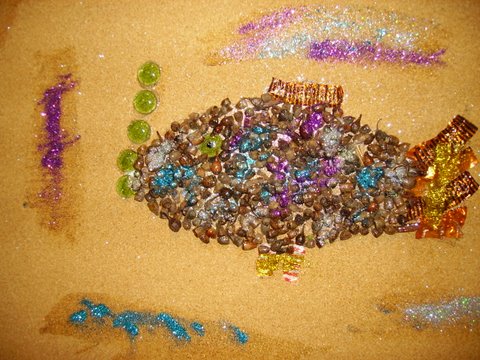
Other things we did were collecting a bucket full of gumnuts, putting them through a polisher and used the colourful little things to make a fish statue, he did a beautiful job.

What comes through to me is that if there is a reason or a reward that appeals, he ceases to find study to be so painful. It works well.

I have only two students with aspergers, but I have found them both to be very interested in making things that they can use, being very creative as they do, and if not interferred with will do a very good job.

Motivating kids to learn - a truly creative method!

Motivating kids to learn - a truly creative method!

The important thing is to plan ahead so that when they get here, they know what to expect. If I slip up on that aspect of it they don’t seem to emit the same enthusiasm. They seem to feel let down and I get guilty.

Of course as everyone will know, thay are not too keen on instruction, so drawing and planning ahead eliminates the need for further instruction.

Well I hope you don’t mind my sticking my beak in here, but I am so enthusiastic about the results and at how pleased the mothers and fathers are, I just wanted to share this.

Thank you.

And, thank you, Lorraine, for sharing this wonderful story and your insights!

Do you know a ‘knol’?

Wikipedia, look out! 

Google has launched its ‘Knol’ – a site wchich is somewhat similar, though promises to be more ‘Google monitored’, as a rival repository for popular knowledge.   I cannot wait to read some of their write-ups.

Just a quick search showed that -as yet – there is no entry on the Canadian Human Rights Commissions!  Gee, I wonder who would be best qualified to write it up?

Somebody ought to give Mr. Levant a heads-up!

(via TheReferenceFrame)