Aspies: if I know it, everyone knows it

One of the most difficult things for a young Aspie to grasp is that not everyone has access to the same information, nor is everyone taught the same rules for everything.  Even a mature Aspie, who is aware and tries to be mindful of it, can easily fall into this ‘trap’ and leave out bits of information that are ‘obvious’…

Let me back up a little:

Aspies, especially young ones, have difficulty understanding that not everyone reasons from the same baseline, has access to exactly the same information, using the same ‘rules’ as they do. 

It is hard to understand that ‘available’ information would be denied or inaccessible to others.  The corollary also holds true:  many young Aspies have a hard time understanding that information beyond what they know may be available to others…as in, that they do not have all the available information.

Predictably, this may lead to confusion – and frustration, misunderstandings, resentment, self-doubt…. 

I remember reading that one of the very early childhood tests for Aspergers is to take a candy box and ask the child what is inside.  The child will answer ‘candy’.  Then, the therapist (person administering the test) opens the candy box to reveal that there is a crayon inside instead of candy.  Now – this is the tricky bit – if the therapist were to ask the child at this point:  ‘If your mom came in and I asked her where the crayon is, where do you think she’d start looking for it?’

While many children would understand ‘the joke’ (it’s not really a joke, as it only satisfies the ‘unexpected’ or ‘secret knowledge’ aspect, which alone is insufficient to constitute a joke, but many ‘neurotypicals’, especially children, often mistake it for one),  the Aspie kids expected their mom to go directly towards the candy box to find the crayon

This is an illustration of the Aspie ‘if I know this, then everyone knows this’ blindspot.  It is becauseof this very inability of young Aspies to differentiate between ‘I know’ and ‘everyone knows’ that many ‘specialists’ do not consider us capable of ‘higher abstract reasoning’. 

Predictably, I think them stupid (this was the mildest word I could bring myself to use) for this patronizing, self-centered presumption:  Aspies are capable of extremely abstract reasoning!  Plus, most Aspies do learn this differentiation – perhaps using a different part of the brain than ‘average’ people, but we do learn it.  Perhaps we learn it at a higher age, and some of us learn it more easily than others.  Perhaps some of us learn it at an intellectual level, but still have a difficulty applying it at a mundane, practical lever… but this is NOT an indication of an inability to self-conceptualize, to ‘differentiate’ between ‘the self’ and ‘others’, as many misguided ‘specialists’ condescendingly and erroneously attempt to suggest!

So, having (hopefully) established that this ‘blindspot’ is not what many ‘experts’ pretend it is, it is still very important for Aspies and for people interacting with Aspies to be aware of this.

Many times, people think Aspies ‘arrogant’ for presuming that everyone ‘ought to’ hold the same views.  The corollary is that the Aspie may view the failure of other people to gather the same information, follow the same reasoning process (at this has ‘definite rules’) and arrive at the same conclusion to be a sign of inferior intelligence in other people.  After all, the Aspie followed this process without any difficulty – why couldn’t everyone else?  Or, perhaps more accurately, why wouldn’t everyone else do the same? 

It is not an attempt at being ‘haughty’ or putting other people down – the Aspie may simply not understand why other people would not follow the rules of reasoning to arrive at the same conclusion as they had.  So, either the person has chosen not to follow the rules of reasoning – and Aspies like to stick to their rules – or that person is unable to follow the process….  You can see how that could cause the Aspie to ‘appear haughty’.

It may alienate peers, care-providers or educators and make them not want to help the Aspie.  After all, they are trying to help this person, and getting this attitude in return! It may make the Aspie appear ‘arrogant’ and to ‘lack empathy’ – something that has also often been erroneously asserted about us by ‘specialists’ who do more harm than good  by misunderstanding their observations of Aspies and than basing great, sweeping theories on these misunderstandings.  If you ask me, they have failed to follow the reasoning process correctly!

I am not saying that adult Aspies should be excused for not properly compensating for this known aspect of ‘Aspieness’.  However, when kids are young, it would be unreasonable to expect them to have developed coping mechanisms to deal with this, as they may be too young to even understand that this is happening, or that it is something they should try to compensate for….  So, understanding the root of this attitude is important in order to not discourage people from helping – and also in teaching the young Aspie what is happening and how to compensate for it.

If the Aspie is not taught (or does not learn on their own) this lesson, they will never understand why it is that their ‘reasoning’ is ‘always out of step’ with everyone else’s.  This is not a healthy way to grow up. 

Either the Aspie will ‘learn’ that they are an ‘idiot’ whose ‘reasoning’ cannot be trusted.  After all, everyone else came to a different conclusion – and either the Aspie thinks, or someone close to them pointedly tells them that ‘it is higly unlikely that the Aspie is right and the rest of the world is wrong’.  In this case they will spend the rest of their life always doubting themselves and thinking their ‘reasoning’ skills to be faulty and untrustworthy. 

Or it might set up an expectation that the ‘rest of the world’ cannot be trusted and one must hide their opinions from it.  After all, every time you tell people your opinions, you are told you are being rude and then are ostracized.  Either way, speaking your mind causes people to be angry at you – so you learn not to.

Or, it may breed a complete contempt for the rest of the world in the young Aspie.  Or something similarly self-isolating…

Either way, it is not going to lead to the development of a  ‘healthy’ sense of ‘self’ for the young Aspie.  I do not know what the ideal solution to this is – or what the best ‘compensating behaviour’ would be, as these tend to differ from one Aspie to another.  The right age at which the Aspie is ready to deal with it may also differ greatly.   But, the ‘frustration levels’ of both the Aspie and the Aspie’s caretakers, educators and friends may all be reduced if this ‘blindspot’ is understood and addressed.
Fighting opression through education: ‘hole in the wall’

The best way to make this world a better place for everyone, in my never-humble-opinion, is to make good education so accessible, everyone gets some.

The more, the better.  Why?

It may be naive on my part, but I have always thought that many injustices throughout the world are not opposed because it simply does not occur to people that they could be opposed.  One good thing that results from education is the broadening of one’s perspectives, learning about different places where things are done differently, and the realization that it is possible to ‘question stuff’

Education also teaches us how to reason.  It does not matter what we are learning, we cannot escape acquiring some formal reasoning when we ‘learn stuff’.  That is also good.

But, perhaps one of the best reasons for making education available to everyone is that it will open horizons for kids and open up possibilities for them that they never dreamt of before.

That is why I think that efforts like ‘One Laptop per Child’ are so important – and why every child, male or female, should become educated.

But many people question how children would benefit from simply having an internet-connected laptop.  What would they do with one?  How would they learn?  Many of them do not even speak English – or any of the other languages dominating the internet!  What use would such a computer be to them?

A little while ago, one of my sons came across an interesting article about a brilliant study done by a physicist named Sugata Mitra in New Delhi, India.  It was called ‘Hole in the Wall’:

An Indian physicist puts a PC with a high speed internet connection in a wall in the slums and watches what happens. Based on the results, he talks about issues of digital divide, computer education and kids, the dynamics of the third world getting online.

The results were brilliant!  The computer, connected to high-speed internet, had a touch-screen interface.  It ‘mysteriously’ appeared, cemented into a wall, in a New Delhi slum… no instructions, no manual, no rules, no help.  What happened next was, well, enlightening!

What he discovered was that the most avid users of the machine were ghetto kids aged 6 to 12, most of whom have only the most rudimentary education and little knowledge of English. Yet within days, the kids had taught themselves to draw on the computer and to browse the Net. Some of the other things they learned, Mitra says, astonished him.

If you have the time to read the whole interview with Dr. Mitra, I would greatly suggest it.  If not, here are some of the highlights:

  • Children aged 6-12 were the most avid users of the computer
  • without any instruction, they taught themselves to use a paint program and to access sites with games
  • Dr. Mitra played an mp3 file for them – a capability of the computer that had not occurred to them.  In several days, Dr. Mitra says, they knew enough about mp3 files and music online ‘he could have learned a thing or two from them’.
  • If children think something is worth learning, it is not necessary to use formal instruction (expensive in the developing countries) to teach kids – instead, it ought to build on knowledge kids can self-teach

But there was more to Dr. Mitra’s curiosity…he wondered how effective self-directed learning would be in more formal subjects…like, say, physics…

Well, I tried another experiment. I went to a middle-class school and chose some ninth graders, two girls and two boys. I called their physics teacher in and asked him, “What are you going to teach these children next year at this time?” He mentioned viscosity. I asked him to write down five possible exam questions on the subject. I then took the four children and said, “Look here guys. I have a little problem for you.” They read the questions and said they didn’t understand them, it was Greek to them. So I said, “Here’s a terminal. I’ll give you two hours to find the answers.”

Then I did my usual thing: I closed the door and went off somewhere else.

They answered all five questions in two hours. The physics teacher checked the answers, and they were correct. That, of itself, doesn’t mean much. But I said to him, “Talk to the children and find out if they really learned something about this subject.” So he spent half an hour talking to them. He came out and said, “They don’t know everything about this subject or everything I would teach them. But they do know one hell of a lot about it. And they know a couple of things about it I didn’t know.”

That’s not a wow for the children, it’s a wow for the Internet. It shows you what it’s capable of. The slum children don’t have physics teachers. But if I could make them curious enough, then all the content they need is out there. The greatest expert on earth on viscosity probably has his papers up there on the Web somewhere. Creating content is not what’s important. What is important is infrastructure and access … The teacher’s job is very simple. It’s to help the children ask the right questions.

This makes so much sense!

And, please, consider that many universities and colleges have started putting their undergraduate courses online – accessible for free!!!

Here are some examplesMIT Open Courseware, Carnegie Mellon open learning initiative, John Hopkins open courseware, and many, many more!!!  So, with a laptop, an internet connection and a healthy dose of curiosity and desire, a kid in Africa or Sri Lanka or anywhere else in the world can access world-class education.  There is still the question of accreditation, but that is only necessary to getting a job – not to actually using the education on their own! 

Just think how empowering it would be for young people, all over the world, to gain access to this kind of education!  If Dr. Mitra is correct, then self-directed learning is the most effective way to educate our children.  So, let us put the tools into their hands – and let’s watch them grow!

Of course, education is not the answer to ending oppression – but it is an important step.  It is much more difficult to oppress a society of people who are well educated and internet literate than it is to control people who don’t know how to call out for help!

Aspie sense of ‘fair play’: kids and ‘rules of the game’

One of the characteristics that many people notice about us Aspies is that we tend to have an overdeveloped sense of ‘fair play’.  This is the first look at how this may manifest itself.

Often – especially during childhood – this takes the shape of very rigid adherence to ‘rules’.  I remember the genuine tears of my kids as other children would play a game ‘wrong’ or ‘with the wrong rules’.  I also remember the arguments of ‘you can’t change that – it’s a rule of …. ‘!

This can lead to difficulties in many social settings.  Aspie kids can be very good at board games or card games, so this is an excellent way to have them interact with other kids.  However, it is important to make sure that everyone agrees to the rules of the game exactly the way the Aspie had learned it…..or the Aspie ‘inflexibility’ and ‘obstinance’ will start a temper tantrum will end the game and result in further ostracism of the Asperger child.

Of course, I do not think of it as ‘inflexibility’ or ‘obstinance’ at all.  Instead, I see it as an issue of ‘right’ and ‘wrong’.  But then again, I am an Aspie…  Whatever the cause, however, the problem – this barrier to social interaction – is still there.

So, how to handle it?

Aspie kids can handle ‘different rules’ in variations of games IF things are presented in the correct perspective.  The key is recognizing WHY they are so opposed to ‘changing rules’.

Imagine yourself living in among a group of people whose language you did not understand.  Then, you begin to discern some ‘patterns’ in behaviour.  If you would indulge me in a personal story to help draw a parallel:

Two friends and I went down to visit another friend in a Spanish-speaking country.  None of the three of us spoke Spanish, but we were staying with our bilingual friend and her family, so we were not worried.  Except…through series of circumstances, our friend had to go to a different town and we were left with her non-English speaking family. 

Much to their credit, they took awesome care of us.  They took us places, showed us things, treated us extremely well.  Except that when they would come and tell us we are going somewhere in the car, we had NO idea whether we were going out for lunch to a fancy restaurant, to a tourist attraction, to a beach, or – as happened once – for a 3-day stay at a beach villa.  We had no idea how to dress, what to bring with us, when we’d be back.

After a bit, I began to notice some patterns – and these were my lifeline!  It set up some ‘rudimentary rules’ we could go by.  We clung to these – when you don’t know what is happening all the time, you feel very vulnerable!

Similarly, an Aspie child has a lot of difficulty understanding social communication.  We take it for granted that people can read and understand our body language and facial expressions (even tone of voice) – and so we do not comprehend just how much we do not actually say when we communicate.  We presume that much is understood from how we say something, not just the words we use to say it.

But Aspies cannot do this.  It is difficult to explain just how difficult it is to comprehend ‘communication’ – one even often questions one’s ability to understand the spoken language.  After all, ‘bad’ means ‘bad’ – but here it means ‘good’….  Without the ability to add body language, facial expressions and tone of voice to the word itself, the ‘rules’ of social interaction and even language can become incomprehensible.  Add to this that for very long time, many Aspie kids do not even know that there is such a thing as ‘body language’ which others understand and they have to learn to look for!

It is like pointing to a picture while talking about an apple – and expecting a blind person to know we are talking about the red apple in the picture.  The blind person does not even know there is a picture…..and does not understand how come everyone else knows the apple in question is red! 

Perhaps this is only one of the ‘contributing factors’, but it is one that is easy to explain as to why Aspies cling to rules they actually know they understand!

And that is they key:  understanding.

Activities like board and card games have very explicitly stated rules – rules that everyone understands before the game begins.  Aspies and therefore not handicapped and can participate on an equal footing with everyone else.  That means a lot.

So, starting to change the rules – that can bring up the whole overwhelming frustration right up!  It’s as if the Aspie is being robbed of the one glimmer of understanding of how things are supposed to be.  No wonder it upsets us to no end.

So, what is the solution?

When you teach an Aspie a game and explain the rules, make sure you explain these are the rules for THIS version of THAT game.  Explain there are MANY versions – we play version …. (name it something the Aspie child can relate to).  Then, you can say there can be versions of the game which have ALMOST identical rules, with just little variations – and that if they go to play the other version, everyone will make sure to teach them the NEW GAME!  Because that IS what it is:  each ‘variation’ is really a different game, with different rules:  they are called the same thing because they are a ‘family of games’ that has ‘similar rules’.  (You can even relate it to family name and first name – different people in the same family…)

This releases the tension of ‘changed rules’!

Instead, you are setting up the expectation of different rules because one is learning a ‘NEW’ (though similar/related) game.  This is a completely different situation – and usually quite acceptable.  Yes, there will be the inherent insecurity by the Aspie, wondering if he/she understands the rules of the new game sufficiently well to play with the others (and the Aspie may select to watch for several turns, precisely to make sure of the rules), but it is not turning the Aspie’s world upside down by negating their rare and precious understanding of at least some rules.

It is important to set this expectation up before encountering the situation, because once that meltdown has started, it is difficult to stop it.  Release of ‘pent up frustration’ is difficult to get back under control, especially in a young child.  So, making sure that the situation is properly framed before it occurs is very helpful.

No, this is not a magic wand that will make it 100% perfect every time – the Aspie may wish to get everyone to play by the rules they are familiar with, because they are more secure when dealing with the understood rules.  But when parents, educators and caregivers understand this, it may affect the way they approach the resolution, so it is more successful. 

My personal experience is that this approach usually results in a positive interaction with other kids and builds an Aspie child’s confidence in their ability to learn the rules of interacting with others.  And as they become more confident in their ability to play successfully with other children, more social skills can be built – and this is a good step towards a successful and happy Aspie child.

‘Motivating Asperger kids’ – a tutor’s story

A HUGE obstacle in teaching Aspie kids is engaging their interest and motivating them.  Unless motivated, these kids will simply not retain learning.  And since these kids tend to be have problems reading ‘social cues’, usual motivation techniques, which involve some forms of ‘social pressure’ will fail to motivate them.

This can lead to frustration on all sides!  Teachers/tutors, parents and the kids themselves!

Following is an excellent account Lorraine has sent in, about her experiences of tutering two Aspie boys and SUCCEEDING by MOTIVATING them.  Please note:  the story is as Lorraine had written it, with only minor editing.  The emphassis, however, is my addition.

It was very interesting to read the mail posted on his site.  I am tutoring spelling to a 10 and an 11 year old boy with Aspergers.
Until I met these boys at the beinning of 2007, I had never heard of the condition.  I am amazed at how intelligent these boys are compared to other ‘normal’ children. They love facts and tell me things that outstand me, that a young boy of his age could know those things.

The reason these boys are coming to me is that they have problems with reading and writing. They were at the very bottom of their classes at first and have now come to second top, and fourth from the top.
One teacher commented to the parent, “How can she teach him 10 words in one hour and I can’t teach him one word in a week.”

I hope my crazy methods will work for others as well, and that is why I have decided to post here.  Who knows, maybe the ideas might be helpful to someone else!

We don’t do spelling when they are here in the way that you would expect. We invent things we are going to do the week before, so that they know what we are doing before they come here.  This seems to be pretty important, planning ahead.

The boys come here on different days to each other.

With one boy, we made a coffee table that his mother is so proud of she nearly cried. Another time he did a lovely painting in oils using my good oil paints and a big canvas. On this he painted a dragon, it was beautiful. Next he got to use real tools and made a four piece candle holder complete with candles in little dishes. The list goes on.

Back to the table. We went to the local op-shop and bought a “daggy coffee table” for three dollars. Then we bought a pile of plates, about 20, in his favourite colours. He chose the plates himself, not me. The plan was to use tools and sander to refresh the table, and break the plates to use as tiles to do a mosiac on top.

Each step was pre-planned and fun motivation to learn.

Each step was pre-planned and fun motivation to learn.

We went back to my place and for every word he spelled correctly three times, he got to go outside, place a plate in the bag and break it with a hammer. It wasn’t too long before he had enough smashed china to make the top of the table. He spelt a lot of words, had a lot of fun and laughter, and overall enjoyed himself. That part took two visits each for one hour.

The following week, he got to work on the wood with with my small electric sander. Same thing, spell the word and get to do a section of the table. That took a couple of weeks. The exciting thing for him then was to be able to do a drawing on the table.

The folowing week, he worked out his design and the pieces he would put in the places he chose. The week after that he glued his pieces where he thought they would belong.  However that was a slow process and it took two weeks also.

The following week, he got to grout his tiles. That took a long time and we had arranged to ring his Mum when it was finished. He had done a beautiful job on it. This also had a dragon. He had chosen his own colours and I was a bit dissapointed when he chose the colours he did, but I didn’t say so, and it was just as well I didn’t because his table is wonderful.

The project took a whole term, he learnt all his words, wrote several sentences each day, gained confidence in the class room. He became a bit more friendly with his teacher and so the tantrums and frustration have lessened.

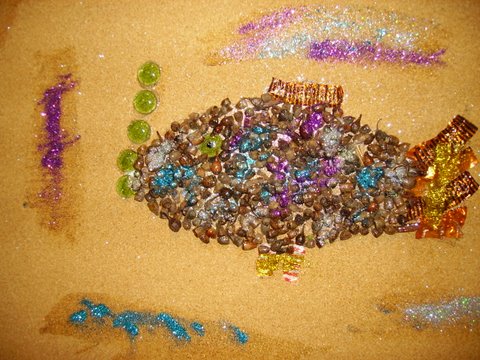
Other things we did were collecting a bucket full of gumnuts, putting them through a polisher and used the colourful little things to make a fish statue, he did a beautiful job.

What comes through to me is that if there is a reason or a reward that appeals, he ceases to find study to be so painful. It works well.

I have only two students with aspergers, but I have found them both to be very interested in making things that they can use, being very creative as they do, and if not interferred with will do a very good job.

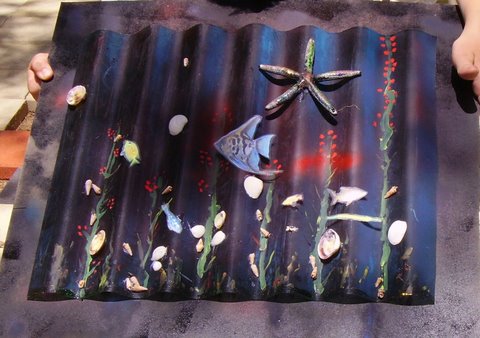
Motivating kids to learn - a truly creative method!

Motivating kids to learn - a truly creative method!

The important thing is to plan ahead so that when they get here, they know what to expect. If I slip up on that aspect of it they don’t seem to emit the same enthusiasm. They seem to feel let down and I get guilty.

Of course as everyone will know, thay are not too keen on instruction, so drawing and planning ahead eliminates the need for further instruction.

Well I hope you don’t mind my sticking my beak in here, but I am so enthusiastic about the results and at how pleased the mothers and fathers are, I just wanted to share this.

Thank you.

And, thank you, Lorraine, for sharing this wonderful story and your insights!

Do you know a ‘knol’?

Wikipedia, look out! 

Google has launched its ‘Knol’ – a site wchich is somewhat similar, though promises to be more ‘Google monitored’, as a rival repository for popular knowledge.   I cannot wait to read some of their write-ups.

Just a quick search showed that -as yet – there is no entry on the Canadian Human Rights Commissions!  Gee, I wonder who would be best qualified to write it up?

Somebody ought to give Mr. Levant a heads-up!

(via TheReferenceFrame)

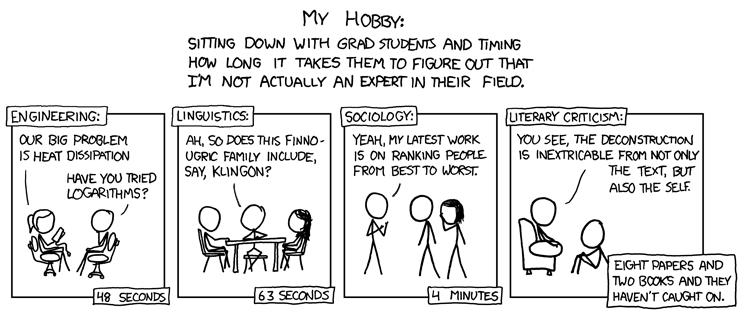
xkcd – ‘Impostor’

One of their funniest ones yet!

One of their funniest ones yet!

Yet another lesson… will it be learned?

All right, this clip is not from the boys down under, it is from Pen and Teller – the professional sceptics who put on the show ‘Bullshit’.

In their role as sceptics, they have gone on to challenge much – and not everyone is always pleased with them.  Here, they are teaching a lesson in how ‘environmental enthusiasm’ – a very real and honest desire to protect the Earth from harm by us, humans – can be so very easily abused by those who wish to use these honest, trusting and eager activists and subvert them and their voices for something completely different… 

In some ways, it kind of is like that ‘Trojan Horse’ idea!

Beware of Aussies Bearing … Horses?

OK, this is another one of history’s unlearned lessons.

It would really be quite sad, if it were not so funny – and vice versa…

The lesson of the ‘Trojan Horse’:

Aspergers and writing – sentences

Writing a sentence seems like a simple thing – just figure out who is doing what, and write it!  Right.  Except it is not that simple for an Aspie

This seems incomprehensible to many teachers, parents, and any ‘outside observers’.  How come an Aspie is fully capable of presenting a coherent, detailed explanation of something without any preparation, but when asked to write a sentence or two on that same topic, they are unable to produce one?  How come that when asked a question, an Aspie student can speak for 15 minutes, giving exhaustive, accurate answer, but will only put down a single word as a response to the same question on a written test?

It does not seem credible – to the teachers or parents – that this could be possible.  ‘Just write down what you said!’ tends to be the response/command/advice, but it just does not work like that.  I do not know how or why, but I have seen it and experienced it.  Needless to say, this only leads to very high levels of frustration among both sides…

Many professionals in this field are studying this, and doubtlessly, there are many excellent theories about why or how this occurs.  I do not attempt to address that here – I just hope to look at the mechanics of how this can be overcome… at least, a tiny little bit!

First, the way language is taught is terribly important.  It can mean the difference between practical illiteracy (at least, in the ‘output’ phase) on the one hand, and ‘functionality’ on the other.  How can this be so?

Aspies tend to like to follow rules.  Perhaps not everyone’s rules, perhaps they have a lot of difficulty decoding social rules, but – once a rule is understood and accepted, Aspies tend to derive comfort from adhering to them.  This is true for language.

It is unfortunate that the current ‘model’ for teaching English (as a first language) in much of North America is the ‘whole language’ approach:  this is the hairebrained idea that children will simply ‘absorb’ the rules of English when they are ‘exposed’ to them.  Perhaps this may work for a small minority of kids.  It certainly makes the teaching less laborious, because the teacher does not have to actually teach grammar, correct grammatical errors in written work (we are looking for substance, not grammar…).  And, much more often than I would have liked, I have come across teachers who are not even able to follow simple rules of grammar themselves!

This is a major problem for Aspies:  the rules are difficult to ‘absorb’ – especially when the teacher does not use proper grammar….  Constructing a proper sentence then becomes quite bewildering.  Yet, many Aspies can master written language quite well, so there must be something else going on here.

Perhaps there is a different part of the brain that controls verbal and written expression.  Or, perhaps many Aspies consider things that are ‘written’ to be ‘permanent’ – and therefore there is a much higher level of perfection that is required.  I have asked many adult Aspies who have tremendous difficulties writing things, and there seem to be striking similarities among most of them.

First, the idea.  That is the easy part.  In other words, the Aspie knows what he (the friends I questioned were all men) wants to write.  The problem comes in the how to write it:  they will put a word down, wonder if it is the most accurate one – and start ‘googling’ it. Wikipedia probably has some pretty good definitons of this – you should check it…. 

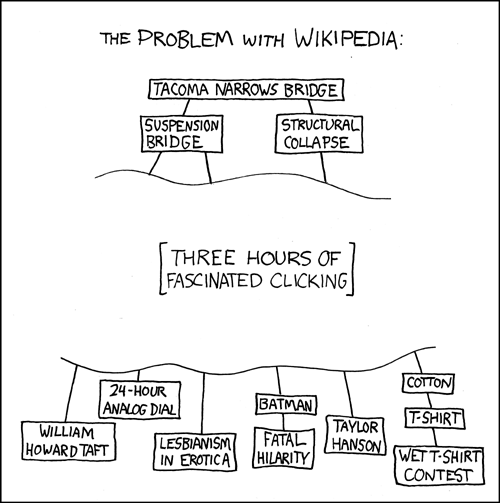
The problem with Wikipedia

OK, refocus.  Now you have the correct word.  So, how do you fit it into the sentence correctly?  Is that the right grammar?  Perhaps you should ‘google’ that….


OK, refocus.  You now have a noun and a verb, most likely in the proper grammatical structure.  But it is nowhere near sufficient to capture the meaning…  Perhaps it is time for lunch.

And so it goes.  Not very productive, but, eventually, some semblance of a sentence will be produced.

So, how can one help a child learn to overcome this?

My personal exerience gave me some insight.  I was lucky enough to be able to reproduce patterns – sound patterns and picture patterns.  This helped me get selected for a language school when I was 8 years old… and while I was struggling to write basic sentences in my native tonngue, miraculously, I did not experience the same problem in the new languages.

Perhaps advice from a teacher helped: 

‘Do not write what you want to say, write what you are able to say!’

With a limited vocabulary of less than 50 words, and only a rudimentary rules of how to construct a sentence according to the new language’s rules, the prospect of ‘writing a sentence’ became more managable!  With only a limited number of permutations possible, selecting the best possible combination of them which most effectively gets the point across became easy!

When my older son got to a point in his schooling where he was expected to construct more than just simple sentences, he started having a problem.  Trying to help him, I realized that he only had a very basic (and somewhat flawed) idea of how English grammar works….

Solution?

Basic textbook of Latin!

The reasons for selecting Latin were many:  from loan words down.  But the most important reason was that the Latin grammar was very explicitly spelled out – and that the endings of the words would change, depending on what role in the sentence that word played.  This is very key – it reinforces the rules of grammar, and helps figure out how to use them to construct a sentence.

My goal was not to teach my son Latin.  As a matter of fact, we spent no effort on memorizing vocabulary – we only focused on learning the rules for ‘flexing’ the words:  what does a particular ending mean – and what it tells us about the role this word plays in the sentence.  This skill was then easy to transpose into English sentence composition.

Yes – sentence composition.  Because that is how it has to be approached – this word is the subject.  This word describes the subject.  This word is the verb.  This word describes the verb….  and so on.

For younger kids, it might help to use tools:  on small, rectangular pieces of card paper, print a limited number of words related to the topic the child needs to write a sentence about.  Depending on the kid, start with 20-30.  Separate them according to their role in the sentence – it migh be very helpful to colour code them.  Nouns in one colour, verbs on another, pronouns, adverbs…so on.  Or, just separate them into piles. 

Then, when the child needs to write a sentence, let her/him pick out the right words and ‘build’ the sentence out of the ‘card words’.  Since only a very limited number of words are available, the child must be told the task is not to ‘answer the question’ – because that might seem impossible!  Explain to the child that the goal is to ‘build the best possible answer out of these words.  It will not be perfect – and it is not expected to be! Make it a game to try to create the best ‘best fit’ that could be done from this set of ‘card words’.

Once the sentence is created, the child can copy it – and use it as the answer. 

The word-pool can be altered, based on the topic. It can be increased or decreased, based on the child’s needs:  the more difficulties, the fewer words to pick from.  It is a tedious process, but it does work – or, at least, it worked in several instances when I have used it (not just with my own kids). 

My personal opinion is that it teaches several things: 

  • By limiting the pool of words, it makes ‘finding the right word’ easier – by making it OK to settle for the ‘best available word’.
  • By forcing the use of ‘different types’ (as signified by colours/piles of words, based on role played in the sentence) of words, the Aspie reinforces the proper use of grammar
  • This exercise builds one’s confidence in their ability to form sentences – which is much more important than most educators acknowledge.
  • Perhaps most importantly, it creates the habit to ‘write what you can, not what you want to’

It is not perfect, but this might help overcome the obsessive need to only write an ‘impossibly perfect’ sentence…

Learning to write is not easy for people with Asperger syndrome.  There are many obstacles in  their way:  from mechanical difficulties, to ‘holding onto their thought long enough to write it down’.  Add the desire for perfectioninsm in written expression…. 

Following the suggestions of professionals who know the child is the best way to help him or her learn to overcome the difficulties which are part and parcel of Aspergers.  Yet, if nothing seems to work, frustration levels are building, the child is unhappy… I know there were times when I would have tried just about anything!  And letting the child help sort the words just might take an edge off the frustration.

Aspergers, drawing and art

Many kids with Aspergers do not enjoy drawing and colouring.  This could be due to the fact that many have less ‘handedness differentiation’ – neither hand has better developed control, so drawing (and eventually writing) is more difficult.  But there could be more to it than that.

Just as there seems to be a difficulty in translating thoughts into a written form, some Aspies experience a similar difficulty in translating visual images into a drawing.

This is strictly my own observation, and I am not aware of a connection between these two aspects in any professional literature, but I cannot but wonder if this is a different expression of one underlying problem.  Let me describe it a little bit.

My dad has never been diagnosed with Aspergers – nor has he ever sought an opinion on the topic.  However, I do see some similarities between the way he, my sons and I processes information – at least, in some instances.  When we were trying to figure out this whole ‘Aspergers’ thing, he shared with me something that happened to him, when he was about 10 years old.

Standards and teaching methods in school were a little differen in his days, and teachers were more authoritarian.  During an art class, a substitute teacher said they were to draw a picture of a pig and hand it in at the end of the class.   A simple assignment – right?  Except that nobody had ever taught him how to go about drawing a picture of a pig… and my dad simply could not figure out how to even start.

He sat there, for the whole period, without making a single mark on his sheet of paper.  The teacher was not pleased.  As a matter of fact, he got very angry.  My dad was smart and had high marks, but he was not the most compliant of students.  The teacher would not believe him when my dad said he did not know how to do draw a pig, and concluded this was simply defiance…  and to report to him after school for detention.

The detention?  My dad was to sit at his desk until he drew the picture of a pig, then he was to bring it to the teacher’s office.  Once that was done, he could go home.  But try as he might, he simply could not resolve the image of a pig into its componenet parts, which he could then draw.  So, he sat at his desk, for several hours.  Finally, the janitor took pity on him. 

He, too, found it hard to believe a kid could not figure out how to draw a pig, but when he saw my dad just sitting there, for hours, he took a plain piece of paper and a pencil, drew a rectangle for a body, a triangle with a dot for the head and an eye, four sticks coming out of the bottom of the rectangle for legs and a curly spring on the back for tail.  “Here” he said.  “A pig!”

This was a revelation to my dad!  He easily reproduced the simplified ‘pig’ onto his sheet of paper, brought it to the teacher, and was allowed to go home.  

I have since met several people who do not naturally have an ability to break down a visual image into subsets, individual lines, which could then be put onto paper.  However, they can be shown how to go about it, and learn the process – just that to be effective, this process of learning needs to take place when they are older than when most kids learn to draw. 

Similarly, many Aspies do not have a natural ability to break a thought into constituent parts that can be written down – we start looking up words, checking spelling and grammar, wonder about better ways of saying it…. and end up producing very few actual words…  Yet, like with drawing, this process can also be learned – and it, too, will only be effectively learned at a later age than that of non-Aspie peers.

Could it be the same ‘prioritization’ or ‘orderig’ of ‘stuff’ that is causing both effects?

Another connection between them:  once Aspies ‘learn’ this process, they do not simply ‘learn’ it, they often ‘master’ it, and become better at it than most other people.  And yes, some do become successful writers or artists… Eccentric, yes, but successful.

Is this simply ‘overcompensation’?  Or is there something else at play here?