Animal-speak: squirrels

Believe it or not, I used to wear a hat like this!
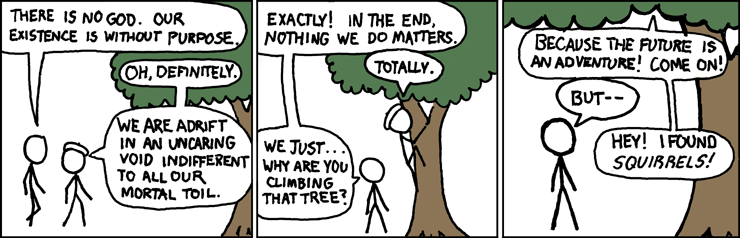
nihilism - xkcd

I also am a bit of a nihilist.  And I love squirrels!!!

Yet another character shamelessly based on me…

Ego-aggrandizing jokes aside, I do love watching squirrels.  They are an easy animal to see in the city, and I love nature way too much to spoil it by stomping through it. So, urban wildlife is it for me.

Perhaps because I am not naturally good at reading people’s facial expressions and body language (as is common with Aspies), I have learned the habit of really paying attentinon these – or, at least, trying to.  But, only used it with Humans and pets, not really giving other critters too much credit.

I was quite young when I realized how mutually incompatible the ‘natural’ body language of cats and dogs is.  Yet, cats and dogs who lived together (especially if they did so from an early age) are quite capable of learning each other’s language.  Well, if cats and dogs could learn another species’ language, I should certainly be able to ‘learn’ this elusive body language of humans!!!

As I have argued before, kids with Aspergers who are having trouble discovering the ‘key’ to human communication can often decode the somewhat ‘simpler’ (or, perhaps, less complex) body/expression language of animals.  …sort of like learning to crawl before one attempts the marathon of nuances in human ‘non-verbal communication’.

Back to my main point!  As the trees matured in our neighbourhood, we began to see more and more squirrels who came to our bird feeders.  One winter, we were especially touched by ‘The Twins’.  Late in the summer, they started coming with their mom.  We suspect they must have been born later in the season, because they were very tiny.  And, before the first snow came, we stopped seeing the mom…

Yet, ‘The Twins’ stuck together.  They were very, very affectionate to each other, touching and reassuring each other often.  The smaller, bolder one would climb up the birdfeeder and throw food to the other Twin!  (  The Twins stuck together until late next summer, always together.)  Well, that winter, I started putting out food specifically for the squirrels….

Several years have passed, and one of the twins has returned here with three separate litters of her own!!!  Two of these litters were after she had become blind in her right eye, too.  Now I call her ‘One-eyed Jackie’, and she is the matriarch of the ‘Bruno’ (they are much browner than most our visitors) clan of squirrels. 

Besides the ‘Brunos’, we have two other ‘clans’ that come here.  One is called ‘Fuzzy-wuzzies’, because they have incredibly fuzzy fur, especially on their ears.  These are closely related to the ‘Brunos’, and they often mix.  The third ‘clan’ that comes here are called the ‘Zekes’ – and do not get along with the other two clans at all.  Curiously enough, they get their name from the Blue Jays that come here….

Yes, last summer, we had a family of Blue Jays come regularly, too.  And one of the adults was not at all shy!  If I was late putting our their breakfast, or if I the food I put out was not her favourite (I am guessing here that it was the female – we are more discriminating…), she would sit on a branch directly in front of the door, and in a loud, incredibly annoying voice, screech ‘Zeeeeeeke!!!’ – over and over, until she woke me up and I put out the approved food.

Believe it or not, the matriarch of the ‘Zekes’ learned to immitate that call!!!

Many times did I come out, looking for the Blue Jays that were not there, only to see her sitting on ‘the branch’.  It was not until I heard her actually make that call that I realized that it was she who was making it!  Obviously, I had underestimated the squirrel’s linguistic skills.  She has since also learned to perfectly immitate the neighbour’s little dog’s bark.  I began to pay more attention.  (It would probably have been faster to just read up on it, but I had fun watching them.) 

Soon, I identified that the clicking sounds they made were not random.  If I immitated the ‘clicks’, starting at the back of the mouth and moving forward, the squirrels took it as a ‘all safe’ sign, and would come down from the tree.  Even if the dog was nearby.  (It’s ok, he does not hunt them – he is a watchdog, so he just likes to watch!  When a squirrel once fell out of the tree and landed right in front of his nose, he started crouch-jumping up like he does when he is trying to get another dog to play with him.)

a dog who likes to watch squirrels

If I reversed the order of clicks, increasing the volume, the squirrels would panick and run!  Even if there were no danger anywhere about!  Then, seeing all was safe, they would flick their tails a lot and come back down.

Over that summer, I learned about 5 different ‘sets’ of clicks, each of which would be understood by ‘my’ squirrels.  Now I had a question:  did I really learn something of ‘their’ language, or have they learned to simply interpret my behaviour?  This was something I had to test, and an opportunity soon presented itself.

My son and I went to an event in a park about 5 km away from our house – far enough, I hoped, that I would not encounter ‘my guys’.  We were sitting in our lawnchairs, listening to some music, when a squirrel started hopping from one tree to another.  I saw my chance!

I started with my ‘all safe’ set of clicks – it was the first one I learned and I was most comfortable with it.  Plus, it is rather quiet – there were people about… 

The squirrel stopped in its tracks, as if frozen, and just listened.  Encouraged, I repeated the clicks, and added a second set (I think this one means ‘food is present’).  The poor little squirrel perked up its ears, and started looking about.  Actually, it looked a bit paranoid.  I kept up the soft sets of clicks. 

Suddenly, and with great incredulity, the squirrel realized that I was the source of this jibberish!

Well, this became one confused squirrel.  It resumed its original journey to the tree, but now, very, very slowly – and never taking its eyes off of me.  It kept turning its head, side to side, as if to confirm that it really was that human that was chatting with it.  I suppose I must have had an atrocious accent – and I fervently hope I did not say anything bad about its mother!

I guess you can predict how this story ends….  The squirrel was on a direct path to the tree, but was too shocked at the stuff coming out of my mouth to pay attention to where it was going….  Yes.  The squirrel hit the tree!

Hopped straight into it!

This was the only time ever that I saw a squirrel run into a tree.  So, I shut up.  Anyhow, I had to go and help my son up – he laughed so hard, he tipped over his lawnchair!
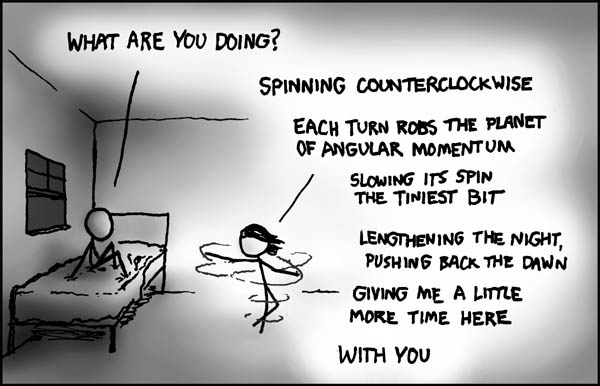
XKCD – Aspie Humour

Many people claim that Aspies do not have a sense of humour.  NOT TRUE!!!

We certainly do enjoy humour.  Some of us naturally find some things funny, others need to learn the rules of humour – but we certainly enjoy it.

In my never-humble opinion, teaching kids with Aspergers the rules of humour may be helpful with overall social skill development.  I have done this, and seen the improvement in their ability to interact with their peers and the resultant increased comfort level with themselves.

Here is how I might go about ‘explaining humour’:

There are several things that constitute ‘humour’ and different people will find different things funny – so there is no need to feel bad when you understand a joke, without thinking it is funny.  Some people think that anything to do with bodily functions is funny – and they will laugh when someone farts, or of they burp.  Other people think this is gross and not at all funny.  So, it is normal that not everyone finds every joke funny.

Many poeple laugh when they find themselves in situations which either do not go as expected, or when some danger is lifted.  This is done to release tension which people experience in such situations, and which is unpleasant.  It demonstrates to others that either the danger has passed, or that even though things are unexpected, the new course of actions is acceptable.

Perhaps that is why so many jokes are ‘funny’ because of an ‘unexpected’ or surprising ending.  It might even tie in with why ‘strange’ or ‘different’ or ‘unexpected’ is sometimes called ‘funny – but not as in ha-ha’.  Puns are an excellent example:  the correct (or correctly sounding) word is used, but in with an unexpected meaning.

It is not easy for Aspie kids that many cartoons rely on facial expressions to convey humour.  That is why I was so entertained when I came across this (not aimed at kids) comic, XKCD.  To me, it screams ‘Aspie Humour’!

And since along with a sense of humour, many people incorrectly describe Aspies as lacking feelings or empathy, I have selected, for your viewing pleasure, these few XKCD comics:

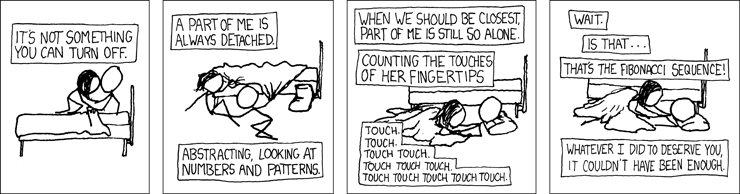
We like to spend time with our loved ones.

We love to spend time with our loved ones - XKCD


Passion reaches new levels for us!

Sharing thought - XKCD


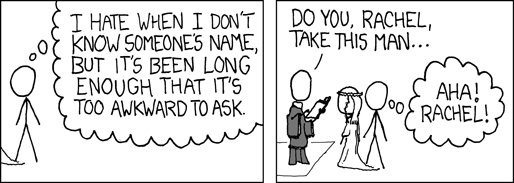
 Of course, we may have a hard time remembering names….  Nothing personal!

forgetting names - XKCD


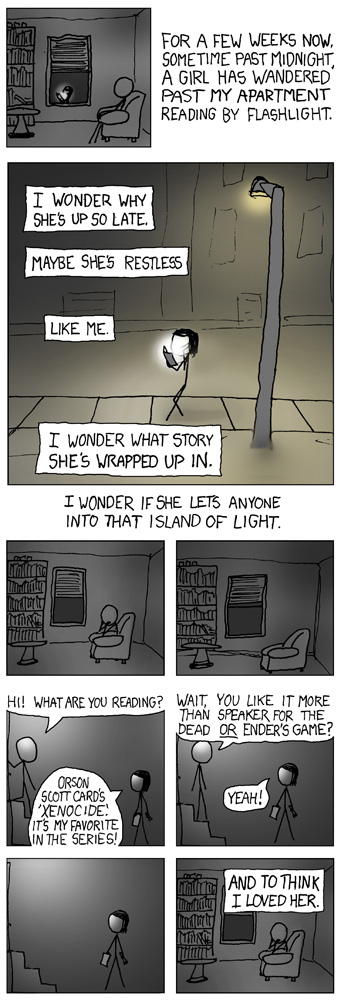
 Yet, we can be very particular in whom we select as potential mates:

xenocide - XKCD

Personally, I could not date someone who did not thing ‘Ender’s Shadow’ was the best book in this series.  Ok, if he were cute, I might settle for ‘Shadow of the Hegemon’.  But ‘Xenocide’??? Really!

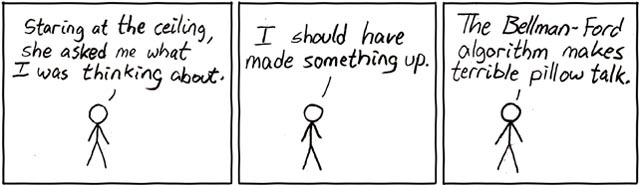
And ‘pillow talk’ is much easier if both of you are Aspies….

pillow talk - XKCD


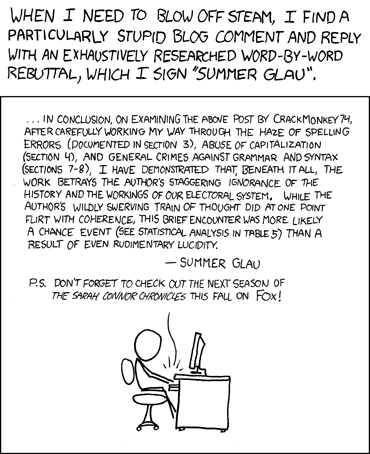
And many of us fully appreciate the advantages of online interactions with others (my husband claims this ‘has to be’ taken from one of my online comments….):

venting - XKCD


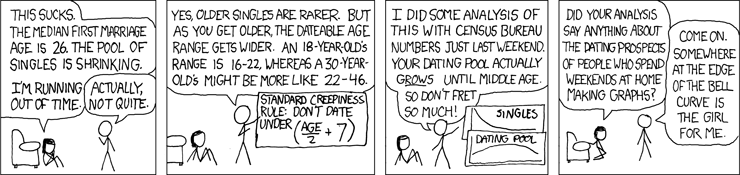
Here is a good example of how not everyone ‘gets’ every joke.  For example, in the following one, I do not understand why the characters are implying this practice is unusual.  Surely, it is the norm!  (See my posts on Old Men in the Bible)

graphs - XKCD


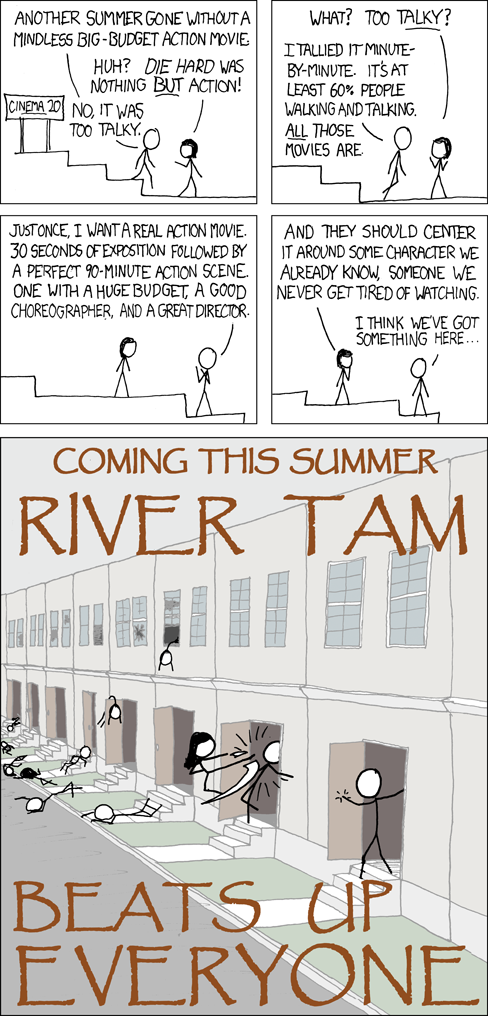
But we all enjoy good quality entertainment!  (And no, this is NOT just a cheap ploy to get ‘Papyrus font’ onto my blog!  Though, who could resist the allures or ‘Papyrus Font’???  It’s even better intelic…)

 River Tam - XKCD

 EVERYONE loves River Tam!!!

add to del.icio.usDigg itStumble It!Add to Blinkslistadd to furladd to ma.gnoliaadd to simpyseed the vineTailRank

Aspergers and accurate words

School!  It can be a testing place at the best of times!

For people who need to use ‘precise’ and ‘accurate’ words to describe things as those of us with Aspergers do, it can be baffling.  After all, one becomes used to the vocabulary and expectations at home – but at school, the rules are different.  And people just do not communicate clearly.  In the words of the immortal Inigo Montoya, “I don’t think that word means what you think it means.”

Let me give you an example.

Schools are filled with many kind and caring people who truly have the best intentions towards our kids.  They are dedicated.  At times, they will even enter ‘uncomfortable’ situations, if they think the ultimate result will help one of ‘their’ kids.  I admire that.

One year, at the beginning of winter – just as it was time to start wearing hats and mits etc. – I got a phone call from one of my kids’ teachers.  Even though I am pretty thick at picking up on such clues, I could tell she was very uncomfortable.  She spoke in a little soft voice and picked her words very carefully.

The school, as it turns out, gets some free ‘stuff’ from the milk people, through the milk program.  Yes.  And it there are some families, which – at some times, and through no fault of their own – needed a little help, they could give these things as ‘prizes’ to their kids.  Since it is a ‘prize’, there is no stigma…

I was really beginning to wonder what this was about.  We were not in any financial difficulties – at least, I thought I would notice if we were.  So I made a non-commital sound, to show I was listening…

The teacher, kindly and gently, continued.  The promotional items they had included hats.  Since the weather was getting kind of cool, it was important that kids should wear hats.  And, today, during recess, my son had told her that he does not own a hat, and that he does not think we’re planning to buy him one.  So, if it would not cause offense, they could give him a hat from the milk programme…

Whatever reaction she was expecting, laughter was not it.  But, I just could not help myself!  I burst our laughing.  You see, my son was absolutely correct!!!  Yet, I owed the teacher an explanation…

The previous weekend, we had indeed gone shopping for a new winter hat.  My son became intrigued by these ‘hat and neckwarmer in one’ contraptions.  It looked just like a winter hat that was attached to the ‘neck’ part of a turtleneck.  It had a nice round opening for the whole face, but covered more skin than a ‘hat’ would.  That is what he chose to get instead of a regular hat.

And what did he wear the previous winter (to be used as a spare)?  A tuque!  If many people think that ‘tuque’ and ‘hat’ are the same, they should be corrected:  if they were the same, they would not have different names!!!

So, with puppy-dog eyes, solemnly and truthfully, my son told his teacher that he does not onw a hat!  And when she asked if we were just slow at getting ready for the winter, he truthfully said that we were not planning to get him one…instead of simply saying he forgot his new headwarmer.

The teacher was amused and greatly relieved! I suspect the story was used as a source of amusement at the teacher’s lounge. 

But this is a very real example of how people with Aspergers do not understand what they are being asked, unless the accurate word is used.  The terms used must be specific, precise and accurate, because Aspies do not ‘make leaps of faith’ or read things into stuff.  If we don’t know, we don’t know – we are not likely to jump to unsupportable conclusions.  The teacher would likely have received a different answer had she asked him if he owned something to wear on his head to keep it warm.

Another example of ‘crossed communications’ occurred when my other son was very, very young – certainly under 2 years old.  He absolutely loved watching ‘Bill Nye the Science Guy’, and absorbed much of his early vocabulary from that show.

One time, my mom was over, and was in the livingroom with my son.  When I came into the room, she was frustrated:  “I told him to stop picking his nose, but he just stares back at me as if I just fell off the moon!  What is wrong with him?!?!?”

I told her he just did not understand what she meant.  He already had a nose, so how could he pick another one?

Turnning to him, I said:  “Stop touching your mucuous membranes.”

He took his finger out of his nose, looked at me and said:  “Ah, spread germs!”  And went to wash his hands…

These may be funny incidents, but they do illustrate the difficulties Aspies have trying to understand people who use language sloppily.  Just imagine how impenetrable the meaning of many test questions is to them!!!  No wonder they often score very poorly on school tests – many questions do not really ask what they think they ask…

(This is ALWAYS the hardest part of writing a post:  how to end it!  I could go on talking about this endlessly…)

Aspies can, and do, learn to search the speech patterns of others for ‘similar concepts’ – this way, many Aspies learn to ‘decipher’ common speech.  And when we do, we are often so delighted, we drive others mad by playing with it!  Yet, this is not an easy skill to acquire, and it would not be realistic to expect young kids to ‘pick it up’.  This will lead to frustration – not just of the child, but also of educators, parents and others who interact with Aspie kids.

And, Aspie kids usually experience very high levels of frustration, even if they do not communicate this (or display the ‘typical’ signs of frustration, until it builds up into uncontrollable anger).  Making all these people aware of the need for accurate, precise and non-ambiguous use of language (and what that actually is – in the mind of an Aspie) would go a long way towards making life easier for everyone involved. 

If we could only teach the rest of the world to communicate accurately!

Aspergers and writing

Writing is one of the major woes for people with Aspergers

It is difficult to describe the depth of despair most Aspies suffer when trying to put pen to paper.  And it starts very, very early on.  There appear (to me) to be at least three different ‘subsystems’ in the brain that are conspiring to make writing next to impossible for young Aspies.

The first one to be encountered is the ‘mechanics of writing’.  Many Aspies have less ‘sidedness‘ differentiation, so their ‘writing hand’ is less ‘dominant’ – and thus has less fine motor control – than most peoples.  This is often encountered early on in childhood – as a result, the kids may not enjoy drawing, or they may draw with both hands.  Regardless of drawing, however, Aspie kids usually display severe difficulties when learning the mechanics of writing.  This is more pronounced in cursive writing, where forming letters needs to be combined with smoothly moving the hand along the page, so many Aspies end up printing instead.  

I suspect this is a motor issue, and could be overcome by ‘overdoing’ the practice.  This has, to a degree, been my case:  where I went to school, we started out learning cursive, and we were marked on our handwriting.  I totally sucked at it, for the longest time.  Then, I saw what handwritings the teachers marked as the best, and shamelessly immitated them.  And yes, I spent endless hours practicing, because I was going to be *%$#*^# if those air-headed girls with ‘pretty’ handwriting got better marks than I did.  The result?  I am told I have extremely beautiful, though almost completely illegible, handwrititng!

Another problem which Aspies encounter when writing is – and this is based on my observations, not an expert assertion – a problem with short term memory.  At least six different kids with Aspergers have described it as ‘the ideas going by so fast, by the time I’m done the first letter, I don’t know what word I am writing’.  Now, this is very interesting, but worthy of a post of its own (soon, I hope).

The third major problem I have observed is a little more complicated.  I do not know how frequent it is, but again, I have observed it in very many Aspie kids.  It has to do with language, its use and the very words that make it up.  Also, many Aspies perceive there to be a big difference between what is spoken and written.   Perhaps a little explanation is needed…

Asperger Syndrome is often described as ‘verbally expressive form of Autism‘.  Now,  it is important to make a distiction here:  just because Aspergers falls under the same spectrum of disorders as Autism does, or that the spectrum itself may have the word ‘Autism’ in it, does not mean that it is nearly as crippling as Autism can be.  Comparing Aspergers to Autism (as the Ontario Government recently did, in order to deny Autistic children proper treatment) is about as accurate as comparing a sinus infection to pneumonia – both are respiratory system infections, but they are not the same in severety or affect.  It would be an inappropriate comparison.

While Aspies are usually able to speak extensively on a topic, most have a difficult time writing on a topic.  This is very curious and puzzling to many parents and educators:  it can appear as defiance! So, what is it that makes it OK to say things, but not to write them down?  Perhaps an unusual form of perfectionism could be at play here.

It is my observation that Aspeis, especially children, consider anything that is written down to be much, much more serious, important and permanent than what is spoken.  Even when practicing forming letters, some of these kids will be extremely anxious about not being able to get the shape just perfect.  Not Aspies are this extreme, but I certainly was, and so was one of my sons.  He was so terrified to commit an imperfect letter onto paper, we ended up getting him to practice writing onto clear plastic sheets (of the type you can put through the printer, to use for overhead presentations) with easy-wipe-off markers.  And even thought he could wipe off any letter he did not like, before anyone else could see it (and at first, he wiped off all of them), it was still hard for him.

It is my suspicion that in a similar way, it is difficult for Aspies to write ideas down because they are not sure if their idea is good enough to be commited to paper.  And even if they get over that, and judge the idea worthy – and this is the key here – it is next to impossible to express their idea accurately, using everyday language.

I have often wondered – and would appreciate feedback from those who have observed this – if something similar could be at play with Autism…  Many (not tall) autistic children are said to begin learning language relatively normally, but then at some point, they revert and begin to use language less and less.  Could it be possible that as they learned language, words attained ‘colouring’ – secondary, or implied meanings – unrelated to their ‘object or action definition’…. and that these words became perceived as no longer accuratley describing its original meaning, and therefore discarded?  I don’t know, but I would be curious what others think about this.

It is often asserted that Aspies use language somewhat rigidly, or sound very pedantic.  Could it be that a similar perfectionism in expressing an idea, a similar subconscious frustration with the inaccuracy of language, is at play when Aspies try to put ideas onto paper?

I love debating, and do it online.  And, people have noted, that whenever I get into a serious debate, I spend most of my time defining the specific and narrow meanings of every word I intend to use (plus a few others, that I exressly will not use).  Many people find it redundant, annoying and boring.  Some think it is a ploy to manipulate the debate.  But I do not intend it as any of these:  before I can express what I mean, I need to ensure that there is no ambiguity in the language I use to express my point.  General language simply cannot do the job!

There is no simple answer to overcoming this.  

Each Aspie may require a completely different approach, what works for one may not work for another.  It will take years.  And it will always take much more time and effort for an Aspie to write something than it would take most people.  (It usually takes me 2-6 hours to write any single post – and some, I have spent 14+ hours composing.)

Yet, Aspies can learn to write.  And when they do, the documents they produce are usually very well researched and accurately expressed!

If you can’t laugh at yourself, someone will make a sitcom…

On Monday, I posted ‘Pitfalls’ – a glimpse into the process that an ‘Aspie’ uses to write something up.  Yes, it has a lot to do with my recent posts on Aspergers – I think I have it ready, then read something else and have to hit the re-start button… 

I’m afraid I modeled it on my experience…only.  And while that may be a typical ‘Aspie’ thing to do, it is (I am told) more applicable to female Aspies…who are in minority.  Aside:  As ‘ADifferentVoice’ aticulated, I also wish there were a better terms for ‘a person with Asperger Syndrome’ and ‘Neurotypical’ (NT)- if you know of one, or would like to suggest one, please, let me know.

In the interests of accuracy and entertainment, I have re-thought the post…and come up with a conclusion more indicative of the ‘Aspie-typical’ person.  (How’s that for a convoluted term???  It makes me proud!)  ;0)

Most of the post would remain unchanged:  the bits where excessive research is done, 2-3 major studies are read and their raw data reassessed, several books, a stack of periodicals, and numerous online sources, cross-referenced and indexed (physically or mentally), you start thinking about the actual write up.  Except that somebody mentions something related, so now you have to research that, or risk inacuracy!  So, more research is required…and then you go for 3 days without posting!!!

Now, here is where the difference comes in.  When I start to ‘write’ the actual post/write-up/article/assignment, my most difficult task is cutting the 80-odd pages down to a managable bite.  So much stuff to be stuffed in!  And it has to be phrased carefully, so as not to mislead or misrepresent – not intentionally, anyway!

 Well, I do need to correct the misconception that all Aspies are like that.  The vast majority would be much more efficient at analyzing the salient and essential points, and expressing them in a highly efficient manner.  The long, painful hours I would spend ‘cutting down’ my notes, they spend in expanding their resultant 3 sentences into a full paragraph.

No kidding.

But then again, if you can’t laugh at yourself, somebody will make a sitcom … and the world will laugh at you!  My family insists that when I forget to keep a tight control over my ‘inner voice’, it reveals itself to be a bit of a ‘Sheldon’… or perhaps a little bit of ‘Leslie’….hope you enjoy the clips below! 


Aspergers and ‘hearing dyslexia’

This is another one of my very personal looks at living with Aspergers – both as an Aspie, and as a parent of Aspie kids.  While doctors and psychologists can tell us a lot about Asperger Syndrome, it seems to affect different people differently – even siblings can have incredibly different ways in which they are affected.  Not only does each person’s underlying personality determine the best (and worst) ways of handling it, there are often many physiological conditions which occur along with it and affect the skill-set available to be drawn upon.

One of the conditions that often occurs along with Aspergers and/or ADD is dyslexia – I know that when I was learning to read and write, I had a lot of trouble with it (and, to a very small degree, I still do).  What surprised me, however, was that just like people with dyslexia see letters either reversed, or in the wrong order, some people hear sounds ‘jumbled up’ in much the same way!  The technical term for this is Auditory Processing Disorder (APD), but I find it easier to think of it as ‘sound dyslexia’ or ‘hearing dyslexia’.  Apparently, this condition is not easy to test for, and many doctors do not even think of testing for it….yet it can have very major impact on the development of a child learning language for the very first time – whether neurotypical or Aspergers or Autistic.

Just like people with dyslexia can see letters reversed, or in the wrong order, people with APD can hear sound within words ‘reversed’, or lasting the wrong length of time so several sounds become superimposed over top of each other and very, very difficult to ‘separate out’ and understand….especially when one is just learning that different sequences of sounds can actually carry different meanings. 

Please, imagine that you have this – not correctible by a hearing aid, because the problem is not mechanical, but by the way sound is processed in the brain.  Because you cannot effectively (or reliably – the problem is notoriously intermittent) differentiate between words or phrases, it is very difficult to ‘catalogue’ or ‘make sense of’ sounds and their associated meanings.  Now add to it the Aspies’ inability to comprehend facial expressions, tone of voice or body language.  Frankly, I do not know how these young children can make any sense of the world about them at all!

How to overcome this?

One has to work within the child’s interests and strengths.  It is my hope that sharing what worked for our younger son may help you develop strategies which may work for yours.

When our younger son had problems learning to speak, it did not look to us like a problem.  Instead, it looked as a willful behaviour:  we were told he was refusing to use language in order to manipulate us, the parents.  It was a call for attention, we were told. 

But, that just did not ring true to me.  While we would read him every evening, and while he had our full focus and attention, he would still be unable to follow even the sipmlest stories.  He loved counting picture books with a number and that ‘count’ of objects.  That he could follow, and would lift the correct number of fingers – even try to say the numbers.  Sometimes, he even liked ‘word’ books – ones that showed a picture of an object and had the word for it written beneath the object.

But the moment we tried to read him even very simple stories, we lost him.  He would fidget, climb, jump, and generally do anything to demonstrate his complete lack of interest.  Thinking he wanted more of the attention focused on him (as we were told this was attention-getting behaviour), I would start telling him stories.  This way, there was no book and he was my sole focus.  Same reaction.

Eventually, he got interested – but on a very different level.  Accepting the ‘book routine’, he started picking out letters, one at a time.  The joy on his face as he would yell over top of my voice (as I was reading):  “A!!!  A!!!  A!!!”  I would confirm that yes, that was indeed ‘A’, and tell him how clever he was to have recognized it.

He’s settle down and look interested.  But he was not interested in the story.  No, because I would barely read another paragraph when he woud get excited again:  “D!!! D!!! D!!!”  Again, I would praise him, and try to resume reading.  But, it was not a ‘relaxing time’ that would get one ready for bedtime…

Eventually, I gave up reading him stories and broke out the ‘Alphabet books’.  I had thought he was too young for them, but if he loved reading the letters, I whas happy to oblige him.  For the first time, he was making ‘human’ sounds, one letter at a time!  And at this point, I saw that as a reason to celebrate.

We also added ‘bathtime’ to the fun.  He loved his letters, so I got soap crayons and we had great fun using the white ceramic tiles on the wall by the tub as our canvas!  I would let him pick a letter and then write every three-letter word which started with that letter.  As I would write them, I would read the letter, then the word!  And, surely enough, my son would read each letter with me.  B-A-T.  BA-. BAT.

Miracle of miracles:  he learned to speak!

Of course, he would NOT EVER repeat a word until he had learned what letters it was made up of, how it broke down to syllables, and how it fit together.  I suppose he was the only toddler I had ever encountered who had learned to READ before he learned to SPEAK!!!

Now, he has a little lisp when he speaks, but he has an above-average vocabulary.  

Another factor, which was happening at this time, and which I think was incredibly beneficial to our son as he tried to decode the mystery of communications, was his interaction with our dog.  Good natured and well trained, he was also very intelligent – and showed incredible patience with both the boys.  And while any pet will be beneficial, a well trained dog in the home can be very valuable in a situation like this. 

Why? 

Because the communication lines are so very clear.  Our dog was trained to obey a limited number very distinct-sounding commands, accompanied by hand signals.  In addition, the dog’s response to these commands was consistent and predictable.  His overall body language was also a much ‘simpler’ communication than the ‘human’ type.  To a young person who is having trouble understanding the underlying rules of communication, this can just be the key to unlock the mystery. 

We did not ‘get’ what was happening, and thought he was just ‘playing pretend’ when our son began to immitate the dog’s actions when we would give the dog a command.  And since the dog loved to ‘practice’ his commands for treats every day, I switched the ‘treat’ from a dog bicuit to an animal cracker….and let them both practice together. 

It may seem silly to people who are not ‘dog lovers’, but many kids love pretending to be ‘the dog’.  It is partly a game, and partly to see what reaction this would get.  And since I thought it was fun, and I was happy that he was interacting, I was delighted.  I would say ‘Sit!’ – and both boy and dog would sit!  I would give them a cracker each, they would happily eat them up, and look to me for the next command!  And he was happy – he finally understood some ‘stuff’!

Perhaps not every child would respond in this way, but then again, my guy is one of a kind!  Yet, I do hope that his story might help people understand that kids who ‘seem’ to be ‘manipulative’ or ‘acting out’ might not be doing that at all.  They may simply not understand what is going or around them, and be trying ‘weird’ ways to make sense of them.  And they may also be very frustrated….

But if you can find the key that will unlock the mystery, they will learn!  And they will be much, much happier – it is rewarding for everyone!  Even the dog…     ;o)

Pitfalls

The following is a painfully accurate description of one painful ‘creative’ process  people with Aspergers Syndrome undergo when ‘writing stuff up’:

You have found the perect topic – or perhaps it has been assigned to you.  Either way, you spend weeks figuring out the best angle from which to approach it, because that will determine what you need to read up on and how you organize your thought.  You read anything and everythig related to it, until you find just the most perfect way to present the main idea.

The brain engages, and does not let go!  Not for a little bit.  You even dream about it – if you can sleep at all!  You find yourself reading tons of stuff you realize you should have read long ago, because it added important data that needs to be included in the analysis of whatever it is you are thinking about – and you had already started thingking about it!

OK, re-organize the data in your brain and push the re-start button on the analysis process!  Oh, and all that stuff you wrote up yesterday – well, might as well re-read it before tossing it out….but wait!  This bit – let me ‘Google’ it, it needs to be expanded on so the reader does not become confused!  Oh, you’d better read that, too!

Then you realize that five or six years ago, you read a book or an article on an unrelated topic, but which could be used as an effective parallel – so you spend several hours hunting it down.  Better to also read a few of the underlying studies – to get a feel for the raw data, and thus better understand the reasoning underlying the analysis.  Right.  More data to add, re-start the analysis thinking bit again.

You think you have it:  and tell a friend about it.  It helps to bounce ideas back and forth – not just for the plausibility of your conclusions, but – and perhaps most importantly – to see if there are whole huge chunks of ‘stuff’ you did not explain, because it seemed ‘obvious’ or ‘common knowledge’ to you – yet which do not appear so to people who have not obsessively immersed in this topic for several weeks/months/years.  It is surprising to you how all these people could live happily without intimate knowledge of ‘whatever the topic topic happens to be’!

Your friend has no idea what you’re talking about – so you make a mental note to read up on ‘lay terms’ used to express ‘your stuff’.  More reading, learning how to dumb-down perfectly clear and precise phrases into common words which have layers of meanings, and so can never accurately describe anything exactly and unequivocally.  You’ll just have to compensate by expanding the section where you explain in detail how the words are used in your article.  It’s not a perfect solution, but it’s the best that can be hoped for.  Better add a paragraph or two to each sub-section, with more detailed explanations, or the whole point will have been lost.

Right.  Your deadline was a week ago – so even though you know you have a lot more to read up on to make an truly accurate analysis, you’d better get stuff down on paper.  Better include a paragraph or two to explain what you did not get to read up on, so people know and can compensate for it.  Sloppy…  But better than being misleading!

So, you write it up.  It is there, it took days of writing.  It is still terrible, even though you re-wrote each sentence four or five times, re-edited each paragraph to accomodate each sentence re-write, then adjusted the whole document to the changes in the paragraph. But, the basic ideas are there.  Good!

Almost ready.  Now, you just need to edit it down to under 2 pages….which is going to be a little hard.  You now have 78 of them, and that is in very small font in an effort to shrink it.  That will NEVER work!

Perhaps, you decide, you will pick a different topic…

Aspergers, schooling and frustration

Many people with Aspergers have been treated as ‘stupid’, or – and this is the ‘teachers’ favourite’ – “Your child is co clever, if only he/she would apply himself/herself, he/she could do so much better!”  As if the world were not frustrating enough without such patronizing haughtiness!   

There are very many ‘things’ going on – and many will display themselves as various ‘learning disabilities’:  dyslexia and/or its auditory equivalent, sequencing difficulties, social rejection + + + … and an ever growing frustration.  And yes, this frustration can be crippling – it can ‘freeze’ the mind which is capable of complex reasoning, yet treated as an idiot because one can’t seem to express it!  

In North America, school tests are all written – a ‘double jeopardy’ for Aspies.  First, understanding the scope of the question is a challenge in itself.  Is the answer supposed to be one word, one sentence – or a paragraph?  During written test or exams, one is not supposed to speak – and so cannot ask and find out how big the answer is supposed to be.  Then, it is incredibly difficult for Aspies to write their thoughts down in a consistent, comprehensive manner.  The mechanics of writing itself are hard enough, formulating answers and then remembering them long enough to write them down is something that will take most Aspies years to master.  This difficulty in written expression is kind of the ‘hallmark’ of Aspergers!

I know of a child who was slipping into a deep depression and getting bad marks in school.  After a series of tests, it was shown that he was able to express himself so badly (on tests), he scored in the lowest 25% in general cognitive tests for his age-group.  (That means that 75% children his age were able to write a better answer.)  Yet, in oral testing (and with guidance – letting him ask questions so he assured himself he understood the question and how detailed the answer was supposed to be – and with no time limit), he was found to score higher than 95% of his peers!  He was able to solve math problems from grade 8 exams, yet he was almost failing grade 2!

Can you imagine the amount of frustration this lead to?  That disparity between one’s actual ability, and one’s capability to demonstrate that ability to others can lead to very, very destructive self-image.  Frustration, shame, self-loathing….not really something that will help make things better.  And because it is more pronounced when they are young and have not learned to compensate, early on into their schooling, many Aspies figure out that even trying is pointless.

The key question, of course, is:  so how to fix it? 

The simple sounding answer is:  by exercising the brain.  The latest research on neuroplasticity suggests this can be done, with great results.  In the next few posts, I will try to describe the exercises that I have seen work – though not all people respond to the same way to all the exercises.  I guess that even despite being Aspies, we are all individuals!

And speaking of being individuals:  I just came across a neat article.  Perhaps forms of self-expression like these futuristic tattoos just might help people with Aspergers read the emotions of others!  Perhaps a little silly, but worth the read!

Aspergers and ADD

As promised, this the second one of my very personal perspectives on living with Asperger Syndrome.  If you have missed my introduction, you can find it here.

Not being professionally trained in these fields, I can only offer the most basic observations.  Many people diagnosed with ‘Asperger Syndrome’ are also diagnosed with one or more of other ‘problems’, such as ‘Attention Deficit Syndrome’ (ADD).  I wanted to link the ‘ADD’ bit to some good site that defines it, but, well, I could not find one that reflects reality.  My reality, anyway!

Contrary to popular belief (and the focus of most ‘ADD’ articles and treatments), this does not denote the inability to pay attention.  Rather, it denotes difficulties in contolling one’s ‘concentration’.  It’s like the ‘focus switch’ is very, very deep:  it takes a lot for something to trigger it, but when it does – it is just as hard for it to get un-triggered.  This is a much more complex thing than just being unable to settle down or to control one’s impulses. 

Rather, these are possible symptoms, not the causes of the problem.  Yet, it seems that no professional seems to want to see , discuss, treat or, indeed, acknowledge anything other than the symptoms…which is why they usually are not much help at all.

This is my personal suspicion of a small part of the causes:  it has a lot to do with ‘filtering’ the stimulae we are constantly bombarded with.  It’s like the ‘light’ and ‘medium’ filters are completely missing.  So, the only options the brain has is to use the ‘extra-strenght-don’t-let-anything-through’ filters, or no filters at all…

For example, I have a problem with my hair:  if it is cut short (or if I have bangs), the areas of my skin which are touched by the ends of the individuals hairs are constantly being stimulated.  I cannot, no matter how hard I try, control this continuous input.  It is constantly rubbing and I cannot block it.  The continuous stimulation to the skin results in a physiological response – exczema.  Mine is not a reaction to any hair product – this was tested for. 

It is a response to the constant, minor yet unceassing stimulation due to the hair-ends rubbing against my skin and it is something that fails to be filtered by the brain.  My only solution is to have hair long enough to pin up or tie back, so it does not touch my skin….then I have to rearrange it often so the ‘position’ of the hair does not become painful.  To other people, it looks like I am always fidgeting with my hair – like a nervous habit or a mannerism.  Yet, I am only relieving built up pain.

Compare this to a ‘normal’ (or, as many ‘Aspergers pride’ people refer somewhat condescendingly to the rest of the population, the ‘neurotypicals’, or NTs) response:  after being exposed to a repetitive stimulus for several minutes (less for some individuals), their brain automatically compensates.  An example is ‘getting used to’ the cool temperature of the lake, or the hot water in a bath.  The skin sends initial signals informing the brain of the new stimulus, but after a while, the intensity is decreased. 

For many people who have ADD (and most ‘Aspies’ do have some form of it), this ‘filtering’ does not always happen.  You are always aware of the clothing that is touching you.  You are always aware of even the minutest breeze rubbing your skin (I, for one, I experience even a tiny draft in a room as intense pain on my skin – I could never understand how people could stand in front of a fan, or go outside in the wind).

For me, it’s my skin (well, that’s one of my ‘things’).  Other people can have other things that they have trouble filtering out.  Bright light can make them feel blinded or anxious, or the light contrast between the digital display of a clock in a dark room can trigger such anxiety as to prevent one from being able to fall asleep.  Falling asleep in front of a TV would be unimaginable for these people.

On the other hand, I know several people who can only sleep with the TV on:  the constant yet irregular changes in light and sound levels help block the regular cyclicity of the white noise of the heating system, air conditioner, and so on which seem to feed into the subconscious and cause bad reactions.  If the TV is turned off after they fall asleep, the cyclicity of the white noise will be enough to trigger some feenback loop, which keeps buildig up until they get an axiety attack while they are sleeping!  Not a pleasant way to wake up…

And don’t even let me get started on the rustling of leaves, crickets chirping or wind chimes!

On the other hand, when my brain focuses on something – and I mean, really focuses on something – external stimula have about zero chance of breaking through.  People can talk to me – and claim I made responses – yet I am not aware of it…not even a little bit!  Little things, like fire alarms, can go completely unnoticed.  And I am not alone! 

When my younger son was only a few months old, we became worried because there were times – but only some times – when we could make a very loud noise, directly behind him – and I mean LOUD – yet it would produce absolutely no response in him whatsoever!  Not even the tiniest twitch!  His brain was being used in processing something else – so it paid no attention to the audial input.  The physical reaction was the same as if he had never registered the stimulus at all!  I must admit, I am also guilty of this – as are both my husband, and my father….

But, here comes the interesting bit:  and yes, my father, my son and my husband all display this:  sometimes, you speak to them, they hear what is said and their brain stores it in some sort of a ‘buffer’ – but it never gets to the bit of brain that actually processes it.  They are completely unaware of whatever it was that was said, and appear oblivious to having been spoken to.  But, if you ask them to go back, they can ‘replay’ the message from the ‘buffer’ in their brain and ‘listen’ to it.  ‘Oh, yes’, they say, ‘I get what you want now!’

Hopefully, this will help give people a little bit of understanding of what is happening in those of us with ADD.

Aspergers

Since mentioning in past posts that I had Asperger Syndrome, I have received many private messages on this topic….and requests to explain how it affects me – and what strategies I employed to develop coping skills.  So, every now and then, I will write a bit about my experiences in this area.

 However, before I start, some qualifications are in order…

I am not a physician, and the closest I ever came to being a therapist was an after-school job in a gift shop down the hall from the hotel bar with a pianist so loud, the bartender could not hear ‘life stories’ over the music – so I had to fill in!  Whatever I post about Aspergers are my personal experiences, observations and ideas – and are not to be mistaken for an expert opinion or the prevailing medical opinion -or, in fact, any respected opinion on this topic whatsoever.  These are just my musings!

Yet, I hope that it might offer an insight into how at least one ‘Aspergers’ brain processes the surrounding world, and help to relieve the frustration that people often experience when dealing with an ‘Aspergers’ child or colleague.  And it CAN be challenging!!!

Perhaps I am completely off on this, but it seems to me that what we call ‘Asperger Syndrome’ is actually several very different conditions.  They may present similarly, but have underlying causes…and if you read my rants, you know how I abhor it when people confuse symptoms with causes!  I can only address my particular variety.  ;0)

Aspergers has been described in many ways, given many nicknames:  the absentminded professor syndrome, the Silicone Valley syndrome, the uber-geek/nerd syndrome…there are more labels.  When I was in high school, I watched the original Star Trek series in order to figure out why some of my classmates kept addressing me as Ms. Spock…  Yet lately (and perhaps due to the success of people like Bill Gates – I don’t know if he has Aspergers, but he does have the appearance of a ‘nerd’, just as many ‘Aspies’ do), there has been a literary (well, as close as TV comes) explosion of characters who undeniably portray different manifestations of the Asperger syndrome – outside of the ‘Trekkies’.

This list is not meant to be exhaustive, rather, it is meant to demonstrate the very different ways (and severity – it is much more like a continuum than an on/off thingy) that Aspergers people behave  (or, at least, ones that we, Aspies, consider to be ‘our ways’):

Dr. Gregory House

Mr. Monk

Just about everyone (excepting Penny) on ‘The Big Bang Theory’

Dr. Spence Reid from ‘Criminal Minds’

Chuck Bartowski

 …and that does not even account for Mr. Bean!

So, if this topic is of interest to you, drop in every now and then – more on Aspergers is going to trickle in!