Aspergers and writing – holding on to that thought!

Different people are affected by Asperger Syndrome differently, and to varying degrees – it is more of a ‘continuum’ than an ‘on/off switch’.  I am by no means an expert – but I have some experience in living with it, and raising kids who are also Aspies.  The following will not work for everybody, but it did work for one of my kids.  Perhaps it may help another family, too – if not to improve skills, then at least to build an understanding.

Many Aspies are quite capable of speaking their mind, but have difficulty writing.  Previously, I have noted several factors that could be at play.  Here, I would like to look at only one of these:  how to hold on to that thought long enough to write it down.

Whether it is some problem with short-term memory, a non-differentiation in the prioritization of our 7-or-so ‘attention slots’, or if it is due to different causality, the practical result is that many Aspie kids say: ‘there are so many ideas swirling in my head, I cannot hold on to one thought long enough to write it down’. 

This problem could be related to ADD – a condition which often occurs along with Aspergers.  And it is something that can be incredibly frustrating.  The child knows the answer, but there is some kind of a breakdown in the communication between the brain and the hand…  To an outside observer, it looks like nothing less than obstinance!

The earlier it is discovered that a child has this aspect of Aspergers, the easier it is to correct.  As is so often the case, the smarter the child is, the longer they can ‘mask’ the problem by ‘leveraging their core competencies’.  (Ooooh, I do love it when I talk bureaucreteese – while I don’t have to!  I amuse easily.)  This can be a good thing:  if the problem is mild, this can be a way the child ‘owns’ the problem and develops perfectly tailored coping mechanisms.

My son’s problem, however, was not mild.  Even though he did well, hiding his problem for quite a long time, half way through grade 2 he simply ‘got stuck’.  And even when we discovered it, it was completely new to us.  Nobody seemed to understand why he would sit at a desk for an hour and manage to write less than 3 words.

In grade 1, he tackled his inabiltiy to learn to read – and leapfrogged his peers, reading ‘The Lord Of The Rings’ on his own during the summer.  He had mastered the mechanics of forming letters – this also had been a struggle in grade 1.  (He had gone to a Montessori pre-school, where he learned to iron washcloths instead.)  So, we had been optimistic that we were ready for grade 2!

And now, this – to us – unprecedented and inexplicable inability to write even the siplest sentences.  The teacher was great, and even took a seminar to see if she could learn about this – but by this point, we had never even heard the word ‘Aspergers’, or what it means.  It took us a long time, but we finally worked out a way to get written work done.

  1. My son and I would sit at the table, he would read the question, and say the answer out loud.   
  2. I would write the answer in large, clear letters on a notepad. 
  3. I would place the notepad on the table, and he’d get ready to write his answer.
  4. Now I asked:  “What is the question?”  – He’d read it out loud again.
  5. “What is the answer?”  –  He’d say the whole answer again.
  6. “What is the first word?”  –  He’d repeat it.
  7. “What is the first letter?”  –  He’d repeat it and write it.
  8. “What is the second letter?”  –  He’d repeat it and write it.
  9. “What is the third letter?”  –  He’d repeat it….

And so on.

Except that, at the beginnig, by the second letter, he would forget what it was.  And what the word was.  And what the question was.  So, we’d go back to reading the question, answering it, reading what he had written, and forcing him to realize what the next letter was.  

It was hard, and it took a long time.  Especially in the beginning – it could easily take us an hour to write 4 sentences.  But, he was doing it!  And over time – long time – he built up the capacity to hold on to more and more information, before needing to go back and re-checking it.

At first, on the advice of the teacher, we had instituted a ‘reward system’.  She was one of those teachers who really care – and I don’t know if I could have done it without her.  And, because I did not give my kids too many sweets – she suggested that some very small candies or raisins could be used as ‘earned rewards’ – say once a sentence or a particularly long word is completed.

The reward system was working.  Not that it would make the work easier, or that it would motivate him to write faster.  It did not work in that way.  But, as hard as all this was on me, it was even harder on my son:  he had just spent a full day at school – good and bad – and now we were sitting at the table for hours, working.  That is a lot for a 7-year-old!  The ‘reward’ was exactly that – it allowed him to graphically see his progress!  As my pre-measured ‘pile’ of ‘rewards’ on the table was shrinking, so was the amount of work still ahead of him.

That is something neat:  Aspies like rules.  They are much more likely to reach their potential in a highly structured environment, where the expectations are very, very clear.  In a way, the ‘rewards’ were a little bit of ‘structure’, a measure of how much work is still expected from him.  Anyhow, he seemed calmer, and more ‘focused’.

Soon, I started finding the ‘rewards’ in his pockets when I would do laundry.  This puzzled me – so I asked him about it.  His answer?  “Well, I don’t really like to eat when I’m doing my work, but you looked so happy giving me the treats that I did not want to spoil it for you!”

After this, we switched from edible rewards to other non-edible ‘markers’:  marbles, poker chips, pebbles, or even coins from his piggy bank.  He got to pick what we would use that day, and helped count out the ‘markers’.  Once he had earned them all, we would put them back into their baggie, and into the ‘marker box’.  He liked that.

It was slow going.  After about a week of this, we both noticed that we would almost fall into a rhythm of question-answer-write.  And that really was the point when we both noticed beginnings (very, very beginnings) of progress!  Just to vary it – for fun – we started calling it out in the rhythm of that song soldiers sing to keep beat, with the question-answer called out loudly. 

My son loved it, and called it ‘writing with shouting’.  He explained to me that when we were ‘writing with shouting’, the sound scared away the other thoughts, so he could sometimes hold on to three or even four letters before needing to go back to see what word it was he was writing!  He would be excited by this, and ask for us to ‘do the writing with shouting’.

Excited by this progress, I reported back to the teacher how well we were doing.  Perhaps I was a bit hahazard in how it all tumbled out of me, but I was very excited and happy to tell her.  I did not get the reaction I expected.  She looked aghast, and started crying.  When I asked why, she said: 

“The poor child!  He’s trying so hard!  And you took away his treats and are shouting at him instead!”

I explained better.  So, why exactly does ‘relief’ make people want to punch my arm?

In conclusion, it did work – but it was a long, hard road.  The performance level at school rose faster than my son’s skills, so it could be downright discouraging at times.  But, we stuck with it – there was about a 3 week period when we worked 3-4 hours a day at it, and there was not a single day when we did not spend at least 2 hours ‘writing’ – without or ‘with shouting’!  And we beat it! 

Eventually, we would not need to go letter by letter.  Instead, we went word by word.  We got there during grade 3….  But the habit of having me write the answers down, and then writing them down himself with the notepad in front of him ‘for when he needed it’ – we continued that until the end of grade 5.  And, if the schoolwork really piled up, I would sometimes (with the teachers’ permissions) script for him.  One needs to be flexible when the workload is greater… and other learning must not be neglected.  Eventually, his writing skills have caught up with the amount of work required of him at school.   

It took a ‘few’ years, but we beat it!  It was not the last problem with ‘writing’ that we encountered, but it was by far the most effort-intensive to overcome.  But it was worth it!
Animal-speak: squirrels

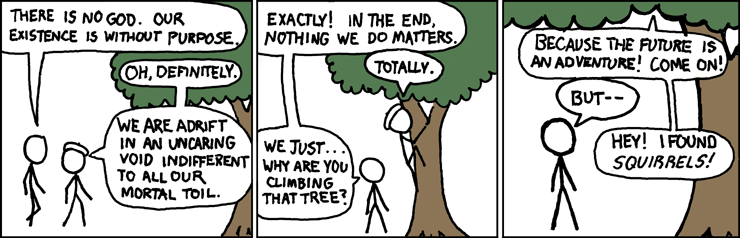
Believe it or not, I used to wear a hat like this!

nihilism - xkcd

I also am a bit of a nihilist.  And I love squirrels!!!

Yet another character shamelessly based on me…

Ego-aggrandizing jokes aside, I do love watching squirrels.  They are an easy animal to see in the city, and I love nature way too much to spoil it by stomping through it. So, urban wildlife is it for me.

Perhaps because I am not naturally good at reading people’s facial expressions and body language (as is common with Aspies), I have learned the habit of really paying attentinon these – or, at least, trying to.  But, only used it with Humans and pets, not really giving other critters too much credit.

I was quite young when I realized how mutually incompatible the ‘natural’ body language of cats and dogs is.  Yet, cats and dogs who lived together (especially if they did so from an early age) are quite capable of learning each other’s language.  Well, if cats and dogs could learn another species’ language, I should certainly be able to ‘learn’ this elusive body language of humans!!!

As I have argued before, kids with Aspergers who are having trouble discovering the ‘key’ to human communication can often decode the somewhat ‘simpler’ (or, perhaps, less complex) body/expression language of animals.  …sort of like learning to crawl before one attempts the marathon of nuances in human ‘non-verbal communication’.

Back to my main point!  As the trees matured in our neighbourhood, we began to see more and more squirrels who came to our bird feeders.  One winter, we were especially touched by ‘The Twins’.  Late in the summer, they started coming with their mom.  We suspect they must have been born later in the season, because they were very tiny.  And, before the first snow came, we stopped seeing the mom…

Yet, ‘The Twins’ stuck together.  They were very, very affectionate to each other, touching and reassuring each other often.  The smaller, bolder one would climb up the birdfeeder and throw food to the other Twin!  (  The Twins stuck together until late next summer, always together.)  Well, that winter, I started putting out food specifically for the squirrels….

Several years have passed, and one of the twins has returned here with three separate litters of her own!!!  Two of these litters were after she had become blind in her right eye, too.  Now I call her ‘One-eyed Jackie’, and she is the matriarch of the ‘Bruno’ (they are much browner than most our visitors) clan of squirrels. 

Besides the ‘Brunos’, we have two other ‘clans’ that come here.  One is called ‘Fuzzy-wuzzies’, because they have incredibly fuzzy fur, especially on their ears.  These are closely related to the ‘Brunos’, and they often mix.  The third ‘clan’ that comes here are called the ‘Zekes’ – and do not get along with the other two clans at all.  Curiously enough, they get their name from the Blue Jays that come here….

Yes, last summer, we had a family of Blue Jays come regularly, too.  And one of the adults was not at all shy!  If I was late putting our their breakfast, or if I the food I put out was not her favourite (I am guessing here that it was the female – we are more discriminating…), she would sit on a branch directly in front of the door, and in a loud, incredibly annoying voice, screech ‘Zeeeeeeke!!!’ – over and over, until she woke me up and I put out the approved food.

Believe it or not, the matriarch of the ‘Zekes’ learned to immitate that call!!!

Many times did I come out, looking for the Blue Jays that were not there, only to see her sitting on ‘the branch’.  It was not until I heard her actually make that call that I realized that it was she who was making it!  Obviously, I had underestimated the squirrel’s linguistic skills.  She has since also learned to perfectly immitate the neighbour’s little dog’s bark.  I began to pay more attention.  (It would probably have been faster to just read up on it, but I had fun watching them.) 

Soon, I identified that the clicking sounds they made were not random.  If I immitated the ‘clicks’, starting at the back of the mouth and moving forward, the squirrels took it as a ‘all safe’ sign, and would come down from the tree.  Even if the dog was nearby.  (It’s ok, he does not hunt them – he is a watchdog, so he just likes to watch!  When a squirrel once fell out of the tree and landed right in front of his nose, he started crouch-jumping up like he does when he is trying to get another dog to play with him.)

a dog who likes to watch squirrels

If I reversed the order of clicks, increasing the volume, the squirrels would panick and run!  Even if there were no danger anywhere about!  Then, seeing all was safe, they would flick their tails a lot and come back down.

Over that summer, I learned about 5 different ‘sets’ of clicks, each of which would be understood by ‘my’ squirrels.  Now I had a question:  did I really learn something of ‘their’ language, or have they learned to simply interpret my behaviour?  This was something I had to test, and an opportunity soon presented itself.

My son and I went to an event in a park about 5 km away from our house – far enough, I hoped, that I would not encounter ‘my guys’.  We were sitting in our lawnchairs, listening to some music, when a squirrel started hopping from one tree to another.  I saw my chance!

I started with my ‘all safe’ set of clicks – it was the first one I learned and I was most comfortable with it.  Plus, it is rather quiet – there were people about… 

The squirrel stopped in its tracks, as if frozen, and just listened.  Encouraged, I repeated the clicks, and added a second set (I think this one means ‘food is present’).  The poor little squirrel perked up its ears, and started looking about.  Actually, it looked a bit paranoid.  I kept up the soft sets of clicks. 

Suddenly, and with great incredulity, the squirrel realized that I was the source of this jibberish!

Well, this became one confused squirrel.  It resumed its original journey to the tree, but now, very, very slowly – and never taking its eyes off of me.  It kept turning its head, side to side, as if to confirm that it really was that human that was chatting with it.  I suppose I must have had an atrocious accent – and I fervently hope I did not say anything bad about its mother!

I guess you can predict how this story ends….  The squirrel was on a direct path to the tree, but was too shocked at the stuff coming out of my mouth to pay attention to where it was going….  Yes.  The squirrel hit the tree!

Hopped straight into it!

This was the only time ever that I saw a squirrel run into a tree.  So, I shut up.  Anyhow, I had to go and help my son up – he laughed so hard, he tipped over his lawnchair!

Aspergers and accurate words

School!  It can be a testing place at the best of times!

For people who need to use ‘precise’ and ‘accurate’ words to describe things as those of us with Aspergers do, it can be baffling.  After all, one becomes used to the vocabulary and expectations at home – but at school, the rules are different.  And people just do not communicate clearly.  In the words of the immortal Inigo Montoya, “I don’t think that word means what you think it means.”

Let me give you an example.

Schools are filled with many kind and caring people who truly have the best intentions towards our kids.  They are dedicated.  At times, they will even enter ‘uncomfortable’ situations, if they think the ultimate result will help one of ‘their’ kids.  I admire that.

One year, at the beginning of winter – just as it was time to start wearing hats and mits etc. – I got a phone call from one of my kids’ teachers.  Even though I am pretty thick at picking up on such clues, I could tell she was very uncomfortable.  She spoke in a little soft voice and picked her words very carefully.

The school, as it turns out, gets some free ‘stuff’ from the milk people, through the milk program.  Yes.  And it there are some families, which – at some times, and through no fault of their own – needed a little help, they could give these things as ‘prizes’ to their kids.  Since it is a ‘prize’, there is no stigma…

I was really beginning to wonder what this was about.  We were not in any financial difficulties – at least, I thought I would notice if we were.  So I made a non-commital sound, to show I was listening…

The teacher, kindly and gently, continued.  The promotional items they had included hats.  Since the weather was getting kind of cool, it was important that kids should wear hats.  And, today, during recess, my son had told her that he does not own a hat, and that he does not think we’re planning to buy him one.  So, if it would not cause offense, they could give him a hat from the milk programme…

Whatever reaction she was expecting, laughter was not it.  But, I just could not help myself!  I burst our laughing.  You see, my son was absolutely correct!!!  Yet, I owed the teacher an explanation…

The previous weekend, we had indeed gone shopping for a new winter hat.  My son became intrigued by these ‘hat and neckwarmer in one’ contraptions.  It looked just like a winter hat that was attached to the ‘neck’ part of a turtleneck.  It had a nice round opening for the whole face, but covered more skin than a ‘hat’ would.  That is what he chose to get instead of a regular hat.

And what did he wear the previous winter (to be used as a spare)?  A tuque!  If many people think that ‘tuque’ and ‘hat’ are the same, they should be corrected:  if they were the same, they would not have different names!!!

So, with puppy-dog eyes, solemnly and truthfully, my son told his teacher that he does not onw a hat!  And when she asked if we were just slow at getting ready for the winter, he truthfully said that we were not planning to get him one…instead of simply saying he forgot his new headwarmer.

The teacher was amused and greatly relieved! I suspect the story was used as a source of amusement at the teacher’s lounge. 

But this is a very real example of how people with Aspergers do not understand what they are being asked, unless the accurate word is used.  The terms used must be specific, precise and accurate, because Aspies do not ‘make leaps of faith’ or read things into stuff.  If we don’t know, we don’t know – we are not likely to jump to unsupportable conclusions.  The teacher would likely have received a different answer had she asked him if he owned something to wear on his head to keep it warm.

Another example of ‘crossed communications’ occurred when my other son was very, very young – certainly under 2 years old.  He absolutely loved watching ‘Bill Nye the Science Guy’, and absorbed much of his early vocabulary from that show.

One time, my mom was over, and was in the livingroom with my son.  When I came into the room, she was frustrated:  “I told him to stop picking his nose, but he just stares back at me as if I just fell off the moon!  What is wrong with him?!?!?”

I told her he just did not understand what she meant.  He already had a nose, so how could he pick another one?

Turnning to him, I said:  “Stop touching your mucuous membranes.”

He took his finger out of his nose, looked at me and said:  “Ah, spread germs!”  And went to wash his hands…

These may be funny incidents, but they do illustrate the difficulties Aspies have trying to understand people who use language sloppily.  Just imagine how impenetrable the meaning of many test questions is to them!!!  No wonder they often score very poorly on school tests – many questions do not really ask what they think they ask…

(This is ALWAYS the hardest part of writing a post:  how to end it!  I could go on talking about this endlessly…)

Aspies can, and do, learn to search the speech patterns of others for ‘similar concepts’ – this way, many Aspies learn to ‘decipher’ common speech.  And when we do, we are often so delighted, we drive others mad by playing with it!  Yet, this is not an easy skill to acquire, and it would not be realistic to expect young kids to ‘pick it up’.  This will lead to frustration – not just of the child, but also of educators, parents and others who interact with Aspie kids.

And, Aspie kids usually experience very high levels of frustration, even if they do not communicate this (or display the ‘typical’ signs of frustration, until it builds up into uncontrollable anger).  Making all these people aware of the need for accurate, precise and non-ambiguous use of language (and what that actually is – in the mind of an Aspie) would go a long way towards making life easier for everyone involved. 

If we could only teach the rest of the world to communicate accurately!

Aspergers and writing

Writing is one of the major woes for people with Aspergers

It is difficult to describe the depth of despair most Aspies suffer when trying to put pen to paper.  And it starts very, very early on.  There appear (to me) to be at least three different ‘subsystems’ in the brain that are conspiring to make writing next to impossible for young Aspies.

The first one to be encountered is the ‘mechanics of writing’.  Many Aspies have less ‘sidedness‘ differentiation, so their ‘writing hand’ is less ‘dominant’ – and thus has less fine motor control – than most peoples.  This is often encountered early on in childhood – as a result, the kids may not enjoy drawing, or they may draw with both hands.  Regardless of drawing, however, Aspie kids usually display severe difficulties when learning the mechanics of writing.  This is more pronounced in cursive writing, where forming letters needs to be combined with smoothly moving the hand along the page, so many Aspies end up printing instead.  

I suspect this is a motor issue, and could be overcome by ‘overdoing’ the practice.  This has, to a degree, been my case:  where I went to school, we started out learning cursive, and we were marked on our handwriting.  I totally sucked at it, for the longest time.  Then, I saw what handwritings the teachers marked as the best, and shamelessly immitated them.  And yes, I spent endless hours practicing, because I was going to be *%$#*^# if those air-headed girls with ‘pretty’ handwriting got better marks than I did.  The result?  I am told I have extremely beautiful, though almost completely illegible, handwrititng!

Another problem which Aspies encounter when writing is – and this is based on my observations, not an expert assertion – a problem with short term memory.  At least six different kids with Aspergers have described it as ‘the ideas going by so fast, by the time I’m done the first letter, I don’t know what word I am writing’.  Now, this is very interesting, but worthy of a post of its own (soon, I hope).

The third major problem I have observed is a little more complicated.  I do not know how frequent it is, but again, I have observed it in very many Aspie kids.  It has to do with language, its use and the very words that make it up.  Also, many Aspies perceive there to be a big difference between what is spoken and written.   Perhaps a little explanation is needed…

Asperger Syndrome is often described as ‘verbally expressive form of Autism‘.  Now,  it is important to make a distiction here:  just because Aspergers falls under the same spectrum of disorders as Autism does, or that the spectrum itself may have the word ‘Autism’ in it, does not mean that it is nearly as crippling as Autism can be.  Comparing Aspergers to Autism (as the Ontario Government recently did, in order to deny Autistic children proper treatment) is about as accurate as comparing a sinus infection to pneumonia – both are respiratory system infections, but they are not the same in severety or affect.  It would be an inappropriate comparison.

While Aspies are usually able to speak extensively on a topic, most have a difficult time writing on a topic.  This is very curious and puzzling to many parents and educators:  it can appear as defiance! So, what is it that makes it OK to say things, but not to write them down?  Perhaps an unusual form of perfectionism could be at play here.

It is my observation that Aspeis, especially children, consider anything that is written down to be much, much more serious, important and permanent than what is spoken.  Even when practicing forming letters, some of these kids will be extremely anxious about not being able to get the shape just perfect.  Not Aspies are this extreme, but I certainly was, and so was one of my sons.  He was so terrified to commit an imperfect letter onto paper, we ended up getting him to practice writing onto clear plastic sheets (of the type you can put through the printer, to use for overhead presentations) with easy-wipe-off markers.  And even thought he could wipe off any letter he did not like, before anyone else could see it (and at first, he wiped off all of them), it was still hard for him.

It is my suspicion that in a similar way, it is difficult for Aspies to write ideas down because they are not sure if their idea is good enough to be commited to paper.  And even if they get over that, and judge the idea worthy – and this is the key here – it is next to impossible to express their idea accurately, using everyday language.

I have often wondered – and would appreciate feedback from those who have observed this – if something similar could be at play with Autism…  Many (not tall) autistic children are said to begin learning language relatively normally, but then at some point, they revert and begin to use language less and less.  Could it be possible that as they learned language, words attained ‘colouring’ – secondary, or implied meanings – unrelated to their ‘object or action definition’…. and that these words became perceived as no longer accuratley describing its original meaning, and therefore discarded?  I don’t know, but I would be curious what others think about this.

It is often asserted that Aspies use language somewhat rigidly, or sound very pedantic.  Could it be that a similar perfectionism in expressing an idea, a similar subconscious frustration with the inaccuracy of language, is at play when Aspies try to put ideas onto paper?

I love debating, and do it online.  And, people have noted, that whenever I get into a serious debate, I spend most of my time defining the specific and narrow meanings of every word I intend to use (plus a few others, that I exressly will not use).  Many people find it redundant, annoying and boring.  Some think it is a ploy to manipulate the debate.  But I do not intend it as any of these:  before I can express what I mean, I need to ensure that there is no ambiguity in the language I use to express my point.  General language simply cannot do the job!

There is no simple answer to overcoming this.  

Each Aspie may require a completely different approach, what works for one may not work for another.  It will take years.  And it will always take much more time and effort for an Aspie to write something than it would take most people.  (It usually takes me 2-6 hours to write any single post – and some, I have spent 14+ hours composing.)

Yet, Aspies can learn to write.  And when they do, the documents they produce are usually very well researched and accurately expressed!

“say, doesn’t co2 kill plants??????”

While I have been taking a look at Aspergers, and describing some of my experiences and coping methods that worked for me, I have neglected a number of other very important topics. 

For example, I have promised to post on the topic of the climate.  And I promised that I would provide some solid information about why I hold the views I do.  Thus, I was preparing something on this. 

Alas, it is difficult to assess the information one is provided if one is not familiar with the underlying science behind the words.  More and more of what I have been reading from non-scientific (that is, MSM (main stream media) and many blogs, debating sites etc. – you know, all them places that have replaced the ‘watercooler chat’) has convinced me that before I can hope to provide useful information, it will be necessary to log in some explanations first.

As if to convince me that I ought to do this, in a coment on this post on a dime a dozen blog , somebody asked the following question: 

“say, doesn’t co2 kill plants??????”

I thought this question needed to be addressed, the sooner the better.  Here is my (somewhat expanded) answer:

No.  CO2 does NOT kill plants.  Nor is it pollution!  It is plant food, and what plants use to make food for us.

There are 2 basic ‘gas exchange’ processes that occur in plants:  breathing (respiration) and photosynthesis.

RESPIRATION

Why breathe?  What is the purposeENERGY!!! 

To carry out the process of living, all cells need energy.  That is why we – and plants – need to breathe 24 hours a day.  So how do we get energy by breathing in oxygen?

An oxygen molecule is made up of two oxygen atoms  (hence O2 – the 2 means the molecule is made up of 2 oxygen atoms).  These two atoms are held together by a ‘bond’ – breaking this bond releases energy.  But an oxygen atom by itself has a strong ‘need’ to bond to something (we rate it a level 2 need).  If left in this state, it would harm the surrounding cells (it is called a ‘free radical’). 

Organisms ‘solve’ the problem by taking a carbon atom (C) which has an even higher ‘need’ to bond (level 4).  Two oxygen atoms (with a ‘2’ each) are bonded to the one carbon atom (to add up to the carbon’s ‘4’).  (Yes, this is a major simplification – but the underlying principles are accurately described).  The resulting molecule is CO2 – or one carbon and two oxygen atoms.  All of its ‘needs’ for ‘bonds’ are met, so it is not harmful to the surrounding tissues.

Yes, it does require energy to bind the oxygen atoms to the carbon one.  However, because carbon has such a high ‘need’ for bonds, it takes less enegry to bind the oxygen atoms to it than was released by breaking the bonds between the two oxygen atoms.  In other words, when one breaks the molecular bonds between the two oxygen atoms in O2, then take a part of that energy and uses it to bind the two oxygen atoms to a carbon atom, one has some energy left over.  I stress again, this is a major simplification – there are many steps and other ‘bits’ (like glucose, which is where the carbon molecules for the reaction come from) are essential!!!  However, the underlying principle is correct.  If you would like to read more about this, here and here and here are good starting spots.

This energy difference is what cells use to carry out ‘living’.  We call this process aerobic respiration, both in plants and animals.  And though other molecules may be used in its place, oxygen is by far the most efficient one.  (Respiration in the absence of oxygen is called anaerobic respiration.)

PHOTOSYNTHESIS

During respiration, living cells get energy by breaking ‘bond’ betwen two oxygen atoms in an oxygen molecule (O2), and then use carbon atoms from glucose (simple sugar, made up of carbon, hydrogen and oxygen atoms) molecules to stop the resulting oxygen atoms (free radicals) from harming the cell itself.  So, where does the glucose come from?

Glucose is produced by photosynthesis.

Plants have special organelles called chloroplasts.  These are specialized organelles (sub-section of a cell with a specialized function) in the plant cells which contain the green pigment chlorophyl.  Their function is to take IN carbon dioxide (CO2) form the air, and combine it with hydrous oxyde (H2O – water). 

The C (carbon) from the CO2 is combined with the OH group from H2O.  OK, I am simplifying again:  you need several molecules of CO2 and H2O to make it work, because the result of combining the carbons and oxygens and hydrogens together is the simple sugar, glucose:  and it has 6 carbon atoms in it. 

It is, in fact, pretty much the reverse of the chemical reaction during respiration.  But the reason for respiration is to release energy.  So, this process of photosynthesis needs energy from the outside to happen – and this is the reason why it occurs in the chloroplasts, which contain the green pigment chlorophyll, which is very good at absorbing light energy from the sun.  It then uses this energy to drive the chemical reaction of binding carbon atoms (from CO2 in the air) to water molecules to produce the simple carbohydrate, glucose.

This process is called photosynthesis because it uses the enegy from light (photo) to build (synthesise) glucose, a simple sugar.  Glucos molecules can, in turn, be joined up into long chains so they can be stored efficiently.  The end product, the carbohydrate chain, is called starch.

Plants can then use the stored up starch in order to breathe.  And animals, unable to make starch themselves, eat plants in order to get it.  Thus, energy from sun gets stored by plants (using carbon dioxide and water) as carbohydrates. The byproduct of this process in the oxygen molecule. Plants and animals use these carbohydrates and oxygen from the air to use this stored solar energy to ‘drive’ their cells.  The byproduct of this is carbon dioxide.  This is the basic energy cycle of our current lifeforms.

The more complex the plant, the more CO2 it requires to grow and thrive.  For example, the ‘Great Plains’ in the US used to be mostly covered by trees – until the carbon dioxide levels became too low to support them.  Then, they reverted to grassplains, because grass is a less complex plant and requires (and uses)less CO2 in the air.

If you love trees, as I do, you cannot but object to anything that will reduce the CO2 levels available for them to grow.  I am a self-admitted tree hugger – and a scientist.  I thought the ‘global warming’ thing sounded good when it was first proposed, so I have ‘looked into’ it (extensively – though this is NOT my field of expertise!!!  I do not wish to mislead!).  The evidence has convinced me that this is not dangerous.  To the contrary.  Incerases in CO2 levels are higly advantageous to lifeforms on Earth because historically, they raise food availability and are accompanied by greater species differentiation and increase in overall lifeforms supported.  And despite some claims, hard datea shows that we are nowhere near historically high levels of CO2 in the atmosphere.

So, why the hype?

I don’t know.  In situations where things get as murky as this is, I like to use a very simple ‘rule of thumb’:  “cui bono?” 

Or, in other words, ‘Follow the money, honey!’ 

add to del.icio.usDigg itStumble It!Add to Blinkslistadd to furladd to ma.gnoliaadd to simpyseed the vineTailRank

If you can’t laugh at yourself, someone will make a sitcom…

On Monday, I posted ‘Pitfalls’ – a glimpse into the process that an ‘Aspie’ uses to write something up.  Yes, it has a lot to do with my recent posts on Aspergers – I think I have it ready, then read something else and have to hit the re-start button… 

I’m afraid I modeled it on my experience…only.  And while that may be a typical ‘Aspie’ thing to do, it is (I am told) more applicable to female Aspies…who are in minority.  Aside:  As ‘ADifferentVoice’ aticulated, I also wish there were a better terms for ‘a person with Asperger Syndrome’ and ‘Neurotypical’ (NT)- if you know of one, or would like to suggest one, please, let me know.

In the interests of accuracy and entertainment, I have re-thought the post…and come up with a conclusion more indicative of the ‘Aspie-typical’ person.  (How’s that for a convoluted term???  It makes me proud!)  ;0)

Most of the post would remain unchanged:  the bits where excessive research is done, 2-3 major studies are read and their raw data reassessed, several books, a stack of periodicals, and numerous online sources, cross-referenced and indexed (physically or mentally), you start thinking about the actual write up.  Except that somebody mentions something related, so now you have to research that, or risk inacuracy!  So, more research is required…and then you go for 3 days without posting!!!

Now, here is where the difference comes in.  When I start to ‘write’ the actual post/write-up/article/assignment, my most difficult task is cutting the 80-odd pages down to a managable bite.  So much stuff to be stuffed in!  And it has to be phrased carefully, so as not to mislead or misrepresent – not intentionally, anyway!

 Well, I do need to correct the misconception that all Aspies are like that.  The vast majority would be much more efficient at analyzing the salient and essential points, and expressing them in a highly efficient manner.  The long, painful hours I would spend ‘cutting down’ my notes, they spend in expanding their resultant 3 sentences into a full paragraph.

No kidding.

But then again, if you can’t laugh at yourself, somebody will make a sitcom … and the world will laugh at you!  My family insists that when I forget to keep a tight control over my ‘inner voice’, it reveals itself to be a bit of a ‘Sheldon’… or perhaps a little bit of ‘Leslie’….hope you enjoy the clips below! 


Aspergers and ‘hearing dyslexia’

This is another one of my very personal looks at living with Aspergers – both as an Aspie, and as a parent of Aspie kids.  While doctors and psychologists can tell us a lot about Asperger Syndrome, it seems to affect different people differently – even siblings can have incredibly different ways in which they are affected.  Not only does each person’s underlying personality determine the best (and worst) ways of handling it, there are often many physiological conditions which occur along with it and affect the skill-set available to be drawn upon.

One of the conditions that often occurs along with Aspergers and/or ADD is dyslexia – I know that when I was learning to read and write, I had a lot of trouble with it (and, to a very small degree, I still do).  What surprised me, however, was that just like people with dyslexia see letters either reversed, or in the wrong order, some people hear sounds ‘jumbled up’ in much the same way!  The technical term for this is Auditory Processing Disorder (APD), but I find it easier to think of it as ‘sound dyslexia’ or ‘hearing dyslexia’.  Apparently, this condition is not easy to test for, and many doctors do not even think of testing for it….yet it can have very major impact on the development of a child learning language for the very first time – whether neurotypical or Aspergers or Autistic.

Just like people with dyslexia can see letters reversed, or in the wrong order, people with APD can hear sound within words ‘reversed’, or lasting the wrong length of time so several sounds become superimposed over top of each other and very, very difficult to ‘separate out’ and understand….especially when one is just learning that different sequences of sounds can actually carry different meanings. 

Please, imagine that you have this – not correctible by a hearing aid, because the problem is not mechanical, but by the way sound is processed in the brain.  Because you cannot effectively (or reliably – the problem is notoriously intermittent) differentiate between words or phrases, it is very difficult to ‘catalogue’ or ‘make sense of’ sounds and their associated meanings.  Now add to it the Aspies’ inability to comprehend facial expressions, tone of voice or body language.  Frankly, I do not know how these young children can make any sense of the world about them at all!

How to overcome this?

One has to work within the child’s interests and strengths.  It is my hope that sharing what worked for our younger son may help you develop strategies which may work for yours.

When our younger son had problems learning to speak, it did not look to us like a problem.  Instead, it looked as a willful behaviour:  we were told he was refusing to use language in order to manipulate us, the parents.  It was a call for attention, we were told. 

But, that just did not ring true to me.  While we would read him every evening, and while he had our full focus and attention, he would still be unable to follow even the sipmlest stories.  He loved counting picture books with a number and that ‘count’ of objects.  That he could follow, and would lift the correct number of fingers – even try to say the numbers.  Sometimes, he even liked ‘word’ books – ones that showed a picture of an object and had the word for it written beneath the object.

But the moment we tried to read him even very simple stories, we lost him.  He would fidget, climb, jump, and generally do anything to demonstrate his complete lack of interest.  Thinking he wanted more of the attention focused on him (as we were told this was attention-getting behaviour), I would start telling him stories.  This way, there was no book and he was my sole focus.  Same reaction.

Eventually, he got interested – but on a very different level.  Accepting the ‘book routine’, he started picking out letters, one at a time.  The joy on his face as he would yell over top of my voice (as I was reading):  “A!!!  A!!!  A!!!”  I would confirm that yes, that was indeed ‘A’, and tell him how clever he was to have recognized it.

He’s settle down and look interested.  But he was not interested in the story.  No, because I would barely read another paragraph when he woud get excited again:  “D!!! D!!! D!!!”  Again, I would praise him, and try to resume reading.  But, it was not a ‘relaxing time’ that would get one ready for bedtime…

Eventually, I gave up reading him stories and broke out the ‘Alphabet books’.  I had thought he was too young for them, but if he loved reading the letters, I whas happy to oblige him.  For the first time, he was making ‘human’ sounds, one letter at a time!  And at this point, I saw that as a reason to celebrate.

We also added ‘bathtime’ to the fun.  He loved his letters, so I got soap crayons and we had great fun using the white ceramic tiles on the wall by the tub as our canvas!  I would let him pick a letter and then write every three-letter word which started with that letter.  As I would write them, I would read the letter, then the word!  And, surely enough, my son would read each letter with me.  B-A-T.  BA-. BAT.

Miracle of miracles:  he learned to speak!

Of course, he would NOT EVER repeat a word until he had learned what letters it was made up of, how it broke down to syllables, and how it fit together.  I suppose he was the only toddler I had ever encountered who had learned to READ before he learned to SPEAK!!!

Now, he has a little lisp when he speaks, but he has an above-average vocabulary.  

Another factor, which was happening at this time, and which I think was incredibly beneficial to our son as he tried to decode the mystery of communications, was his interaction with our dog.  Good natured and well trained, he was also very intelligent – and showed incredible patience with both the boys.  And while any pet will be beneficial, a well trained dog in the home can be very valuable in a situation like this. 

Why? 

Because the communication lines are so very clear.  Our dog was trained to obey a limited number very distinct-sounding commands, accompanied by hand signals.  In addition, the dog’s response to these commands was consistent and predictable.  His overall body language was also a much ‘simpler’ communication than the ‘human’ type.  To a young person who is having trouble understanding the underlying rules of communication, this can just be the key to unlock the mystery. 

We did not ‘get’ what was happening, and thought he was just ‘playing pretend’ when our son began to immitate the dog’s actions when we would give the dog a command.  And since the dog loved to ‘practice’ his commands for treats every day, I switched the ‘treat’ from a dog bicuit to an animal cracker….and let them both practice together. 

It may seem silly to people who are not ‘dog lovers’, but many kids love pretending to be ‘the dog’.  It is partly a game, and partly to see what reaction this would get.  And since I thought it was fun, and I was happy that he was interacting, I was delighted.  I would say ‘Sit!’ – and both boy and dog would sit!  I would give them a cracker each, they would happily eat them up, and look to me for the next command!  And he was happy – he finally understood some ‘stuff’!

Perhaps not every child would respond in this way, but then again, my guy is one of a kind!  Yet, I do hope that his story might help people understand that kids who ‘seem’ to be ‘manipulative’ or ‘acting out’ might not be doing that at all.  They may simply not understand what is going or around them, and be trying ‘weird’ ways to make sense of them.  And they may also be very frustrated….

But if you can find the key that will unlock the mystery, they will learn!  And they will be much, much happier – it is rewarding for everyone!  Even the dog…     ;o)

Pitfalls

The following is a painfully accurate description of one painful ‘creative’ process  people with Aspergers Syndrome undergo when ‘writing stuff up’:

You have found the perect topic – or perhaps it has been assigned to you.  Either way, you spend weeks figuring out the best angle from which to approach it, because that will determine what you need to read up on and how you organize your thought.  You read anything and everythig related to it, until you find just the most perfect way to present the main idea.

The brain engages, and does not let go!  Not for a little bit.  You even dream about it – if you can sleep at all!  You find yourself reading tons of stuff you realize you should have read long ago, because it added important data that needs to be included in the analysis of whatever it is you are thinking about – and you had already started thingking about it!

OK, re-organize the data in your brain and push the re-start button on the analysis process!  Oh, and all that stuff you wrote up yesterday – well, might as well re-read it before tossing it out….but wait!  This bit – let me ‘Google’ it, it needs to be expanded on so the reader does not become confused!  Oh, you’d better read that, too!

Then you realize that five or six years ago, you read a book or an article on an unrelated topic, but which could be used as an effective parallel – so you spend several hours hunting it down.  Better to also read a few of the underlying studies – to get a feel for the raw data, and thus better understand the reasoning underlying the analysis.  Right.  More data to add, re-start the analysis thinking bit again.

You think you have it:  and tell a friend about it.  It helps to bounce ideas back and forth – not just for the plausibility of your conclusions, but – and perhaps most importantly – to see if there are whole huge chunks of ‘stuff’ you did not explain, because it seemed ‘obvious’ or ‘common knowledge’ to you – yet which do not appear so to people who have not obsessively immersed in this topic for several weeks/months/years.  It is surprising to you how all these people could live happily without intimate knowledge of ‘whatever the topic topic happens to be’!

Your friend has no idea what you’re talking about – so you make a mental note to read up on ‘lay terms’ used to express ‘your stuff’.  More reading, learning how to dumb-down perfectly clear and precise phrases into common words which have layers of meanings, and so can never accurately describe anything exactly and unequivocally.  You’ll just have to compensate by expanding the section where you explain in detail how the words are used in your article.  It’s not a perfect solution, but it’s the best that can be hoped for.  Better add a paragraph or two to each sub-section, with more detailed explanations, or the whole point will have been lost.

Right.  Your deadline was a week ago – so even though you know you have a lot more to read up on to make an truly accurate analysis, you’d better get stuff down on paper.  Better include a paragraph or two to explain what you did not get to read up on, so people know and can compensate for it.  Sloppy…  But better than being misleading!

So, you write it up.  It is there, it took days of writing.  It is still terrible, even though you re-wrote each sentence four or five times, re-edited each paragraph to accomodate each sentence re-write, then adjusted the whole document to the changes in the paragraph. But, the basic ideas are there.  Good!

Almost ready.  Now, you just need to edit it down to under 2 pages….which is going to be a little hard.  You now have 78 of them, and that is in very small font in an effort to shrink it.  That will NEVER work!

Perhaps, you decide, you will pick a different topic…

Aspergers, schooling and frustration

Many people with Aspergers have been treated as ‘stupid’, or – and this is the ‘teachers’ favourite’ – “Your child is co clever, if only he/she would apply himself/herself, he/she could do so much better!”  As if the world were not frustrating enough without such patronizing haughtiness!   

There are very many ‘things’ going on – and many will display themselves as various ‘learning disabilities’:  dyslexia and/or its auditory equivalent, sequencing difficulties, social rejection + + + … and an ever growing frustration.  And yes, this frustration can be crippling – it can ‘freeze’ the mind which is capable of complex reasoning, yet treated as an idiot because one can’t seem to express it!  

In North America, school tests are all written – a ‘double jeopardy’ for Aspies.  First, understanding the scope of the question is a challenge in itself.  Is the answer supposed to be one word, one sentence – or a paragraph?  During written test or exams, one is not supposed to speak – and so cannot ask and find out how big the answer is supposed to be.  Then, it is incredibly difficult for Aspies to write their thoughts down in a consistent, comprehensive manner.  The mechanics of writing itself are hard enough, formulating answers and then remembering them long enough to write them down is something that will take most Aspies years to master.  This difficulty in written expression is kind of the ‘hallmark’ of Aspergers!

I know of a child who was slipping into a deep depression and getting bad marks in school.  After a series of tests, it was shown that he was able to express himself so badly (on tests), he scored in the lowest 25% in general cognitive tests for his age-group.  (That means that 75% children his age were able to write a better answer.)  Yet, in oral testing (and with guidance – letting him ask questions so he assured himself he understood the question and how detailed the answer was supposed to be – and with no time limit), he was found to score higher than 95% of his peers!  He was able to solve math problems from grade 8 exams, yet he was almost failing grade 2!

Can you imagine the amount of frustration this lead to?  That disparity between one’s actual ability, and one’s capability to demonstrate that ability to others can lead to very, very destructive self-image.  Frustration, shame, self-loathing….not really something that will help make things better.  And because it is more pronounced when they are young and have not learned to compensate, early on into their schooling, many Aspies figure out that even trying is pointless.

The key question, of course, is:  so how to fix it? 

The simple sounding answer is:  by exercising the brain.  The latest research on neuroplasticity suggests this can be done, with great results.  In the next few posts, I will try to describe the exercises that I have seen work – though not all people respond to the same way to all the exercises.  I guess that even despite being Aspies, we are all individuals!

And speaking of being individuals:  I just came across a neat article.  Perhaps forms of self-expression like these futuristic tattoos just might help people with Aspergers read the emotions of others!  Perhaps a little silly, but worth the read!

Aspergers and Reading

Teaching children with Aspergers’ syndrome new skills can be very trying and, at times, discouraging.  Perhaps because there are so many ways Aspergers affects children, no single method will work for all Aspergers kids.  If you have missed my introduction to my personal insight into Aspergers’ and a look at Aspergers and ADD, you can find them here and here.

Aspergers is something my family shares:  I, my husband, our sons, several of our nephews and nieces – we all have Aspergers in common.  Yet, each one of us exhibits it a little differently, each one of us needs to build up quite a different set of tools to help us function.

For example, my older son loved to be read to.  He had a favourite nighttime routine, and it involved about an hour of being read to.  And he soaked it all up, like a sponge.  He loved some fairy tales, some myths, but his favourites were non-fiction books. And he remembered it all.  I loved to tease him by changing a word here or there – and he always ‘caught my cheating’!  Once he learned that this was ‘humour’, we laughed a lot about it.

When it came to learning to read himself, it was not so easy.  He went to a Montessori pre-school, where the teachers thought that ‘making him learn his letters would discourage him from wanting to learn’.  So, they didn’t – they let him iron facecloths instead (it also fell under the ‘practical skills’ section, just as ‘learning letters’ did).  Needless to say, we did not continue with Montessori for grade 1.  It genuinely appears to be a good educational system, but the only children I personally have met who thrived in the Montessori environment were girls whose sole learning motivation was pleasing their teachers/parents.

Yet, learning to read (much less write) did not come easily, even when we switched our son to a highly structured classroom environment with a very high teacher to student ratio.  His grade 1 teacher was most excellent, however, and dedicated to making him succeed.  She taught us many valuable lessons!

Our son was struggling to understand the written words.  His constant complaint was that by the time he decoded a letter, he could not remember what the prevoius letter was – or what the sentence was about.  He was trying, but it looked to us like the only things he seemed to be able to really concentrate on effectively were video games.

Seeing our opening, we pounced! 

A friend recommended ‘The Legend of Zelda – Ocarina of Time’ as an excellent videogame.  It is interesting, engages the child, age appropriate – and it requires reading in order to play!  From the very first moment, it captivated our son.  He was eager to play the game, as much as he possibly could.

At the beginning, we were very accomodating.  We read all the text which popped up, and without which he could not progress in the game.  Being a perfectionist, he liked to make sure he completely mastered each and every skill before moving on to the next bit.  The key to learning skills in videogames is repetition.  And so, he repeated the same sections, over and over and over.  He seemed to derive comfort as well as pleasure from the ‘variable predictability’ which came from this: he knew that if he went and chopped down the grass in front of a particular house, there would be rupees (gems which designate points) in several clumps of grass – but not which clumps!  It was the perfect combination of suspense and predictability – at least, for our son, at that time!

Slowly and over time, however, we stopped reading the text to him.  He had been over the same areas so many times, he seemed to have memorized them anyway, and so it did not seem to be much of a big deal.  And one of us was always there, whenever he explored a new section of the game, ready to read the new instructions.  Once, twice, three times.  Occasionally, more than that…and each time we read it, we were slower, and slower, and slower…

As he became more interested in the plot of the game, he became more and more anxious to decode the information quickly.  Having been read it once or twice, with the setting to remind him of the context, he found it easier and easier to remember the captions, with the aid of visual prompts of the text…  And, over time, we only needed to read the text the first time around – after then, he would remember/decode or decode/remember  it on his own. 

And, through it all, we would talk about it (while he was not playing the game):  what did he do, how, what it meant, how did he think things would go next…  When he could not come up with possible future scenarios (to be expected), we would supply some and have him tell us how likely it seemed, based on what had already happened.  This is an essential step – it connects the experience to the analysis centre of the brain, something which is not automatic, yet very important in the development of critical reading skills.  These neural pathways need to be established and reinforced, over and over and over.

Eventually, this decoding became reading in its own right!  Not just decoding text to sound, but really, really reading, with all the levels of comprehension this implies!

It is hard to know whether it was the repetition of the text, the motivation, or the context which stimulated the decoding of a message anticipated by memory.  My opinion is that it was a combination of all these factors.  Regardless of the mechanism, he learned to read!

But more than that!  Once he was able to ‘wrap his brain’ around the mechanics of reading, he became one of the most voratious, fast, discriminating readers I have ever met.  By the end of grade 1, he read several books, including ‘The Hobbit’.  Once he finished that, we -as a family – read ‘The Lord of the Rings’ aloud together, each of us taking turns to do parts of the reading.  Over the summer, he read the trilogy on his own.  Twice.

Just to give an example of the speed with which he now reads:  when one of the ‘Harry Potter’ books – the one that was about 1200 pages – came out a few years ago, he read it in under 12 hours.  Not only did he retain an almost encyclopedic memory of the plot, he also gained a deep comprehension of it.

Of course, this is just one story of one boy’s journey to learn to read.  It will be different for each child with Asprgers.  It certainly was for my other son!

Yet, it does seem to me (both from this, and many other experiences) that once an ‘Aspie’ masters a skill – and I really mean masters, not just ‘becomes profficient enough to hide their difficulties’ – it has an immense impact on all the other spheres of learning and experience.  It almost seems that acquiring a skill opens not just a door, but a veritable portal – a superhighway through which new skills and experiences can be routed!

Yes, it is much more challenging to teach an ‘Aspie’ child – but it is also incredibly rewarding!  Each step is a struggle, and it may seem overwhelming – both for the child and the parents and educators.  Yet, in no other group of children that I have worked with (voluneering, it is essential that I stress I have no professional credentials in this field and these are my personal observations) have the successes had such a tremendous impact on both the overall cognition and happiness of the child.

Please, no matter how hard it is, do not give up.  Change your methods, try out your hunches and new experimental things – and see if they work.  Give them time – but not too much time!  If they do not work, regardless of the credentials of the person recommending them, try something else.  Because each child is different, and each ‘Aspie’ child is profoundly different….  And you, who spends the most time with them, are the one who is by far the most competent to judge what is or is not effective.

The brain is a wonderful and wonderous thing.  It can do way more than we ever expect.  Neuroplasticity is real, even if it takes a while to show.  So, as they say on ‘Galaxy Quest’:  “Never give up!  Never Surrender!”