‘Linking to offensive site is not defamation’ – legal precedent set in BC court

As many Canadian bloggers are being targetted for ‘lawfare’ – using real courts or the semi-judicial (but just as legally binding) Human Rights Commission/Tribunals in order to bully them with the threat of stressful, expensive and long-term legal battle – we have a legal precedent that might serve to curb at least some of these.

For example, Kathy Shaidle of Five Feet of Fury  is being dragged in front of the HRC for having linked to a site which contained something that was ‘potentially offensive’.  She, and many others like her, may now have a new weapon in their defense:  the precedent set in a BC court (a real court – unsurprisingly, is not as random as the HRCs!).

In this case, Jon Newton (p2pnet) was being sued for publishing a link – the argument being that the link itself constituted ‘re-publishing’ the offensive material. 

From p2pnet, in his own words:

Following a landmark decision by British Columbia Supreme Court judge Stephen Kelleher, p2pnet is the victor in a case in which Vancouver businessmen Wayne Crookes, once an important federal Green Party of Canada official, tried to claim I defamed him by linking to articles he didn’t like.

That amounted to publication,  he maintained.

The full decision can be found here (from p2pnet) and the actual pdf is here.

An excellent summary can be found at ‘EXCESS COPYRIGHT’:

Essentially, the Court held that a link is much the same as a footnote, except a lot more convenient.

Congratulations to both Mr. Jon Newton and his lawyer, Mr. Dan Burnett!  And, Judge Kelleher – well done!

Aspergers: paying attention

Paying attention at school can, at times, be trying for anyone.  It can be even harder for kids with ADD.  Yet, for Aspie kids, there can be an additional thing at play!

I am an Aspie, married to an Aspie, raising a couple of kids who are Aspies – not a professional in this field!  For a ‘boilerplate explanation’, please see my ‘Guide to my Aspie posts’ page.

One of the ‘things’ that define Aspies’ is the inability to innately read and comprehend body language.  However, many of us (especially ‘girl Aspies’, or ‘Aspiettes’, if you’d like) tend to realize we have this ‘blind spot’ and we try to compensate for it.

This often involves becoming more ‘observers’ than ‘doers’.  It means an Aspie trying to ‘decipher’ this is more likely to choose to be present for a lot of ‘social’ situations, but not actually actively participate.  Yet, the Aspie will keenly observe everything that happens in order to try to analyze the situation for behaviour patterns which would give us our personal ‘rosetta stone’ to non-verbal communication.

This process, by itself, is enough to alienate (‘creep out’) many ‘neurotypicals’ who are our peers – resulting in more ‘shunning’ and greater social isolation….which leads to more ‘Aspie frustration’!  After all, you are only trying to learn the patterns in non-verbal communication:  with your usual OCD intensity…  Yet, THAT is not the point of this post!  The point here is to point out how many Aspies’ attempts to pay attention are really misunderstood.

Let me use myself as an illustratory example:

I was raised in Central Europe – with a somewhat different schooling system.  50% of our mark was based on written tests – just as 100% of it is in North America now.  The other 50% was based on ‘oral/verbal testing’:  the person ‘being tested’ gets called up, stands in front of the class and the teacher, and is asked a question they must answer.

There IS quite a lot of merit to this form of testing.  For one, many of us (especially Aspies) are WAY better at demonstrating our knowledge verbally than in writing.  Also, if we have concerns about the question (often, test questions are so vague as to be meaningless), we can ask the teacher for clarification.

The other – and often unnoticed – benefit of this form of testing is that no two people will explain the same material in exactly the same manner and wording.  So, when a student is being tested, the whole class is being presented with a repeat lecture presenting the material, but in a slightly altered manner.  The teacher conducting the test will correct any incorrect statements by the student – and this is really key in helping other students correct their own misconceptions and learn!

Thus, testing students by calling a student to the front of the class and asking them to demonstrate their understanding of the material taught acts to both reinforce the lesson to the rest of the students, as well as correcting misconceptions and presenting alternate explanations of the material.  To me, this seems like a win-win-win situation…as it also helps people overcome fear of speaking in front of an audience.

Usually, there is several days of ‘study time’ between the time new material is presented to students and when their testing on it begins.

Sorry for the long explanation – but it is important to ‘set the stage’, if you will.

I was in grade 6 when I became most acutely aware of the whole ‘facial expression/body language’ method of conveying ‘colouring’ to one’s statements.  Predictably, I became completely fascinated by this weird and counterintuitive phenomenon!  When someone would speak, I would begin to obsessively ‘superfocus’ on their ‘non-verbal’ message, so that I could relate the two to each other later, when I ‘replayed’ the experience (in my memory) for analysis.

Except that there was one tiny-little problem:  when I would superfocus, I would – wanting to or not – block ALL other stimulations!  Unfortunatelly, this meant that if I focused on ‘non-verbal communication’, I could not help but block out all sounds…  Yes, it kind of defeated the purpose.

Well, this one day, I was in a history class.  The teacher (who had issues with my Aspieness – without understanding it was Aspieness) was actually presenting an extremely interesting lecture!  I was totally fascinated by it, and did not want to miss a single word!  I was determined to pay full attention and not miss a single word, no matter what!

Yet, I knew that if I started looking at the teacher, I would ‘skip’ into the ‘superfocus’ mode, where I would ‘record’ every bit of her body language and facial expression nuance – but I would loose everything she said!  And I was too interested in the lesson to want to miss what she was saying!!!

So, I did EVERYTHING I COULD to pay attention to what my teacher was saying!

To keep myself from ‘getting stuck watching my teacher’, I forced myself to pointedly stare out of the window.  When that started failing, I looked at the ground under my desk.  Then I stretched my arms out on my desk and tried to burry my head in them – as aggressively as I could – so that I could prevent any visual stimulation which would distract me from listening to my teacher!  However, the temperature in the classroom was pretty cold, so even this was difficult.  So, I started hitting my head on my desk – just a little bit – to force myseld not to look at my teacher – just enough to keep focus so that I could pay attention to what she was saying.

I got told off for disturbing the class!

You must understand, back then and there, NOBODY knew (or was allowed to know) about Aspergers.  Even migranes – which I suffered terribly from since early childhood – were not a ‘legal’ diagnosis….  My mom, who got me to see a doctor at the hospital (not an easy task in a socialist country where the medicare is ‘free’ – she had to call in a bunch of ‘favours’ and give out a number of non-monetary ‘gifts’ to get me to be seen by a specialist) was told that my symptoms ‘would be’ a textbook example of migranes, except that officially (read ‘political correctness dictating medical diagnosis’), migranes were ‘something upper-class, bored ladies pretended to get to make themselves more interesting’ – and as such, ‘migrane’ was not a permissible diagnosis in a progressive, socialist country that did not have ‘bored rich ladies’…  It was CERTAINLY not an acceptable diagnosis for a little school-girl! The doctors would loose their jobs…

IF Aspergers had even been part of either the educator or medical training, it would still have been stigmatized, along the lines of ‘migranes’….but, it most definitely was NOT taught or mentioned at all!

Predictably, in the classroom, my many attempts to pay attention were greatly misunderstood!

I got into trouble for NOT paying attention!

Frankly, there was nothing I could do to pay attention more!  Yet, my teacher seemed (as usual) extremely angered by  my behaviour… 

And she did something unusual and unexpected!  (I knew it was unusual, because I had not witnessed this before.  I realized it was unexpected by analyzing the surprised and shocked noises and (YES! I had learned this much!) facial expressions of my classmates:  my teacher called me up to the front of the class to test me on the material she had just finished presenting!!!

Frankly, I think I shocked her.

I could repeat everything she said, every date she presented, understood and could explain every ‘reasoning’ she had presented to us in her lecture!  As she gave me an ‘A’, she said she was shocked because she ‘saw’ I was ‘totally not paying attention’ during the whole class, and this was meant to ‘discipline me’!  Looking back, I think she thought me defiant when I truthfully said I had NEVER tried to pay attention as hard as I had that day!

So, what is the point of this post?

When Aspies look like they are doing everything NOT to pay attention – they might truly be escaping into their own world of interests….OR, they might be doing their best to truly and honestly listen to what the teacher is saying!!!  Just because their behaviour does not conform to that of other children who are paying attention does NOT mean that Aspies are not paying attention, nor does it mean that they are not TRYING to pay attention!

Just as Aspies ‘suck’ at ‘reading’ body language, there are times when we just as much ‘suck’ at PRESENTING body language!  We are VERY BAD at emulating the ‘cultural norm’ external body language ourselves (especially when we are young and before we have learned to emulate/fake it).

Yet, just as WE are bad at ‘reading’ the body language of ‘nerotyoicals’, the ‘neurotypicals’ are eaqually as bad at reading OUR body language!

This may lead to ‘Aspergers’ so called ‘specialists’ of the past (hopefully not the present) to put inappropriate emotive labels on Aspies:  claiming we are lacking in empathy, social belonging, inability to sympathize, stunted emotions and so on.  Nothing could be further from the truth!

These false charges and many misunderstandings only hurt young Aspies and further undermine our regard for our abities, our self-confidence.  It is one of the many ‘drops of poison’ which causes many Aspies to shut themselves away from ‘the world’ and limit ourselves to our ‘internal worlds’, where such hurtful undermining of us is not a daily reminder of our inadequacies.

So, the next time you see a person whose body language you think inappropriate, please, consider the possibility that you are simply unable to understand THIS person’s non-verbal communications – just as much as that person is unable to understand yours.  Respecting this difference – and learning from it – is constructive.  Rejecting or ridiculing such a person – well, this is not so nice…and can ruin a person’s ability to EVER truly believe in themselves again.

Steal this post!

With the upcoming conference ‘The Media’s Right to Offend: Exploring Legal and Ethical Limits on Free Speech’ in Halifax (Yes, Ezra will be speaking), I cannot but make the connections between the limitations on the freedom of speech the government on one hand and corporate interests on the other.

This is not meant to distract from the one – rather, it is to call attention to the connections between the two, and to make sure we don’t get side-swiped by corporate censorship just as we will have won the legal battle against the government.  And, it seems clear to me that corporate censorship is as much of a threat to our freedoms as government censorship is.

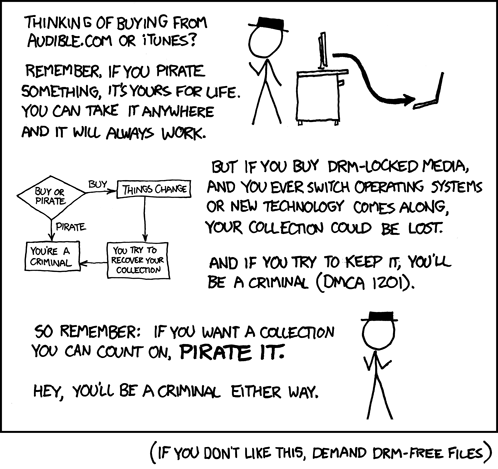
xkcd’s ‘Steal this comic’

If you dont like this, demand DRM-free files
xkcd says:  … I have lost every other piece of DRM-locked music I had paid for. 

While I have too much respect for the rule of law to advocate piracy, I do think that we need change bad laws.  And laws which turn the majority of the population into criminals (even without their knowledge) are bad laws – in my never-humble-opinion.

If you want more info on this – and missed my earlier rant on this, please, watch ‘Steal This Film’!  It is important that we understand how these laws can affect us….and what USED to be perceived as ‘piracy’:

  • in the 1970’s, network TV fought against Cable, saying putting their content onto a cable that ran to people’s home was ‘piracy’
  • when the VCR was invented, Hollywood movie studios predicted that this would be the end of them, as this ‘piracy’ would rob them of revenue.
  • the ‘sheet music’ people – as well as many musician unions – resisted ‘recorded music’, because they perceived it as ‘piracy’
  • the 1st mp3-player out there (long before ipod) was met with lawsuits for ‘facilitatin piracy’

Traditionally, copyright violation was a matter for civil courts.  In order for a criminal prosecution to occurr, there had to be more than just simple copyright violation.  But that is no longer the case, as corporations are forcing criminal charges to be laid agains simple, non-commercial copyright violation….that is something we need to pay attention to!

So, please,

Steal This Film

Steyn/Macleans update

As most Canadians are aware, the ‘Steyn verdict’ came out yesterday:  Steyn and Macleans have been acquitted.  If you are not aware of the situation:

  • Macleans is Canada’s oldest news magazine. 
  • Macleans reprinted, as an article, an excerpt from ‘America Alone’, a book by Mark Steyn.
  • In this excerpt, Mark Steyn quotes a Norwegian Imam as saying that (I am paraphrasing) Muslims will win Europe without ever raising the sword, because they will outbreed the indigenous Europeans.
  • The term the Imam used was that ‘Muslims are breeding like mosquitoes’…
  • There was never a question that this is an accurate quote, the Imam has confirmed saying this
  • Despite this, 3 different ‘courts’ – Human Rights Commissions/Tribunals in Canada have charged Steyn/Macleans for ‘spreading hate against Muslims’ for pritnitn this quote.
  • The Human Rights ‘courts’ do not follow the rigorous rules and procedures of a regular court, but their rulings are no less binding.  And, ‘double jeopardy’ (in this case, triple), where a person can only be charged once per offence, do not apply, nor does ‘innocent until proven guilty’, nor is truthfulness of the comment an acceptable defence:  they do not decide truthfullness, but ‘hurtfulness’ of a comment.
  • Their defence bill (not reimbursable, not allowed to even sue to be reimbursed for court costs) has topped 7 figures.

So, finally, yesterday, they were aquitted of the charges.  Here is an MP3 podcast of an interview where Mr. Steyn describes the experience in his own words.   Here’s the audio [mp3] (via Western Standard’s shotgun blog)

Chilling.

‘Right’ versus ‘left’: not a telling distinction

Many people are having a difficult time deciding how to vote, because it seems like we are having to decide between bad and worse….a discouraging proposition at best.  We see the ‘left’ as wanting to raise taxes and we can see how this will cripple the economy – and make us poorer.  We see the ‘right’ as ‘in bed’ with big business, not concerned with the well-being of the little guy, namely us.  And the ‘middle’ – we have seen the corruption there and it turns our stomachs…

What to do?

Big part of the problem is that we have been lookning at ‘politics’ as ‘left’ and ‘right’.  But, that only captures one aspect of the political spectrum, and not a very good one at that.

We need to re-define the way we view political party platforms and policies, but according to a different set of criteria.  Namely:  individualism versus collectivism. 

Collectivism is correct in recognizing that together, we can achieve more that each one of us could alone.  We should pool all our resources, and ‘the collective’ decides how we use them together in the best way. 

Of course, this is true – to a degree. 

The problem is that when ‘everything’ is decided by the collective, there is no longer such a thing as an individual – only ‘member of the collective’.  Thus, the good of the collective is placed above the good of any member.  The voice of the collective is placed above the voice of any member.  The will of the collective is placed above the will of any member.

The difficulty with this is obvious. 

There is an old saying that the ‘collective intelligence’ of any group of people is defined by the average intelligence of each person in the group – divided by two

‘Collective decisions’ are usually stupid – there is no denying it.  And in a setup where individuals are not heard, nobody can sound a warning against stupid decisions or doing counterproductive things.  To the contrary – anyone attempting to sound a warning will be perceived as opposing the collective and mercilessly torn to bits by a collective which transforms itself into the mob it inevitably becomes.

Individualism is correct in recognizing that every single one of us has a will and the ability to use it.  It places the individual as the ‘responsible’ ‘decision-making’ unit.  Sometimes, individuals may come together to pool their efforts and resources, but these are all voluntary arrangements and any individual has the right to opt out of them at any time.  In other words, there is no coersion to pool one’s resources with others.

Again, there is an obvious difficulty with ‘total individualism’.

We do not live in isolation.  We may be a group of individuals, but we are still a group and, as such, need the means of acting as a group.

We are a nation, a political entity – we need to pool our resources to protect ourselves and maintain order, etc.  And if most of us contribute towards maintaing order which all enjoy, those who ‘opt out of contributing’ are getting ‘free ride’.  This sets up a bad precedent and a bad dynamic.  Eventually, the ‘free loaders’ become resented… and could become just as torn to bits as the ‘member of the collective who speaks up’ in the ‘collectivism’ example, but this time by a bunch of individuals who ‘voluntarily’ form a ‘temporary mob’.

So, what we need to do is find a balance:  to form a sufficient collective to allow us to pool our resources and achieve those things we need to do ‘together’, but still retain enough individualism to not get lost in the process.  Achieving this balance is the difficult part. 

Before you protest that these are the same distinctions as ‘right’ and ‘left’, take a moment to look at history.  Yes, it is true that traditionally, ‘left wing’ idealizes ‘collectivism’.  But, just as having a ‘red square’ does not mean that a ‘circle’ must be ‘blue’, ‘right wing’ parties can – and often do – also embody the principles of ‘collectivism’:  Nacism, for example, is perceived as being ‘right wing’ – but it is very much ‘collectivism’.   It’s long name is ‘national socialism‘ – and socialism is a form of collectivism.

Similarly, George W. Bush’s policies are more collectivist than individualist – yet he is perceived as ‘right wing’!

This was the difference between the Canadian ‘right wing’ parties:  ‘Reform Party/Canadian Alliance’ were no more ‘right wing’ than the ‘Progressive Conservative Party’.  But where Progressive Conservatives were collectivists, the Reformers were fiercely individualist.  After the parties merged, the resulting party is somewhere in between…

Yet that is the difference between the current Conervatives in Canada and the current conservatives in the US – despite the US emphasis on the individual, it is the Canadian Conservatives who are actually (and very slowly) returning some of the decisionmaking to the individuals.  THAT is why the current financial crisis sweeping the US is not nearly as bad up in Canada – there simply aren’t enough individuals who had made as bad choices as some of the groups south of the border.

OK, this IS an oversimplification – and an intentional hyperbole.  But the principle meant to be demonstrated by it is the correct one – and ONE of the factors in this. 

So, if the ‘individualist’ ways are so much better, why are most successful political parties ‘collectivist’? 

In order to succeed in the political arena, a party has to present a unified image, stand for one thing that voters across the country can recognize and identify with.  A ‘Party Brand’, if you will.  This is easily achieved with a group of people who believe their individual voices are nowhere near as important as the voice of the collective.

If you have a group of people who are fiercly individualist, this becomes much more difficult.  The term ‘herding cats’ comes to mind!  The individualist will not hesitate to speak up when the party’s policy does not reflect their personal view of something.  That is what makes them individualists!

And that is what makes the ‘individualis’ parties look disorganized, not ‘together’.  That is why it is difficult for people to figure out what they stand for. 

And THAT is why most parties that value ‘individualism’ tend to be less successful than parties made up of collectivists. 

So, when you go to vote this time around – and if you are not sure whom to pick – take a look at the policies and ideas from this, slightly different point of view:  who will allow you the most individual freedom?  Who will respect you as an individual?  Is it the right ‘balance’ you seek – or as close to it as you’d like?

Perhaps if you do, you may arrive at a decision you will be happy with.

What do Olympics and DRMs have in common?

Freedom of speech is so important, it is fundamental to freedom in a society.  The threats to freedom of speech come in many shapes – some from government (like the Canadian Human Rights’ Commissions and similar organizations), some from religious leaders, others from corporate interests.

After all – he who controls what and how ideas are communicated has a great amount of control of what and how people think.  And how they spend their money.  Power and money – it’s that crass.

John Perry Barlow wrote, in an article The Economy of Ideas which appeared in Wired in 1994:

The greatest constraint on your future liberties may come not from government but from corporate legal departments laboring to protect by force what can no longer be protected by practical efficiency or general social consent.

Barlow was speaking of things which we have all seen to happen.  From DRM laws, which are based on the idea of ‘every customer is guilty of being a potential pirate, don’t bother with a defence’, to some serious weight being thrown around by the Olympic committees, we are experiencing true and real erosion of our freedom of speech and expression with the sole aim to further corporate interests.

Don’t think so?

If someone from ‘the government’ tried to control what people wore to a sporting event, we would scream ‘censorship’.  Yet, Olympic organizers get away with it – if your T-shirt displays a logo of a non-sponsor, you are asked to remove it, wear it inside out, or – I know this happened at the Athens games – you are handed an official Olympic ‘logo cover’ thingy you have to stick over top of your ‘unapproved’ logo.

This is all in the name of ‘protecting their sponsors’!

Want to drink water from a non-sponsor’s bottle?  Not at the Olympics….

Is your hotel, near the Olympic venue – and visible from it, not a sponsor?  Well, then its name will have to be covered up during the games by the official Olympic ‘sign cover’.  (In Beijing, all logos, even on water taps and toilets, from non-sponsors were covered up by sticky tape.)

And we all know how much the IOC is intent on ‘protecting’ freedom of speech from the nice deal they struck with the Chinese about censoring all ‘non-sports relevant’ internet sites.  Their attitude is best exemplified by this answer, given by BOCOG speaker Sun Weide, when asked why access to all sites about Falun Gong religion….keep in mind, the question was why was the access censored:

“I would remind you that Falun Gong is an evil, fake religion which has been banned by the Chinese government.”

But all this is just a tip of the ice-berg.

The IOC – and its various local minions – have been busy little beavers indeed.  If you think the Beijing one (BOCOG) was in Communist country and therefore much more oppressive than most, think again.  Look at what is already happening in preparation for the Olympic Games in Vancouver (VANOC) in 2010!

  1. Bits of the Canadain National Anthem are being TRADEMARKED by the Vancouver organizers.
  2. Other words, like ‘winter’, ‘2010’, ‘games’, ‘medal’, ‘gold’ and many more are also being trademarked by VANOC. 

Usually, these would be just too general to be registered – but that does not worry the Olympic committee.  While back, they got a law passed (I understand that there is a similar law in the USA), Bil C-47, which makes it OK…

You may think that it is really just meant to protect the sponsors, that the IOC would not abuse this to hassle legitimate businesses, right?  You might want to discuss that with the many businesses that have the word ‘Olympic’ in their name – even Greek restaurants, in Greece…or ones on ‘Olympic peninsula’ in North America.  They might be able to explain why they keep receiving letters from the IOC lawyers, telling them they are in violation of a trademark…

Freedom of speech indeed… 

From DRM laws which assume all of us are lawbreakers and must be handcuffed (digitally) lest we steal what we see, greedy corporate interests, to corrupt, money and power grubbing international organizations, we are increasingly finding our freedoms eroded, one little bit at a time.

And isn’t it a coincidence that both the ‘Olympic marks’ Bill C-47, which allows unprecendented powers of censorship to the Olympic Committee, and the ‘movie piracy’ Bill C-59 both received royal assent on the same day?

There is more than one way to stop ‘free speech’

Many of us who are 100% ‘free speechers’ wave our hands dismissively and tune out when somebody raises the issue of ‘fair use rights’ on copyrighted materials.  This is a mistake. 

Just as ‘free speechers’ are not just a bunch of racists and rednecks, no matter how loudly their opponents laber them as such, ‘fair use rights’ advocates are not just a bunch of ‘pirates’ and ‘thieves’.  If they were, they would simply steal the content – and certainly not bother to stand up and fight for their rights.

What we need to recognize that these issues are connected:  both revolve around finding the ‘right’  balance of rights versus limitations.  Once we recognize the similarities between these two seemingly separate issues, we can better understand how to arrive at a balance we can all be satisfied with – at least a little bit.

Just like we are willing to put limits onto ‘free speech’ – the proverbial ‘yelling ‘FIRE!’ in a crowded theatre’, and similar limits – it is also justifiable to place limits on the use of ‘music’, ‘movies’, books’ and other intellectual content meant for consumers.  In the first case, ‘public safety’ is threatened.  In the second case, the rights of the creators of this ‘IP content’ need to protect their investment and their ability to reap a fair compensation for having created it.

This does make sense.  The trick is, and always has been, in finding acceptable balance of rights. 

The problem arises when the laws are written so as to only protect one side’s rights, at the expense of the other.  It is no less oppressive than having unreasonable limits placed on one’s freedom of speech, in order to protect some from ‘hurt feelings’. 

But there is another connection, a very fundamental one, between these two issues:  both seek to restrict communication.  Limiting freedom of speech imposes limitations on an individual as to what they are, or are not, free to communicate.  So called ‘fair use’ laws seek to control the means of communication….

Recently, I watched a program that drove home the difference.  It is one-hour long (and part 2 of a 2-part series), but it is well worth watching.  Here, in brief, is the background…

In Sweden, there used to be different ‘fair use’ laws than in North America.  Under Swedish laws, it was legal to set up a company called ‘Pirate Bay’ – even though this was, at that time, illegal under US laws.  The ‘Hollywood industry’ used its influence to pressure the White House, which, in turn, pressured the Swedish government, into police raids and materiel confiscation against ‘Pirate Bay’, even though their own attorneys advised the government that the operation was perfectly legal…..  Part 1 of the show, ‘Steal This Film’ deals with this.  I found the segments of it on YouTube here, here, here, and here.

Part 2 discusses the very interesting issue of how these ‘fair use’ laws are (and are not) balanced – and why.  And yes, how this directly impacts ‘freedom of speech’.  Very interesting, the whole lot of it.  The links for the YouTube version are here, here, here, here, here and here.

While Part 2, section 2 has a comprehensive history of ‘copyright’ and its implications from book printing on (and thus VERY much worth watching), it is Part 2, section 4 that sums up – in my mind – the essence of this debate.  It is not just about IP – it is about the control of the means of delivering ‘culture’ to us all…  And whoever controls the means of delivery also controls which voices will be heard.

I suppose one could see the ‘fair use’ battle as the corrollary to the ‘free speech’ battle.  While one is a battle to allow one to speak freely, the other one is the battle to allow one to be heard freely.  After all, if one is allowed ‘free speech’ – but only in isolation, where what one says is not actually heard by any other human being – it is a hollow victory…

It’s something to think about.

Jumping junipers!

There are several types of blogs.  Some, much like ‘old-style newspaper’ editorials, present views and thoughts.  Others, much like ‘old-style newspapers’ themselves, bring you a collection of posts from other places by giving a little intro with a link.  There are other types of blogs, but this combination is usually quite effective in spreading news and ideas through the blogosphere. 

I like to think of the two types I described above as ‘articles’ and ‘newspapers’ – in the old fashioned ‘way’.  (In my own mind, I call the blogs who specialize in providing links to interesting places ‘blinks’ – ‘blogs+links’.)  And people learn which is which, and come to these sites with specific expectations.

Usually, I leave the ‘blinking’ to others much better at it than I….but when I came across this at Dime-a-Dozen, I didn’t quite know what to think…..

Robert writes:

Some random photos found on Flickr from a protest in 2006 – recognize the woman at the top?   Elizabeth May, leader of the Green Party.  This is from the notorious anti-Israel/pro-Hezbollah rally in Toronto during the Lebanon War.  Scroll below to see why that rally was notorious.

This appearance of hers likely slipped under the radar as no one knew who she was back then.  We know who she is now, so doesn’t she have some explaining to do?

The sign reads: ‘Down with Zionism, USA, UK’

The fellow in the turban is Hassan Nasrallah, head of Hezbollah.  The flag of Hezbollah is obscured by the kid with the keffiyah headband.

The t-shirts read “Hezbollah”


I still don’t know what to think:  Elisabeth May, the leader of a ‘national party’ in Canada – and who had gained herself a spot at the ‘nationla leaders’ debate’ as such – featured speaking at a pro-Hezbollah rally??? 

By the way – did you know that green is the sacred colour of Islam?  Talk about a ‘hidden agenda’….

Holy junipers!

Which way does the insult go?

I love Canada.  I am a proud Canadain.  However, nothing is perfect – not even Canada.  And it has made me ache to see my beloved country destroyed from the inside by the ‘tyrrany of the nice’.  Of course, there is nothing ‘nice’ about this tyranny.  It corresponds to ‘nice’ about as much as shadenfreude does to ‘pleasure’.

I speak of nothing else than the encroaching ‘fascism with a smile’The thought police.  And before most of us noticed, they have rotted the core of several of our legal institutions here in Canada – and are having a go in the USA, too.  But, like a wart – the infection gets deeply sunk into the flesh before the outward signs are visible.

More and more Canadians have begun to wake up and smell the poison in our cups.  Mostly regular people, who don’t understand why a person is not allowed to smoke a perfectly legal cigarette where a ‘privileged’ one can openly smoke marijuana.  Or why a priest must never express his views – for the rest of his life – on issues like gay marriage.  (Don’t get me wrong, I think it idiotic and immoral to oppose same-sex marriage.  But somehow, I expect that many priests might have a different take on this – and that is their right.)

And since the calm, laid-back Canadians that we are actually began to discuss this at the watercoolers, coffe-shops and medical clinic waiting rooms (lots of people to talk to there), you know the winds of change are not far behind.  So, how do our social engineers respond?

By sicking their ‘calming sqad’ at us. 

I have trouble reading most ‘mainstream media’ print, because I love the English language and it pains me to see the abuse of grammar so routinely commited there.  But, on occassion, people bring articles to my attention… as Blazing Catfur and FiveFeetOfFury have done here.

It is stories like these that make me question whether there is such a thing as ‘media bias’.  That seems a singularly inappropriate concept – which implies that ‘bias’ is something that ‘could’ be a property of today’s journalism.  Considering the ‘social engineering’ tone of ‘calming the populace’ this article takes, I think its aim is to educate us on what we ought to be thinking.  How could that be referred to as bias?  

It is not a ‘fluff piece’, as some seem to suggest.  To the contrary.  It is a well crafted educational piece, loaded with all the ‘proper’ buzzwords to ‘show us’ what we ‘ought to think’.  To coddle us back into our woolly-headed sleepiness.  Herd the sheep into the corale…   That is the aim of the article – at least, in my never-humble-opinion.

Yet, it seems to have backfired.  Perhaps it went too far in its tone of condescention, or perhaps it came too late.  People were too awake to simply sink back into their slumber.  The comments section reflects this, and is the most interesting part of this article.  I, too, would have left a comment – but there is no way I’m giving my address to any organization that prints drivel like this! 

Ah, yes.  The comments section.  Many of the comments point out that Mr. Warman, the much-admired subject of this article who often sues on behalf of others who – in his mind – ‘ought to’ have been offended but were not (and who is one of the worst offenders the thought police has to offer) is suing ‘some bloggers’ (including FiveFeetOfFury and BlazingCatfur) because, somebody commenting on their site called Warman a ‘Nazi’ (I think). 

What I am not entirely clear about is this:  is he suing because he thinks that calling him a ‘Nazi’ is an insult to himself, or to ‘Nazis’???

It could go either way, you know….

Correction:  Blazing Catfur is not, in fact, being sued by Warman (though she had been threatened with other suits).  This was my misunderstanding.  However, many pro-free speech bloggers are.  I apologize for my mistake.

UPDATE:  The Globe and Mail has not closed the ‘Comment’ section on the article I wrote about in this post.  However, Blazing Catfur has taken some screenshots and these can be accessed HERE!  I wonder if this is simply frustration on thier part, because their ‘education’ had backfired, or if someone had threatened them….

‘The Truth about big government’

As the political debates rage on both sides of the 45th parallel, it might be timely as well as interesting viewing:

The Truth About Big Government (part 1 of 2)

The Truth About Big Government (part 2 of 2)