Learning from history…

In the past, I have ranted on about how it is not enough to learn from history, but how we must actually learn the right lesson from it.

Perhaps I was just a little too eager…

Perhaps it would be asking way too much for people to learn even the most literal, obvious lessons from history…

My ideas on the lessons from history was turned upside down from the boys down under…

Immigrants: escaping the ‘self-imposed ghettos’

Over the last few years, people all over the world have noticed ‘problems with immigrants’.

Failure to integrate leads to demands for the host culture to adapt to the immigrants, rather than the immigrants adapting to the culture and accepting the customs of their adoptive land.  Perpetuation of non-integration leads to immigrant-youth alienation, which, in turn, leads to immigrant-youth radicalization.  This leads to a vicious cycle of conflict between immigrants and their host cultures.

BUT IT DOES NOT HAVE TO BE THAT WAY!!!

Immigrants come to their new, carefully selected homeland filled with dreams and hopes….  I know I did!!!  Along with these, there are also a few apprehensions, or dowright fears.  The greatest fear which I, as an immigrant, personally faced in coming to a new land is that of ‘the unknown’.

Yes, most of us educate ourselves about our new land before arriving here.  We study the demographics, the political system, the statistics about the population.  Yet, the textbooks can never capture the essence of the landscape, TV-documentaries never reveal the true atmosphere of a place – at best, these are mere glimpses that can help prepare us for the reality which our new homeland will be.

And we want there to be differences! If there were none, there would have been no point to having left our birthplaces!  We come here for the differences!

So, it is not the fact that there are differences that is frightening.  Rather, it is the not knowing the scope of the differences….and how we will be able to understand them and learn to adjust to them.  It is sort of like going through one’s teens all over again – but without the benefits of youth!  That is a very real fear most of us immigrants do face when we first arrive.

It is natural that we should reach out to others, who have gone through this before us.  Especially the members of our original ethnic groups who will have experienced these differences already, and know how to explain them in cultural and linguistic terms that are easiest for us to understand.  It is comforting to the new immigrant to see people who came from similar backgrounds are thriving and happy here, and we try to learn from thier experiences.  And that is good – usually…

As with everything, too much of a good thing becomes poisonous.

So it is with this type of help. 

The first, and perhaps most obvious, danger is that the person(s) doing the explaining of the customs have not successfully integrated themselves, that their understanding of the mainstream culture and how to integrate into it is flawed. 

This does not, in any way, shape or form, imply that there is any malice or ill intent here.  To the contrary.  There are many immigrants who misunderstand or misinterpret much of the cultural mainstream about them, and only partially succeed in integrating.  Perhaps their professional skills and/or their tenacity allow them to succeed economically, but they simply do not have the time, skills or desire to integrate socially.  Perhaps their social obligations to non-integrated members of the community hold them hostage.

It does not mean that they are any less intelligent, or any less ‘cultured’!  Not in the least!  Being able to successfully integrate into another society requires a specific set of skills, and ‘intelligence’ is not a deciding factor in these.  Nor is the ‘previous culture’, the one they are coming from, necessarily an indicator of how successful will be their social integration.  I really do not know what the indicators are, or what the required skills are – though mastering the language does have a lot to do with it.  Simply, I have observed that this phenomenon of ‘partial integration’ cuts across cultures, professions, education levels – even perceived ‘people skills’.

The people who have only partially integrated then naturally cleave towards other immigrants, who are a ‘fresh source’ of contact with their ‘original culture’.  After all, intelligent, sociable people have a need for ‘cultured expression’.  Those for whom the host culture is incomprehensible – or, at least, viewed in a skewed way – will seek out immigrants in order to satisfy this need to sustain the ‘cultured’ part of their soul. 

In turn, they honestly try to be helpful to the newcomers, helping them establish themselves here….mirroring their own un-integrated ways!  And much of what they do is helpful – yet, at what cost…

This is strike one against many new immigrants:  the very help they receive may, indeed, perpetuate misconceptions about the host society and actively prevent the new immigrants from successfully integrating within it.

The second, much less ‘visible’ or ‘correctible’ danger is ‘social indebtedness’.

One of the best human qualities is our reciprocity in kindness.  It is what we need for that most human of things:  building communities. It is one of our best qualities – yet, it is also this very same quality which may shackle immigrants and prevent them from successfully integrating into their host society.

When we receive help from someone – someone who is truly interested in helping us, not one who is trying to somehow get an advantage by doing things for us, but who is genuinely doing things because they want to help us, we feel truly gratefull, and ‘well-inclined’ towards them.  We wish to reciprocate their kindness.  Through this benevolence, this ‘reciprocity of voluntary kindnesses’, communities are built – one relationship at a time. 

In order to successfully itegrate, an immigrant needs to turn to its host society to satisfy her/his cultural needs. 

If this does not happen, there will not be anything but the most superficial integration.  It is therefore ESSENTIAL that these ‘community bonds’ be establilshed with members of the mainstream society – NOT that of the socially un-integrated immigrant community!

Yet, it is exactly within the un-integrated elements of the immigrant community that a newcomer to a society will find help, and it is with these people that the social bonds will begin to be built through ‘reciprocity of kindnesses’.

Before they realize it, many immigrants find themselves living (socially and/or physically) in a self-imposed ghettos, made up of immigrants from their background, who have not integrated into the host society.

As the size of this ‘ghetto’ grows, the need to integrate decreases.  Once the ‘community’ is large enough to satisfy both the economic and social needs of the immigrants, there will be little incentive to interact (much less integrate into) the host society.  Even worse:  any desire or attempt to integrate (outside the immigrant community) will be perceived by the ‘helpful’ elements within this sub-culture as ‘being ungrateful’ for the help received.  After all, this would be a rejection of their version of the host society – and, in effect, the rejection of the benefactors themselves!!!

Nobody wishes to be ungrateful or disrespectful of the very people who have gone out of their way to help her/him.  Eventually, there will be very strong pressure on the new immigrant to reject integration into the host society.

So, how do we escape this self-imposed ghetto?

I don’t know a ‘good’ way of going about this.  I know how I escaped – but I also know ‘my way’ cannot possibly work for everyone…. 

I escaped by ‘being eccentric’.

I’m the first one to admit it – I am eccentric.  And, ‘eccentric’ is one of ‘them irregular words’:

  1. I am ‘original’/’free thinker’
  2. You are ‘eccentric’
  3. he/she/it is ‘certifiably nuts’

I know I hurt people’s feelings along the way – people who were nice people, and tried to help me the best they could.  But, I was ‘equal’ in my treatment of others and rejection of their ‘help’.  Soon, my ‘would-like-to-be-benefactors’ realized that I was indeed grateful to them, in my own way, it’s just that I was a bit weird…. and incredibly pig-headed, headstrong and perhaps even a little bit stubborn! 

So, socially, I was ‘written off’ as a ‘lost cause’….. 

Still, when I became of ‘marrigable age’, there were MANY attempts to find an ‘appropriate match’ for me from within the ‘immigrant community’.  I suspect that male or female, all young immigrants – and children of immigrants – go through this to some degree.  And I also understand that this is really meant in the best possible way. 

But, well, that way, self-ghettoization lies! 

Again, I know I was seen as rude – but in the most polite way I could manage (yes, that is not saying much…), I rejected ALL ‘help’ equally.  I did understand the desire to help me drove these efforts, and thanked my ‘benefactors’ for their efforts, even as I rejected them.  As politely as possible, but firmly and definitely. 

My best help in this came from my parents.  They were supportive of my desire to fully integrate.  Had they had a different set of morals, had they thought my desire to actually exercise the freedoms my adopted homeland afforded me was an attack upon them and their honour, I might not have had the desire or courage to make my integration complete.  And to them go  my eternal thanks for empowering me like this!

In times when so many immigrants live in self-imposed ghettos, it is important for those of us who have succeeded in integrating into our host cultures to share our experiences and insights.  It is imperative that we go out of our way to help all other immigrants – not just those from out specific background – succeed the way we have, so they, too, may enjoy all that our new homeland has to offer us! 

It is just as important that we do identify ourselves as immigrants to ‘the mainstream culture’ – in order to make people see that immigrants CAN successfully integrate!  And, of course, to reassure them that we came here BECAUSE of thier culture and customs, and that we, the immigrants, want them preserved at all costs!!!

Therefore, it is also imperative that we, the well-adjusted immigrants, oppose most vehemently and most vocally the erosion of values in the cultures of our adoptive homelands!!!  We are the ones who MUST LEAD the forces that protect the cultures and customs whose protections we sought when we were the most vulnerable! 

After all, this is the only way we will be able to preserve our host cultures!  We have NOT picked them lightly, we picked them because we liked them. 

Perhaps we each and every immigrant is not completely comfortable with all aspects of the host culture, but the whole is what we came for, and this whole cannot exist without the bits we are not all that comfortable with….so we must protect ALL OF IT!!!! 

All right, I know I am ranting now – but, well, this is something really, really important! 

I do not wish to loose all that my adoptive homeland has to offer – especially its culture!  I came here for the benfits the ‘Western culture’ of individualism has to offer – and I’ll be damned if I don’t do everything in my power to preserve it for my children to enjoy!!!

Canada’s ‘relevances’

It seems that everywhere I turn to theses days, some icon of ‘Candadian-ness’ is being eroded, poo-pooed or called irrelevant.  And that makes me angry.

Why?  I happen to like Canada.  I am a Canadian by choice.  I immigrated here a few decades ago, because I liked what Canada was, its values, its attitudes to its people and peoples.  Perhaps that is why I am so upset to see that Canada erased, one little symbol, onle little custom at a time.

Last month, we celbrated Victoria Day:  the birthday of Queen Victoria, which also represents the birthday of Queen Elisabeth II, the queen of Canada.  Predictably, many people used this occassion to diminish the role of The Crown here, and ridicule our system of government, the constitutional monarchy.  I think that John Robson – who used to be a History professor, and understands the workings of political systems (brokien or not) had said it best in his column, where he heaps criticism on those who hurl uninformed abuse in the direction of our monarch:

“More generally, I don’t see what they think are sound constitutional principles. Do they favour a separation of powers, with or without checks and balances? Should the chief executive have a veto over legislation? Should Supreme Court appointments and foreign treaties require legislative assent or remain part of the executive prerogative? Or would they prefer “convention” government by an all-powerful legislature, a quasi-monarchical system where all power rests with an elected executive, or perhaps pseudo-aristocratic government by appointed judges accountable only to their own impeccable political correctness? Do these people have a theory of government at all? Resentment doesn’t qualify, and neither does insolence.”

“If people don’t know our history, including why we honour Queen Victoria, they should learn it. Good government isn’t just for dead white males. All Canadians enjoy an enviable constitutional heritage. And while suggestions for refining it are welcome, they require a foundation more solid than ill-informed scoffing and hitting distinguished people in the head with hard objects.”

Mr. Robson is right, as he so often is.

Then, last week, CBC – our tax-payer funded TV corporation, has decided to not renew the rights to a silly little song that it had used for some 40 years to announce ‘Hockey Night in Canada’ – its only profitable show.  OK, not a big deal, it’s just a jingle.  Except, that is not the point.  The point is that so many Canadians identify this song with their childhood and their, well, ‘Canadian-ness’, that the fact this overbloated, condescending, brainwhashing-focused public white elephant (the CBC, in case I lost you) thinks so little of preserving it…well, it is a symptom of their disconnect with the populace they truly think they represent! 

The CBC big-wigs think the jingle irrelevant – and by doing so, they are telling a lot of Canadians that their concept of what makes them Canadian is also irrelevan, even unacceptable in this brave new world of theirs.

And, of course, this goes hand in hand with the erosions of our basic rights – our naturual heritage as Canadians and free peoples – like ‘that American concept’  (as a Human Rights ‘inquisitor’, and a public servant, had called it) of freedom of speech.

Yes, these are all connected.

We must start paying attention to the little things, as well as the big ones, because together they weave the fabric of who we – as Canadians, as ‘Westerners’, as free human beings – are. 

Great idea – people helping each other

There are so many things to write about – but today, something truly good took place.  It is an all-round happy story.  It all got started a few years ago…

We all know that some of our neighbours are having a tough time making ends meet.  The cost of food and fuel (!!!) does not go into the official inflation calculations, yet we all know that feeding a family costs way more than it did even 6 months ago.  It is therefore not surprising that many families or people on fixed incomes end up relying on visits to the local food bank…  Sad, but true.

At the same time, local beef farmers were hurting.  The US had closed its market to Canadian cattle, which caused the prices of beef to plumet – at least, for the farmers.  Thwell, let’s just say that through a combination of many factors, the farmers were receiving record lows for their cattle, yet the prices at the stores were at an all-time high…

Now, there was a smart person (and I would tell you his name, if my ‘Google’ were functional today – rather than mangle the spelling, I’ll supply the name in an edit when I get my system up to snuff) who saw a way to make things better:  both for the people who had difficulty making ends meet – and thus were not likely to be able to afford much meat in their diet – and the local farmers who were hurting because they could not get a fair price for their livestock.

FOOD AID DAY was born!

The idea is simple:  people donate money, which is used to buy livestock from local farmers at a fair price.  This livestock is then turned into ground beef, which the Food Bank in turn distributes to those who are in need of help.

It’s a WIN-WIN-WIN situation!

  • The farmers win, because they get a fair price for their work, and do not end up at the Food Banks (or in forclosure, loosing the farm) themselves.
  • The people who are down on their luck and in need of the help get much needed protein, the importance of which is obvious. (315, 000 pounds of beef so far, and counting!)
  • The community wins, because not only do we have great fun during this day, we know ‘we gone done good’. 

During the day, CFRA, a local radio station and great force for good in the Ottawa-area,  was taking pledges on air.  And while many of us city folk dug into our pockets, there were calls from farmers who were donating a cow or two…  How cool!  It’s not every day you hear a person say “I’ll donate a cow!”

Since its inception in 2005, the highlight of the Food Aid Day festivities is the traditional ‘Celebrity Cow-Milking Competition’.  Local media people, personalities and politicians have called up their best farming skills to compete:  who can get the most milk from a dairy cow in one minute!

Yes, always entertaining!

And, this year, the winner of the 10:30 Cow Milking Competition?

Mrs. Laureen Harper – the First Lady of Canada herself!

Congratulations, Mrs. Harper!  Congratulations to all those who have worked hard to make today a success!  Last but not least, thanks to everyone in the community who helped – by participating or donating.

When good people come together, wonderful things happen.  It proves we CAN achieve things, make life better for all of us, that working together as a community really does bring people together like very few other things could!

XKCD – Aspie Humour

Many people claim that Aspies do not have a sense of humour.  NOT TRUE!!!

We certainly do enjoy humour.  Some of us naturally find some things funny, others need to learn the rules of humour – but we certainly enjoy it.

In my never-humble opinion, teaching kids with Aspergers the rules of humour may be helpful with overall social skill development.  I have done this, and seen the improvement in their ability to interact with their peers and the resultant increased comfort level with themselves.

Here is how I might go about ‘explaining humour’:

There are several things that constitute ‘humour’ and different people will find different things funny – so there is no need to feel bad when you understand a joke, without thinking it is funny.  Some people think that anything to do with bodily functions is funny – and they will laugh when someone farts, or of they burp.  Other people think this is gross and not at all funny.  So, it is normal that not everyone finds every joke funny.

Many poeple laugh when they find themselves in situations which either do not go as expected, or when some danger is lifted.  This is done to release tension which people experience in such situations, and which is unpleasant.  It demonstrates to others that either the danger has passed, or that even though things are unexpected, the new course of actions is acceptable.

Perhaps that is why so many jokes are ‘funny’ because of an ‘unexpected’ or surprising ending.  It might even tie in with why ‘strange’ or ‘different’ or ‘unexpected’ is sometimes called ‘funny – but not as in ha-ha’.  Puns are an excellent example:  the correct (or correctly sounding) word is used, but in with an unexpected meaning.

It is not easy for Aspie kids that many cartoons rely on facial expressions to convey humour.  That is why I was so entertained when I came across this (not aimed at kids) comic, XKCD.  To me, it screams ‘Aspie Humour’!

And since along with a sense of humour, many people incorrectly describe Aspies as lacking feelings or empathy, I have selected, for your viewing pleasure, these few XKCD comics:

We like to spend time with our loved ones.

We love to spend time with our loved ones - XKCD


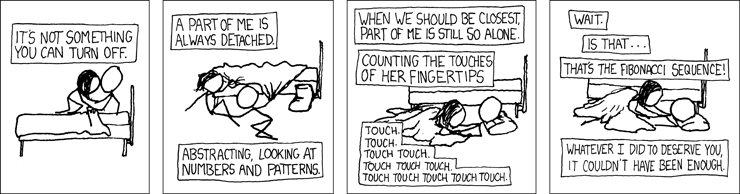
Passion reaches new levels for us!

Sharing thought - XKCD


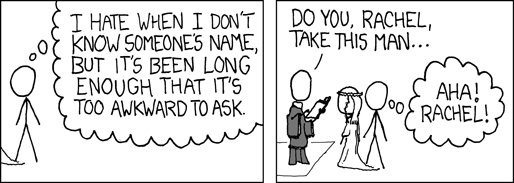
 Of course, we may have a hard time remembering names….  Nothing personal!

forgetting names - XKCD


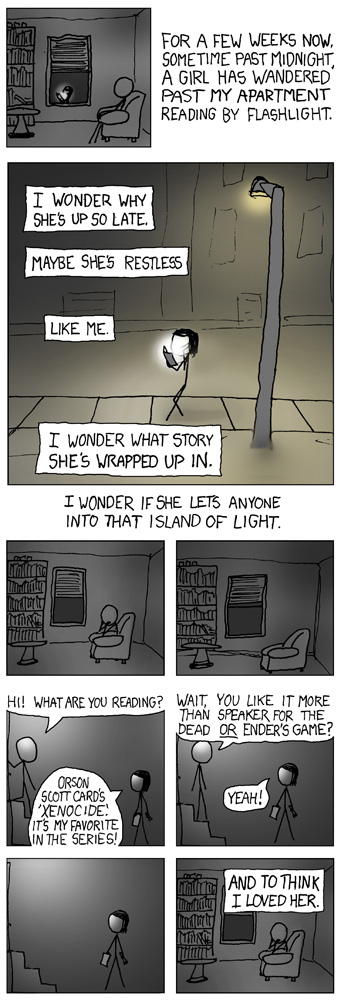
 Yet, we can be very particular in whom we select as potential mates:

xenocide - XKCD

Personally, I could not date someone who did not thing ‘Ender’s Shadow’ was the best book in this series.  Ok, if he were cute, I might settle for ‘Shadow of the Hegemon’.  But ‘Xenocide’??? Really!

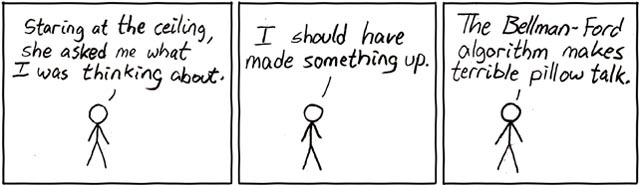
And ‘pillow talk’ is much easier if both of you are Aspies….

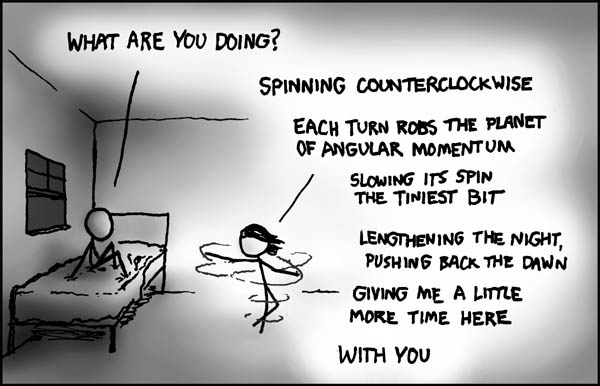
pillow talk - XKCD


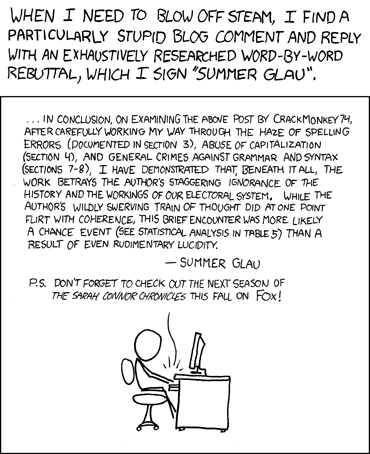
And many of us fully appreciate the advantages of online interactions with others (my husband claims this ‘has to be’ taken from one of my online comments….):

venting - XKCD


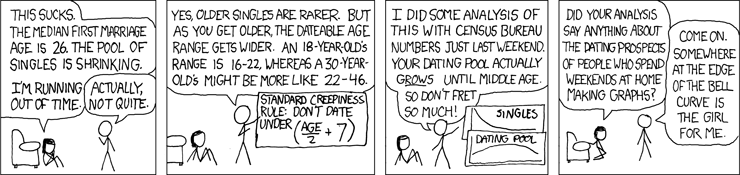
Here is a good example of how not everyone ‘gets’ every joke.  For example, in the following one, I do not understand why the characters are implying this practice is unusual.  Surely, it is the norm!  (See my posts on Old Men in the Bible)

graphs - XKCD


But we all enjoy good quality entertainment!  (And no, this is NOT just a cheap ploy to get ‘Papyrus font’ onto my blog!  Though, who could resist the allures or ‘Papyrus Font’???  It’s even better intelic…)

 River Tam - XKCD

 EVERYONE loves River Tam!!!

add to del.icio.usDigg itStumble It!Add to Blinkslistadd to furladd to ma.gnoliaadd to simpyseed the vineTailRank

Abolish, not boycott

This morning, a talk-show host on the radio was going on about teaching the moral leeson of the Olympic Spirit to our children….  It made me think:  what exactly are the ‘morals of the Olympics’?

Since we live in modern days (and in order to not get into actual wars fought inside the Olympic stadia while the races were on), let’s just look at the morals displayed in the modern-day Olympic Games. 

The logical place to look is at the governing body, the International Olympic Committee (IOC).  Just a quick ‘Google’ for ‘IOC Scandal’…and the first five searches yielded scandal stories written in 5 different years:  2004, 2000, 1999, 2002 and 1998 respectively.  Either, they have a LOT of scandals, or their scandals are big enough to drag on for years….  Bribery and misconduct are among the charges.  A fine example of ‘moral’ behaviour by the individual members of the IOC…

Yes, you may say, humans are not infalliable.  At least their aims are good!  Well, look at their stated goals on the Wikipedia page.  I will list them here, translated from ‘bureaucratese’ (in which I am fluent) into ‘common-sense’ English (caution – this is my interpretation, and might differ from the way the IOC might wish you to interpret them):

1.  Promote ‘ethics’ and ‘fair play’ – that is, if the Russian figure skating judge promises to the French figure skating judge that if she gives the Russian pair the highest marks, they’ll give the French ones high marks in individual skating, by gosh, that Russian judge had better keep his word!

2.  Give money to our subsidiary organizations.

3.  Make sure EVERYBODY celebrates (gives money to) the Olympic Games – that is, us.

4.  World peace – you can pay for it through us!  Send money to P.O. Box…

5.  Protect the ‘Olympic Movement’ – yeah, and poo-pooh people who criticize us!  They’re probably just jelaous of our cash!

6.  Same as point 5, but in different words:  we really don’t want to stem the flow of cash!

7.  Promote women’s sports and equality of all men and women.  That is why we’ve imposed sexual apartheid in all competitions – the pretty little things would stand no chance against us big strong men!

8.  No doping – unless we’re paid off to change the tests first.  Just today, we’re taking an American runners’ medals away – so make sure you pay us enough!

9.  Protect the health of athletes:  that is why we make sure that the levels at which these athletes compete will cripple them from arthritis by the time they’re 40.  And, the smog-filled places we hold the games, well, the health effects of smog are exaggerated…

10.  Oppose commercialization and politicization of athletes.  Really, we mean it!!!!  Never mind that the Olympic Games are plastered with sponsor ads.  We can prove the politicization bit, though:  the accomplishments of the athletes themselves are recognized – not their home country….except for all the anthems and flag-waving and keeping track of medals by country and…  Just, never mind this one!

11.  Home countries should pay the athletes to train, so we can make money off their performances.

12.  Promote sports – through our subsidiary organizations only, so the cash can keep flowing!

13.   The decision of where future games will be located will be made based on the latest political buzzwords, as well as bribes financial contributions to our movement (yeah, not the ones to us individually).

14.  Leave a good feeling with the host country/city – i.e. we will be gracious in accepting the bribes culturally enriching presents from our hosts.  In the name of the Olympic Spirit, of course…

15.  Politicize sports, brainwash kids to it – it doesn’t count when we do it.

16.  Give money to our minion subsuduary organizations.  Keep the cash flowing!!!

Oh, my, these are some ‘morals’!  Are we sure this is not a religious cult in its own right?  All that talk about sending money, and the ‘Great Olympic Spirit’, and promoting themselves…  However, I fail to understand why anyone would want to teach this – as a ‘good thing’ – to their kids!  Just a bit more decay, and the IOC will be as ‘moral’ as the UN!!!

Perhaps calling for the boycott of the Beijing games is not the best course of action:  perhaps we have to scrap the whole thing!  Starting with the Beijing games…

Conspiracy or good marketing?

Oh, my!  Technology is FUN!!!

Today, I had some REAL fun.  Thanks to a tip from CanadianBeaver, I stumbled upon BlogTV!  Sort of like any other blog, except that instead of text, you pump out live video, and people type comments which pop up as you go….  And, once I got me a mike, I got to even talk – live – to a whole ‘roomful’ of people who were chatting with CB!  Thank you, one and all!

One topic which came up was the ‘world domination by the illuminati/banking families/the-13-bloodlines’.  I’d like to make an important point:  never ascribe to a ‘conspiracy’ what you can explain by human stupidity/greed.  Or, really, really good marketing!

Think about it, really.  If YOU were a person in control of great wealth/multinational corporate conglomerate, and you had the opportunity to create strategic alliances with other really wealthy businesses/individuals/families, would you consider this to be ‘a conspiracy’, or would it simply be good business sense?  Prudent corporate strategy, perhaps? 

How naive would we all be if we did not think that ‘strategic alliances’ have been forged and broken and re-forged, all throughout our history?  Visible ones, and ‘behind the scenes’ ones…  It is the most predictable, natural course of things… and calling it a ‘conspiracy’ just seems so silly!  Of course it is going on.  Of course the aim is to concentrate wealth, control and market share – power.  It is the most reasonable course of action! 

And….what is the real difference between being ‘secretive’ and ‘discrete’?

But to think it all this is somehow evil?  Come on!

Symptoms and Causes

Advertizing and politics are some of the most obvious examples of ‘idea bundling’, as I discussed in my last post.  But, these are not, by far, the only fields.  This trend can be seen everywhere around us.

Bundling ideas can be useful by helping us categorize our surroundings, yet it can also hinder us – especially when other people try to do the ‘bundling’ for us.  Sometimes it is intentional manipulation (advertizing, ‘spin’, propaganda), but often, the people doing the ‘bundling’ are not even aware they are doing it…..and these ‘bundles’ are often the hardest to ‘unpack’ into their components, since there is no ‘false note’ to detect!

One of the greatest dangers of this is that when a specific ‘solution’ is a part of a ‘bundle’, it is harder for us to recognize whether it is a ‘symptom fix’ or a ‘root cause solution’.  And mistaking symptoms with causes is so easy…and so unfortunatelly frequent in our society!

Perhaps it is a human characteristic, perhaps there is a lapse in the schooling we received in critical reasoning … but confusing symptoms for causes is just SO rampant!!!!  And so many of us do not even seem to recognize that this is even going on, much less see it as a problem.

The whole ‘banning cellphones while driving’ debate is a case in point: the cellphones are a symptom of distraction, the underlying cause is the apalling disrespect some drivers accord to the act of driving – considering driving an ‘automatic right’ instead of an earned privilege.  And, while bannig cellphones while driving may make us feel as if we are ‘protecting society’, and politicians may get a few extra photops, it does not fix the underlying problem of getting drivers to pay attention to driving….  What’s next:  banning the application of ‘mauve dreams’  shade of lipstick because statistics clearly showe that more people crash while applying that shade of lipstick during driving than any other?

Another example is the alarming attitude in our schools:  volunteers who wanted to help kids who were falling behind in math were turned away, on the grounds that being seen as singled out for extra help would stigmatize a child.  Oh no, the lack of math skills (for whatever reason) was not a problem at all.  No, the problem was being seen getting help!!!  The symptom (potential embarassment) is treated, not the undelying problem (lack of skills).  I would not have believed it if I had not seen it with my own eyes. 

It is part of the same absence of critical thinking that ‘protects’ children from being ‘stigmatized’ by having them repeat a grade when they have not learned material, and instead allows illiterate children to graduate from schools.  They will be completely unprepared to face the challenges in life, but they will not have had their feelings hurt along the way…..  We are teaching our kids that it is OK to be ignorant, but not OK to be seen working hard to improve… What was that about ‘learned helplessness’?

Perhaps it sounds like I’m picking on the educators (and they do make it so easy), but this is just the tip of the iceberg.  Just look around you – the examples aboud! 

We, ‘the Western society’, seem to be rapidly loosing the ability to distinguish between causes of problems – which need remedying, and the symptoms of problems – which can lead us to the causes, but would which it would be pointless and a waste of time and resources to address in isolation.

 …and don’t get me started on separating valid from silly idead which had been ‘bundled’ together!

Bundling Ideas

Patterns – how fascinating they can be!  For some of us, patterns can become obsessive…and I am no exception.  If I examine a piece of clothing, I’ll be able to reproduce its pattern.  I can accurately draw the floor plan (pattern) of every single building I’ve ever been in (at least, the areas I saw).  I love visual puzzles.  But, observing social interactions – human or animal – has always been my favorite venue for observing patterns.

One very important aspect of human behavioural patterns is that we tend to bundle ideas together.  It seems so very natural to us, we don’t really even think about it.  Yet, we inevitably do bundle ideas together without even being aware of it.  It couldd be as simple as ‘connotations’, at other times the ‘bundling process’ is more complex. 

This is a handy way for us to ‘categorize’ things, help us make sense of all the ‘stuff’ out there.  And that is good.  As long as we remember that we are doing it.  Because if we are not careful, we can end up rejecting very good ideas (or accepting very bad ones), just because someone (innocently or manipulatively) has managed to bundle them with a whole other set of ideas that are quite unrelated, yet which will colour our perception of the whole ‘bundle’.

Perhaps I am not being very clear … an example or two might help illustrate.  One time, while buying shampoo, my (at that time) four-year-old son told me I should buy a particular brand.  When I asked why, wondering if he liked the smell or something, he answered:  “Because you’re worth it, Mom!”… this was the catch-line of that brand’s latest ad campaign….

Ads are one of the most familiar ways ideas are intentionally bundled:  if the advertising campaign can successfully link a product with an image which is desiarable within the target audience, the sales of this product will be higher than should the campaign have only presented factual information on the product.  This works with positive as well as negative advertising.

Most of us are wary of the manipulation of idea-bundling by advertizers, but there are so many other areas in which we are bombarded by these idea bundles, yet where we are much less sophisticated at detecting them.  Still, they occurr all around us. 

So, what does one do when society ‘bundles ideas’ in a way that does not line up with one’s own ‘bundles’?

Perhaps the most obvious example is in the world of politics.  The more ‘right of centre’ one’s fiscal and social ideas are, the more one is presumed to be ardently Christian.  The more ‘left of centre’ one’s fiscal and social ideas are, the less ‘religiously Christian’ their ideas are presumed to be.  Perhaps, in the past, this might have ‘sort-of’ been  so.

This ‘bundling’ of ideas on the political scene really does not account for the emerging trends within our society.  Two of these many ’emerging trends’ are ‘non-religious conservatives’, the other are ‘very religious non-Christians’.  These are just two off several of the fast growing segments of our population that simply do not ‘fit’ the political ‘idea-bundles’.

It is extremely difficult for non-religious (or, the also emerging anti-religious) conservatives to find a place in our society.  These people are extremely uncomfortable with the religious right, and their motivations for many policies.  Yet, they see the folly of the social and fiscal policies of the liberal (or, perhaps more accurately called, anti-liberty) left. 

On the other hand, the ‘religious right’ perceive this new and growing segment on their end of the political spectrum with suspicion, not considering them to be ‘real’ conservatives )and being very vocal about this).  Perhaps that is how people like George Bush Jr., whose fiscal policies are anything but conservative, yet who is a Christian fundamentalist, can be perceived as somehow more ‘conservative’ than a fiscal conservative libretarian who is not shackled by religious dogma.  I’m not making a judgment here, simply observing a pattern!

Similarly, many very religious non-Christian immigrants are finding an uncomfortable ‘political home’ on the left side of the spectrum.  Not hung up on the historical division between the religious right and the communist (and atheist) left, they appreciate the benfits they receive from social programs instituted by ‘left’.  Among a small segment of them, there is also a very real fear (justified or not)  of both the ‘religious right’ and the ‘libretarian right’.

This is the dilemma that was, to some degree, faced by the Jewish populations in ‘the West’ following WWII.  As Barbara Amiel (yes, Lady Black is Jewish) had explained in her writings, following WWII, many Jewish people were, rightly or wrongly, wary of anything that was deemed ‘right wing’ – and threw their support behind the ‘humanist left’, whatever the costs.  An unesy arrangement, at best.

So, with the growth of non-Christian religious vote, are we going to see a re-alignment of the current political parties?  Will the ‘consrevatives’ come to represent non-religious, fiscally conservative libretarians, while the ‘religious vote’ will flock to the ‘liberal/socialist’ vote?  Or will we see a fragmentation of the traditional parties, into the ‘four corners’:  ‘religious right’, ‘religious left’, ‘non-religious right’ and ‘non-religious left’? 

And if we do, how will the different faiths within one movement come to terms with each other?

What Convinces Us: the corollary to ‘How We Argue’

Often, I feel like an outsider looking in on how the rest of the world lives, bewildered by all these ‘unseen rules’ that guide human interactions.  The fact that I am heavily ‘Aspergers’ probably has a lot to do with it:  I compensate for my lack of intuitive understanding by obsessively observing and cataloging behaviour.

Noticing how people argue seemed relatively easy:  the evidence was ‘out there’.  But understanding what convinces people to change their minds….that I have found much tougher.  I can see the arguments ‘out there’, in the open, but the ‘convincing’ process itself is inside a person’s head – hidden from direct observation.  It was easy to see that some arguments were more effective than others, but it always puzzled me how come an argument could convince some people, but not others.  Do not all people undergo similar thought processes?

I’m still not sure I get it.  But, it seems to me that both how much of an ‘investment’, and of what type it is, is of importance. 

A few years ago, something unusual happened: I was wrong.  Yes, it does happen, occasionally….  :0) 

During a get-together, I got into a heated-yet-amicable discussion with someone on an inconsequential topic – and, not having proof for either side on hand, we came to an impasse.  Another person came in, who just could have had the answer, so we asked her.  As she began to speak, it became apparent that the information was not favourable to my position, but the general revelry of the get-together was beginning to drown out her voice.  So, I started to ‘shush’ everyone, so we could hear the rest of what she had to say.

My opponent, sparks of laughter in his eyes, commented that perhaps it was not in my interest to be getting her to speak, as she’ll only prove me wrong!  This puzzled me, and I said so:  I’d rather be proven wrong, than persist in an incorrect position.  It was my opponent’s turn to be puzzled – it seemed this approach, which I took to be the only plausible one, had never occurred to him.

This gave me a big clue:  some people cannot be convinced, because they value winning an argument (and not ‘loosing face’) higher than they value being right.  And if this could be true of an inconsequential thing, among friends – where laughter was the measure of the volume of the argument – how much more true this would be for ‘big things’!

One of the ‘big debates’ that is going on now centers on the veracity of the ‘Anthropogenic Climate Change’ model.  I was one of the earliest proponents of ‘global warming’ – it sounded reasonable to me.  However, over more than a decade of  reading up on the underlying science, the IPCC reports, and after speaking with some of the scientists (and an economist)who were part of the whole UN shindig about it, I have concluded that it is much more of a political tool for behaviour modification than it is a scientific theory…

Not that long ago, I got into a discussion about ACC with an intelligent, educated young man – and an excellent debater – whose positions fall far left of the centre.  I made an observation that most of the ACC’s proponents were left of centre, and he accused me of politicizing the debate.  Yet, he was logical, and challenged me to convince him that ACC is a load of dingo’s kidneys, without ‘politicizing’ it. 

So, I explained a lot of the ideas that the ACC’s proponents are using, and explained the underlying science behind them…and why this model does not fit the scientific evidence.  I also explained the IPCC’s process in writing the report, and how the methodology was used to exclude science to play significant role in the report.  I even pointed out a few bits where frustrated scientists used wording that acted as ‘red flags’ to other scientists, indicating the unsoundness of the statement.

Nothing seemed to work.  I simply did not know how to convince this man.  Frustrated, I made an offhanded comment about how the whole pseudoscience of ACC was started when Margaret Thatcher commissioned a report that would show ‘fossil fuels should be abandoned in favour of nuclear power’, in order to use it as a weapon with which to end a pesky coal-miners strike….

I was quite floored when he retorted:  “You might have mentioned Thatchers involvment at the start and I would have instantaneously lost all of my credible thought procceses and immediately jumped on your wagon.”

Perhaps it is beyond me to figure out what convinces people…