Question about ‘Hippies’

All right, we all know what the Hippies stood for:  peace and love and removing socially repressive barriers imposed by mainstream culture.  Sort of  modern-day Dionysians, except with LDS and marijuana instead of wine…

They self-describe as being peaceful, accepting, laid-back…  When one hears the word, we think of open-air music festivals, free love, the ‘peace’ movement, bad hair and ‘punch-Buggies’ painted in psychadelic colours and other similar cultural icons of the 60’s era.

Here is my question:

What can we conclude about the Hippie counterculture from the fact that they self-branded with the only car whose distinctive ‘look’ was designed by Adolf Hitler?

‘Cooperation’ is to ‘Collaboration’ like ‘Hippies’ are to ‘Yuppies’

Sometimes, things nag at me.

‘Buzzwords’ ‘bug’ me in general, the buzzword ‘collaboration’ bugs me in particular.

Being a slow thinker, I have wondered for years now why I even care.  And, yes, I do flinch every time I hear it used….’collaborative efforts’ sets up a whole tick of flinches!

But, why?

The obvious reason is the pejorative connotation ‘collaboration’ has in all the European countries once occupied by Nazi Germany.  Collaborators were those who sought to improve their individual circumstances by working alongside (co-labour-ating) the oppressive occupational forces through (and this is key in my mind) harming others.  Growing up, there was no ambiguity in morality:  ‘collaborators ought to be lined up along a wall and shot’. 

Of course, that is not the only meaning in which the term is used.  Is there something else about ‘collaboration’ that I am almost – but not quite – picking up on here? 

Perhaps a good starting place is to contrast ‘collaboration’ to its ‘predecessor buzzword’, ‘cooperation’.  The dictionary definition is – excepting the whole ‘lining collaborators up against the wall’ thingy – somewhat similar…yet slightly different.  Some dictionaries list them as synonyms, others define ‘collaboration’ as ‘directed cooperation’…  Many people more qualified in this than I have done excellent analysis of the difference in meaning from one discipline to another (some are mutually quite exclusive)…

What about cultural connotations, who uses the words, and to what end.  Could I find a clue there?  Perhaps…

The ‘old’ buzzword, ‘cooperation’, has a decidedly ‘Kumbaya’ feel about it…  It is all about caring and sharing and stoning anyone who isn’t already stoned into cooperating with, like, nature, and people, and, like, stuff. 

But it is also evocative of super-exclusivist intellectuals, like those who wear Birkenstock sandals (those non-conformists!) and set up ‘condominium co-operatives’ where they insist on interviewing potential condo buyers to make sure they are ‘suitable’ kinds of people to ‘cooperate with’.  They are open-minded, of course – ‘minority status’ is a bonus, so long as they have the right ideology and score high enough on the ‘pretentiousness scale’.

And it also makes one think of some more ‘proletarian’ forms of ‘cooperation’, usually called ‘co-ops’.  These would be ‘co-operatives’ set up to ‘help’ a specific class of people – say, farmers.  These tend to be incredibly inclusive:  as in (here in Canada), they successfully lobied governments to make it illegal for someone – like, say, a farmer – to farm UNLESS they were a member of the cooperative.  Papa Stalin would have been so proud!

From ‘Milk’ and ‘Egg’ and ‘Wheat’… these took on names like ‘Marketing Board’ and – strictly to protect the farmers and assure a ‘fair’ wage for their work – set out manipulating produce prices by setting quotas to limit production.  ‘Member’ farmers then have to buy a ‘quota’ and are forced to destroy any produce above this – or the ‘inspectors’ will destroy their means of production.  It is so strict that a chicken farmer is not allowed to bring a chicken she grew to her son’s barbecue… for removing the chicken from the premises and allowing ‘others’ to consume it with her, she could be stripped of her production quota. 

Now, THAT is SOME protection ‘cooperation’ can provide!

Marx had seen human cultures as forming a closed circle:  starting with a ‘primal collectivism’ in the earliest dawns of human civilization, through various stages like feudalism, capitalism and socialism, all the way to ‘advanced collectivism’ (I am translating these terms, never read this bit in English – sorry if it is not in ‘usual terms’…it is, however, in accurate terms.)  ‘Advanced collectivism’ is, of course, synonymous with ‘communism’.

So why does the word ‘collaboration’ make me cringe even more?

Perhaps because ‘cooperation’ is to ‘collaberation’ like ‘hippies’ are to ‘yuppies’!

It is ‘self-centred’, ‘task-oriented’, ‘mean, lean and cold’.  Still just as pretentious – especially among the ‘condo people’.  Which is where the whole ‘WWII collaboration’ meaning comes in.  No, don’t invoke the ‘Goodwin law’, not like that…  Just that whatever the evils of ‘coerced cooperation’ may be, there is at least a ‘lip service’ paid to ‘improving’ and ‘community building’.  It still hold the idea – as wrong as this is – that whatever the means, there will be a common good that will come out of this.

‘Collaboration’ shakes these illusions.  Yes, is also is ‘working together’ but not like a team – more like cogs in a machine!

It is strictly business!  No social benefits, no community building, no ‘common goals’.  We have a ‘task’ here, you do your bit, I’ll do mine. Don’t bother trying to build an infrastructure from which other ‘stuff’ could grow – we don’t have funding for that.  Just build your widget – I don’t care how or whom you hurt in the process – and hand it over to the next guy in line!

I suppose it is a sort of a ‘modern day production line’, except without the robots.

Like ‘cooperation’, ‘collaboration’ is less and less a matter of choice and more and more a matter of coersion.  It has all the negative aspects of ‘cooperation’ (except the campfire songs – no time for that), yet more dehumanizing…. 

Oh, yes, we are all pulling ‘together’, but not as a team… it’s each collaborator for him/her self!

Where ‘cooperation’ was (in its infancy) a reaction to a controlling society, an attempt to band together to stand up to ‘big business’, ‘collaboration’ is the ‘next evolutionary step’.  It is – in every sense of the word – ‘bureaucratization’ of ‘cooperation’.  Just think about it for a while – it really is.

Which brings me to the WHO: Who are the people most fond of this buzzword?

Bureaucrats of all stripes! 

Oh, they don’t see themselves as bureaucrats!  They are ‘educators’, ‘intellectuals’ and ‘professionals’!  Except that….they’re not.  They could have been – but instead of ‘teaching’ and ‘discovering’ and ‘achieving’, they are busy ‘defining the process’ and ‘implementing best practices’ (controlling the process) and going to important meetings to tell other important people about their latest ‘best practices’… bureaucratizing!

Collaborators, the whole bunch of them!

‘Motivating Asperger kids’ – a tutor’s story

A HUGE obstacle in teaching Aspie kids is engaging their interest and motivating them.  Unless motivated, these kids will simply not retain learning.  And since these kids tend to be have problems reading ‘social cues’, usual motivation techniques, which involve some forms of ‘social pressure’ will fail to motivate them.

This can lead to frustration on all sides!  Teachers/tutors, parents and the kids themselves!

Following is an excellent account Lorraine has sent in, about her experiences of tutering two Aspie boys and SUCCEEDING by MOTIVATING them.  Please note:  the story is as Lorraine had written it, with only minor editing.  The emphassis, however, is my addition.

It was very interesting to read the mail posted on his site.  I am tutoring spelling to a 10 and an 11 year old boy with Aspergers.
Until I met these boys at the beinning of 2007, I had never heard of the condition.  I am amazed at how intelligent these boys are compared to other ‘normal’ children. They love facts and tell me things that outstand me, that a young boy of his age could know those things.

The reason these boys are coming to me is that they have problems with reading and writing. They were at the very bottom of their classes at first and have now come to second top, and fourth from the top.
One teacher commented to the parent, “How can she teach him 10 words in one hour and I can’t teach him one word in a week.”

I hope my crazy methods will work for others as well, and that is why I have decided to post here.  Who knows, maybe the ideas might be helpful to someone else!

We don’t do spelling when they are here in the way that you would expect. We invent things we are going to do the week before, so that they know what we are doing before they come here.  This seems to be pretty important, planning ahead.

The boys come here on different days to each other.

With one boy, we made a coffee table that his mother is so proud of she nearly cried. Another time he did a lovely painting in oils using my good oil paints and a big canvas. On this he painted a dragon, it was beautiful. Next he got to use real tools and made a four piece candle holder complete with candles in little dishes. The list goes on.

Back to the table. We went to the local op-shop and bought a “daggy coffee table” for three dollars. Then we bought a pile of plates, about 20, in his favourite colours. He chose the plates himself, not me. The plan was to use tools and sander to refresh the table, and break the plates to use as tiles to do a mosiac on top.

Each step was pre-planned and fun motivation to learn.

Each step was pre-planned and fun motivation to learn.

We went back to my place and for every word he spelled correctly three times, he got to go outside, place a plate in the bag and break it with a hammer. It wasn’t too long before he had enough smashed china to make the top of the table. He spelt a lot of words, had a lot of fun and laughter, and overall enjoyed himself. That part took two visits each for one hour.

The following week, he got to work on the wood with with my small electric sander. Same thing, spell the word and get to do a section of the table. That took a couple of weeks. The exciting thing for him then was to be able to do a drawing on the table.

The folowing week, he worked out his design and the pieces he would put in the places he chose. The week after that he glued his pieces where he thought they would belong.  However that was a slow process and it took two weeks also.

The following week, he got to grout his tiles. That took a long time and we had arranged to ring his Mum when it was finished. He had done a beautiful job on it. This also had a dragon. He had chosen his own colours and I was a bit dissapointed when he chose the colours he did, but I didn’t say so, and it was just as well I didn’t because his table is wonderful.

The project took a whole term, he learnt all his words, wrote several sentences each day, gained confidence in the class room. He became a bit more friendly with his teacher and so the tantrums and frustration have lessened.

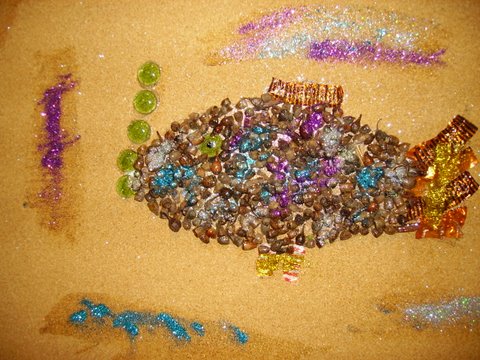
Other things we did were collecting a bucket full of gumnuts, putting them through a polisher and used the colourful little things to make a fish statue, he did a beautiful job.

What comes through to me is that if there is a reason or a reward that appeals, he ceases to find study to be so painful. It works well.

I have only two students with aspergers, but I have found them both to be very interested in making things that they can use, being very creative as they do, and if not interferred with will do a very good job.

Motivating kids to learn - a truly creative method!

Motivating kids to learn - a truly creative method!

The important thing is to plan ahead so that when they get here, they know what to expect. If I slip up on that aspect of it they don’t seem to emit the same enthusiasm. They seem to feel let down and I get guilty.

Of course as everyone will know, thay are not too keen on instruction, so drawing and planning ahead eliminates the need for further instruction.

Well I hope you don’t mind my sticking my beak in here, but I am so enthusiastic about the results and at how pleased the mothers and fathers are, I just wanted to share this.

Thank you.

And, thank you, Lorraine, for sharing this wonderful story and your insights!

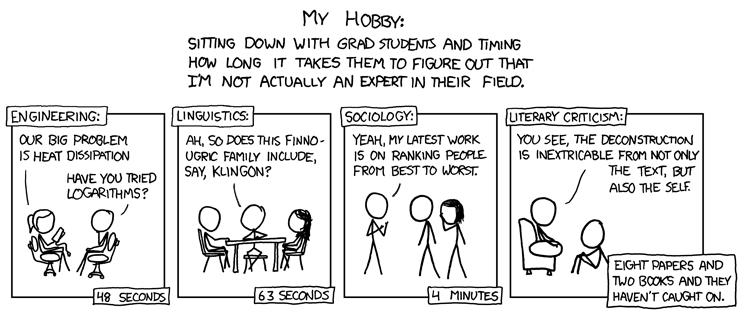
xkcd – ‘Impostor’

One of their funniest ones yet!

One of their funniest ones yet!

More Mind Games

Yesterday, I had a fun post on how easily our perceptions can play mind games on us – looking at optical illusons.  Of course, optical illusions, at least of the ‘fun’ type, are just the tip of the iceberg!

The post showed, I hope, just how easy it is for our eyes to be tricked. 

Our brains are wonderful, comples structures.  They take the information from our eyes, and process it.  It is this processing of information which ‘tricks’ our mind.  Why?  Because our brains have developed some mightily useful ways of ‘figuring things out’ without telling us.  At least, without telling that conscious part of our thoughts we often think of as ‘us’. 

Yes, it is a form of subconscious ‘prejudice’ system – but it is precisely through this type of ‘pre-judgements’ that let humans  anticipate what is likely to happen next, so as to react in the best, most advantageour (to survival) way.  {Aside:  it is precisely because so many of our bad prejudices are also rooted this very deeply, among other survival tools, that we have a hard time recognizing our own ones… and why it is healthy for us to see other people’s ‘obvious’ prejudice openly, so we may learn to recognize our own bad/destructive/unreasonable prejucices and guard against acting on them.  But, that is for another day…}

When our brain gets some input, it matches this input to ‘past experiences’, compares patterns, looks for similarities.  It then interprets this new inputas best as it can – with respect to all the stored past experiences! And it does so quickly, without us even noticing it is doing it…

That is why we find it so hard to ‘wrap our brains’ around something completely new and outside of our experiences:  our brain has nothing to match it to, and would be just as happy ‘not noticing it’…

The immortal Douglas Adams was quite fascinated by this phenomenon.  And, as was his way, he used humour to get his point across… Please, indulge me (highly paraphrased):

The story went something like this:  A guy had a bet with some people about erecting an invisibility field on the mountain that blocked his view…  It was no easy thing, and in the end, the nay-sayers had lost, because even though the mountain could no longer be seen, there was now a suspicious new moon in low orbit, just about the size of that mountain…  Douglas Adams said that trying to generate an ‘invisibility field’ was silly, that is just so very troublesome.  It would have been much easier to simply paint the mountain pink during the nighttime and erect an S.E.P. field on it.

What is an S.E.P. field?  It simply means ‘Somebody Else’s Problem’ – anything that is ‘unusual’ or appears’ unexpected, and has this S.E.P. field on it – will be less than invisible!  People will look straight through it and not see it!  Their brain will just process it as ‘somebody else’s problem’ and refuse to acknowledge its existence…

Seems to me that this is one take on the whole ‘mind tricks’ phenomenon I am trying to get at.  Can’t relate to it – it’s not there. 

But, there are way more sinister uses of this ability we, people have, to interpret what we see according to familiar patterns.  This can be seriously abused by people with very particular – and not always honourable – aims.

Just like we can be tricked by a simple optical illusion, we can be tricked into seeing ‘things’ that never happened.  And once people ‘see things for themselves’, they accept them as true… and belieave them.

All our actions are based on what we perceive.  Not on facts – only on what we think are the acts. Not on truth, because we have no way of separating truth from our very distorted – and sometimes intentionally tricked – perceptions of the truth, on what we think the truth is.

A lie repeated often enough will eventually appear to us as the truth (it’s precisely this ‘previously encountered pattern’ matching thing in our subconsciousness that does this!). 

Conversly, a truth never heard of, will never be considered when one makes decisions.  After all, we can only decide on our best understanding of the truth…

Perhaps it is time we took a moment and re-evaluated just how easy it is for our brains to become victims of ‘mind games’…

Aspergers and ‘painting music’

Over the last few decades, there have been very big changes in classroom attitudes – at least, in this part of the world.  Many teachers are of the opinion that academic rigour stifles self-expression, and in an attempt to foster creativity in their students, they have systematically dismantled structured teaching.

This might work for some students.  Yet, many students do not do well in this new environment, do not learn well using this new method.  Yes, I do focus on kids with Aspergers, but they are not the only ones who are having difficulties.  Many ‘normal’ kids find this ‘unstructured’ method of teaching makes learning more difficult.  The Aspie kids get completely lost in it.

Let me give you an example:

During a series of grade 3 art classes, the teacher played different types of music.  The assignment was to ‘paint’ the music while the students were listening to it.  I thought this was the height of idiocy:  no skills were being taught, and precious school time was being wasted.  But it was explained to me that I was being boorish, that this ‘exercise’ is scientifically designed to stimulate different areas of the brain to synthesize information, which is what kids at this age need more than anything else.

Please, do not misunderstand me.  I don’t have anything against art classes in general:  to the contrary.  My mother teaches art, and I have a deep love for it.  However, I think that kids actually get more enjoynment out of art if they are actually taught about it.  They will derive pleasure from drawing if some of the rules of proportion, or different  fun techniques are broken down into steps for them, so they can master the skills.  Once they have understood the rules, it will be more fun to ‘bend’ them to express their own artistic talents (and no, I don’t mean after years of study….rather, teach a specific skill, rules that govern it, and how to bend them and have fun with art).

Well, my son was in this particular art class.  He was in it because that teacher had gone to receive specific training on how to teach kids with Aspergers.  And then she got angry with an Aspie kid for ‘not being able to paint the music’ he was listening to????? 

Of course, what she was expecting was just non-sensicals colourful swirls – but she would never tell the students that.  With a prim smile, she insisted they ‘paint what the music makes them see’.  Questions of ‘How?’ were met with ‘That is up to YOU!’

Just before setting marks onto the report card, she called me to warn me that my son is about to fail art…  Let’s just say that I found it somewhat difficult to keep my temper.  (The problem was the frustration he experienced in being asked to complete a task he did not have the tools to perform, asking for help and being denied it, then penalized for failing by a bad mark.)

I explained to her that in that case, by her own standard, my son should have received an A+ for his artwork:  the music did not make him ‘see’ anything, so that is what he painted.  Or did not paint.  Either way, the result was accurate, and that he made a bold artistic statement by leaving the page blank.  Quite literally, he ‘drew a blank’!  In other words, I tried to ‘out-pretentious’ her.  It did not work – I’ve never been very good at it. 

However, the teacher said that if my son does 3 of these paintings and hands them in by Monday, he will not fail art.  So, we were left with the task to ‘paint music’.  My son and I talked about it, and it became clear that his frustration level was higher than usual.  But I came up with a solution I am still proud of!

Selecting a Physics textbook which had a good, simple explanation of ‘sound waves’, we read it over together and I explained all the diagrams to him.  Now, here was ‘sound’, represented visually!!!!  We were making progress.  Yet, many Aspies are sticklers for rules – my son could not paint the different types of music the same way!!!  And I was ready…

Rummaging around in the basement, I dusted off our old logic analyzer and brought it up.  Then I set up the display to emulate an oscilloscope, and we played the different types of music.  It worked!  The different sound waves made the oscilloscope display different curves.  Lifting his brush, and dipping it into the green paint (the display was green), my son went and happily painted the different types of music!

His teacher was thrilled!  She told him she knew that if he tried, he could paint music!  He told her they were ‘music waves’ and that he saw them.  I did not tell her that he saw them on an oscilloscope screen – somehow, I did not think that would please her.  Why spoil her pleasure? 

Aspergers, drawing and art

Many kids with Aspergers do not enjoy drawing and colouring.  This could be due to the fact that many have less ‘handedness differentiation’ – neither hand has better developed control, so drawing (and eventually writing) is more difficult.  But there could be more to it than that.

Just as there seems to be a difficulty in translating thoughts into a written form, some Aspies experience a similar difficulty in translating visual images into a drawing.

This is strictly my own observation, and I am not aware of a connection between these two aspects in any professional literature, but I cannot but wonder if this is a different expression of one underlying problem.  Let me describe it a little bit.

My dad has never been diagnosed with Aspergers – nor has he ever sought an opinion on the topic.  However, I do see some similarities between the way he, my sons and I processes information – at least, in some instances.  When we were trying to figure out this whole ‘Aspergers’ thing, he shared with me something that happened to him, when he was about 10 years old.

Standards and teaching methods in school were a little differen in his days, and teachers were more authoritarian.  During an art class, a substitute teacher said they were to draw a picture of a pig and hand it in at the end of the class.   A simple assignment – right?  Except that nobody had ever taught him how to go about drawing a picture of a pig… and my dad simply could not figure out how to even start.

He sat there, for the whole period, without making a single mark on his sheet of paper.  The teacher was not pleased.  As a matter of fact, he got very angry.  My dad was smart and had high marks, but he was not the most compliant of students.  The teacher would not believe him when my dad said he did not know how to do draw a pig, and concluded this was simply defiance…  and to report to him after school for detention.

The detention?  My dad was to sit at his desk until he drew the picture of a pig, then he was to bring it to the teacher’s office.  Once that was done, he could go home.  But try as he might, he simply could not resolve the image of a pig into its componenet parts, which he could then draw.  So, he sat at his desk, for several hours.  Finally, the janitor took pity on him. 

He, too, found it hard to believe a kid could not figure out how to draw a pig, but when he saw my dad just sitting there, for hours, he took a plain piece of paper and a pencil, drew a rectangle for a body, a triangle with a dot for the head and an eye, four sticks coming out of the bottom of the rectangle for legs and a curly spring on the back for tail.  “Here” he said.  “A pig!”

This was a revelation to my dad!  He easily reproduced the simplified ‘pig’ onto his sheet of paper, brought it to the teacher, and was allowed to go home.  

I have since met several people who do not naturally have an ability to break down a visual image into subsets, individual lines, which could then be put onto paper.  However, they can be shown how to go about it, and learn the process – just that to be effective, this process of learning needs to take place when they are older than when most kids learn to draw. 

Similarly, many Aspies do not have a natural ability to break a thought into constituent parts that can be written down – we start looking up words, checking spelling and grammar, wonder about better ways of saying it…. and end up producing very few actual words…  Yet, like with drawing, this process can also be learned – and it, too, will only be effectively learned at a later age than that of non-Aspie peers.

Could it be the same ‘prioritization’ or ‘orderig’ of ‘stuff’ that is causing both effects?

Another connection between them:  once Aspies ‘learn’ this process, they do not simply ‘learn’ it, they often ‘master’ it, and become better at it than most other people.  And yes, some do become successful writers or artists… Eccentric, yes, but successful.

Is this simply ‘overcompensation’?  Or is there something else at play here?

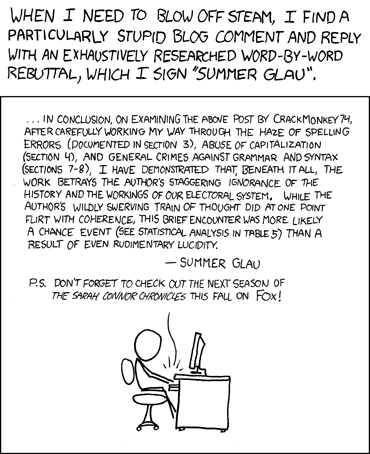
XKCD – Aspie Humour

Many people claim that Aspies do not have a sense of humour.  NOT TRUE!!!

We certainly do enjoy humour.  Some of us naturally find some things funny, others need to learn the rules of humour – but we certainly enjoy it.

In my never-humble opinion, teaching kids with Aspergers the rules of humour may be helpful with overall social skill development.  I have done this, and seen the improvement in their ability to interact with their peers and the resultant increased comfort level with themselves.

Here is how I might go about ‘explaining humour’:

There are several things that constitute ‘humour’ and different people will find different things funny – so there is no need to feel bad when you understand a joke, without thinking it is funny.  Some people think that anything to do with bodily functions is funny – and they will laugh when someone farts, or of they burp.  Other people think this is gross and not at all funny.  So, it is normal that not everyone finds every joke funny.

Many poeple laugh when they find themselves in situations which either do not go as expected, or when some danger is lifted.  This is done to release tension which people experience in such situations, and which is unpleasant.  It demonstrates to others that either the danger has passed, or that even though things are unexpected, the new course of actions is acceptable.

Perhaps that is why so many jokes are ‘funny’ because of an ‘unexpected’ or surprising ending.  It might even tie in with why ‘strange’ or ‘different’ or ‘unexpected’ is sometimes called ‘funny – but not as in ha-ha’.  Puns are an excellent example:  the correct (or correctly sounding) word is used, but in with an unexpected meaning.

It is not easy for Aspie kids that many cartoons rely on facial expressions to convey humour.  That is why I was so entertained when I came across this (not aimed at kids) comic, XKCD.  To me, it screams ‘Aspie Humour’!

And since along with a sense of humour, many people incorrectly describe Aspies as lacking feelings or empathy, I have selected, for your viewing pleasure, these few XKCD comics:

We like to spend time with our loved ones.

We love to spend time with our loved ones - XKCD


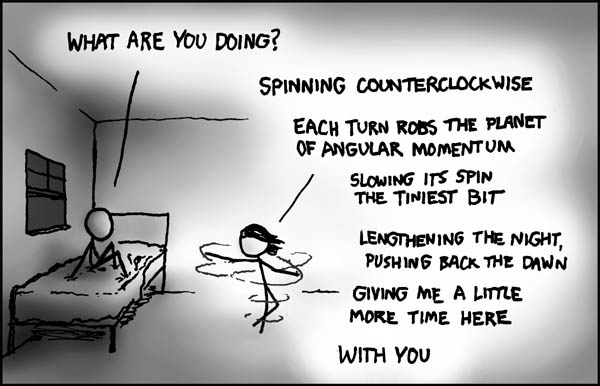
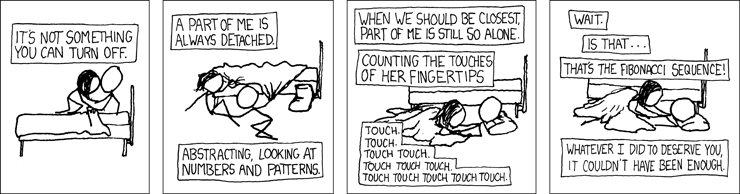
Passion reaches new levels for us!

Sharing thought - XKCD


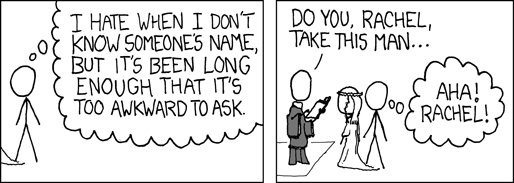
 Of course, we may have a hard time remembering names….  Nothing personal!

forgetting names - XKCD


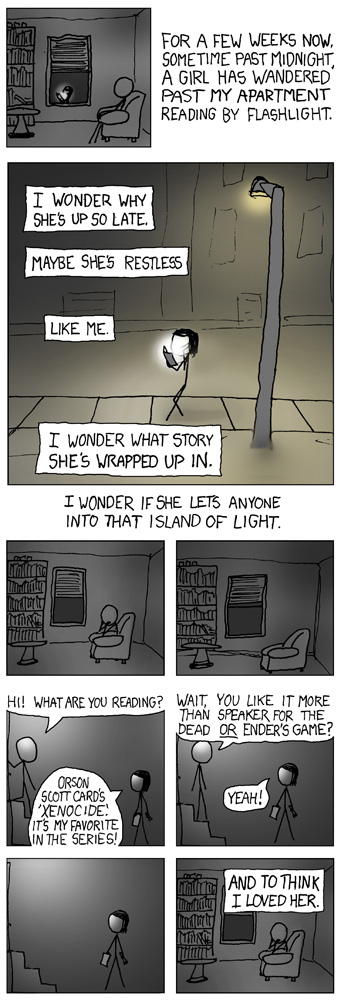
 Yet, we can be very particular in whom we select as potential mates:

xenocide - XKCD

Personally, I could not date someone who did not thing ‘Ender’s Shadow’ was the best book in this series.  Ok, if he were cute, I might settle for ‘Shadow of the Hegemon’.  But ‘Xenocide’??? Really!

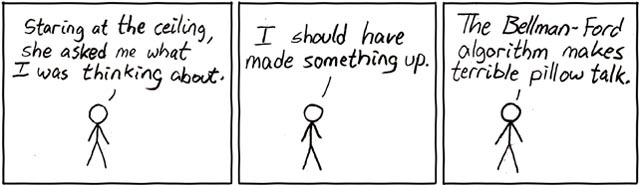
And ‘pillow talk’ is much easier if both of you are Aspies….

pillow talk - XKCD


And many of us fully appreciate the advantages of online interactions with others (my husband claims this ‘has to be’ taken from one of my online comments….):

venting - XKCD


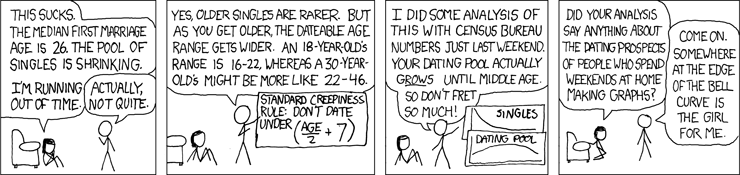
Here is a good example of how not everyone ‘gets’ every joke.  For example, in the following one, I do not understand why the characters are implying this practice is unusual.  Surely, it is the norm!  (See my posts on Old Men in the Bible)

graphs - XKCD


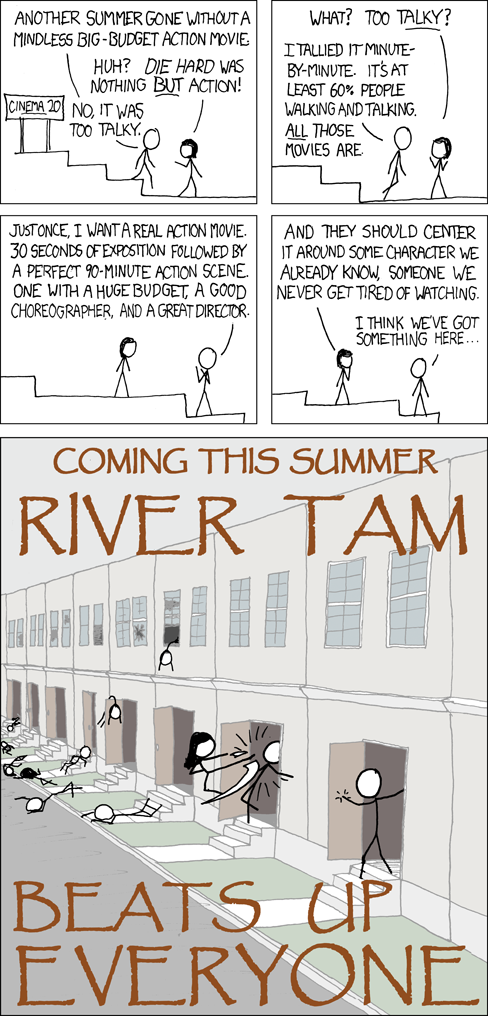
But we all enjoy good quality entertainment!  (And no, this is NOT just a cheap ploy to get ‘Papyrus font’ onto my blog!  Though, who could resist the allures or ‘Papyrus Font’???  It’s even better intelic…)

 River Tam - XKCD

 EVERYONE loves River Tam!!!

add to del.icio.usDigg itStumble It!Add to Blinkslistadd to furladd to ma.gnoliaadd to simpyseed the vineTailRank

If you can’t laugh at yourself, someone will make a sitcom…

On Monday, I posted ‘Pitfalls’ – a glimpse into the process that an ‘Aspie’ uses to write something up.  Yes, it has a lot to do with my recent posts on Aspergers – I think I have it ready, then read something else and have to hit the re-start button… 

I’m afraid I modeled it on my experience…only.  And while that may be a typical ‘Aspie’ thing to do, it is (I am told) more applicable to female Aspies…who are in minority.  Aside:  As ‘ADifferentVoice’ aticulated, I also wish there were a better terms for ‘a person with Asperger Syndrome’ and ‘Neurotypical’ (NT)- if you know of one, or would like to suggest one, please, let me know.

In the interests of accuracy and entertainment, I have re-thought the post…and come up with a conclusion more indicative of the ‘Aspie-typical’ person.  (How’s that for a convoluted term???  It makes me proud!)  ;0)

Most of the post would remain unchanged:  the bits where excessive research is done, 2-3 major studies are read and their raw data reassessed, several books, a stack of periodicals, and numerous online sources, cross-referenced and indexed (physically or mentally), you start thinking about the actual write up.  Except that somebody mentions something related, so now you have to research that, or risk inacuracy!  So, more research is required…and then you go for 3 days without posting!!!

Now, here is where the difference comes in.  When I start to ‘write’ the actual post/write-up/article/assignment, my most difficult task is cutting the 80-odd pages down to a managable bite.  So much stuff to be stuffed in!  And it has to be phrased carefully, so as not to mislead or misrepresent – not intentionally, anyway!

 Well, I do need to correct the misconception that all Aspies are like that.  The vast majority would be much more efficient at analyzing the salient and essential points, and expressing them in a highly efficient manner.  The long, painful hours I would spend ‘cutting down’ my notes, they spend in expanding their resultant 3 sentences into a full paragraph.

No kidding.

But then again, if you can’t laugh at yourself, somebody will make a sitcom … and the world will laugh at you!  My family insists that when I forget to keep a tight control over my ‘inner voice’, it reveals itself to be a bit of a ‘Sheldon’… or perhaps a little bit of ‘Leslie’….hope you enjoy the clips below! 


Pitfalls

The following is a painfully accurate description of one painful ‘creative’ process  people with Aspergers Syndrome undergo when ‘writing stuff up’:

You have found the perect topic – or perhaps it has been assigned to you.  Either way, you spend weeks figuring out the best angle from which to approach it, because that will determine what you need to read up on and how you organize your thought.  You read anything and everythig related to it, until you find just the most perfect way to present the main idea.

The brain engages, and does not let go!  Not for a little bit.  You even dream about it – if you can sleep at all!  You find yourself reading tons of stuff you realize you should have read long ago, because it added important data that needs to be included in the analysis of whatever it is you are thinking about – and you had already started thingking about it!

OK, re-organize the data in your brain and push the re-start button on the analysis process!  Oh, and all that stuff you wrote up yesterday – well, might as well re-read it before tossing it out….but wait!  This bit – let me ‘Google’ it, it needs to be expanded on so the reader does not become confused!  Oh, you’d better read that, too!

Then you realize that five or six years ago, you read a book or an article on an unrelated topic, but which could be used as an effective parallel – so you spend several hours hunting it down.  Better to also read a few of the underlying studies – to get a feel for the raw data, and thus better understand the reasoning underlying the analysis.  Right.  More data to add, re-start the analysis thinking bit again.

You think you have it:  and tell a friend about it.  It helps to bounce ideas back and forth – not just for the plausibility of your conclusions, but – and perhaps most importantly – to see if there are whole huge chunks of ‘stuff’ you did not explain, because it seemed ‘obvious’ or ‘common knowledge’ to you – yet which do not appear so to people who have not obsessively immersed in this topic for several weeks/months/years.  It is surprising to you how all these people could live happily without intimate knowledge of ‘whatever the topic topic happens to be’!

Your friend has no idea what you’re talking about – so you make a mental note to read up on ‘lay terms’ used to express ‘your stuff’.  More reading, learning how to dumb-down perfectly clear and precise phrases into common words which have layers of meanings, and so can never accurately describe anything exactly and unequivocally.  You’ll just have to compensate by expanding the section where you explain in detail how the words are used in your article.  It’s not a perfect solution, but it’s the best that can be hoped for.  Better add a paragraph or two to each sub-section, with more detailed explanations, or the whole point will have been lost.

Right.  Your deadline was a week ago – so even though you know you have a lot more to read up on to make an truly accurate analysis, you’d better get stuff down on paper.  Better include a paragraph or two to explain what you did not get to read up on, so people know and can compensate for it.  Sloppy…  But better than being misleading!

So, you write it up.  It is there, it took days of writing.  It is still terrible, even though you re-wrote each sentence four or five times, re-edited each paragraph to accomodate each sentence re-write, then adjusted the whole document to the changes in the paragraph. But, the basic ideas are there.  Good!

Almost ready.  Now, you just need to edit it down to under 2 pages….which is going to be a little hard.  You now have 78 of them, and that is in very small font in an effort to shrink it.  That will NEVER work!

Perhaps, you decide, you will pick a different topic…