Can having Asperger’s make someone a murderer?

Today, I received a question which deserves a post-long answer:

The question:

I am curious to know how other ‘Aspies’ think about this article.
http://www.foxnews.com/us/2012/12/19/wyo-college-killer-suicide-note-blames-asperger-for-troubles-life-as-bottom/?intcmp=obinsite

My answer:

My personal opinion is that there are troubled people from all walks of life, from all races, of all religions, in all socioeconomic groups and all that. It would be surprising if, every now and then, there were no troubled people who also have Asperger’s.

That was the ‘general’ answer. This article, however, was about a person who considered himself victimized for having Asperger’s – for having been born an Aspie. So, I will go a little deeper into this specific case.

The troubled young man wrote of his ‘right not to have been born’…I think that bit tells us a lot about him: he may have had Asperger’s, but what crippled him was depression.

Unfortunately, it is not all that uncommon for Aspies – especially adolescent and young adult Aspies – to suffer from depression. This is – and I am guessing here, not making a medical diagnoses – likely because in that stage of our lives, we learn to grow apart from our parents and begin to form our individual identity. All young people who perceive themselves to be somehow stigmatized and thus not valued by society, for whatever reason, are at at increased risk of depression during this process.

This is because they may perceive their ‘differentness’ as a serious flaw which will prevent them from having a healthy self-image…which is where the depression sets in.

That is why it is essential that Asperger’s is not treated as a disease or a disaster.

I’ll illustrate what I mean by contrasting two examples:

My friend has three kids. When her middle daughter was diagnosed with Asperger’s, the whole family took the diagnosis as a disaster. The older sister came to talk to me and was crying about the ‘horrible sentence’ her sister was dealt. The father turned more religious, and spent a lot of time praying to God to ‘fix’ his daughter and take that curse off of her….

Needless to say, the Aspie daughter took was devastated by all this and spun into a depression…would not get out of bed, flunked out of high school and lost all interest in just about everything. It took two years before she started going to a special school to try to finish her high school.

She considers herself as being victimized by having Asperger’s.

On the other hand…there is my younger son. My husband and I had been diagnosed with Asperger’s when our older son was and they did a battery of tests on all of us and all three of us came up Aspies… In addition, many of his cousins are also Aspies – including his favourite one whom he has always identified with and emulated.

So, years later, when he was ALSO diagnosed an Aspie, he was thrilled!!!

He said ‘Finally, I’m one of you guys!’

And, I even got a call from his teacher to please ask him to tone it down with his Aspie pride, because he was making the other children feel inadequate for not having a diagnosis of Asperger’s…

I suspect that the difference in attitude towards the diagnosis of Asperger’s is what makes a huge difference in how people will cope in life.

Because, cope is what we must all do – Aspies or not.

Each one of us has personal traits which are positive and negative, which make it easier and harder for us to succeed in whatever we do and how we live. It is up to each and every one of us to maximize our positive traits and minimize our negative ones – or even find a way to make them work for, instead of against us. The attitude with which we approach this will make a very real difference.

If we lament our negative attributes ans feel ourselves aggrieved and victimized by them, if we wallow in self pity, we will grow into bitter and unpleasant losers.

If we accept ourselves for who we are, but think we cannot change our selves – including our negative qualities, this will become a self-fulfilling prophesy and we will not improve ourselves.

But if we accept ourselves for who we are and understand that, for whatever reason we got our traits, each one of us is now an individual who is responsible for all of ourselves, and for what we do with our traits, we can utilize both the good and the bad to our best advantage and improve ourselves. We can develop coping mechanisms to overcome the bad traits and capitalize on our good ones.

And, we will be able to take pride in who we have become because we will understand that we have maximized our potential!

Asperger’s is not a disease or an illness – it is a set of personality traits that require specific strategies to properly integrate into society. Some Aspies despise the expression ‘being diagnosed with Asperger’s’ as they consider it stigmatizing. They prefer the term ‘being identified as an Aspie’. Perhaps this difference in attitude is more important than we know: you don’t get ‘worse’ because you were diagnosed – you will be exactly the same, except that now, you will have identified some of the tools that may be helpful to you to overcome your negative traits and maximize your positive ones.

But, I digress…back to the example at hand.

This man said he was self-diagnosed as an Aspie. This suggests that he never received specialized help in how to overcome his difficulties. Perhaps that is why he could not maximize his potential: he did well in a highly structured environment, like school (he had master’s degree in engineering – they don’t hand those out for just showing up), but could not cope with the unstructured world outside of academia. His father and his father’s girlfriend were also academics – so they would not have been particularly useful in helping him integrate into a non-academic world, which is very different indeed.

In fact, there is very little in our school system to prepare people for the non-academic world, but that is a different rant. Suffice it to say, a person who has difficulty with social integration, but who had successfully (masters in engineering) integrated into the academic world would indeed have terrible difficulties adjusting to the non-academic one…and without help, he might indeed ‘crash-and-burn’. If, in addition to this great disappointment in himself, he also has the attitude of wallowing in self-pity and not taking responsibility for himself (which are personality flaws not associated with Aspergers – they occur across all of our species), such a person might indeed commit a horrendous act…

But blaming his dad for passing on Asperger’s genes is just scapegoating, nothing more!
When families come together – a Christmas shopping story

My husband and I are somewhat cultural Christians – that is, while we do not subscribe to Christianity as a religion, our families are mostly descended from Christians and therefore, we observe some of the cultural Christian festivals (especially the originally Pagan ones, where the Christian patina is particularly thin, as is the case with Christmas) in a secular, non-religious manner.  After all – why waste an opportunity to party?

When we were first married, we tried very hard to maintain the ‘surprise’ element when exchanging Christmas presents, but with a little twist to ensure we both also got what we wanted:  thus, we shopped separately and wrapped the presents separately.  He’d buy his present and I’d buy mine…

This way, my husband would be surprised at what he got me and I would be surprised at what I got him!

But, as our kids got older, we wanted to engage them in the most fun part of gift giving – and decided to go a bit more traditional about the gift-purchasing vector.  So, one day, we all got into the car, drove to the mall and split up:  my husband and our older son went to buy my Christmas present and our younger son and I went to buy the Christmas present for my husband.

I had a most awesome plan.

In the previous week or two, I had noticed my hubby going through some electronics flyers and looking at phones – not cell phones, but nice wireless ones for the house.  So, I paid more attention at what he had been looking at and very carefully (so as not to arouse his suspicion), I had asked some questions about what features he liked and so on – and I thought I knew just the perfect phone to get him.

Since the kids both understood that buying the present in secret was the funnest part of  Christmas gift giving, we had to sneak into the phone store unseen.  So, as my hubby and older son headed off to the coffee shop to fortify their stamina for the onslaught of shopping, we made a big show of heading to the luggage shop in a deft decoy move to make my hubby suspect we were getting him a new wallet.

Then, taking a shortcut through a shoe store, we made our way to the phone shop.

Yes!

There was the phone I was sure would make the perfect present for my hubby!

But, as I reached for the box, I heard my older son’s voice!

Quickly grabbing my younger one’s hand, I told him to duck – we must not be seen or the surprise would be blown!!!

As we made it one shelf over, my older son exclaimed:  ‘Mom!  What are you doing here?!?!?’

Luckily, his dad was not with him.  He was a few shelves over.  Thinking quickly on my feet, I pointed him out to our younger son and told him to quickly catch up to daddy while I went to pay for the phone.  He rushed off, just about at the same time as the older one came up to me and started asking me if I had noticed the sunglasses in the kiosk just outside the phone store.

I did not understand his sudden interest in sunglasses – he had never been interested in them before.  He was quite insistent, but there was no way he was going to deter me from paying for that phone and hiding it before my hubby could catch up to me!

I made it to the cash and lined up – just as my hubby also got there to pay….for the very same phone I was holding!

Apparently, he’d been leaving flyers around the house to see what I looked at and noticed I was asking about phones and cleverly deduced from the various clues exactly which phone I liked best!!!

Yet another instance of how Christmas shopping can indeed bring families together.

Guest post on Aspergers’ by Angel: Teaching the Art of Conversation

A reader, Angel, who is raising an Aspie son, has been kind enough to contribute this article on Asperger’s and teaching the art of communication.  I hope you like it as much as I do!


Teaching the Art of Conversation:

Let’s face it.  Kids don’t want to talk to the odd kid out—the dork who always says the wrong thing. This sets up a vicious cycle—those who need practice interacting the most, get it the least.  My son fell victim to this downward spiral—practically no one would talk to him, so he couldn’t get the practice he needed to talk to them.  In an essay he wrote recently, he recalls what it was like to fall into this pit:


I couldn’t understand them, these seven-year-old kids. I felt like I was the butt of every joke, and I couldn’t handle it. It seemed like I always said the wrong thing, and I couldn’t ever just roll with the punches and “play along,” the absolute skill. Embarrassment was a fire that never ceased to scorch me. It was a daily emotion, and one that I learned to hate above all else. All of this culminated in one event that I’m still unwilling to share, especially with an unknown number of strange readers. It was so embarrassing to me that I was absolutely sure that I could not go back, could not face the kids who shared the knowledge of that day.

Though he didn’t confide in me at the time, I saw something I hadn’t seen before—a dark side emerging from this loving son of mine.  I pulled him out of public school and taught him myself until he decided to return in his junior year.  To both of our amazement, when he returned, he was instantly popular with other kids.

How did talking to me about his reading and writing assignments translate into excellent social skills nine years later?  It seemed that by practicing his skills on me, he was not only able to catch up, but actually got ahead of other teens.  Why are adults so much better than kids when it comes to teaching Aspergers how to conduct a good conversation?

Adults can be skilled listeners who help children “fill in the blanks.” They will entertain any topic, shared or not.  They don’t insist on conventional turn-taking, doing most of the talking for children who barely respond and most of the listening for children who talk like the wind. Adults will also prompt for further elaboration, or provide elaboration when a child omits the details he needs to complete a story.

If you are doing what comes naturally when talking to children, you are practicing speech therapy—coaching your child in what therapists call Speech Pragmatics.  Pragmatics concerns itself with what people mean, not what they say—usually the only type of speech therapy that Aspergers need.  Pragmatics teaches three fundamental skills: contextualization, turn-taking, andelaboration.


Contextualization may be the hardest for Aspergers to learn.  If a child’s statements are irrelevant to a shared topic, he may have misunderstood or forgotten its original context—responding as if he is willfully evading a question or changing the subject.  Parents must listen carefully for this conversation killer, gently insisting that the child stay on topic.  Queues for opening and closing a conversation should be explicit.  Taking turns is also a discipline that should be gently enforced—this could mean getting your child to pipe down and listen or prompting your child to come out of his shell.  Finally, elaboration is necessary to keep a conversation going.


To slow down the action, so that an Aspergers child has the extra time he needs to rehearse each of these three vital skills, you might try what I did for my son at home—interactive reading.  With a book in hand, the context of any topic will not be forgotten or misunderstood until you are ready to turn the page.  You can practice taking turns with your child through give-and-take questions and answers, then move on to general two-way discussions.  The story also provides a springboard for further interpretation and elaboration.


If you take every opportunity to rehearse proper contextualization, turn-taking, and elaboration in a safe environment as a pace your child can handle, you’d be amazed at the way this translates to better conversation with friends.

My son, now a teenager, happily converses with friends as if he never had Aspergers.  Words are spun round and round as each speaker elaborates, thickening the context of shared information, beginning a new round of contextualization, turn-taking,and elaboration,a self-perpetuating cycle, spinning so effortlessly that it sometimes escalates into the wee hours of the morning—particularly with teenagers who are keenly interested in self-expression.

When I first took him out of school, he had a long way to go before this could happen.  He needed extra prompting to move a conversation forward. For years, we privately worked at sowing the seeds of his future success. We rehearsed the contextualization, turn-taking, elaboration, contextualization, turn-taking, elaboration, contextualization, turn-taking, elaboration “spin cycle” until it became second nature. Who could have imagined that rehearsing at home would eventually lead to popularity at school?  In my son’s own words:


So, can you successfully educate an Aspergers kid at home, then, after he has matured, send him back to public school? While I can’t say that this method will work for everyone, the answer is yes, it is possible.  At least one person has done so.

A joke

In which Olympics did the events begin to turn a light-brown/tan colour?

The ‘Beige-ing’ Olympics!!!

H/T:  my son


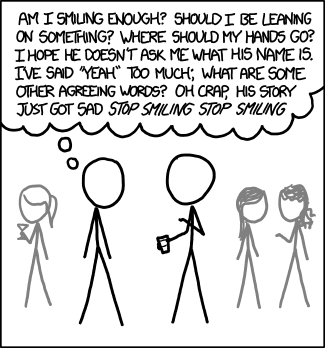
The Aspie in me…

…this type of reasoning goes on all the time when I am forced to interact with other humans face-to-face:

A response to my post ‘Aspergers and Writing’

One of my most popular posts of all times is ‘Aspergers and Writing’, in which I explore some of the difficulties Aspies face when writing and, perhaps, some practical advice on how to improve this difficult-for-most-Aspies skill.

Over the years (yes, years…) since I have written it, it has received a lot of comments which update the post and keep it ‘fresh’.

Here is an example of a ‘conversation’ in the comments which shows how the comments people leave help others and keep the post relevant.

A reader called Riayn left this comment:

I’m an adult with Aspergers and what you have written rings very, very true.

As a child I had enormous problems with handwriting and had to undertake remedial handwriting classes. I never learnt how to form cursive handwriting that is legible. I even have problems signing my name that matches what I have signed on the back of my credit card as I can’t always form the letters properly. However, my printed handwriting, when I concentrate and take my time, is extremely neat.

When it comes to writing, I find there is a disconnect between my brain and the page. I know exactly what I want to say but I just can’t write it down. I blog to improve my writing abilities, but many of my posts sound fantastic in my head but come out completely different & inferior on the page.

I wish I could remove the mental block.


To this comment I replied:

I SO KNOW what you mean. I have found the same thing with my posts…

Though, I have found that if I write it – but not really finish, then I can’t get back into writing from where I stopped. Especially if I have had the chance to bounce the ideas off of someone else – to actually verbally ‘speak’ what it is I am trying to get across in the post.

Then, I find it easier to just start from the beginning again: complete different angle, and so on. The act of trying to write it, then saying it out loud (sometimes getting feedback – my poor family!), and then tackling it from a different angle seems to help me get more of my point across.

I also find it much easier to answer comments: then, it’s more like talking to a person, and it seems easier for me to type the words ‘naturally’ than if I am trying to compose a post. Perhaps that is connected to the fact we, Aspies, tend to be more verbally skilled than and less skilled at writing.

Have you tried recording yourself as you ‘speak’ your post – then transcribing it? I’ve been toying with the idea of, perhaps, doing a few of my blog posts by speaking them, instead of writing them down, just to see. Perhaps.

This exchange had been up in the comments for a while.

Then, a new reader named CD joined the conversation:

‘I’m an aspiring writer who has Asperger Syndrome. This post defines me to a “T”. 

I can spend three hours sitting down in front of a computer, trying to compose a story, with no results. 
Perfectionism is one deterrent. 
Another is over thinking. 
I don’t know what runs through other As minds, but I know my own. I over think things to death. The solution I incorporate is to write endlessly, uncontrollably, for a set time limit. 
For example: I could write “The smoke descended the stairs. Shawn was the only person who saw it. He wanted to warn people….” 
Well not my best but you get the idea. To write this simple sentence I’d begin like this: Smoke, grey, moves, stairs, horror, Shawn sees it, won’t talk, why, wants to…
Anything for an hour, like I said. Then I return a day later and piece the words together like a puzzle, trying to produce coherent meaning. 
My ideas are so insightful. I won’t allow AS to prevent me from expressing them in any damned form I see fit. My goal is to write
‘endlessly and uncontrollably’ until I complete an entire story, then return to fix it up.  After that, the process of general editing, which a normal person without As would’ve already completed, comes into play. 
Though this may be a daunting task, it has worked for me. 
Plus, taking care of your physical health is very important for an AS individual to hone and display his natural god given gifts. Just waking up everyday with AS and dealing with the world, not just writing, drains the persons health. 
Anyway, I hope this long post helped. I’d like a personal email telling me how I helped. If you find the time that is. I don’t check blogs very often. Guess I should get started creating my own blog,huh? 
Well that is another topic in and of itself. I’m rambling now so hope I was of some help.
Thanks.
CD’
I hope CD’s advice can help more people – which is why I am highligting it as a post in itself.  Thank you, CD.
And if you have found strategies which work for you, please, share them!!!  We need to try all the ideas we can get!!!

Q&A on Aspergers and ‘hearing dyslexia’

Recently, I got a question on my post ‘Aspergers and ‘hearing dyslexia’.

When my highly imperfect answer topped a thousand words, I thought it worth a post of its own, because I think that while some Aspies might find it useful, others might  have helpful suggestions – much better than mine, which, if they are willing to share, could benefit us all.

Question:

My son is 16. We didn’t notice this “hearing dyslexia” for many years [perhaps we were too distracted by the other symptoms] but now it is overwhelming. Unless someone speaks very slowly and distinctly to him, my son will answer, “What did you say?” almost inevitably.
My question is: Am I understanding correctly that there’s really nothing to be done about this? My son can read great, can speak [though he tends to speak way too fast and mumbled; doesn’t seem like he used to as a child], but he definitely has the problem listed on this site.
Nice to know what it is, but beyond that, no suggestions?

Answer:

This is a difficult question.

Something can be done, but…

There are therapies which have been used on young children – 3-6 years of age – which are showing definite improvement. This therapy is in the form of computer programs where they do simple tasks (say, help frog catch a fly) based on the length of a tone…which later builds up into series of 2,3+ tones done in the proper rhythm.

The theory behind this is neuroplasticity: the brain is being trained, slowly but surely, to use a different bit of the brain to do the job of integrating time with sound. Because the different bit of brain uses a slightly different ‘strategy’, even to accomplish the same task, the underlying problem will not interfere with that task.

Of course, trying to get a 16-year-old interested in a video game designed for 3-year-olds is not likely to have positive outcome.

But, there are other ways.

They are less effective, but they can work. And, for a 16-year-old, they are more practical.

It really depends on the Aspie: what will motivate them and what will work for each one individually.

One thing that helped both my sons was music.

With a metronome. (One on their computer was more ‘fun’ than a real one – plus it’s much cheaper.)

The sounds are written down in the music score – not just the tones, but their lengths and pauses.

He creates the sound on his instrument (from a cheap recorder or little keyboard to a sexy instrument he’d be willing to play, this bit is way less important) based on what is written down and the metronome helps him integrate the time element into the sound which is generated based on the visual input from the music score. Listening to himself play is the feedback…

I think the visual component is important – ‘playing by ear’ lack the rigor of integrating visual stimulus with the tone and metered time elements necessary to help re-route the ‘time-sound-synchronization’ bit into another area of the brain. Then, as he learns the piece (motor nerve integration into the time/sound system), the metronome can eventually be eliminated and he will still be able to ‘keep pace.

This is not a quick and easy solution, but one that might make an improvement in a teen. We definitely saw an improvement in ours once they took up an instrument – but only an improvement…certainly not an elimination of the problem.

Of course, the ‘shortcut’ would be the videogames where the computer plays the music and displays the colour-coded notes which have to be pressed for a specific period of time, which information is conveyed visually. (Games like RockBand and so on.)

Now that I come to think about it, these are the ‘teenager’ versions of the young-kid games used in the therapy which has been demonstrated to be effective in clinical trials for 3-6 year-olds!

Music could not ‘work’ for me – not only am I not interested in it, I find music actively annoying. Yes, I am sure that my hearing dyslexia is at least partly to blame – imagine listening to music, but with some of the notes jumbled up…you, too, might find it gives you headaches. (This is one of the reasons I avoid shopping malls and other places that force music at me.)

And even though I took piano lessons, within 2 years, 3 teachers kicked me out as ‘un-teachable’…so, no, for me, music absolutely did not work. (For example, I still have difficulty telling apart the movie themes from ‘Star Wars’ and ‘Indiana Jones’ – the same pathetic bombast, the same notes, just slightly re-ordered. Unless I hear them together, I have to think very, very hard to tell which one it is…)

However, what did work for me (a bit) was learning to speak foreign languages. Practicing making the sounds in front of a mirror, getting audio feedback to make sure I eliminated mispronunciation, and so on. (If you want to get really fun, you can use an oscilloscope to display the proper sound wave pattern, then try to match yours to it – hours of fun!)

Learning a language (even without the oscilloscope), I could use the audio, visual and work in the timing with the motor nerves of speech.

And the hook that kept me interested in learning languages was the pattern-making intricacies of grammars. Yes, grammars: because each language has a different approach to this and exploring this logic puzzle set my endorphins hopping! (I get happy just thinking about it!) It’s kind of like algebra, but with words.

(OK – the different alphabets were fun, too – but grammars are like logic puzzles on steroids! Especially when you compared the grammatical ‘philosophy’ to the culture it was used in and the religious memes it best supported – what could be more fascinating!!! But, I’m off on a tangent…)

Again, I am nowhere near ‘cured’, but it certainly helped me become more functional.

I still have extreme difficulty understanding spoken words when there is background noise – like, hum of other conversations, but, especially, music. That is why I loath movies – their background music is not just icky to listen to and calculated to be emotionally manipulative (a deep insult to the audience – in my never-humble-opinion), but it makes it difficult to follow the dialogue in the movie. I usually have to wait to see movies till I can buy them and watch them with subtitles. If the soundtrack is particularly emotionally manipulative, I’ve been known to turn the subtitles on and watch the movie on mute – a much more satisfying experience!

In social situations, I often rely on partial lip-reading: it helps me make more sense of the sounds. (And, yes – that is one reason why I hate the cultural normalization of niqabs and burkas.)

Well, that is my best advice for how to improve your son’s comprehension. As to speaking fast and mumbling…

If I knew how to stop my sons (13 and 18 now) from speaking very fast and mumbling, I’d try it – because they both do.

I’ve tried to get them to recite poetry in order to get them to improve the cadence of their speech – but they are about as interested in reciting poetry as I am in learning to sing movie scores… (Many of us Aspies have a deep-rooted hate for pretentiousness – and let’s face it, much poetry is very, very pretentious.)

In grade 9, my older son took drama in school – that did help him learn to speak slowly and understandably. Now, when he remembers to do so, he uses that skill.

Another thing which has helped them was talking to their grandmothers: one has a hearing problem and does not tolerate hearing aids well, the other struggles with English. So when they speak to either one of them, they have to consider not just what they want to convey, but also how best to convey it. They have to tailor their words differently for each grandmother – which forces them to pay attention to their diction.

It is surprising how helping other people overcome their difficulties can be an excellent tool for Aspies to help themselves overcome their own ‘little things’!!!    ;0)

I wish I could be of more help…

If anyone ‘out there’ has better suggestions, please, comment and let us all know.

The Economist: ‘Why business needs people with Asperger’s syndrome, attention-deficit disorder and dyslexia’

An excellent article on some of the roles best filled by us, Aspies – even if it does have a bit of a sting in the tail…

Software firms gobble up anti-social geeks. Hedge funds hoover up equally oddball quants. Hollywood bends over backwards to accommodate the whims of creatives. And policymakers look to rule-breaking entrepreneurs to create jobs. Unlike the school playground, the marketplace is kind to misfits.’


Aside:  both my sons attended a school with a program for the most gifted kids (one of only two such schools in Canada’s capital region).  It was a large school and typically, there were 7 to 8 classes per grade (grades 7/8), only one of which was ‘gifted’. Having an Asperger’s diagnosis is seen as a bit of a status-symbol there…my younger son, shortly after his diagnosis, even got asked not to boast about it because he was making the other children feel inadequate for not being Aspies!  I guess this school playground was kind to misfits…

Thinking in a Foreign Language Makes Decisions More Rational

I’ve been saying this for years!!!

Or, at least, a version of this…because I have noticed this in myself.

This ‘Wired’ article is about a recent study which found that people’s risk assessment appears to be less affected by linguistic positioning when they are functioning in a language they are just studying:

“It may be intuitive that people would make the same choices regardless of the language they are using, or that the difficulty of using a foreign language would make decisions less systematic. We discovered, however, that the opposite is true: Using a foreign language reduces decision-making biases,” wrote Keysar’s team.

It is an interesting article, well worth the read.

NOTE:  The sign in the picture which accompanies the article  says different things in English and in Czech.

The Czech wording, if simply translated, would say ‘Prohibition on Interpreting’. Though, for ease of use (and, perhaps symmetry), this would be interpreted as ‘Interpreting Forbidden’.

The Czech word for ‘translating’ (accents omitted) is ‘prekladani’ ‘Tlumoceni’ means ‘interpreting’.

There is a difference!

OK – details aside….

Thinking using any symbolic language is slow and cumbersome.  It is much faster, clearer and accurate to think without the use of symbols.  The difficulty comes in trying to express the process and/or results of this process in any kind on manner in order to communicate them:  so much gets lost in any translation!

It often takes me a long time to find a way to communicate the results of my thinking to anyone, in any language.  Sometimes, it takes me years – many years.  (This is why I sometimes respond with:  I know what I want to say, but it will take me a while to figure out how to say it…regardless of the language in question.)

However, often, I will reason things through in a language.  And, because it may be a complex thing that will take me a while to reason through at this slow pace, I will sort of set it into the background of my mind.  I find it impossible to do this in the language in which I happen to be functioning at that time:  there is so much interference that my ‘background’ chain of thinking gets derailed.  (Perhaps it’s my ADD…)

To make it easier, when I do the ‘background thinking’, I will set it in a different language than the one I happen to be functioning in at that time.

When I was doing business internationally, I often altered the ‘background’ processing language between the ones I was sufficiently ‘natural’ in to do this with (these differed over time).  Or, if I had a conversation with a business associate in one language, then went on to talk to somebody else in another one, I would continue to analyze our conversation (and the proposed deal) in the language I had conducted it in (even if I were not ‘natural’ in it, because the details were in that language).  This was very useful, as it allowed me to analyze several situations at the same time.

When, later, I would analyze the results of my thoughts and build a cohesive, cross-referenced picture in my mind (abandoning symbolic language), I noticed that my analysis would often differ, based solely on the language I had done it in.

So, I thought about it – quite obsessively – for a while.  OK, years.

It soon became clear to me that my analysis was affected by the ‘colouring’ of words in the various languages.  The less ‘natural’ I was in that specific language, the less ‘coloured’ the reasoning would be – but it would also be much less nuanced.

I have often wondered if this is ‘normal’ to all humans, if this is ‘natural’ to Aspies’, or if my brain is simply wired funny.  And, I would greatly appreciate any feedback on this from other people who have even remotely similar experiences.

In conclusion:  for years, I have been saying that the ‘colouring’ of words affects our reasoning on a profound level and that we ought to pay more attention to this phenomenon.

Aspie Christmas humour

All right,  properly should have posted this on the 8th of December, but…

…it’s still in the spirit of the Christmas season!

(Thanks to WordPress’s most awesome ‘improvements’ to their embedding process, it looks that the best I can do for now is to link to the comic instead…..my apologies!)