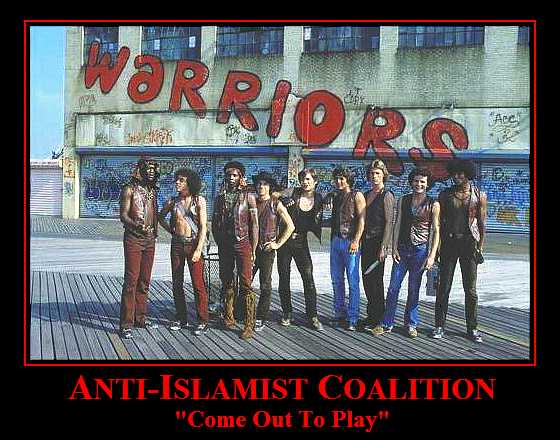
Anti-Islamist coalition

A new blog has entered ‘The ‘Sphere’!

Anti-Islamist Coalition

Anti-Islamist Coalition

Thanks to Babazee for creating this logo!

And, just to avoid any possible confusion, let me re-state this once again:

Islam is not the same as Islamism.

Islam is a religion, which is practiced in peace by millions of wonderful people.  I know and love some of them, and I certainly respect many of them.

Islamism is not the same sort of thing at all.  It is a political movement, intent on world domination, which just happens to be dressed up in the guise of Islam. These types of political movements have plagued humanity for thousands of years – and they have usually sought to legitimize themselves by wrapping themselves in the respectability of a ‘religious movement.  It just happens that this particular political movement is abusing Islam for its ends!

Certainly, Islamists believe themselves to be following Islam – which is why they cite it as a justification for their crimes.  And many Islamists truly believe what they are doing is following their god’s will – which is what makes this such a dangerous combination.

Which is what makes it that same old …

Go ahead and hate your neighbour,

Go ahead and cheat your friend,

Do it in the name of Heaven Islam,

So you can justify it in the end …

And THAT is why Islamism must be opposed.

It is an insult to Islam, and a deadly threat to the rest of us.  Never forget what happened to the ‘Mountain People’…  If you don’t know, then, listen, children, to the story that was recorded long ago…

(Please, take a special note of how the ‘Valley People’ reacted when invited in to share, as equals…  Of couse, were I the composer, I would have the ‘Treasure’ say ‘Freedom of Speech and Equal Rights for ALL’!  In my never-humble-opinion, without these, there can be no true peace!  But, that might be too big a mouthful for a song…)

add to del.icio.usDigg itStumble It!Add to Blinkslistadd to furladd to ma.gnoliaadd to simpyseed the vineTailRank

Marijuana-smoking athlete should be stripped of medals

Over the last little while, I have been amused at the discussions generated by an admission from an athlete that he smoked cannabis.

This, in a nutshell, is the situation as I see it:

  1. Michael Phelps, an athlete with 8 Olympic blood medals, is photographed inhaling from a marijuana pipe.
  2. Following the publication of the photo, he admits to cannabis use.
  3. This creates negative publicity:  from dismay over an again-tainted role model (he faced a drunk-driving charge earlier), to the discussion of ‘recreational use of cannabis’, to calls that he be stripped of his medals.
  4. The athlete issues an apology.
  5. Public debate continues – but not only does it not look like the athlete will not be stripped of his medals, it looks like he will be eligible to continue to compete in athletics!

THIS IS RIDICULOUS!!!  WRONG DEBATE!!!

While I have some very strong opinions (sic) about the use of illegal drugs – recreational or otherwise – this is not the post where I would like to explore them. I’ll be glad to oblige later.

The ‘legal status’ of cannabis should not be the main focus of public debate about any athlete admitting to smoking cannabis.  The debate should be about how to treat an athlete who admits to using a performance-enhancing drug, after the competition is over…

After all, cannabis is a performance-enhancing drug!

There are several active chemicals in cannabis which have medicinal effects. One of the two main ones is Beta-Caryophyllene, an anti-inflammatory which may be very useful in fighting immune system diseases.  Yet, I would like to focus here on the other one – cannabidiol, which turns into THC under some conditions and into quinine under others. THC is the ‘active’ ingredient in cannabis, which gives people the ‘high’ associated with its use.

THC, of course, is known to trigger the release of dopamine – the very word from which ‘doping’, as in ‘using performance-enhancing drugs’, comes!

In a very real way, by triggering the release of dopamine, THC affects the endorphins (natural pain-killers) and serotonin levels in the brain, both immediatelly and in the long term.  These two effects, in my never-humble-opinion, classify it as a ‘prformance-enhancing-drug’!

Cannabis creates a temporary high – that is true, and that is why it is illegal in many jurisdictions.  THC blocs pain-perceptions by causing the brain to produce too much dopamine, which numbs one to pain and causes a euphorea.

Even after the ‘high’ associated with cannabis use is gone, not all of this chemical is metabolized.  Some of the THC gets stored in a person’s fatty tissues, where it stays inactive for weeks – perhaps months.  When a person is in a situation of great pressure or stress, their body releases adrenalin (and related hormones).  This ‘under-stress-hormone coctail’ triggers a chemical reaction which causes the stored-up THC to be released into the body.  And, yes, this has the same physical effect on the body as if the person had just toked up!

In other words, cannabis can produce the immediate, ‘short-term’ effect of a ‘dopamine high’ even months after it was used.  It’s called a ‘marijuana flash’.

Also, it has been medically demonstrated that people with low serotonin levels feel pain much more easily and much more acutely.  (This is especially true of people suffering from depression.)  When the serotonin levels are increased, the person’s long-term pain threshold goes up significantly.

Cannabis effectively raises the serotonin levels in that brain.  That is why it has consistently been found effective in treating medical conditions involving dopamine-serotonin balance:  migraines, melancholia, loss of appetite, nausea, pain –  both topical and systemic, insomnia…and is used in treating very serious psychiatric conditions, like dementia and schizophrenia.  This very real, long-term effect is why cannabis has been prized since the times of ancient Egypt!

So, let us consider these effects on an athlete who had, in the past, used cannabis.

The athlete now has an overall higher tolerance to pain than is natural – so he can push himself harder during training than his peers.  This will necessarily result in achieving an artificially high physical condition, one the athlete could not have attained without the use of cannabis.  Even if there were no THC left in his body by the time of the competition, the athlete would still have used performance enhancing drugs to achieve his physical condition, making any competition unfair.

Perhaps even more importantly, if there are still even small amounts of THC in the athlete’s system, the stress of a high-level contest, the ‘competitive juices’ that flood an athlete’s body, will ‘flush them out’.  Now, this athlete has a flood of extra dopamines in his blood stream!

In a very real sense, the athlete’s own body released the ‘stored-up dope’!

Unless I am greatly mistaken, competing while ‘doped up’ is against the rules…

Now, back to Mr. Phelps:

Since he has admitted to cannabis use, he had – knowingly or unknowingly – used drugs to enhance his performance. Therefore, it would be unjust to other athletes if he were allowed to compete again.

The only question remains:  did he use cannabis BEFORE he won 14 Olympic medals?  If the answer is ‘YES’, then he must indeed be stripped of each and every one of them.  Even if unintentionally, he was ‘doping’…

It has nothing to do with ‘legal’ or ‘illegal’ drugs.  It has nothing to do with making ‘good’ or ‘bad’ choices.  It has everything to do with fair play!

add to del.icio.usDigg itStumble It!Add to Blinkslistadd to furladd to ma.gnoliaadd to simpyseed the vineTailRank

Groundhog Day – What does it mean?

If you live in North America, you are likely ‘familiar’ with ‘Groundhog Day’:  on the 2nd of February, ‘The Groudhog wakes from winter slumber and sticks hear head out of her den.

If it is sunny enough for the groundhog to cast a shadow, the sleepy gal will get startled and run back into her den to continue napping.  This will cause the cold winter weather to continue for 6 more weeks.  If it is cloudy, there will be no shadow to startle her and she’ll wake up nice and slowly.  She will then stay awake, causing the winter weather to recede and the spring weather to come early.

So, what is this quaint little legend all about?

Perhaps there is a reversal of causality:  this could simply be a weather pattern observation, set into a quaint little story.  After all, during the coldest winter temperatures, the sky is cloud-free and sunny.  Clouds act like a blanket that traps heat, so cloudy winter days tend to be warmer.  That is why it never snows when the temperatures are cold.  (We are talking relative winter temperatures here….as in, -40 degrees (Celsius and Fahrenheit ‘meet’ this point) is ‘chilly’, -10 degrees Celsius is ‘warm’.  Remember, I am writing from Canada.)  When it gets that cold, one could not even drive a groundhog out of its den!

It is conceivable that, over generations, people observed that if this time period was particularly cold – it was likely to signal that the winter weather would drag on for a bit.  Conversely, if the temperature at this time was mild, it would be followed by more mild weather, bringing the spring in earlier.  So, the co-relation.

Plausible.  Or, the roots of ‘Groundhog Day’ may lie somewhere else….

There are several things which are significant:

  1. The date – 2nd of February (plus or minus a day or two)
  2. 6 more weeks of winter
  3. The Groundhog herself
  4. The Groundhog affects the weather

1.  The date:  2nd of February

It is the halfway point between the Winter Solstice and the Spring Equinox:  this makes it a ‘cross-quarter day’.

From earliest historical records of human civilizations, we have seen that the solstices and equinoxes had been noted and celebrated by our ancestors.  These 4 ‘easy to define’ (through simple observation) markers of the Earth’s annual cycle are called ‘quarter days’.  The midpoints between them – when that season is most ‘intense’ – are also marked: these are called ‘cross-quarter days’.

Many cultures have described this ‘cycle’ as the ‘Wheel of the Year’:

http://www.midnightmoonchild.com/images/wheelx.gif

This image is from the names of the ‘marker days’ reflect the one of traditions descended from the British isles.  The ‘Pagan’ belief systems which accompany the annual cycles associate various Gods and Goddesses with specific parts of this cycle.

The 2nd of February is Candlemas, often also called Imbolc.  When considering the roots ‘Groundhog Day’, its date would suggest that we are not discussing simple long-term weather pattern observation.

2. ‘6 more weeks of winter’

This is also closely connected to the Wheel of the Year:  the period between each of the 8 ‘markers’ along the wheel is 6 weeks.

Let us consider the ‘season’ of ‘winter:

Astronomically, Winter Solstice marks the first day of winter and the darkest day of the year – after this point, daylight periods: begin to lengthen.   Astrologically, this marks the ‘Rebirth of the Sun’:  still too ‘young’ to bring warmth, but his strength is growing.

Even though the Sun had been ‘reborn’ and the days are now getting longer, the momentum of the ‘cooling’ takes 6 weeks to ‘ripen’.  That is why, 6 weeks after the beginning of a season, its’ ‘weather characteristics’ are the ‘strongest’.  And, winter is usually most bitter around the beginning of  February… just as we approach the ‘height of the season ‘holiday’:  Candlemas.

Accordingly, following Candlemas, winter begins to recede.  It is still there – but overall, the temperatures begin to warm, the sun is more visible and begins to slowly but surely melt the snow… and it will only be 6 weeks before the day is longer than the night!

Is it only co-incidence that the ‘Groundhog Day’ tradition cites this identical time period of 6 weeks?


3.  The ‘Groundhog’ herself

Spring is the time when things begin to grow.  Accordingly, Pagans associated growth and fecundity with spring and anthropomorphised the principle into the Goddess of Spring and Renewal:  Eostera (also spelled Ostara, and about 8 other ways, like ‘Easter’).

What is interesting about this goddess is that she is said to ‘awake’ on the winter cross-quarter day, Candlemas.  As she awakens, she adds her own magic to strengthen the growing Sun and because of her effort, the winter begins to recede.

Her power is greatest at the full moon following the Spring Equinox:  that is how we derive the timing of our Easter celebrations even today.  (Yes, there is a ‘detour’ through the Judeo-Christian tradition, but their ‘timimng’ of these festivals in Judaism and Christianity ultimately leads to the same archetype, even if through Ishtar and Isis.)

Since chickens only lay eggs when the day is longer than the night, the Spring Equinox marked the return of this cherished source of nutrition:  it became one of the symbols of the Goddess Eostera.  With their renown fecundity – and the timing of giving birth to their babies – rabbits also became symbols of Eostera.  And yes, that is why the ‘Easter Bunny brings eggs’.

Yet, there was another shape Eostera is said to take on when appearing to humans:  Groundhog.

So, is it co-incidence that it is Groundhog, as opposed to another hibernating animal, day?


4. The Groundhog affects the weather

Our little modern myth of Groundhog Day specifically states that it is the groundhog who changes the weather – not the other way around.  Why should the groundhogs ‘going back to sleep’ cause the weather to be colder, while ‘staying awake’ would cause it to warm up?

Curiously enough, it is when Eostera awakens and lends a helping hand to the Sun that the Pagan myths say winter begins to recede…  Co-incidence?  I think not!

In Conclusion

Today, ‘Groundhog Day’ is in no way a ‘religious celebration’.  Not in the least!  It is nothing more than a bit of fun to liven up chilly winter days.

Yes, it contains an echo of its roots in old Pagan traditions.  And that’s great!  Just as ‘inheriting your mother’s smile’ does not make one the same person as one’s mother, having fun with Groundhog Day does not mean one is inheriting its ancient religious significance.

Yet, just as looking at an old family photo album is fun, allowing one to trace certain characteristics they inherited from various ancestors, it is also fun to trace our today’s fun little customs, to see which echos of our ancestor’s traditions we have inherited!  It’s just a different kind of a ‘photo album’…

add to del.icio.usDigg itStumble It!Add to Blinkslistadd to furladd to ma.gnoliaadd to simpyseed the vineTailRank

The concept of ‘murder’ is not ‘universal’

In the dawn of civilization, we lived in smaller groups – sometimes little more than extended families of 20-30 people.  The actual number depended on many factors, such as the environment, population density, how developed our societies were and what they depended on for sustenance, and so on.

For thousands of years, these earliest societies hardly ever grew to more 150 people – the Dunbar’s number – and formed our monkeysphere.  In these small communities, we could care about each person as an individual:  we knew them, their family, and we could relate to them on  an individual, personal level.  This group was what we related to as ‘we’ or ‘us’.  Everyone else was ‘them’, an outsider.

This is very important, because these concepts of ‘us’ and ‘them’ were key in the evolution of our concept of morality.

For example, the Yanomamo of the Amazon basin live in relatively isolated ‘traditional villages’.  They have a very specific understanding of the concept of  ‘murder’ ‘Murder’, in their view, is killing someone or something ‘of the village’.  Killing a person who is ‘not of the village’ is ‘killing, not ‘murder’.  For the Yanomamo, killing a dog or a chicken that lives in the village is just as much ‘murder’ as killing a person who is ‘of the village’.

After all, everyone living ‘in the village’ forms a community which shares social bonds and therefore has an expectation of trust from the other members of the community.  It is killing a being with whom one shares social bonds that defines ‘murder’ for the Yanomamo.  The act of transgressing against the social bonds, the breaking of  trust which was built up through living together in one community, that constitutes ‘murder’.

This little example shows how a concept we consider universal can be thought just as universal, yet interpreted completely differently in other societies.

As we ‘scaled up’ our communities and instituded rules/laws – rather than direct resolution of specific actions – to govern our behaviour, we have moved from the early, Yanomamo-style concept of ‘murder’=’breaking social bonds of trust’ to the more general concept of ‘murder’=’killing a human’.

It is we, ‘The Westerners’, who have a shifted our moral concepts somewhere along our society’s development.  Instead ‘drawing the line’ based on ‘trust’ and ‘social bonds’, we have made them more abstract (emotionally) choice:  we base in to genetic similarity, belonging to the same species.

Yes, it is much more complex than just ‘genetic similarity’…  The strong and undeniable influence of Christian doctrines of ‘soul’ and their separation between ‘human’=’soul’ and ‘non-human’=’no soul’ probably has a lot to do with why our ancestors shifted their definition of ‘murder’ from ‘breaking the expectation of trust’ to ‘killing a member of our species’.  The root cause is not the point here – the fact that it happened is.

We can still see the ‘old morality’ hold true in some of our attitudes:  many of us struggle with the cultural understanding that killing an enemy soldier during war does not constitute ‘murder’, while killing a stranger on the street during peacetime does.  These ‘conflicting attitudes’ have been much remarked upon.  Still, most people who comment on it miss the true significance of this apparent contradiction:  this is a vestige of our original, ‘human’ concept of ‘murder’ – from before we drew an abstract line around ‘human’ and began to consider it to be ‘absolute’.

This is a clear and undeniable demonstration that it is our own cultural morals which have deviated from their original meanings.

There is nothing wrong with that – societies evolve and so do their ideas of morality.  Evolving our morals to keep pace with social evolution is usually a good thing – in my never-humble-opinion.  I am not criticizing that in the least. Yet, I am calling attention to the fact that most of us still have trouble even conceiving of the very idea that OUR understanding of what constitutes morality is not universal!

Hinduism, for example, has a much broader concept of what constitutes ‘murder’ than we, in ‘the West’ do.  While the very idea of ‘soul’ originated in the area of today’s India (and influenced certain mystic Jewish sects, like the Essenes – via whom Christianity acquired the concept of the divine soul), the Hindus do not limit the concept of ‘soul’ to just humans.  Therefore, their idea of ‘murder’ is also different from our ‘Western understanding’.  To pious Hindus, killing any living being constitutes ‘murder’.

And Islam teaches that all Muslims are members of the same greater family (Umma), or tribe: to be a Muslim is to be one of ‘us’ – non-Muslims are ‘they’.  Therefore,  killing a member of the Umma is ‘murder’….but killing someone who is not a Muslims (and therefore not a member of the Umma, not one of ‘us’) is not ‘murder’, it is just ‘killing’.  The ‘Umma’ may have grown beyond a single village, but the concept of ‘being of the Umma’ has not!

Understanding this is essential in order for people form different cultures to communicate effectively.  This is especially important as we are reaching the next stage of ‘scaling up of our communities‘ – this time on the global scale.

When negotiating how we integrate our cultures (because that is what is happening, like it or not), none of us (all sides) must fall into the error of considering our interpretation of deep concepts, of what constitutes ‘morality’, to be somehow ‘universal’.

Doing so would only lead to deep misunderstandings which lead to conflict and suffering.

add to del.icio.usDigg itStumble It!Add to Blinkslistadd to furladd to ma.gnoliaadd to simpyseed the vineTailRank

Geert Wilders: NOT a ‘perfect poster boy’…SO?

While reading the reactions to ‘The Geert Wildres case’, I have been saddened, dismayed and disheartened….

Why?

Because so many people who – in principle -think they support Freedom of Speech are critical of supporting of Geert Wilders in particular!

I have read criticism in many places, to the effect that if we ‘want to fight for Freedom of Speech’, we ‘should find a better poster-boy’….

People who express these sentiments are missing the point!!!

Let’s go back to basic human psychology…

Whom does a bully pick on first???

The successful bully will first pick on the strongest opponent who does not have allies ready to come to his/her defense!

This is a very basic psychological principle, taught to us both in school (if one were inclined to study psychology or anthropology/sociology or even history or business skills) and also in fiction – good fiction (including ‘science fiction’ and ‘historical novels’, ‘where’ most good ‘fiction’ writer are).  From Waltari to Card, from Čapek to Asimov.  The lesson is clear.  One would expect that most intelligent people would have learned it by now…

It is precisely because Geert Wilders is not likable, it is precisely because he is on the fringes of society, that he is one of the ‘first lines of victims’ of this new form of totalitarianism which hides its ugly face beneath a pretense of ‘multiculturalism’ and ‘accommodation’.  Not aware of his new totalitarianism?  Please, look around!  (Or read Kathy Shaidle’s book, ‘Tyrany of the Nice’.)

More and more invasive internet censorship….

More and more government regulation of our information streams…

More and more interference with mainstream media (through not using ‘organized means’)….and more and more media activism…

Add to this the growing debts by ‘Western’ governments – and the reality of who holds the bonds on these debts….

Include the Western obsession with the intentionally manipulatedGlobal Warmingagenda – with the billions paid in ‘carbon indulgencies’ by European countries….  (Along with unsupportable social systems, do you think sucking billions out of the European economies could have played a tiny role in the economic meltdown?)

And, last but not least, these latest ‘economic bailout packages’ with ‘strings attached’ give governments way too much control over industries (not that the European countries have not been racing down this road already…).  Whenever big business and big governments get all nice and cozy with each other, the rest of us need to worry.

This little peek around should dispel any last doubts that ALL our governments are steadily moving down the road towards totalitarianism….perhaps a little slower in Canada and the US than in Europe, but, slow and steady….

But, back to my main point:

Totalitarian governments are always bullies – it’s part of the definition.  That is why they follow classical bully-psychology:  beat up the biggest guy nobody will come and help because he’s a jerk.  When they want to establish – set a precedent – that they have the power to control something, totalitarian governments will pick on their strongest opponent who is least likable.  Once the precedent is set, they can then pick on their other opponents, one at a time. Please, notice the pattern!

In the words of Martin Niemöller:

When the Nazis came for the communists,
I remained silent;
I was not a communist.

When they locked up the social democrats,
I remained silent;
I was not a social democrat.

When they came for the trade unionists,
I did not speak out;
I was not a trade unionist.

When they came for the Jews,
I remained silent;
I was not a Jew.

When they came for me,
there was no one left to speak out.

Have we really forgotten the lesson?

For those who have, or who have failed to learn it, let me say it once again: IT’S NOT ABOUT GEERT WILDERS.  IT’S ABOUT FREEDOM OF SPEECH – AND ABOUT POLITICIANS USURPING THE POWER TO SILENCE US.

Don’t let them.  Please!

add to del.icio.usDigg itStumble It!Add to Blinkslistadd to furladd to ma.gnoliaadd to simpyseed the vineTailRank

In defense of Free Speech: Geert Wilders

This is NOT about Geert Wilders, or about his movie Fitna.

This is NOT about what I, you – or anyone else thinks about him or the movie.

This is about giving our politicians the power to silence us, one voice at a time!

Ezra Levant has all the details of the charges now brought against the Dutch Paliamentarian for daring to speak his mind.  Ezra also has a most excellent analysis of the situation – clear, concise and exhaustive.  Much better than how I could say it!

All I will add is:  it is not about a particular voice, what that voice says, or how that voice says it.  It is about us permitting our governments, our politicians, the power to decide which ideas are ‘legal’, which are ‘illegal’ – and giving them the ability to silence us, one voice at a time….

h/t:  BlazingCatfur


UPDATE:  Walker Morrow has started ‘Defend Geert Wilders’, to central place to bring attention to the fight for Free Speech in the specific case of Geert Wilders!  Thank you, Walker Morrow! 

UPDATE: 

add to del.icio.usDigg itStumble It!Add to Blinkslistadd to furladd to ma.gnoliaadd to simpyseed the vineTailRank

Disbelief

Perhaps it seems counterintuitive to define ‘disbelief’ before defining ‘belief’.  Yet, in this case, approaching things ‘from behind’, can allows a definition of what does not constitute belief.  Since belief is such a complex matter, it may, in fact, be effective to define ‘disbelief’ first so as to better focus on the different concepts we all lump together as ‘belief’.

Disbelief is simply ‘absence of belief’.

If I were to present you with the statement:  ‘my great-grandmother’s eyes were blue’, and if you would have no way of knowing if it is true or not (no facts are supplied along with the statement and there are no means for you to obtain the facts/you do not dig for the facts).  You would now be faced with two choices:


1. Believe

Having read some of what I have written, you could conclude that I am a reliable source and that if I say that ‘my great-grandmother’s eyes were blue’, then they truly were.  While this particular belief may not alter your life to any significant degree, you  invest your trust into me  and accept the statement at face value. 

You believe that at least one my great-grandmothers indeed had blue eyes.


2. Disbelieve

You may find that even though there is no reason for my statement to be false, without any supporting evidence, there just is not enough there for you to believe the statement. 

The following sub-categories of ‘disbelief’ are in not somehow official, scholarly, or in any way learned from any source.  Please, do not consider these divisions as somehow ‘authoritative’ or based on any specific philosophy (something I chose never to train in – but that is tangential to the issue….) – they are just my way of looking at the principle of ‘disbelief’.  Yet, I hope they will help to clarify the concept of ‘disbelief’, because it seems to me to be terribly misunderstood in current popular culture.

  • Tentative acceptance (conditional acceptance) 

You may decide that the information came from a credible source, so it is likely to be true.  You have no reason to doubt it.  Yet, you reserve committing to belief  in the veracity of the statement: if more information were to come along (like, say, a statement from several people who knew my great-grandmothers, or some other unforseen event which provided contradictory data), you would have no problem changing your mind on the matter.

On an intellectual level, in the absence of further evidence, you tentatively accept the statement as true, but you do not putt any emotional investment into its veracity.  Were you to learn that the statement is false, you might change your opinion of me as a source of information, but it would not greatly trouble you.  Though, for now, you may behave as if the statement were true, the absence of any ’emotional investment’ in its veracity means you disbelieve it.

This is why I contend that Pascal’s wager  does not constitute belief, but tentative acceptance.  Therefore, in my never-humble-opinion, it is a form of disbelief:  it is an acceptance on an intellectual level, but not on an emotional one.  The emotional investment is, in my opinion, necessary to constitute ‘belief’.

The tentative/conditional acceptance is what, in scientific terms, is termed a conclusion.  It is similar to belief, but not quite there.  It asserts that according to the best information currently available, this seems likely – it is the best conclusion from currently available information – yet, this conclusion is open to ammendment as additional information comes to light.  This is as close to belief as science ever gets….and, irritatingly (to me, anyway), many scientists refer to their conclusions as beliefs.  In reality, when a scientist replaces conclusions with beliefs, they cease being a scientist!

  • Possibility/probability assessment

Here, instead of believing the statement, or tentatively (conditionally) accepting the premise pending further data as truth, you may entertain its veracity as a distinct possibility.  Perhaps you might even give it a ‘probability rating’ – whether scientific or subjective.  Whether this probability is 1% or 99%, it is still a probability assessment – not a belief.

Back to scientists:  if a scientist assesses a conclusion to have a  high probability of being true, they may express this.  Again, this is not in any way the same as belief:  it is a probability assessment, without the emotional investment necessary to cross the boundary between possible or probable on the one hand and belief on the other.  Irritatingly, many people (including scientists – most of whom are not really all that up on liguistics and the nuances of expressions, and many of whom are rather deaf to ‘social nuances’ to start off with) erroneously lump this position in with belief when they speak about it – yet they do not, in any way, imply belief in the religious sense..

  • Absence of opinion

You may read the statement, file away in your mind that I had made it, but make no conclusion about its veracity.  You simply do not care enough to believe it.  It’s there, you can recall that this statement had been made, but that is really the end of it for you. 

  • Belief in the opposite

OK, I admit it:  I am uncomfortable including belief in the opposite into the category of disbelief.  Why?  Because unlike the other positions, listed above, it involves holding a belief.  Not a belief in the statement itself, but rather, a belief in the opposite of the statement in question.  What would be the opposite?  Here, you might believe that my great-grandmother’s eyes were green or brown, so long as you believe they were not blue.

This is disbelief=withholding belief with respect to the statement in question, even if it is not general disbelief. 

  • Belief in unknowability

Again, I am not happy to include this positive belief in the category of disbelief, but, it must be included because it constitutes disbelief with respect to this statement.  The positive belief held here is that there is no way of finding out whether or not the statement is true:  that the veracity of the statement is unknowable.


This is not a perfect division – and I am aware that not everybody will agree with the lines I have drawn up to distinguish belief from disbelief.  Yet, I have attempted to apply logic consistently throughout.  I would welcome any and all comments which would help enrich this discussion.

 Aside:

If you are interested in a great documentary on the topic of disbelief, I would recommend ‘Jonathan Miller’s Atheism: A Rough History of Disbelief’.  While I am not sure if I agree with everything he says (I’ve only been pondering it for a little over a year – and I am a slow thinker), it is interesting and thought provoking.  It is available for sale, or order over the internet in various places.

Alternately, the 3-hour series can be found many places on the web…  YouTube has many channels which feature it.  One of them has broken it up as follows:

Part 1.1,   part 1.2part 1.3,  part 1.4part 1.5,  part 1.6

Part 2.1part 2.2part 2.3part 2.4,  part 2.5,  part 2.6, part 2.7

Part 3.1part 3.2part 3.3,  part 3.4,  part 3.5part 3.6

add to del.icio.usDigg itStumble It!Add to Blinkslistadd to furladd to ma.gnoliaadd to simpyseed the vineTailRank

Merry Christmas, everyone!!!

add to del.icio.usDigg itStumble It!Add to Blinkslistadd to furladd to ma.gnoliaadd to simpyseed the vineTailRank

The rise of ‘Unions’ – Part 1

This is part of The Big Picture series of posts – my attempt to explain what is happening in the world around us.

Trade Unions  (labour unions) had been a puzzle to me for years:  I could not reconcile their stated goal, their self-proclaimed ‘raison d’etre’, with their behaviour. 

For years – while a teen, I watched my parent’s employers and their attitudes towards their employees.  My mom worked for a large crown corporation – a union shop – while my dad worked for a huge, multinational hi-tech company (no union). 

I had learned in school that unions were there solely to protect the employees from the ruthlessness of the employer – yet, my mom’s militant union constantly bullied her and caused her incredible stress.  Even when the union was not planning a strike – there were a lot of tentions raised by them in everyday life at my mom’s work.  And whenever the union ‘pushed’ the employer, the employer ‘pushed’ right back, leaving the employees stuck in the middle.  It was stressful, to say the least.

Contrast that with my dad’s employer:  they had first class benefits (my mom often used my dad’s ‘family member’ plan, when her own union-won plan would not cover things), they had much higher salaries (OK – so it was a high-tech company, but even their secretaries were better paid than the secretaries at my mom’s work), there was hardly any discord or any of the ’employer-employee stress’ that was present at my mom’s work.  There were family picnics and all kinds of ‘family stuff’ at my dad’s work (like summer jobs for employees’ kids, if they wanted them) that were completely unthinkable at my mom’s work.

It seemed to me that while my dad’s non-unionized employer motivated their employees with the proverbial ‘carrot’, my mom’s unionized place of work employed what could only be called a ‘double stick’ – one weilded by the employer, the other by the union.

Since then, I have worked a number of jobs – two of them unionized.  I have had good employers whom I would go to the end of the world for – and bad ones, whom I would like to leave at the end of the world.  And, I have started a number of small businesses which employed people – so, I guess I have had a ‘job’ as the employer, too.  Yet, I must admit, that my two unionized jobs were by far the most stressful environments – way more stressful than figuring out how to meet payroll in difficult times.

So, why unions?

Of course, history answers that one – that is a no-brainer! 

Yet, I cannot but think that the very reason why unions came about is also the reason why they are no longer a positive influence.  It all has to do with the whole ‘Scaling up of communities‘and ‘scaling up of caring’ rant I have been on lately… 

What started up as a small group to protect the rights of its members grew – and grew – and grew…  until it became too big to ‘care about’ (represent) each member of the union as an individual.  Just as we have seen with states, the ‘scaling up’ of any organization requires the introduction of governance structures which necessitates replacing ‘caring’ and ‘social bonds’ with ‘rules’ and ‘procedures’.

That is exactly what happened with unions!

Instead of being a small, yet ‘caring managable’ sub-group which represented each member, unions became a separate organization of its own – there are now even ‘unions of unions’, umberella organizations which organize the unions ‘from above’ and remove the ability of individual members to affect significantly the course of the union’s actions!  In effect, the unions have now become an additional layer of highly bureaucratized management which battles with the employer’s management structure for power over the employees…

And all because the unions grew to a size where they lost the ability to ‘care’!

add to del.icio.usDigg itStumble It!Add to Blinkslistadd to furladd to ma.gnoliaadd to simpyseed the vineTailRank

Scaling up ‘caring’

We all care deeply about our ‘loved ones’ – be they family or friends, or even pets.  We also want to be loved and respected.  We thrive in the knowledge that someone cares about us – not for what we are, but for who we are.

This is a very strong human need.  Some would point out that this need is not unique to humans – all ‘social beings’  share it:  and they would be right.  Our pets agree to adopt us as much as we adopt them.  And we are all aware of inter-species bonds in nature, too.  But, I am off on a tangent again…  This post is part of the current discussion of ‘The Big Picture’, which is focusing on human society in particular – so I will limit this look to humans…

In the Scaling up communities segment (to which I will be adding more posts), I have tried to look at how the process of living in ever-larger social units – communities – has necessarily affected the way we organize our societies, how we interact and govern each other.  Yet, this scaling up of communities has also affected us on very personal levels:  how and whom we interact with and what our expectations of ‘caring’ are, of others and of ourselves.  And that is what the posts ‘congregated’ here will concentrate on.


Back to The Big Picture

add to del.icio.usDigg itStumble It!Add to Blinkslistadd to furladd to ma.gnoliaadd to simpyseed the vineTailRank