Squirrel Watchers – part 3

For a little enjoyment, here is the laterst look at ‘the Squirrel Watchers’.

The loud sound as the clip opens is made by the Blue Jay:  he yells like this if we are too slow to put out food for him.  He’ll even sit on our window sill and make this sound…. and last Friday, I guess I was just not fast enough for his liking, so he flew just inside my back door, made this screeching sound, turned around in mid-air and flew out again!

The squirrels had learned that when the Blue Jay makes his little screech, my hubby will put out almonds – something the squirrels much prefer to peanuts or sunflower seeds.  So, last summer, there was one squirrel which actually learned to immitate that sound!!!  It was not as loud, and a little lower pitched, but unmistakeable!  That same squirrel also learned to immitate our neighbour’s little yappy dog’s barking…  Who would have thunk it that squirrels could be multilingual!

If you are wondering about the rabbit’s expression – he was getting jelaous that the I – and perhaps more importantly, the camera – was paying attention to things other than himself….  Typical:  if you are paying attention to him, he gets suspicious.  If you are not, he gets jelaous.

Anyhow, I hope that the little bit of backyard entertainment will be a pleasant interlude in your information-filled day.

Squirrel Watchers part 2

More ‘Thanksgiving fun’ for your viewing pleasure:

Squirrel Watchers – part 1

For your viewing pleasure this (Canadian) Thanksgiving weekend:

I am thankful that I have such an attentive watch-dog – he could watch squirrels for hours – and does!

What does ‘revenue neutral’ mean?

With all the ‘electioning’ all over the place, there are many promises tossed about by all sides.  Some promises are for tax cuts.  Others are for introducing new taxes – but in a way that will revenue neutral. And while we know that a tax cut means that we will hand less of our money to the government, what exactly does does revenue neutral mean?

Revenue simply means income:  how much money is actually coming in. 

Neutral speaks for itself:  no change.  Or it could mean ‘not positive, not negative’ = 0.

So, when a government changes taxes around, but in a way so that the changes are revenue neutral, it means they will not take in more in taxes than they had before.  It does NOT, however, mean that each taxpayer will still pay the same amount!  To the contrary – if everyone were to pay the same as before, there would have been no point in changing the tax system.  Some will pay more, some will pay less, but the total will add up to the same number.  (And if you believe that, I just happen to have this miracle-cure for….)

Of course, English is a wonderfully flexible language! 

For example, take the phrase ‘You can never put too much water into a nuclear reactor’.  Among others, it could have two rather opposite meanings:

  1. ‘You can never put too much water into a nuclear reactor’ (as in, if there is too much water- kaboom!)
  2. ‘You can never put too much water into a nuclear reactor’ (as in, water makes it so much safer, so pour in as much as you possibly can – it will not be too much)

The phrase ‘I will introduce new taxes, but it will be revenue neutral’ can also be interpreted in several different ways.  Either, as the politician hopes we will interpret it, it could mean that the amount of ‘taxes collected’ would be unchanged (as was explained above). 

However, the ‘it’ might also be referring to my income.  As in, after taxes, my revenue (inome) will be neutral…exactly ZERO!!!

So, next time politicians introduce tax changes which will be ‘revenue neutral’, do not forget to ask them WHICH revenue they intend to neutralize!

Dion unveils plan for a new $3,000,000,000 ‘slush fund’

Would you believe it?

During an interview with Mike Duffy last night, Liberal leader Stephane Dion alleys the fears of advertizing companies in Quebec:  if he is elected, things will go back to the ‘Chretien gravy-train’ days!

See for your self…. About 50 seconds into the interview, he promises to set aside THREE BILLION DOLLAR ‘CONTINGENCY FUND’ – to be used for unsupervised  ‘unforseen boosts’ to the economy.

(Sorry, for not embedding the video – I could not find it on YouTube yet.  If I do, I’ll edit the post to add it.)

Ah, the New and Improved Liberal Spending Party of Canada!

What is the difference?  Under Chretien, the slush funds were kept on the quiet.  Under Dion, they are the centerpiece of their newly unveiled election platform.

I guess Mr. Dion’s communication skills are improving!

Aspergers: not just ‘extreme male brain’ syndrome

If you have done some reading up on Aspergers, you have likely come across the description of it as ‘an extreme male brain’ syndrome.  It is a ‘quick and easy’, one-phrase explanation that ‘makes sense’ to some people.  I’ve often wondered if this theory is based more on the ‘men are bad at social skills, women are bad at math’ stereotype than on anything actually particular to Aspergers itself. 

It seems I am not alone in being a little uncomfortable describing aspergers as ‘extreme male brain’…to the contrary, many suggest that this description of Aspergers arose because it was only studied in males.  And only in a particular type of males, to boot!

Here is an extremely good rebuttal of that idea, written by Felinophile, a young woman who also happens to be an Aspie:


This theory that people with Aspergers have an extreme male brain is sexually-discriminatory, as it is based on studies of Aspergers males and people who fit the Asperger-male sterotype. It completely ignores the way Aspergers manifests in women, which is part of the reason it is seen as controversial.

Like a lot of Aspergers girls, though, I don’t fit the Asperger-male stereotype; while I have difficulty interpreting and expressing body language and facial expressions I have learnt over time to mimic others behaviour and responses, and to form a rough checklist for interpreting other people’s behaviour. While I have good spatial abilities, and do better than non-Aspergers girls in some areas of maths, I never had a gift for mathematics; instead, it was for language, as it is for some other Asperger girls


Read the rest here.

Aspergers and memory – part 2: rote memory vs. reasoning

In yesterday’s post, I explained that while I have not been writing about Aspergers, I have been reading up on it.  While I am interested in this topic (being an Aspie myself – and living with other Aspies), I am not an expert in this field in any way whatsoever.  What I write are personal observations and should not be taken as anything other than that.

So, in Aspergers and memory – part 1: ‘sequencing’, I described that some ‘memory’ studies found that Aspies had difficulty recalling the order in which words were placed on a list they were given to read/memorize, which lead me to wonder if the frequent occurrence of dyslexia and ‘hearing dyslexia’ (APD) might be related to some memory or brain proccessing bit that messes up ‘sequencing’. 

Other studies I looked at would also have a list of words (10, 20, or more) to read/memorize in a short period of time, then the person would be presented with a whole page of words. The goal was to identify the words from the original list – Aspie results were compared to those of their ‘neurotypical’ peers.  The Aspies also did not do as well on this test as others did.  Yet, there was something that more than one researcher found quite intriguing:  for every ‘list’ word the Aspie missed, he or she was very likely to identify another word with similar meaning!  As in, they replaced some ‘list’ words with their synonyms…

Now, that opens a whole new way of looking at things!

I even read one very interesting study (only one, but I am looking for more) which concluded that Aspies of similar IQ as their peers were much, much worse at ‘rote memory’, but much, much better than their peers at remembering things they had reasoned out. 

This study found that ‘rote learning’ was absolute torture for Aspies, and they, frankly, sucked at it.  Not that they were incapable of it – they could improve it with practice.  Yet, it was not one of those things that came easily to Aspies.   Most Aspies had better recall of things which were ‘explained’ to them, rather than simply memorized.  They slightly outscored their peers, while other Aspies were just as dismal at this as they were at rote learning.  Where all Aspies excelled far above their peers was in remembering things they had reasoned out for themselves. 

Consider the implications of this:  some Aspies will be dismal in ‘rote learning’ or even ‘comprehensive learning’ (not proper term, I mean things they were taught through ‘comprehension’), but they are extremely good at remembering things they had figured out on their own!

And I must admit, this makes sooooo much sense to me!!!

The things I remember best from school are the ones where the teacher would introduce the topic, set up what he was going to use to explain it, and – before he would even say the first sentence – I would ‘see’ the pattern and understand exactly what he was about to explain.  As in, if I reasoned it out by myself – I still remember it without any ‘time degradation’, while if I understood the teacher’s explanation, the whole things gets ‘fuzzy’ with time and I have to strain to remember it, even if at one time I understood it and knew it perfectly.

Please, consider what is seen as one ‘typical’ Aspie trait:  they acquire ‘ecyclopedic’ knowledge about some obscure subject which they become absorbed in.  Could this be related?  Perhaps not ‘an explanation’, but could this be another manifestation of the same, or very related, phenomena?  After all, their ‘encyclopedic knowledge’ is to a large degree ‘self-taught’….

What are the implications of this?

First, I think it means we have to approach teaching Aspie kids very differently.  Take spelling, for example.  Instead of teaching Aspie kids simply the sound of the letters, what letters make up the word, and so on….what if we started teaching them from a broader linguistic background?  It is what I did with my kids – and it really worked…but I did it because to me, it seemed ‘the only’ way to approach it….  It would go something like this:

“See this word?  Well, look here – this is the Latin word for …”

“Hey, they have a bunch of similar letters in them!”

“Why do you think that is?”

“Ah, this bit of the meaning is the same!  They just took a Latin word bit and stuck it to …!”

Spelling that word would never be a problem in the future!  (There would still remain the often difficult task to actually motivate and Aspie kid to look at the words in the first place…but that is a whole different topic!)

Mind you, I took this approach to teaching grammar to my older son, too.  Our school system is operating on the ‘whole language’ method, where kids are expected to ‘absorb’ the language from their surroundings.  This simply is torture for Aspies, who like very specific rules they can apply – especially with English, where the linguistic ‘rules’ of a sentence are extremely well masked!

So, I turned to Latin – no we did not memorize the vocabulary, but the words in Latin are ‘flexed’ very specifically based on the role they play in a sentence.  It is therefore easy to see the patterns of how sentences are constructed.  Just showing the rules to my older son and letting him figure out for himself how to then build a sentence with latin words ‘flexed’ properly had an incredibly positive impact on his ability to write in English. 

Perhaps this is only one example, and perhaps this may not work with other Aspies, because there are soooo many individual differences between us.  Yet, I would be curious to know if others’ experiences and observations are similar to mine…so, please, let me know!

Aspergers and memory – part 1: ‘sequencing’

During the past few months, I have not been writing about Aspergers because I have been doing a bit of reading up about it – there is so much ‘food for thought’ in the feedback to my earlier posts on Aspergers (thank you all) that I just had to check some things out.  Of course, not all my curiosity has been satisfied – but I think that I have learned things that have helped me make a little bit of sense of some ‘Aspie patterns’.

The one thing I have read about the most is memory.  And if you Google it, there actually are quite a few studies about Aspergers and Memory out there – so I, an Aspie (and definitely NOT an expert) am not the only one to suspect that one of the ways Aspies differ is in the way our memory works.

The conclusions of the studies were unsurprising:  Aspie memory works slightly differently. 

Yes, there were IQ tests as part of many of these studies to ensure that Aspies and ‘others’ of ‘similar’ intelligence were compared.  Some looked at adults, others at kids or teens.  (Many studies I read looked at Aspies vs. Autistics, but  that is a different story.)  (Frank admission:  while I read some studies completely, others I only read the ‘hypothesis’, the ‘methodology’ and ‘conclusions’ sections.  This was not from slacking or taking shortcuts, but because I really wanted to read many different studies, from different areas, looking at different age groups, run with different goals, so as to get a glimpse of the ‘big picture’ and the patterns within it. )

Here is where I must warn you:  the scientific studies I read made observations and conclusions.  Various studies, various observations and conclusions.  What follows here is my interpretation of the conclusions of several of these studies.  It is NOT any opinion (as far as I know) of a professional in this field.  These are my higly subjective ideas, so, please, treat them as nothing more than such.

Several of the studies had (with variations) presented a list of words which the people had a chance to read several times (or, variously, study for a given time period), and then had to repeat in the same (or reverse) order.  The Aspies usually remembered fewer of the words from the list than their peers.  Now, here is the intereseting bit:  they were absolutely terrible at putting the words into the proper order!

This immediately made me think of the very high incidence of dyslexia and ‘hearing dyslexia’ (Auditory Processing Disorder (APD)) in Aspies.  I may have it backwards, but it sounds to me like this difficulty in ‘putting things into order’ is a pattern:  sounds, letters and words cannot be ‘remembered’ in the ‘right order’….  But with APD, the science tells us it is a problem in ‘perception’. 

So, I reasoned, perhaps this is a general ‘processing’ difference of the brain itself.  Perhaps this is not a simple ‘memory’ function.  Perhaps this is telling us something about the overall processing that the brain does – and how an Aspie brain does it differently.

Or it could be a memory function – but the memory fails very, very early on. 

Let’s consider hearing:  our ears sense vibrations, which are translated into a neural impulse.  This impulse travels into the bit of the brain which makes sense of the sound, and sends the ‘translated’ information to other bits of the brain, as required.  For example, if it determines a sound to be ‘words’, it might send the message to the ‘language’ section of the brain.  But, is all of this instantaneous?

In many people it is.  But I don’t think this is in any way universal.  For example, I know several people who can hear me say something and completely fail to react to it.  When I ask them what I said, they look thoughtful and then repeat word for word what I had said.  Yet, until they were requested to repeat the words, they were completely unaware that they had even heard them.

It’s as if the phrase were held in some sort of a ‘buffer’, completely preserved and perfectly remembered, but not deciphered by the brain.  Only when this ‘buffer’ was consciously accessed did the brain actually get access to the information in it.  This suggests to me that in-between the different ‘processing’ stages, the brain must hold the information in some sort of a memory slot. 

And if the Aspie memory has a predisposition to ‘jumbling up’ the order of sounds (or pictures) it is holding on to, it could explain all of these.  Jumbled up sounds, pictures, order of words.  All of it.

Or, it could be something completely different.  Yet, I have received so many messages from people, asking for more of my observations about Aspergers – as well as offering me their perspectives about what I wrote – that I thought that even though I really am not sure what it all means, putting this observation ‘out there’ might be a good idea.

This way, I hope, many of you will share your own experiences in this and together, perhaps, we can make more sense of this!

Particularly fun day at CERN

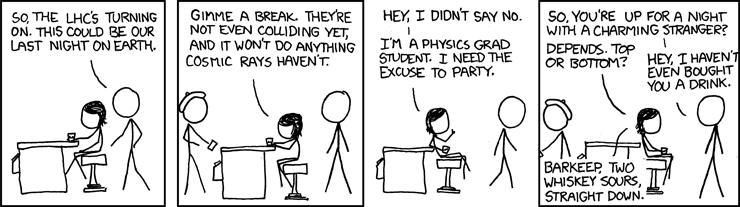
turn-on

xkcd: 'turn-on'

Today, the Large Hadron Collider (LHC) in CERN was turned on!

How exciting!

Despite the dire predictions of ‘generating black holes which will end our Universe’ – predictions which were accompanied by death threats, something most physicists are not used to and unexplicably find mildly funny – things would appear to have gone relatively well!  I guess science’s search for interactions between  Truth and Beauty continues!  (Well, at least scientists expect to see SUperSYmmetry (SUSY) ).

From today’s xkcd (above) and the ‘Scott Adams Blog’ which gives advice to all the bosons our there on ‘Nerdy pick-up lines’, it seems that events like these would appear to open up the horizons to an increase in puns among certain demographics….

Currieous!

P.S. – special mention to the person who can find all the puns in this post….there may be a few.

MSMs approval ratings sink lower that Bush’s

We have all heard the cries that the Main-Stream Media (MSM) has a pro-liberal, anti-conservative bias.  Members of the MSM dispute this, righteous indignation inflaming their passions.  I am convinced that they truly are unable to see any bias in their coverage – from daily events to political commentary.  Yet, I am equally convince that the bias exists – and that it is very, very pronounced. 

‘Bias’ is such a difficult thing to prove – yet it is easy to spot.  It might not be ‘what’ is written, but ‘how’.  It may not be the words a newsanchor speaks, but how they tilt their head, square or slump their shoulders, how steadily they hold their gaze. 

I notice these things quite a bit – being an Aspie, I do not understand body-language and facial expressions naturally.  Therefore, I have had to learn the nuances of their meanings – and am accustomed to ‘search and interpret’ them.  Where others might get a ‘feeling’ or simply be swayed, I have to actually go through the conscious process of interpreting the manner, affect and body language.  So, yes, I do see it – and it drives me crazy when people deny it is there! 

NewsBusters had an article recently, which confirmed what I have been thinking:  it is not a ‘conspiracy’ among media members, nor are they bribed, or anything ‘fun’ like that.  The righteous indignation most members of the MSM feel does not ring false.  Something else is going on.  Here is a part of the conversation between two journalists, quoted in that article:

HARWOOD: Well, some of – I get what you’re saying, and look, I think that people who talk about bias in the mainstream press, left of center bias, are not imagining things. 

KERNAN: No. 

HARWOOD: It has to do with the kind of people who go into journalism, okay? So I’m not arguing with that general notion.  I think those of us in journalism have to do our best to try to present the most objective view we can of what we have –

KERNAN: I agree.

HARWOOD: But everybody brings their own filter into it.

This is an honest admission that most of the people who wish to enter the profession of journalism are, for reasons unknown, more likely to hold left-of-centre views than otherwise.  But, surely, once in journalism school, the professors will have taught their young recruits how to recognize their own bias, and how to overcome it?

Well, not in my experience….  I went to a University which was known for excellence in two disciplines:  journalism and physics.  I studied the latter.  Yet, I did have some interactions with the school of journalism…

When one of my Math exams was located in the Journalism buildings, some friends joked I did not have to study for it- it was ‘bound to be cancelled’.  Regardless, I went to the exam – only to find the whole building locked up, metal grills blocking all entrances:  someone had phoned in a bomb threat.  I got upset – a bomb threat?!?  That was not a laughing matter!  Yet, other students tried to comfort me:  “This is the Journalism building – the profs would fail them if they did not phone in one or two bomb threats!”

So, who exactly are these professors of journalism? 

Here, demographics play a very important role…  The journalism departments are (or, at least, while I was in University, they were) run by baby-boomers and ex-hippies:  the same people who fought against the Vietnam war by staging student protests and who learned the wrong lesson about ‘class struggle’:  instead of learning (and teaching) to oppose ‘the establishent’, they learned to fight the political views which defined ‘the establishment’ of their youth.

These people are still trying to fight McCathy!

These professors even go so far as to teach that ‘responsible journalism’ is one which provides the information in such a way as to lead their audience to the ‘correct’ opinion!  In other words, instead of teaching ‘impartial journalism’ which reports the facts and allows the audience to form its own conclusions, they are teaching young journalists that producing propaganda is ‘responsible journalism’!  No wonder most of today’s journalists are unable to discern their own bias, or see manipulative reporting as inappropriate!

This is, by no means, an American phenomenon:  it is worldwide… with the added dimension that people outside of the US add a very unmistakable ‘anti-American’ twist.  Please, indulge me here for just a little bit:  American or not, we are all bombarded by the coverage of the US elections.  So, I could not help but notice…. 

Both Barack Obama’s father, and step-father (who influenced him as he grew up) were employed by oil companies.  I do not think there is anything wrong with the fact itself – I am only asking if you think that most people would be left unaware of this fact had this candidate been a Republican?

Which brings me to Mr. Bush – perhaps one of the least liked politicians today.  His popularity ratings today are – according to the most recent polls – somewhere between 35% and 30%.  So, how do the American people see their media?

Among unaffiliated voters, 49% say reporters are trying to hurt Palin, while 32% say their coverage is unbiased. Only five percent (5%) say reporters are trying to help her.

Only 32% of ‘unaffiliated’ Americans think the media does not have left-wing bias!  This, by coincidence, is about the same percentage as approves of Bush as President.

This ought to make them think…