Net Neutrality Becomes the Law in the Netherlands

This is indeed positive news:

In addition, the law includes an anti-wiretapping provision, restricting internet providers from using invasive wiretapping technologies, such as deep packet inspection (DPI). They may only do so under limited circumstances, or with explicit consent of the user, which the user may withdraw at any time. The use of DPI gained much attention when KPN admitted that it analysed the traffic of its users to gather information on the use of certain apps. The law allows for wiretapping with a warrant.’


Bits of Freedom goes on to explain that with passing this law, Netherlands becomes the first country to implement the EU guidelines on Net neutrality.

This comes shortly after we have had a tangentially related – but nonetheless noteworthy – ruling from EU Court of Justice: No Copyright on Computer Functionality or Computer Languages.

Which only makes sense.

Scientific American raises concern about unpublished source-code

Scientific American has sounded the alarm about the dangers of ‘doing science’ and then presenting the results without permitting anyone to see the code which was used to ‘massage’ process the data.  (Global Warming apocalypse-predicting ‘computer models’ pop into my mind:  ‘Yeah, our computer models predict catastrophic climate changes – no, you can’t see how!  Just take our word for it!’)

Pseudo-scientists hide behind the ‘copyright on source-code’ to present bad research – and many genuine scientists are truly limited by it, too.  The result is that, without the source-code, it is impossible to replicate their research:  an essential step in the actual real scientific process.

Without this step – replicating one team’s research by another, unrelated team to either verify or disprove their results – we will not be able to tell ‘good science’ from ‘bad science’ – or, indeed, downright scientific fraud. This will not only undermine people’s trust in all ‘science’, it will lead to people getting seriously hurt as ‘bad science’ becomes public policy.

This is yet another example of how copyright has been taken to a level which is harmful to us all.

The Fight Against the Copyright Lobby Is Part of the War for Freedom Of Speech!

I have said this often – and in many ways.

I have lamented the disconnect that exists between the people who fight for civil liberties in general and freedom of speech in particular and those who are battling the copyright trolls and those hardly audible voices that are trying to raise alarm about the abuse of patent laws.

Part of the problem – in my never-humble-opinion is that each of these groups comes from a completely different sphere of interest/infuence and, for all practical purposes, from different cultures.

They do not dress alike.

They do not follow the same trends in popular culture.

They do not agree on what ‘societal norms’ are today.

They do not read the same news sources.

And – perhaps most importantly – they do not use language the same way:  not only do they not use the same words to express themselves, when they do use ‘common’ words, they do not use them in the same sense.

Example:  when Canadian Free Speech acvocate Ezra Levant was being sued for defamation by an HRC troll by the name of Vigna, one of the ‘defamatory’ statements was that Mr. Levant accused Mr. Vigna of ‘hacking’.  The judge then started a bit of a lengthy discussion about what does the term ‘hacking’ really mean:  the consensus – undisputed by Mr. Levant’s sounsel – was that ‘hacking’ implies an illegal act!

Sitting in the audience, I came close to screaming out:  it does no such thing!!!

‘Hacking’ simply means ‘an innovative use of existing code/coding’!

I can easily say that I ‘hacked together’ a new app from bits of code I had from before:  no illegal activiy implied!  Sure, many people can use hacking for illegal purposes, but ‘cracking a problem’ is not the same as ‘cracking a safe’ – so the word ‘cracking’ does not, in itself, have illegal connotations.

Same with ‘hacking’.

BTW:  Mr. Levant was found to have defamed Mr. Vigna for saying he had ‘hacked’ something…

No wonder that the first two groups (civil libertarians/free speachers and anti-copyright-people) as ureasonable and weird…  (The last group is perhaps less distasteful to each of the first two, but, being mostly scientists, they are just not that great at communicating just how dire the situation really is….they are trained to overcome problems – not bitch about them:  so, that is what they do.  Which does not mean the problem is not there and is not desctroying our way of life!)

So, why is the message not resonating?

Perhaps this following article articulates this very point a little bit better than I ever could:

‘At this point in the discussion, the copyright industry will complain that they only take action for the illegal bitpatterns found, and that there is no infraction on the right to legal communications. And in doing so, they put themselves in the exact same spot as the old East German Stasi, which also steamed open all letters sent in the mail – but only took action on those with illegal content, just like the copyright industry describes as their preferred scenario. Stasi, too, sorted legal from illegal, and left the legal alone.’

And that is exactly what the copyright industry is demanding:  decrypt and check all the communication, permit the legal bits through and hand the rest over to law-enforcement agencies!

Please, consider the following court ruling in the UK:  All UK ISPs are now compelled to block access to Pirate Bay.

Please, c

onsider what is necessary to accomplish this:  each and every bit of communication has to be decrypted, analyzed and then either permitted to pass through or not.

That means that a private company not only has the right – it is compelled to – read each and every single email everyone sends.

What do they do with the information they receive in this manner?  The ruling does not bother itself with such mundane details….

WTF?!?!?!?

Sorry – please, insert the worst invectives of your choice here….

Because in a very real sense, this does indeed mean the end of private speech on the internet and the end of anonymous speech on the internet.

And let’s not forget our not-so-distant history:  anonymous speach is the cornerstone of liberty!

Without anonymous speach, there would be no Federalist Papers.

Without anonymous speach, there would be no way to overthrow tyrants.

No wonder those who want to hold power will use any pretext that presents itself in order to eliminate private communication and anonymous speech!!!

Copyright, censorship and freedom of speech

Property rights are an essential parts of our civil liberties because in a very real sense, property rights are an extension – and confirmation – of the principle of self-ownership.

How can I be in favour of protecting property rights, but at the same time oppose the copyright industry?

It may seem like a contradiction, but a deeper look will reveal that copyright and property rights – though related – are not exactly one and the same thing.

Property is physical and material:  it can only be possessed by one owner at a time.  If I steal your DVD of a movie, you no longer have the ability to enjoy possessing it.  By stealing, I have deprived you of possessing something.  It is possible to justify a law that does not permit me to deprive you of some object against your will .

Ideas do not work in the same way.  If I begin using your idea, I have not deprived you of the use of the idea:  it’s still available for you to do with it what you please.  But, is it reasonable to forbid me to think your idea and incorporate it into my own thoughts to produce a new idea or product?

Is that not a little too close to criminalizing thought?


YouTube identifies birdsong as copyrighted music

Really?

This is just getting silly!

From the Center for the Study of Innovative Freedom:

I disputed their claim with YouTube’s system — and Rumblefish refuted my dispute, and asserted that: ‘All content owners have reviewed your video and confirmed their claims to some or all of its content: Entity: rumblefish; Content Type: Musical Composition.’ So I asked some questions, and it appears that the birds singing in the background of my video are Rumblefish’s exclusive intellectual property.”

ThunderF00t: DMCA abuse? YouTube says – Not our problem.

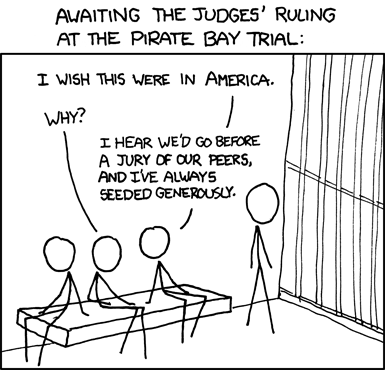
Pirate Bay founders cannot appeal, change domain name from .org to .se

Two related stories from TorrentFreak update us on what has been happening in Sweden in the Pirate Bay saga.

First, the founders have not been permitted to appeal their case, so their conviction stands.  (This should put fear into all of us, because what they were doing was legal under Swedish law – they were only charged and prosecuted because of pressure from the US movie industry.)

Second, now that their court case is concluded, they have changed their domain from .org to .se in order to prevent seisure.

If you don’t know the back story, perhaps you should ‘Steal This Film’:

http://www.youtube.com/watch?v=uKyuFJgGxJc&feature=colike

You’ve got to fight for your right to jailbreak

Imagine you buy a cake mix and then don’t follow the recipe on the box.  You could risk ‘sub-optimal results’ – but that is it.

How different would our world be if you were also facing jail time?

What if not following the manufacturer’s instruction – even just to add chocolate chips to the mix – meant that you could be arrested and criminally charged?

Well, that is actually quite similar to what used to happen to people who used their electronic devices in slightly different ways than what the manufacturer said they should.  For various reasons, the manufacturers of electronic devices argued that even though a person has purchased and 100% owns an electronic device, they are not allowed to add the ‘chocolate chips’ (like, say, Linux) to ‘the cake mix’ in a process so persecuted, it has been dubbed ‘jailbreaking’.

Why are the manufacturers opposed to this?  It really just boils down to a loss of control over their customer, making it harder for the companies to spy on their customers to obtain loads of data they could monetize…

Luckily, consumer (we really should say ‘citizen’) groups have won this battle:  jailbreaking smartphones became OK through an exemption in the DMCA.

A temporary exemption.

Which is about to run out…

bunnie Huang, standing shoulder to shoulder with the Electronic Frontier Foundation, has drafted a letter and a petition to extend the jailbreaking exemption, both in time and in scope:

‘Three years ago, the Copyright Office agreed to create an exemption to the Digital Millennium Copyright Act so that folks could jailbreak their smartphones. But that exemption is about to expire. We need you to renew that exemption and expand it to cover jailbreaking gadgets with similar computation potential. These are all siblings to the PC, yet unlocking their potential as versatile and powerful computers is burdened with legal murkiness.’

You can sign the petition here.

Unless, of course, you don’t think people should be allowed to add chocolate chips to their cake mix…


The Agile Panda: US Bill Creating the Great Firewall of America

A few places have been picking up on the implications of the US SOPA (Stop Online Piracy Act) bill, but I think that The Agile Panda has a very good analysis of the situation with comparisons to how this is being done in China.

Michael Geist, of course, has an excellent post:  SOPA:  All Your Internets Belong to US

“To put this is context, every Canadian Internet provider relies on ARIN for its block of IP addresses. In fact, ARIN even allocates the block of IP addresses used by federal and provincial governments. The U.S. bill would treat them all as domestic for U.S. law purposes.”

Yes, SOPA would define ‘all’ Canadian IP addresses as being under US jurisdiction – and if you want to argue about it, just to get your foot into the door to register a complaint, you must acknowledge US has jurisdiction…no, I am not being circular, SOPA is.  And, as we have seen with other internet legislation, an accusation is sufficient to force your ISP to deny you service – as well as all online financial services would be cut off based on an accusation.

Lovely, is it not?

The Agitator points out that the US is trying to make it a federal crime to lie on the internet.

As I have said before – and doubtlessly will say again – we really really really need a diffused peer-to-peer internet alternative that will, by its very structure, be uncontrollable.

H/T:  Hacker News, Blog of Walker

Europe v. Facebook