What ‘Earth Day’ is about

April 22, 2010 is the 40th anniversary of the Earth Day!

And, while I think that just about everyone who lives on Earth would like it to be a nice, happy, comfortable little planet – have you paused to think what Earth Day is really about?

Oh, sure – we are being told that it is a reminder ‘not to pollute’ and ‘to be good to the Earth’ and not to forget ‘Mother Earth’….

But, things  have a way of being more than they seem.

No – this is not ‘yet another conspiracy theory’ – mostly because I think that even though conspiracies are ‘fun’, most people are simply not disciplined enough to carry them out….

What I mean is that every message has its ‘obvious’ meaning – the one we perceive easily.  In addition, it also has a deeper message:  sometimes intentional, at other times it is just ‘stuff’ that ‘piggie-backs’ on that message…the transmisssion of ideas the originators of the message ‘took for granted’ and which ‘snuck in’ without them (and/or their audience) even being aware of it.  Once these subtle and sub-conscious bits are part of the message, any message, they necessarily affect the subconscious attitudes of the people who hear and accept the message’s ‘obvious’ meaning.

And, in my never-humble-opinion, the deep, subconscious message behind Earth Day is this:

Anthropocentrism and theocentrism are mutually exclusive...

‘Anthropocentrism’ and ‘theocentrism’ are mutually exclusive…

Seeking volunteers for Crowdreview of IPCC’s references!

Donna Lafromboise of ‘There is No Frakking “Scientific Concensus” on Global Warming’ is seeking volunteers who are willing to spend 3-10 hours in reviewing the IPCC’s references – simply to check (and count) the number of ‘peer-reviewed’ references versus ‘other’ sources (like, say, an ad by WWF, a press release, a guess in an obscure non-scientific magazine, and so on).

The reason?

Most of our policymakers (worldwide) are pretending (acting as if) the 2007 IPCC report were the absolute truth, represented a 100% scientific consensus (you know – anyone who disagrees is automatically defined as a non-scientist, or worse – a denialist!).

One of the reasons most often cited for considering this to be THE authoritative last word that we, pesky humans are boiling poor Mother Earth do death is that the IPCC report is based on solid scientific evidence. All the IPCC evidence, the warm-mongers claim, is based on scientific studies which were peer-reviewed and published in reputable scientific journals.

‘Peer-review’ is what makes a scientific study ‘respectable’.  It is a process in which other respected scientists (ones who are not connected with the people who did the original work and who wrote it up for publication) read the original study, examine how the data was collected, how it was manipulated, how the study analyzed the data and whether the data supported the conclusions which the authors of the study made.  In other words, it’s like having a teacher mark your homework…..  If it is ‘good’ – it passes the ‘peer-review’ and the scientific journal can publish the study with the knowledge that their reputation will not be tarnished by doing so.

This, of course, puts great pressure on the scientists reviewing the study.  No, they are not expected to re-create the experiment, but, they are responsible for making sure that good scientific methodology was followed, that the data collected actually measured what the original scientists thought it measured (THIS is where MORE mistakes in scientific studies happen than most people – including scientists – are aware of), that the statistical analysis used was appropriate for the data, and so on.  It is a big responsibility – with the greatest asset a scientist has on the line:  their reputation!

That is why ‘peer-review’ is considered to be an assurance of ‘good, sound science’.

And THAT is why the IPCC and its supporters argue that since the IPCC is based on ‘peer-reviewed’ scientific studies, it is above reproach!

OK….

For the sake of the argument, let us set aside any claims that the IPCC-associated scientists turned ‘peer-review’ into ‘pal-review’ and actually check to see just how accurate the claim that the IPCC used only scientific studies which were ‘peer-reviewed’ and published in reputable scientific journals.

In her post, Donna says:

‘How much of the 2007 Intergovernmental Panel on Climate Change (IPCC) report is based on peer-reviewed literature? Recent examinations of two random chapters found only 24 percent and 58 percent of the sources cited were peer-reviewed journal articles.’ ‘

So, she has decided to put the whole thing to the test!

But, that is a lot of checking….  Therefore, she is looking for volunteers who would be willing to share the load:

‘The goal of this project is for each chapter to be counted thrice, by three volunteers working independently of one another. In the event that tallies differ dramatically, further examination will occur. Should they differ only marginally, the count that is most favourable to the IPCC will be used.’

So, if you have a bit of time and are willing, head on to her site and get counting!

If a tree falls in the forest….

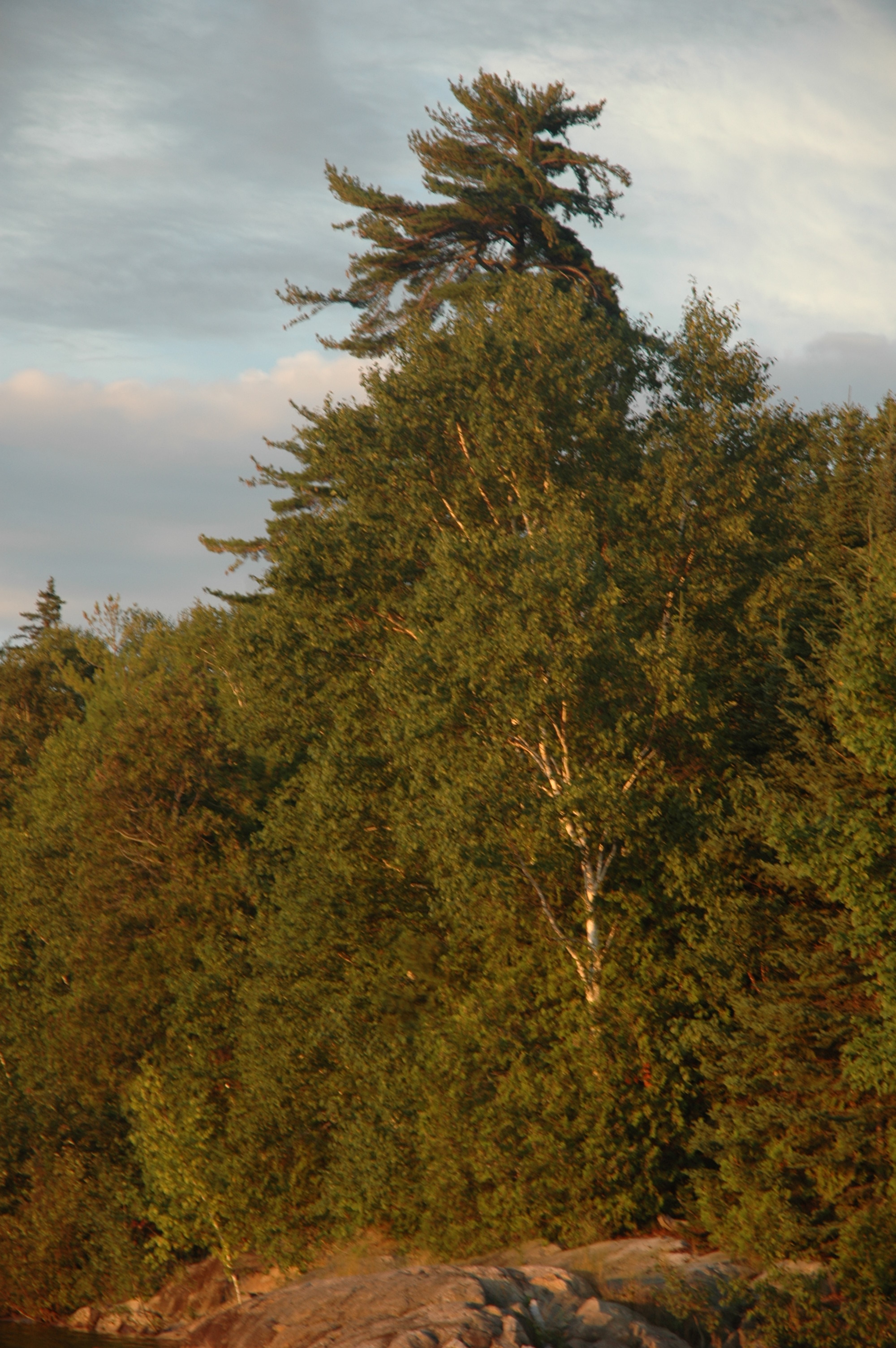
Having spent time in such serene surroundings like this:

Canada has magnificent trees.  This one looks like it's in the thralls of a wild, primal dance!

Canada has magnificent trees.

…is it not surprising that my mind had taken a break from the ‘everyday’ and slipped into a bit of philosophising?

If a tree falls in the forest, and no-one is there to hear it, would it make a sound?

In the past, when discussing this with my kids and husband, we have invariably fallen into the pitfalls like, for example, trying to define what does ‘sound’ mean:  is it simply the movement of air molecules in a particular way, or does it have to be ‘perceived’ by human ears?  (If it is recorded, then the sound we hear is made by the recorder, not the tree…and endless possibilities along these chains of thoughts.)

This year, I began so see it from a different perspective…

Richard Feynman is perhaps my favourite genius of the 20th century – and I am convinced he is an ‘Aspie’ to boot! ( Just reading his most awesome book, ‘Surely You’re Joking, Mr. Feynman!’, is an excellent lesson in how an ‘Aspie’ mind organizes thoughts and commits them onto paper – plus it is fun and curiously comforting to read).  In his Lectures (available as podcasts, and ideal for relaxing with while ‘away from it all’), specifically, in the ‘Quantum Mechanics’ lecture, he also visits this question about the proverbial tree falling in the forest… 

Dr. Feynman gives some very specific qualifications regarding this issue:  he would not be a physicist had he not done that.  He states that in the real world, even if there is no observer when the tree falls, there are still unmistakable physical signgs that it had, indeed, made a sound.  These signs, perhaps as minute as little scratches from vibrating leaves/needles as the sound energy is transferred to them, could then be observed after the event itself and the presence of such sound would be conclusively demonstrated.  Thus, he concludes that ‘in a real world, of course, a tree falling in a forest makes a sound‘.

He is, of course, absolutely correct – given the qualifications he does.  

Yet, listening to him made me think that perhaps his ‘after the fact observer’ – as our familial discussions from the past – were really missing the whole point of the question!

Whether during the act of the tree falling, or afterwards; directly or through recording devices of some sort (even leaves and needles) – this introduces an observer.   And the fact remains that if an observer is present, and the original condition (or, rather, its intent) is breeched.

Yes, I’ll gladly concede that in the real world, it might be impossible to have a ‘no observer’ scenario – but that is not the point.  The question asks us about a hypothetical situation, where no observation (during or after the event) occurred (even had it been possible). 

Let us imagine an observer who makes a direct observation that 999 trees, as they fell, indeed did make a sound.  Then the observer leaves, and our proverbial tree falls.  No observation as to the sound of any kind had been made during the event.  The scene has since been altered so much that no additional evidence can be gathered.  How can we answer the question now?  Did our proverbial tree make a sound, or not?

And this, in my never-humble-opinion, is the crux, the core, of this principle:  one can only say that one does not know.

It would be reasonable to predict that it is highly likely that the tree had made a sound, based on previous observations.  But one would not know !

This is the difference between direct observation and a guess.  Perhaps it might be an ‘educated guess’ (based on the previous 999 observations) , but it is still only a guess.  And that is the whole point:  to get us to stop and think, to learn to recognize that difference between what we know and what we are making educated guesses about (or a semi-educated guess about).

One of my sons thought this simply reduced the question to the ‘Schrodinger’s Cat’ scenario, but I think there is a difference.  This is not about probability curves and their collapses, this is about learning to recognize the blinders we all wear which let us treat guesses (whether ors or those of others) as equally valid to observed facts. 

And it is about time that some of these blinders statred coming off! 

After all, guesses, even educated ones, are not facts – and we must not fall into the easy trap of treating them as such.  Especially in cases where the guess is not based on 999 direct observations of this very event…or not on even one such event having ever happened!

Which leads me to the next question:  If the global temperatures change by 0.6 of a degree, and no well-financed lobby group is there to use it as a pretext to organize a scare-mongering, funds-transfering campaign, would anyone notice?

Perspective - we all need it!

Perspective - we all need it!

Observations do not match IPCC’s predictions

This is the beauty of ‘scientific theories’!

In order for something to qualify as a ‘scientific theory’, it must include a set of predictions of ‘actions or reactions’, which will prove or disprove said theory.  Though not usually well understood, this is what makes ‘scientific theories’ ‘respectable’.

The IPCC’s report formulated a theory.  This theory predicted that due to human activity, there has been (and continues to be) an increase in the Carbon Dioxide levels in our atmosphere, AND that this difference is CAUSING specific, observable changes in world climate.  It then makes a set of specific predictions of how the climate will change as a result of this.

OK.  So far, so good.

Now, back when it came out, there were a LOT of us criticizing the IPCC’s report.  Whether it was: their methodology, their underlying data – whatever the causes, there was much criticism.  This was answered by the supporters of the IPCC report in various ways, which were not always satisfactory.  Much bickering ensued.

But, all this is slowly and surely becoming irrelevant, thanks to the IPCC’s report itself.  WHY?  Because of the predictions it made.  The very ones which – if observed to occur – will confirm that the IPCC report was accurate and the critics were full of dingo’s kidneys.  If, on the other hand, observations are made which are NOT in agreement with the IPCC report’s predictions, it proves the sceptics were correct and that the IPCC report itself is a load of dingo’s kidneys!

Well, over the last little while, much data has indeed been coming in.  Like, loads of it.  And, as many actua scientists (as opposed to advisors to policymakers) had predicted, the bits which ‘fail to support the IPCC report’s predictions’ are the ones most favourable to that ‘report’.  Most of the data coming our actually directly contradicts it…. 

Here is just the tip of the iceberg:

‘Climate Sensitivity Reconsidered’

Abstract

The Intergovernmental Panel on Climate Change (IPCC, 2007) concluded that anthropogenic CO2 emissions probably caused more than half of the “global warming” of the past 50 years and would cause further rapid warming. However, global mean surface temperature has not risen since 1998 and may have fallen since late 2001. The present analysis suggests that the failure of the IPCC’s models to predict this and many other climatic phenomena arises from defects in its evaluation of the three factors whose product is climate sensitivity:

  1. Radiative forcing ΔF;
  2. The no-feedbacks climate sensitivity parameter κ; and
  3. The feedback multiplier ƒ.

Some reasons why the IPCC’s estimates may be excessive and unsafe are explained. More importantly, the conclusion is that, perhaps, there is no “climate crisis”, and that currently-fashionable efforts by governments to reduce anthropogenic CO2 emissions are pointless, may be ill-conceived, and could even be harmful.

Just in case you like ‘graphic representations’, the article has some nifty graphs.  Not as alarmist as Mr. Gore’s graphs were, but they DO show actual temperature measurements:  please, follow the link to the article and look at them….using plain linear regression, they demonstrate the temperatures are going down…

According to the IPCC’s graphs, these should be going up.  And, before you say ‘this is natural variation and does not prove anything’, let me point out that the IPCC’s predictions say these graphs cover a long enough period to demonstrate warming.

The article then inclused more colourful and pretty charts, diagrams and graphs, a ‘ton’ of actual physics, and comes up with this closing statement:

In short, we must get the science right, or we shall get the policy wrong. If the concluding equation in this analysis (Eqn. 30) is correct, the IPCC’s estimates of climate sensitivity must have been very much exaggerated. There may, therefore, be a good reason why, contrary to the projections of the models on which the IPCC relies, temperatures have not risen for a decade and have been falling since the phase-transition in global temperature trends that occurred in late 2001. Perhaps real-world climate sensitivity is very much below the IPCC’s estimates. Perhaps, therefore, there is no “climate crisis” at all. At present, then, in policy terms there is no case for doing anything. The correct policy approach to a non-problem is to have the courage to do nothing.

Thanks to Jenifer Marohasy for the story!  But that site also had another interesting article:  ‘Global Warming is a myth:  a Note from Jim Peden’.  It has a respected physicist, looking not at ‘climate change’ itself, but analyzing the physics of the very mechanism that the ACC crowd claims is responsible for ‘Greenhouse gasses’ causing ‘Global Warming’.  This is how it starts:

As a dissenting physicist, I simply can no longer buy the notion that CO2 produces any significant warming of the atmosphere at any rate.

I’ve studied the atomic absorption physics to death, from John Nicol’s extensive development to the much longer winded dissertation by Gerlich & Tscheuschner and everything in between, it simply doesn’t add up.

In case you are not familiar with the claims made by the ACC crowd, they say that the atoms of ‘greenhouse gasses’ absorb energy in the visible and UV spectrum, break it down into smaller bits (heat) which they then release, and which are then ‘trapped’ in our atmosphere.  Here, a physicist who specializes in atomic absorption (and is respected and recognized as an expert in this), calls their claims a load of dingo’s kidneys…. 

Gosh, I hope everyone loves kidney pie!


Please note:  the original post contained an unjustified statement by me, where I jumped to conclusions instead of properly checking my sources.  This was spotted by ‘tamino’, who commented on it.  Many thanks for his help, as getting the correct information is essential.  The incorrect claim has been removed.


IMPORTANT UPDATE:  Viscount Moncton, author of the American Physical Society’s ‘Forum on Physics & Society’ article, which is the 1st of the articles I linked to and quoted from, has some questions for the American Physical Society….  (via SmallDeadAnimals and TheCorner)

Yet another lesson… will it be learned?

All right, this clip is not from the boys down under, it is from Pen and Teller – the professional sceptics who put on the show ‘Bullshit’.

In their role as sceptics, they have gone on to challenge much – and not everyone is always pleased with them.  Here, they are teaching a lesson in how ‘environmental enthusiasm’ – a very real and honest desire to protect the Earth from harm by us, humans – can be so very easily abused by those who wish to use these honest, trusting and eager activists and subvert them and their voices for something completely different… 

In some ways, it kind of is like that ‘Trojan Horse’ idea!

Vaclav Klaus’ Washington CEI speech

This President is one smart cookie!

Yesterday, he delivered a speech in Washington, in which he said:

“It is interesting that you came up with the name Josef Alois Schumpeter (to intentionally use the Czech pronunciation). I don’t expect all of you to know that this great economist was born in 1883 on the territory of my country – the Czech Republic – in the small Moravian town of Třešť, belonging at that time to the Austro-Hungarian monarchy. He was part of an important group of Austrian Moravians which includes names such as Sigmund Freud, Gustav Mahler, Karl Kautsky, Ernst Mach, Robert Musil, and many others.”

“Reading his Capitalism, Socialism and Democracy, which was published in England in the 1940s along with books such as Hayek’s The Road to Serfdom and Orwell’s Nineteen Eighty Four, one comes across a slightly different story, which is his evolutionary theory of the demise of capitalism based on its very success. His main argument – as I remember it – was that innovations would become a matter of routine, progress would be mechanized, problems would be “simply solved” by means of reason and science, entrepreneurship would be replaced by mere calculation, individual motivation would subside, collectivistic mentality would prevail and the growing importance of teamwork in modern large corporations would lead to the gradual obsoleteness and at the end disappearance of the crucial player (or perhaps mover) of capitalism – of the entrepreneur. That was his vision of the end of capitalism. He regretted it, but did not see it as the end of history, progress and development.”

The first problem this theory has is its connection with the reality because the world has not followed Schumpeter’s predictions.”

The complete text is on Mr. Klaus’ blog.

This, to me, is a telling analysis:  this economist looks at the theory, evaluates its internal consistencies (or lack thereof) – and then COMPARES THE THEORY TO REAL-LIFE OUTCOMES !!!!

Not only did he do EXACTLY THIS with the IPCC-type AGW/ACC ‘theories’ (and I do use the term ‘theories’ loosely) in his book ‘Blue Planet in Green Shackles – What is Endangered:  Climate or Freedom?’, he also points out the necessary consequence of actions currently being implemented to ‘mitigate’ AGW/ACC:  establishment of world government. 

So, why would anyone think there are any dangers in establishing this ‘world government’?  Mr. Klaus warns that we just might me passing world government into the hands of arrogant elitists who are convinced that ‘they know better than the rest of us’….  He asserts that some of the same people who are advocating establishing world authorities to regulate carbon emission – with the power of enforcment (that is, world government) – that were also advocating this 30 years ago in the name of world socialism.  Just listen to Glenn Beck’s second interview with him: 

Kind of makes you pause and think, does it not?

It should!