More thoughts about the issues of ‘privcy’ and ‘presumption of privacy’

Over the weekend, this video, purported to be from ‘Anonymous’, was released.  It demands that the Canadian Minister, Vic Toews, remove bill C-30 (which would permit civil servants unlimited snooping powers on the citizens via the internet without judicial oversight) and that he step down immediately.

The following video also purports to be from ‘Anonymous’.  As I have no connection to that group, I have no idea if it is authentic.  However, I do think it is worth posting because it raises several issues worth further discussion:

This video raises the connection between the desire by various governments to regulate arms and to regulate the internet.

This is a deeper connection that one may think, at first glance.  But, deep down, both are attempts to take away the citizen’s ability to protect themselves – including, if necessary, to resist their government.  Both are ways in which governments make their citizens less secure, more isolated, and more afraid of their government.

Even if you are not as libertarian in your views as I am (I think that monopoly control over infrastructure – even, or perhaps especially, information infrastructure – is perilous to civil liberties), it is easy to see how governments are threatened by citizenry that is difficult to control and willing and able to oppose them.

Firearms are a means of physical self-defense and an equalizer between the strong and the weak.  Even a small woman can protect herself from a rapist with the use of a gun:  her physical safety is no longer dependant solely on the timely response of the state to come to her aid.  This threatens the government monopoly on the enforcement of laws:  as every monopoly’s natural reaction would be, the government’s reaction is to restrict this competition.

Let’s be clear about this:  government ‘regulation’ of firearms is not about increasing public safety by having many well trained, well armed citizens available in public spaces who would be able to stop law-breakers and thus increase public safety.  To the contrary:  it is always specifically designed to restrict gun ownership, use, and the very presence of privately owned guns in public spaces.  This intolerance on the part of government of guns in private hands – even though this increases public safety – is indicative of the government’s disrespect for its citizenry, with the goal to increase government coercive powers at the root of all ‘arms regulations’.

Information is a weapon and a powerful one.

So is anonymous speech.

The internet enables both.

As a matter of principle, anonymous speech is necessary for the preservation of the very freedom of speech.  For example, The Federalist Papers could never have been published had their authors not had absolute anonymity at the time of publication!  The bigger the government is, the more dangerous it is to speak up against it openly.  Without anonymous speech, governments do indeed become more totalitarian and more tyrannical in nature:  this cycle has been repeated so often, it is blatant.

Yet, the ever-growing governments in the formerly-free world now wish to have complete and unfettered access to the information which would identify each and every internet user:  to be able to attach a name to every sentence uttered on the internet, from seeking sensitive advice at an online support group to dissenting political speech!

Of course, the governments are also increasing citizen surveillance on so many fronts…  There will soon be no arena where we do have ‘presumption to privacy’, not even in our homes and certainly not anywhere else.  So, the whole ‘getting a warrant’ might be a mute issue…

Technology is beautiful – but it is a tool, to be used for good or evil.  It is necessary that we understand these tools because our society will need to evolve along with them.  What am I talking about?

For example, drone-based aerial surveillance…

Or this totally awesome ‘bug thech’!  (Do watch the video, it is art and technology combined!)

What is my point?

As new technologies arise, we will need to develop laws to govern their use.  However, these laws (all laws, really) ought to be focused on protecting the civil libeties of individual citizens – not legitimizing the ways that governments and big business can circumvent them!
Canadian Constitution Foundation on Brian Lilley: warrantless searches

OpenMedia: A Huge Public Outcry

An urgent message from OpenMedia:

This is big. Powerful lobbyists, working with their allies in government, have put forward what amounts to an unavoidable choke point for your Internet use: two bills aimed at Internet users, and a government decision about the future of Internet access.

If we don’t stop this set-up, you’ll have to deal with bigger bills, widespread warrantless surveillance, and restricted choice.

By signing an OpenMedia.ca petition, you helped push back against new Internet restrictions and Big Telecom price-gouging. But these new challenges require more resources than ever to fight. Will you donate today so we can defend your rights? Your donation will empower the fight for an open and affordable Internet.

These three imminent threats will create an Internet choke point for Canadians, and they’re unfolding right now:

    1. Online Spying: The government has tabled their invasive spying plan (Bill C-30) to mandate that every Internet provider must hand “authorities” access to the private information of any Canadian, at any time, without a warrant1. Despite appearances the contrary, they are still pushing this through parliament.


    1. The Internet Lockdown: Through Bill C-11, Big Media lobbyists are seeking the power2 to compel telecom providers (who will now have surveillance capabilities) to cut Internet access for no good reason, remove or hide vast swaths of the Internet, and lock users out of their own services.


  1. The Cell Phone Squeeze: Big Telecom giants are lobbying the government to turn over control of mobile communications—which experts say are the future of Internet access—to just three giant companies3. This will lead to rising prices, even worse customer service, and more easily controlled surveillance.

Please contribute a few dollars now to help us stop this triple-threat of price-gouging, control, and warrantless surveillance.

With your help, we can put together an airtight, multifaceted plan that will turn government heads. Here’s what we’ll do with your support:

  • Launch a damning viral video that will turn up the heat on government.
  • Run pro-Internet ads targeting conservative politicians in swing ridings.
  • Unleash local, on-the-ground pressure, especially in major ridings.

This approach works. Two MPs have broken ranks4 already; now, we just need to nudge a few more over the fence. But we can’t do it without you.

Please stand with us by chipping in now. Anything helps.

With hope,

Steve and Lindsey, on behalf of your OpenMedia.ca Team

P.S. We created a media sensation this week and your petition signature helped start it all! Your team here at OpenMedia.ca has been run off our feet with media requests! Please chip in so we can keep up the pressure. We’ll report back on our progress to everyone that contributes.


Footnotes

[1] The Information and Privacy Commissioner of Ontario has written that the online spying bills could “undercut the future of freedom, innovation and privacy”

[2] Big Media is pushing for C-11 to include the power for courts to issue injunctions ordering ISPs to block access to websites. Many proposed amendments also include rules that mean accused (i.e. not necessarily convicted) “repeat infringers” could have their Internet connections terminated. The “enabler provision” may also be expanded in such a way that could be used to target legitimate websites that host user generated content. Those websites—including YouTube—could be penalized for hosting content that Big Media controls.

[3] Montreal Gazette: Spectrum auction called a threat to new entrants

[4] Conservative supporters, including some conservative MPs, have denounced the online spying bills.

Support OpenMedia.ca
OpenMedia.ca is a non-profit organization that relies on donations from people like you to operate. Our small but dedicated team ensures even the smallest contributions go a long way to make your voice heard. Please donate today.

OpenMedia.ca: Which Telecom Giant thinks you should pay more?

From OpenMedia.ca:

The Big Three are ripping us off and using the money to manipulate Canadians and the government.

As we’ve been saying, the Big Three cell phone companies have a plan to price-gouge Canadians by shutting out small competitors1. Now they’re unleashing a misinformation campaign to muzzle your voice.

For example,

    1. Rogers recently bought and paid for a trumped-up study2 that wrongly implies Canadians (you) can afford to pay more for telecom services.


  1. Rogers just took to the courts to argue that Canada’s false advertising rules violate the telecom giant’s freedom of expression! This after being caught red-handed and fined $10,000,000 dollars for misleading cell phone advertising.3

Will you let them get away with it?

With these two acts of extreme arrogance, Rogers has demonstrated that they will go to ridiculous lengths to tighten their stranglehold on communications and raise prices.

Some say mobile is the future of the Internet and communications. We have to stop the Big Three from creating a command and control communications market with tight contracts, content controls, price-gouging overage fees, and disrespectful customer service.

The government could make a decision on this at any moment. Sign the Stop The Squeeze petition now.

With hope and determination,

Steve, on behalf of your OpenMedia.ca Team

P.S. Unlike Big Telecom, we listen to Canadians. Some of you have expressed that we should provide more details in our messages. We heard you—here’s some more detailed background information:

    1. Cell phone companies require low-frequency wireless spectrum to deliver the latest mobile devices to customers. There is a new block of 700 MHZ spectrum that will be available for use through an auction later this year and the government is about to decide who will have access to the spectrum.The Big Three providers are sitting on more than enough spectrum to do deliver their services to Canadians (including those in rural areas). They want the government to take a do nothing approach and allow the Big hree to control essential spectrum and shut out independent competitors. You can also check out CTV News coverage of this issue here.
    2. Lemay Yates recently released a report, bought and paid for by Rogers, that suggests Canadians have better Internet speed, availability and pricing than our global counterparts. But this research directly contradicts many other independent reports (from the OECD, Harvard, the New America Foundation, Akamai, and more) that show Canada falling woefully behind on key metrics like price and speed.


  1. According to the Vancouver Sun: “Rogers Communications Inc. is asking an Ontario court to strike down part of a federal law requiring a company to have ‘adequate and proper’ tests of a product’s performance before advertising claims about the product — on the grounds that it violates its freedom of expression.”

Now that you know the details, it’s time to act.

Support OpenMedia.ca
OpenMedia.ca is a non-profit organization that relies on donations from people like you to operate. Our small but dedicated team ensures even the smallest contributions go a long way to make your voice heard. Please donate today.

ThunderF00t: DMCA abuse? YouTube says – Not our problem.

Slashdot: Do You Like Online Privacy? You May Be a Terrorist!

Here is another example of the Western governments’ war on its citizens.

Yes, war.

It sickens me that governments are now openly saying that if you shield your screen from the view of others, this makes you a terrorism suspect!

This creates precisely the type of environment where hacker-vigilaties will be not just tolerated, but positively embraced by a population that feels increasingly under attack by the very institutions created to ensure their individual rights.

Let’s not make any mistakes about it:  it is not Twitter and Google who are increasingly censoring us, the members of online communities.  Even though they facilitate access to the virtual world of the web, they are themselves physical corporations which exist in the real world, very much subject to the whims of real-world governments.

As such, they are subject to the arbitrary rules which various governments impose on corporations operating within their physical boundaries.

It is unreasonable for us to expect that these corporations will put the freedom on the internet above their ability to physically survive…

So, you may blame them for buckling – but don’t blame them for imposing the censorship itself:  the blame lies directly with our governments, our regulating bodies, and us, the citizens, who permit this encroachment!

The solution?

We must all fight to prevent all governments from usurping jurisdiction over the internet, the way they have been doing!

How?

I don’t know.  Yes, I have been thinking about this for a long time, but there simply is no clear answer.

The easiest solution I suspect would be to continue the efforts to create alternatives to the ‘pipelines’ that ISPs use to deliver internet connections, but the more people try to solve this, the more actual attempts there are to make the web truly uncontrollable and impossible to be regulated by anyone or anything anywhere, the better chance there is of success.

So – keep your elective representatives responsible – and keep hacking!

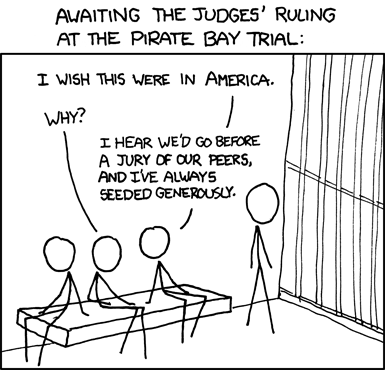
Pirate Bay founders cannot appeal, change domain name from .org to .se

Two related stories from TorrentFreak update us on what has been happening in Sweden in the Pirate Bay saga.

First, the founders have not been permitted to appeal their case, so their conviction stands.  (This should put fear into all of us, because what they were doing was legal under Swedish law – they were only charged and prosecuted because of pressure from the US movie industry.)

Second, now that their court case is concluded, they have changed their domain from .org to .se in order to prevent seisure.

If you don’t know the back story, perhaps you should ‘Steal This Film’:

http://www.youtube.com/watch?v=uKyuFJgGxJc&feature=colike

Michael Geist: The Behind-the-Scenes Campaign To Bring SOPA To Canada

SOPA may appear to be officially dead, but that does not mean that the lobbyists will not try to convince legislators to sneak SOPA-style provisions into other legislation:  whether as bits attached to other bills in the US, or trying to incorporate aspects of it into laws of other countries.  We must remail vigilant!

That is exactly the message from Michael Geist:

‘While SOPA may be dead (for now) in the U.S., lobby groups are likely to intensify their efforts to export SOPA-like rules to other countries. With Bill C-11 back on the legislative agenda at the end of the month, Canada will be a prime target for SOPA style rules. In fact, a close review of the unpublished submissions to the Bill C-32 legislative committee reveals that several groups have laid the groundwork to add SOPA-like rules into Bill C-11, including blocking websites and expanding the “enabler provision”to target a wider range of websites. ‘

‘The music industry is unsurprisingly leading the way, demanding a series of changes that would make Bill C-11 look much more like SOPA. ‘

‘Several lobby groups also want language similar to that found in the infamous Section 103 of SOPA. That provision, which spoke of sites “primarily designed or operated for the purpose of…offering goods or services in a manner that engages in, enables, or facilitates” infringement, raised fears that it could be used to shut down mainstream sites such as YouTube.’

This is something we must stay on top of!

Technorati: List of Sites Going Dark Over SOPA Today

As you may have heard, many sites are going ‘dark’ today over SOPA today.


Technorati has the list – and instructions on how you can, too!

‘Just as they’ve been warning for a few weeks now, a variety of websites, some small and others large in scope and influence, have shut down their virtual doors today in response to the possible passage of the Stop Online Piracy Act, otherwise known as SOPA.

The controversial legislation, before the House of Representatives, has caused nothing less than outrage from Internet service providers and their customers. The legislation, meant to stop companies from copying, or “pirating” content or software from others and reselling it, has been seen by many as over-reaching, a “sprawling new regime” of laws which will “stifle investment” and further “chill free speech” across the Globe.’

The power of your fingertips

Improving the internet, one click at a time!

GoDaddy is a company that hosts domain names.  (If you have trouble remembering them, their most memorable ads show Danica Patrick, a race car driver, claiming she is a ‘GoDaddy girl’.)  GoDaddy also vocally suported SOPA – the oppressive Stop Online Piracy Act  that would not only give the US government unprecedented warantless surveilance powers but would also extend their legal reach far beyond their borders, violationg (among others) Canadian territorial jurisdiction.

(Yes, SOPA would actually give the US government the power to warantlessly monitor all internet communication in domains within the North American sector, including all internal emails of the Canadian government.  And that is just the tip of the proverbial ice-berg…  It is being presented as a copyright protection act, but the way it is written will do little to protect copyright while givving unprecedented tools of oppression into the hands of US government and select large corporations.)

So, GoDaddy says it could not understand why good, law-abiding people would not support SOPA…

Reddit was not impressed:  SOPA will definitely cause injury to the online community – so adding an insult to it did not strike Reddit as cricket.  They called for a boycot of GoDaddy and advocated that people move their domains to other sites.

The news spread through the online community like wildfire!

Immediatelly, these ‘other sites’ publicly announced their opposition to SOPA – and began offering ‘special deals’ for domains being moved from GoDaddy to themselves.

GoDaddy has announced that it no longer supports SOPA…

Is it a case of too little, too late?

It is nice to see that regular people can indeed have an impact.

And let’s hope the anti-SOPA momentum keeps building!