Warren Kinsella’s new low

Blazing Catfur has the whole story...

Warren Kinsella (of the ‘women politicians would be better off baking cookies’ and ‘let’s go to Chinatown for some barbecued cat and rice’ fame) does not like Kathy Shaidle.

While Mr. Kinsella is pro-censorship, Ms. Shaidle is a leader in the fight to preserve our freedom of speech.

While Mr. Kinsella is smooth, political insider, Ms. Shaidle is brash, outspoken commentator/poet.

While Mr. Kinsella is among the forces trying to build politically correct society, Ms. Shaidle wants people to say what they mean, clearly and unambiguously, using words that do not hide their real meaning – even if these words are colourful and perhaps even offensive to some.

While Mr. Kinsella is tries to silence all the voices he does not like, Ms. Shaidle actually helps people be heard – regardless of their message.

Mr. Kinsella is sympathetic to the Palestinian people – even at the cost of supporting the Palestinian terrorists which oppress the Palestinial people more than anyone else ever had.  Ms. Shaidle defends the right of Israel to exist and openly (and colourfully) says that terrorists are not nice people.

While Mr. Kinsella is someone who sues the people he disagrees with, Ms. Shaidle is someone who had been/is being sued by Kinsella for disagreeing with him.

Perhaps there is an underlying pattern here…

When Ms. Shaidle was invited to appear on TVO’s Agenda, to comment on ‘The Atheist Bus’ campaign, Mr, Kinsella went, well, a little too far.  When the host of the show, Steve Paikin, refused to ‘uninvite’ Ms. Shaidle after Mr. Kinsella’s first demand that they do so, Mr. Kinsella threatened ‘there will be consequences’ because ‘he wrote to the Minister of Education about it’.

Had Mr. Kinsella been an ‘ordinary citizen’, this would be an empty threat.  But, he is not:  he is the Liberal spin doctor who helped get this Minister elected, and as such, the Minister ‘owes him’ – on one level or another.  This little fact gives the whole threat a brand new twist – and a very sinister one, at that.

Here, I should declare my personal bias:  I respect Kathy Shaidle greatly, I admit I also quite like her – but I cannot say I agree with her views on Atheism.  I most vociferously disagree with some of the comments she made during the show.  This can be seen from my post on this last week.   I know Ms. Shaidle and I also do not share the same views on Christianity:  she had bought me lunch last summer when I popped into Toronto, the topic came up (briefly), and we walked away respecting each other, even if not agreeing with each other.  Nonetheless… that is not really the point here.

The point is that is Mr. Kinsella’s threat is not an empty one – if his action will really result in the Minister of Education delivering those ‘consequences’ against TVO, The Agenda and Mr. Paikin – then we have even more to fear.

Why not drop Kathleen Wynne, the Ontario Minister of Education, a line?  You can tell her what you think about Mr. Kinsella’s threat here:  kwynne.mpp@liberal.ola.org

Update: It looks like the Canadian Jewish Congress has just decided to no longer associate with (employ) Kinsella…. don’t know the details there is a non-disclosure agreement in place.

add to del.icio.usDigg itStumble It!Add to Blinkslistadd to furladd to ma.gnoliaadd to simpyseed the vineTailRank

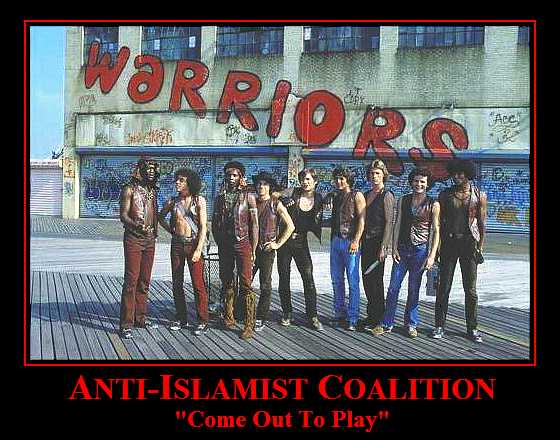
Anti-Islamist coalition

A new blog has entered ‘The ‘Sphere’!

Anti-Islamist Coalition

Anti-Islamist Coalition

Thanks to Babazee for creating this logo!

And, just to avoid any possible confusion, let me re-state this once again:

Islam is not the same as Islamism.

Islam is a religion, which is practiced in peace by millions of wonderful people.  I know and love some of them, and I certainly respect many of them.

Islamism is not the same sort of thing at all.  It is a political movement, intent on world domination, which just happens to be dressed up in the guise of Islam. These types of political movements have plagued humanity for thousands of years – and they have usually sought to legitimize themselves by wrapping themselves in the respectability of a ‘religious movement.  It just happens that this particular political movement is abusing Islam for its ends!

Certainly, Islamists believe themselves to be following Islam – which is why they cite it as a justification for their crimes.  And many Islamists truly believe what they are doing is following their god’s will – which is what makes this such a dangerous combination.

Which is what makes it that same old …

Go ahead and hate your neighbour,

Go ahead and cheat your friend,

Do it in the name of Heaven Islam,

So you can justify it in the end …

And THAT is why Islamism must be opposed.

It is an insult to Islam, and a deadly threat to the rest of us.  Never forget what happened to the ‘Mountain People’…  If you don’t know, then, listen, children, to the story that was recorded long ago…

(Please, take a special note of how the ‘Valley People’ reacted when invited in to share, as equals…  Of couse, were I the composer, I would have the ‘Treasure’ say ‘Freedom of Speech and Equal Rights for ALL’!  In my never-humble-opinion, without these, there can be no true peace!  But, that might be too big a mouthful for a song…)

add to del.icio.usDigg itStumble It!Add to Blinkslistadd to furladd to ma.gnoliaadd to simpyseed the vineTailRank

Ottawa bans ‘Atheist bus ads’

I am shocked at this.

Ottawa buses have sported all kinds of ads – religious or not – which I thought were, well, ‘offensive’.

Few years ago, they ran that ad which had attempted to lure children into the hands of pedophiliac priests:  an outwardly ‘pro-religion’ ad that urged EVERYONE (including underage children, who, of course, can read) to ‘go to church’ to ‘get guidance’.

If one reads its meaning in the ‘commonly understood’ way (at least, commonly understood among the people I know – the ad raised a lot of comments when it ran), it is simply and unequivocally luring children into the ‘dens of pedophiles’ also known as ‘Churches’. (Actually, about 15 years ago, a stranger who happened to be a ‘Mount Cashel’ survivor gave me a very poorly written, yet highly personal and extremely convincing note to warn me that letting my children near a Christian Church is putting them in the hands of pedophiles.  I have not found any evidence to disbelieve him – to the contrary.  When I took my son to a Pentacostal Sunday School, I found a person I knew to have a sexual orientation to ‘children’ – but I do not know if he ever acted on it – to be in charge of the program….and, when I alerted the Church hierarchy, they told me that since he had ‘found Christ’, it was important that they give him a ‘second chance’.  NOT WITH MY SON!!!)

We all know that many pedophiles like to use the ‘channel of divine authority’ to force young people into sex and silence.  It does not mean that every priest is a pedophile, only that pedophiles like to infiltrate the ranks of clergy, because the blackmail of ‘eternal damnation’ is a powerful tool to manipulate.  And, it does explain why the prices of houses within sight of a rectory (or, indeed, a Church) tend to be below the expected market value…. most responsible parents are just not willing to expose their kids to that high a risk!

So, ‘bus ads’ urging young people to ‘go to church’ can, in an undeniable way, be perceived as sending them into an environment where they are much more likely to encounter a pedophile than they would among the general population.  And, in any ‘moral’ judgment, this makes such ads ‘offensive’!

If, on the other hand, one were to read the ‘go to church’ ad in a different way (which, frankly, many Christians have assured me was the intent of the ad), the ad becomes offensive on a completely different  level.  Should the meaning of the ad have been ‘come to our churches when you are most vulnerable, so our priests can emotionally blackmail you to submit to our dogma so you will give us money – and thus buy God’s love and approval’ – well, frankly, that is rather offensive, too.  People who are going through a hard time and are vulnerable are the last ones who should go to places that tell them that ‘giving away money in this world’ will ‘buy them salvation in the next one’!

I also find it offensive in the extreme when some religious people misconstrue the meaning of ‘morality’:  instead of defining ‘morality’ as ‘deep, introspective reasoning to choose the best – least damaging/bad/evil – course of action based on their own experience, reasoning and their specific circumstances’, many religious people reduce ‘morality’ to ‘obedience to a set of dogmatic rules’.  That, in my opinion, is reducing ‘morality’ to the level of ‘puppy-training’ – and something which offends me on the intellectual, spiritual and moral levels!

To sum this up:  I find ads telling people that ‘going to church’ is ‘a good thing’ to be offensive in the extreme!

Yet, ads urging people – especially emotionally vulnerable people – to ‘go to church’ were deemed ‘acceptable’ and ran on the sides of Ottawa buses.

And, that is a good thing:  matters of freedom of expression are more important than any ‘sensitivities’.  Protecting the right of people to get their message out (provided they pay for it from their own pocket) – however much I despise their message – is much more important than whether or not I (or other people) find that message ‘offensive’!

Today, the sides and rears of Ottawa busses sport a different kind of an ad:  ones paid for by our own local ‘Cruella deVille’ and her little furrier empire!

Please, do not get me wrong.  I think that if an animal is killed for food, it is only reasonable to use every part of the animal, including its skin or fur.  However, that is a very a different thing from raising animals in small, crowded cages and then electrocuting them (so the pelt has no holes) and using only their skin to create a ‘luxury product’.  And, it is this latter practice that I find extremely offensive.

Actually, I asked a few of my Hindu friends what they thought about these ads:  they were not particularly fond of them, to say the least!  Their religious sensitivities were deeply offended by the ads promoting frivoulous ‘luxury furs’!

After all, NOT ascribing animals a soul equal to the soul humans have IS just as much of a a religious prejudice as NOT ascribing them one is….   Please, think about this, long and hard.

Yet, these ads urging people to indulge their religious prejudice that animals have no soul (or, at least, not one worth considering) and to indulge themselves by wearing their pelts as an expression of luxury – these are allowed to run!!!  Offensive in the extreme!!!  (Please, ask PeTA what they think of these ads!!!)

And, that is a good thing:  matters of freedom of expression are more important than any ‘sensitivities’.  Protecting the right of people to get their message out (provided they pay for it from their own pocket) – however much I despise their message – is much more important than whether or not I (or other people) find that message ‘offensive’!

Yet, ads urging people not to take their religion to the point of extreme – not to obsess about it, to the detriment of their quality of life (and those near and dear to them) – THOSE ads are deemed to be ‘offensive’?!?!?

I have heard objections to these ads, based on the grounds that ‘seeing them might make people do immoral things’!  Yeah, right… Yet, if that is so….

Well, then, what about a person so obsessed with his religion, he is planning to strap a bomb to his body and blow up himself, along with a busload of schoolkids?  What if THAT person sees the bus and decides not to chance it?  What IF God is NOT real – who would give him the 72 virgins?

Would that be so bad?

Or, what about the father who is planning to clense his family’s honour in his daughter’s blood?  What if HE sees the ad, and realizes that killing his daughter on the GAMBLE that there IS a God just may not be worth it?

Would saving the life of one girl not be worth offending a few people?

Or, what about the man who loves his wife, but who is told by his spiritual adviser that it is not just permitted, but ‘necessary for her salvation’ that he beat her?  It is not so long ago that Christian priests preached this from the pulpit – and many Muslim Imams still do!  So, what if a man who believes them sees this – and it helps him find the courage to respect his wife and treat her like an equal – which is what he wanted to do in the first place, were it not for the ‘religious teachings’???

Would THAT be so offensive?

I suppose that some people think so.  I guess the only time Jews, Christians and Muslims gang together is to lynch atheists – and to silence the voices of reason that threaten the power of clergy to control the lives of nice people.

How ‘offensive’!!!

UPDATE: This week ( ending March 14th), the Ottawa City Council has reversed the ruling and the ‘atheist ads’ will be allowed to appear on the sides of busses.

add to del.icio.usDigg itStumble It!Add to Blinkslistadd to furladd to ma.gnoliaadd to simpyseed the vineTailRank

Groundhog Day – What does it mean?

If you live in North America, you are likely ‘familiar’ with ‘Groundhog Day’:  on the 2nd of February, ‘The Groudhog wakes from winter slumber and sticks hear head out of her den.

If it is sunny enough for the groundhog to cast a shadow, the sleepy gal will get startled and run back into her den to continue napping.  This will cause the cold winter weather to continue for 6 more weeks.  If it is cloudy, there will be no shadow to startle her and she’ll wake up nice and slowly.  She will then stay awake, causing the winter weather to recede and the spring weather to come early.

So, what is this quaint little legend all about?

Perhaps there is a reversal of causality:  this could simply be a weather pattern observation, set into a quaint little story.  After all, during the coldest winter temperatures, the sky is cloud-free and sunny.  Clouds act like a blanket that traps heat, so cloudy winter days tend to be warmer.  That is why it never snows when the temperatures are cold.  (We are talking relative winter temperatures here….as in, -40 degrees (Celsius and Fahrenheit ‘meet’ this point) is ‘chilly’, -10 degrees Celsius is ‘warm’.  Remember, I am writing from Canada.)  When it gets that cold, one could not even drive a groundhog out of its den!

It is conceivable that, over generations, people observed that if this time period was particularly cold – it was likely to signal that the winter weather would drag on for a bit.  Conversely, if the temperature at this time was mild, it would be followed by more mild weather, bringing the spring in earlier.  So, the co-relation.

Plausible.  Or, the roots of ‘Groundhog Day’ may lie somewhere else….

There are several things which are significant:

  1. The date – 2nd of February (plus or minus a day or two)
  2. 6 more weeks of winter
  3. The Groundhog herself
  4. The Groundhog affects the weather

1.  The date:  2nd of February

It is the halfway point between the Winter Solstice and the Spring Equinox:  this makes it a ‘cross-quarter day’.

From earliest historical records of human civilizations, we have seen that the solstices and equinoxes had been noted and celebrated by our ancestors.  These 4 ‘easy to define’ (through simple observation) markers of the Earth’s annual cycle are called ‘quarter days’.  The midpoints between them – when that season is most ‘intense’ – are also marked: these are called ‘cross-quarter days’.

Many cultures have described this ‘cycle’ as the ‘Wheel of the Year’:

http://www.midnightmoonchild.com/images/wheelx.gif

This image is from the names of the ‘marker days’ reflect the one of traditions descended from the British isles.  The ‘Pagan’ belief systems which accompany the annual cycles associate various Gods and Goddesses with specific parts of this cycle.

The 2nd of February is Candlemas, often also called Imbolc.  When considering the roots ‘Groundhog Day’, its date would suggest that we are not discussing simple long-term weather pattern observation.

2. ‘6 more weeks of winter’

This is also closely connected to the Wheel of the Year:  the period between each of the 8 ‘markers’ along the wheel is 6 weeks.

Let us consider the ‘season’ of ‘winter:

Astronomically, Winter Solstice marks the first day of winter and the darkest day of the year – after this point, daylight periods: begin to lengthen.   Astrologically, this marks the ‘Rebirth of the Sun’:  still too ‘young’ to bring warmth, but his strength is growing.

Even though the Sun had been ‘reborn’ and the days are now getting longer, the momentum of the ‘cooling’ takes 6 weeks to ‘ripen’.  That is why, 6 weeks after the beginning of a season, its’ ‘weather characteristics’ are the ‘strongest’.  And, winter is usually most bitter around the beginning of  February… just as we approach the ‘height of the season ‘holiday’:  Candlemas.

Accordingly, following Candlemas, winter begins to recede.  It is still there – but overall, the temperatures begin to warm, the sun is more visible and begins to slowly but surely melt the snow… and it will only be 6 weeks before the day is longer than the night!

Is it only co-incidence that the ‘Groundhog Day’ tradition cites this identical time period of 6 weeks?


3.  The ‘Groundhog’ herself

Spring is the time when things begin to grow.  Accordingly, Pagans associated growth and fecundity with spring and anthropomorphised the principle into the Goddess of Spring and Renewal:  Eostera (also spelled Ostara, and about 8 other ways, like ‘Easter’).

What is interesting about this goddess is that she is said to ‘awake’ on the winter cross-quarter day, Candlemas.  As she awakens, she adds her own magic to strengthen the growing Sun and because of her effort, the winter begins to recede.

Her power is greatest at the full moon following the Spring Equinox:  that is how we derive the timing of our Easter celebrations even today.  (Yes, there is a ‘detour’ through the Judeo-Christian tradition, but their ‘timimng’ of these festivals in Judaism and Christianity ultimately leads to the same archetype, even if through Ishtar and Isis.)

Since chickens only lay eggs when the day is longer than the night, the Spring Equinox marked the return of this cherished source of nutrition:  it became one of the symbols of the Goddess Eostera.  With their renown fecundity – and the timing of giving birth to their babies – rabbits also became symbols of Eostera.  And yes, that is why the ‘Easter Bunny brings eggs’.

Yet, there was another shape Eostera is said to take on when appearing to humans:  Groundhog.

So, is it co-incidence that it is Groundhog, as opposed to another hibernating animal, day?


4. The Groundhog affects the weather

Our little modern myth of Groundhog Day specifically states that it is the groundhog who changes the weather – not the other way around.  Why should the groundhogs ‘going back to sleep’ cause the weather to be colder, while ‘staying awake’ would cause it to warm up?

Curiously enough, it is when Eostera awakens and lends a helping hand to the Sun that the Pagan myths say winter begins to recede…  Co-incidence?  I think not!

In Conclusion

Today, ‘Groundhog Day’ is in no way a ‘religious celebration’.  Not in the least!  It is nothing more than a bit of fun to liven up chilly winter days.

Yes, it contains an echo of its roots in old Pagan traditions.  And that’s great!  Just as ‘inheriting your mother’s smile’ does not make one the same person as one’s mother, having fun with Groundhog Day does not mean one is inheriting its ancient religious significance.

Yet, just as looking at an old family photo album is fun, allowing one to trace certain characteristics they inherited from various ancestors, it is also fun to trace our today’s fun little customs, to see which echos of our ancestor’s traditions we have inherited!  It’s just a different kind of a ‘photo album’…

add to del.icio.usDigg itStumble It!Add to Blinkslistadd to furladd to ma.gnoliaadd to simpyseed the vineTailRank

Religion (definition): part 2

To recap from Religion (definition): part 1 :

Religion is a particular state of mind.  It covers beliefs (faith), convictions and even concepts or principles that humans find note-worthy, worship-worthy or love-worthy.  I attempted to demonstrate that different people define ‘religion’ very differently from each other (and from my above definition), providing example of a school librarian who only considered several sects of Christianity as ‘religion’ (not even covering all of Christianity) and classifying all else as ‘mythology’.  As there is no provision in our society for ‘protection from discrimination on the grounds of mythology’, should everyone define the term as narrowly (or according to their own particular liking), this would effectively place many ‘religions’ outside of legal protection…. 

C.G. Jung’s definition of ‘religion’ (which I happen to like because it is clear, concise and can be workable in both a personal and a legal context – as well as being a definition I think most people could accept), is as follow:

Religion appears to me to be a peculiar attitude of the mind which could be formulated in accordance with the original use of the word religio, which means a careful consideration and observation of certain dynamic factors that are conceived as “powers”: spirits, demons, gods, laws, ideas, ideals, or whatever name man has given to such factors in his world as he has found powerful, dangerous, or helpful enough to be taken into careful consideration, or grand, beautiful, and meaningful enough to be devoutly worshiped and loved.

This definition would effectively eliminate the problem which I cited in the ‘librarian’ example – and more.

This definition of religion limits it to a peculiar attitude of the mindnot the practices or ritualswhich accompany it.

As such, whereever freedom of religion was guaranteed, a person could believe, admit and openly discuss all aspects of their religion freely, without regard to how ‘offensive’ this may be to other religions or to some members of the society.   However, since religion is limited (by definition) to a state of mind – not actions – one could not claim protection under ‘freedom of religion’ laws for taking action which would contravene the laws of the land that person would happen to be living in.  In my never-humble-opinion, drawing a very firm line between ‘beliefs/thoughts/ideas’ and expressing them freely (protected) and actions (not protected) is very, very important.

All actions which contravene the laws of the land – no matter how much rooted in or motivated by ‘religion’ – ought not enjoy any protection under ‘freedom of religion’.

Example:

Human sacrifice is an integral part of many bona fide religions.  From ancient Egypt and other parts of Africa, to China and Japan, to Europe, and the Americas – human sacrifice was an integral part of many religious rituals.  If actions based on religious belief were to be protected under ‘freedom of religion’, any person claiming to subscribe to any one of these religions could commit ritual murder without fear of prosecution or any kind of legal action.  The murderer would be protected under ‘freedom of religion’.

I particularly selected human sacrifice for my example because it is so extreme.  Yet, it is a well documented part of many religious rituals!  If there is a blanket protection for actions based on religious belief, even such extreme acts as ritualized murder would be protected.

In no way am I proposing that this ought to be so.  To the contrary.  I am demonstrating in as strong terms as I can think of that ‘freedom of religion’ must not be allowed to excuse acts which are in breech of secular laws.  OK, so the ‘religious practice’in question need not be as drastic as human sacrifice:  it could be polygamy, ritual rape, paedophilia (child-brides), ritual cannibalism, genital mutilation (male and female) – the list could go on for pages… 

The particulars of the practice are really not important.  The key is that freedom of religion ought to protect one from discrimination based on thoughts, belief, ideas – but must not in any way protect behaviour which contravenes the secular laws of the land.

We must protect everyone’s right to believe and hold ideas freely and openly.  At the same time, we must not allow cries of ‘this is part of my religion’ to protect illegal behaviour:  this would only lead to the hijacking of religions by criminal minded people or those who wish to oppress -or worse. 

It would be wrong of us to allow religions to be abused in this manner.

add to del.icio.usDigg itStumble It!Add to Blinkslistadd to furladd to ma.gnoliaadd to simpyseed the vineTailRank

Religion (definition): part 1

Another term which is important to define when talking about The Big Picture is ‘Religion’.

This is another one of those words that everybody thinks has a universal definition – but not all these ‘universal definitions’ are congruent…. and some of the differences between the various descriptions are, well, rather substantial.  (Yes, this does make our constitution, which forbids discrimination on religious grounds, rather laughable, as in the absence defining what is meant by ‘religious grounds’, this phrase is worse than meaningles…. it is open to abuse!  Please, don’t get me started on that topic!!!)

Just look at the how (not the what) of the way different people practice religion. 

To some, religion is little more than some surreal principles.  They believe in some undefinible, intangable divine principles that form the universal subconsciousness or, if you prefer, which give the Universe a consciousness of her own.  Or, they call it Mother Nature, or some ‘laws of nature’ which have no perceivable form (personification-able, that is).  To these people, spirituality is important, but religiosity – the rituals associated with these beliefs – may be largely irrelevant.

At the other extreme, there are people for whom adherence to the religious customs and rituals is a much more integral part of their religion than any form of actual belief or even abstract concept of the divine.  We see this in many highly ritualistic religions which dictate daily routines and behaviours onto its practitioners.  I have known Anglicans, Catholics, Jews and Hindus who all practice the rituals of their religion because it supports their perception of their self-identity – or serves and supports others in their community – yet who do not subscribe to the doctorines of their religious dogma. 

Perhaps I should explain what I mean by this:  they are able to abstract moral lessons from their religious teachings and see value (either to their personal growth or things helpful or important to others within their community) in adhering to the religious practices, even though they reject the dogmatic or supernatural aspects of their religions.  (I regard this with great respect – it is the opposite of some peoples’ self-righteous pretense at being religious while missing the ‘greater message’!  That is a subject of its own…)

Yet others both have faith in the dogma of a religion, and adhere to its daily rituals.  The spectrum is about as varied as humanity itself…

Many people in The West think that religion is something which deals with questions regarding the meaning/purpose of life, death, afterlife, God, etc.  And, some religions do that.  However, most religions are not this narrowly limited.  So, what exactly defines religion?  What is common to all the religions ‘out there’?

Well, it depends on whom you ask… and what background they are approaching the subject of ‘religion’ from.

The psychoanalyst (NOT to me mistaken with ‘psycho analyst’) Carl G.Jung defines religion as:

Religion appears to me to be a peculiar attitude of the mind which could be formulated in accordance with the original use of the word religio, which means a careful consideration and observation of certain dynamic factors that are conceived as “powers”: spirits, demons, gods, laws, ideas, ideals, or whatever name man has given to such factors in his world as he has found powerful, dangerous, or helpful enough to be taken into careful consideration, or grand, beautiful, and meaningful enough to be devoutly worshiped and loved.

(Emphasis added by me…  I do have to admit that I copied this definition out in calligraphy and stuck it to the inside of my locker door when I was in high-school – yeah, I know, pathetic!)

So, accortding to Jung, religion is a peculiar attitude of the mind

The reason I like this definition is because in a society which allows fredom of thought, freedom of religion is automatic:  you are free to believe – fully, partially or not at all – anything you wish.  Here, freedom of religion becomes a sub-set of freedom of thought and does not require special treatment, privileges or accommodations under the law.

That, in my never-humble-opinion, is very important.  After all, no idea or belief should be accorded greater or lesser protection from persecution, regardless of its nature!  Plus, most oppressors (or would-be oppressors….knowingly or condescendingly) are notorious for defining ‘religious grounds’ in a way that allows them to oppress those whose ideas (religious or otherwise) they do not like! 

Example:  when my older son neared the end of grade 8 and different high-schools were lobbying us to register him to attend them, I visited one of the most highly regarded and very coveted high-schools in Ottawa.  That is when I got a chance to look around the school’s library – and it did indeed contain an impressive selection of books!  When I came to the ‘Religion’ section, there were many, many books on Christianity and Christian philosophy.  Truly, it contained an exhaustive collection of books on all the sects of non-Arian forms of Christianity.  Yet, when I looked for the Torah, the Koran, the Vedas, Tao Te Ching and other texts widely considered ‘religious’, they could not be found….until one came to the ‘Mythology’ section of the library….  Needless to say, we chose to send our son elsewhere.

Obviously, to this particular school’s librarian, only non-Arian forms of Christianity qualified as ‘religion’Everything else was ‘Mythology’, and would not deserve protection under Canadian constitution which bans ‘discrimination on the basis of religion’ – but does not protect against ‘discrimination of the basis of mythology’….  I’m sorry about the circuitous description, but, I do hope I explained by point clearly:

According to this librarian, only non-Arian forms of Christianity qualified as ‘religion’ and therefore, freedom of religion would only extend to people who subscribed to this narrow group of religious sects.

I’m afraid I prefer Jung’s definition or ‘religion’ to this librarian’s!
add to del.icio.usDigg itStumble It!Add to Blinkslistadd to furladd to ma.gnoliaadd to simpyseed the vineTailRank

My response to ‘DMCAs as an instrument of censorship’ video on YouTube

If you read this blog regularly, you may know that Freedom Of Speech is near and dear to my heart. 

It is essential that we defend our freedom of speech, because if we are not free to speak up, we cannot defend any of our other rights.  Therefore, quite uncharacteristically for me, I have gone and made a response to the video telling the YouTube community about how some groups and individuals filed fraudulent DMCA charges against a number of YouTube channels whose message they do not like. 

Instead of using their freedom of speech to challenge the messages they did not agree with, these people (and organizations) tried to curb freedom of speech….  Even though they knew that each one of their DMCA charges would be proven false, they knew that simply by having DMCAs filed against them, it will create a bad reputation for tha channel.  As a result of this ‘bad reputation’, this channel can be suspended by YouTube. 

It is a variation on the ‘lawfare’ we have seen in Canada to silence some voices….

So, here is my response:

add to del.icio.usDigg itStumble It!Add to Blinkslistadd to furladd to ma.gnoliaadd to simpyseed the vineTailRank

Disbelief

Perhaps it seems counterintuitive to define ‘disbelief’ before defining ‘belief’.  Yet, in this case, approaching things ‘from behind’, can allows a definition of what does not constitute belief.  Since belief is such a complex matter, it may, in fact, be effective to define ‘disbelief’ first so as to better focus on the different concepts we all lump together as ‘belief’.

Disbelief is simply ‘absence of belief’.

If I were to present you with the statement:  ‘my great-grandmother’s eyes were blue’, and if you would have no way of knowing if it is true or not (no facts are supplied along with the statement and there are no means for you to obtain the facts/you do not dig for the facts).  You would now be faced with two choices:


1. Believe

Having read some of what I have written, you could conclude that I am a reliable source and that if I say that ‘my great-grandmother’s eyes were blue’, then they truly were.  While this particular belief may not alter your life to any significant degree, you  invest your trust into me  and accept the statement at face value. 

You believe that at least one my great-grandmothers indeed had blue eyes.


2. Disbelieve

You may find that even though there is no reason for my statement to be false, without any supporting evidence, there just is not enough there for you to believe the statement. 

The following sub-categories of ‘disbelief’ are in not somehow official, scholarly, or in any way learned from any source.  Please, do not consider these divisions as somehow ‘authoritative’ or based on any specific philosophy (something I chose never to train in – but that is tangential to the issue….) – they are just my way of looking at the principle of ‘disbelief’.  Yet, I hope they will help to clarify the concept of ‘disbelief’, because it seems to me to be terribly misunderstood in current popular culture.

  • Tentative acceptance (conditional acceptance) 

You may decide that the information came from a credible source, so it is likely to be true.  You have no reason to doubt it.  Yet, you reserve committing to belief  in the veracity of the statement: if more information were to come along (like, say, a statement from several people who knew my great-grandmothers, or some other unforseen event which provided contradictory data), you would have no problem changing your mind on the matter.

On an intellectual level, in the absence of further evidence, you tentatively accept the statement as true, but you do not putt any emotional investment into its veracity.  Were you to learn that the statement is false, you might change your opinion of me as a source of information, but it would not greatly trouble you.  Though, for now, you may behave as if the statement were true, the absence of any ’emotional investment’ in its veracity means you disbelieve it.

This is why I contend that Pascal’s wager  does not constitute belief, but tentative acceptance.  Therefore, in my never-humble-opinion, it is a form of disbelief:  it is an acceptance on an intellectual level, but not on an emotional one.  The emotional investment is, in my opinion, necessary to constitute ‘belief’.

The tentative/conditional acceptance is what, in scientific terms, is termed a conclusion.  It is similar to belief, but not quite there.  It asserts that according to the best information currently available, this seems likely – it is the best conclusion from currently available information – yet, this conclusion is open to ammendment as additional information comes to light.  This is as close to belief as science ever gets….and, irritatingly (to me, anyway), many scientists refer to their conclusions as beliefs.  In reality, when a scientist replaces conclusions with beliefs, they cease being a scientist!

  • Possibility/probability assessment

Here, instead of believing the statement, or tentatively (conditionally) accepting the premise pending further data as truth, you may entertain its veracity as a distinct possibility.  Perhaps you might even give it a ‘probability rating’ – whether scientific or subjective.  Whether this probability is 1% or 99%, it is still a probability assessment – not a belief.

Back to scientists:  if a scientist assesses a conclusion to have a  high probability of being true, they may express this.  Again, this is not in any way the same as belief:  it is a probability assessment, without the emotional investment necessary to cross the boundary between possible or probable on the one hand and belief on the other.  Irritatingly, many people (including scientists – most of whom are not really all that up on liguistics and the nuances of expressions, and many of whom are rather deaf to ‘social nuances’ to start off with) erroneously lump this position in with belief when they speak about it – yet they do not, in any way, imply belief in the religious sense..

  • Absence of opinion

You may read the statement, file away in your mind that I had made it, but make no conclusion about its veracity.  You simply do not care enough to believe it.  It’s there, you can recall that this statement had been made, but that is really the end of it for you. 

  • Belief in the opposite

OK, I admit it:  I am uncomfortable including belief in the opposite into the category of disbelief.  Why?  Because unlike the other positions, listed above, it involves holding a belief.  Not a belief in the statement itself, but rather, a belief in the opposite of the statement in question.  What would be the opposite?  Here, you might believe that my great-grandmother’s eyes were green or brown, so long as you believe they were not blue.

This is disbelief=withholding belief with respect to the statement in question, even if it is not general disbelief. 

  • Belief in unknowability

Again, I am not happy to include this positive belief in the category of disbelief, but, it must be included because it constitutes disbelief with respect to this statement.  The positive belief held here is that there is no way of finding out whether or not the statement is true:  that the veracity of the statement is unknowable.


This is not a perfect division – and I am aware that not everybody will agree with the lines I have drawn up to distinguish belief from disbelief.  Yet, I have attempted to apply logic consistently throughout.  I would welcome any and all comments which would help enrich this discussion.

 Aside:

If you are interested in a great documentary on the topic of disbelief, I would recommend ‘Jonathan Miller’s Atheism: A Rough History of Disbelief’.  While I am not sure if I agree with everything he says (I’ve only been pondering it for a little over a year – and I am a slow thinker), it is interesting and thought provoking.  It is available for sale, or order over the internet in various places.

Alternately, the 3-hour series can be found many places on the web…  YouTube has many channels which feature it.  One of them has broken it up as follows:

Part 1.1,   part 1.2part 1.3,  part 1.4part 1.5,  part 1.6

Part 2.1part 2.2part 2.3part 2.4,  part 2.5,  part 2.6, part 2.7

Part 3.1part 3.2part 3.3,  part 3.4,  part 3.5part 3.6

add to del.icio.usDigg itStumble It!Add to Blinkslistadd to furladd to ma.gnoliaadd to simpyseed the vineTailRank

One AK per child

No, this is not some sort of a perversion of the ‘One Laptop per Child’ initiative – a very positive effort to help fight poverty in developing nations by placing education within the reach of each and every child, and which I wrote about here.

Instead, one Kalashnikov rifle is the price Osama bin Laden paid for each one of the child slaves he purchased to work on his marijuana farm in Sudan.  Think about that next time someone offers you a toke.

Yes – child slaves.

This seems unthinkable – today, in 2008, there are still children being captured and sold to slavery!  Some of their stories are beginning to come out, like ‘Slave:  My True Story’  by Mende Nazer  and ‘Escape from Slavery: The True Story of My Ten Years in Captivity and My Journey to Freedom in America’ by Francis Bok.

You can read more in FrontPageMagazine’s story, ‘Child Slavery in the Sudan’ by Stephen Brown.  The callousness and lack of empathy of the slavers is difficult to comprehend.

So, how could it be that today, slavery could still be practiced so openly?

I suppose we can thank the ‘desert religions’ and their ‘holy texts’ for this!

Please, do not misunderstand me – most Christians, Jews and Muslims today unequivocally condemn the practice of slavery.  Francis Bok even says that he could only escape his slavery because a Muslim family which disapproved of slavery helped him! 

Yet, Christian, Jewish and Muslim ‘holy books’ not only permit slavery, they describe the rules of how it should be practiced.  And, because ‘it is permitted by God’, many people justify the practice today.

Let’s look at the Christian’s Old Testament (it’s Jewish counterpart being the Torah).  Thanks to the Society of Christians for the Restoration of Old Testament Morality, here is an easy link to their ‘Biblically Correct Family Values’ , which quotes: 

Exodus 21:7-8: “And if a man sell his daughter to be a maidservant, she shall not go out as the menservants do. If she please not her master, who hath betrothed her to himself, then shall he let her be redeemed: to sell her unto a strange nation he shall have no power, seeing he hath dealt deceitfully with her.”

If you are confused by the term ‘maidservant’, note that someone is sold to become one.  (Just keep this in mind when reading other bits of the Bible, and the word ‘maidservant’ is used.)  And, we know what ‘bethroher her to himself’ means…

The Society’s ‘Biblically Correct’ pamphlet on how to treat rape victims is no less informative:

Deuteronomy 22:28-29: If a man find a damsel [that is] a virgin, which is not betrothed, and lay hold on her, and lie with her, and they be found; Then the man that lay with her shall give unto the damsel’s father fifty [shekels] of silver, and she shall be his wife; because he hath humbled her, he may not put her away all his days.

Note that it is her father who gets the fifty shekels. The rape victim herself is not even worthy to receive monetary damages.

In other words, the rapist has just bought himself a ‘wife’ by paying her father 50 sheckles.  And, she becomes her rapist’s ‘wife’!

But there is more – here is explicit command to obey one’s owner– especially if one’s owner is also a Christian!

1 Tim. 6:1-2: “Let as many servants as are under the yoke count their own masters worthy of all honour, that the name of God and [his] doctrine be not blasphemed. And they that have believing masters, let them not despise [them], because they are brethren; but rather do [them] service, because they are faithful and beloved, partakers of the benefit. These things teach and exhort.”

My point is not that the slavers in this story are Muslims – there are all kinds of slavers in the world today, both religious and secular.  However, it seems that feeling justified in owning (and abusing) other humans who are enslaved, feeling righteous in this practice, truly believing that one has the right  to oppress others because it pleases God – that is a monstrous mindset. 

Yet, it is this very mindset which is at the root of both slavery and the imposition of religious law onto secular society.  Whether it be the medieval Inquisition or modern-day Shariathe mindset is the same.  People feel justified in committing atrocities because they truly and honestly believe this is the will of one God or another…

That is why it is essential that we do not allow our secular laws to become increasingly accomodating of religious laws or even religious sensitivities!  That is why we must fight against the creeping of religious rules – ALL religious rules – into governing the behaviour (and speech) of the people in our society!


Learning from history…

In the past, I have ranted on about how it is not enough to learn from history, but how we must actually learn the right lesson from it.

Perhaps I was just a little too eager…

Perhaps it would be asking way too much for people to learn even the most literal, obvious lessons from history…

My ideas on the lessons from history was turned upside down from the boys down under…