REAL cultural tolerance!!!

A few days ago, I had an experience that proved to me something I think most of us already know:  the ‘official bureaucrats’, ‘brave and steadfast guardians of multiculturalism’ (in the name of which they are ready to oppress us) really have no clue what ‘being multicultural’ is all about!!!

Having arrived a little early for my son’s ‘parent-teacher interview’, I walked around a little, admiring the pictures and poems posted in the school hallways.  Unusually, in front of the library door, there were a couple of chairs and a desk.  In these chairs sat two girls, I’m guessing about 12 years old.   They were supervised by one of their Mom’s (sitting off to the side) – their smiles betrayed the heritage.  Both mother and daughter wore a hijab – so I am making a presumption that they were Muslim.  The other student, the daughter’s friend, did not wear a hijab. 

Yet, the two of girls were obviously good friends – and they made an awesome team.  These two girls decided that it was important to help kids less fortunate then they – and they figured out a way they could make a real difference in the world!

In order to raise money for a charity helping kids in Africa, they focused their creative efforts.  Taking up card-stock, delicately ornate origami paper, glue and calligraphy markers, they made a whole slew of Christmas cards to sell to parents coming to the parent-teacher interviews!

When I asked, they told me they came up with the idea together.  Their eyes shone with pride of ‘doing right’!  And, they were justly proud – their cards were beautiful!  At a $1.00 a piece, I saw every parent passing them (including myself) dump all the change from their wallets and walk away with a stack of Christmas cards.

The Mom was the ’empowering parent’:  not only did she agree to supervise the ‘sales’, she was the one to buy the supplies, too.  The Mom was happy when other parents stopped and asked questions, and she looked downright ‘parentally proud’ when someone complimented the two girls or their Christmas cards – or their greater goal! 

And the girls deserved every compliment they got!  Many young people have awesome ideals, but these two girls had actually figured out a way they themselves could have an impact in making this world a better place for others.  My deep respect goes to them!

Now, I would like to repeat the reality of this:  I (an ignostic) have just bought a whole pile of the most beautiful Christmas cards ever from 2 very young people, one of whom wore the hijab (and, thus, was presumably not a Christian).  And the adult supervisor/enabler was (in my best guess) a Muslima.  I have no clues as to the cultural or religious thoughts of the third person.  Not one of us found anything in the least offensive in making, selling and buying cards wishing everyone to have a ‘Merry Christmas’!

To me, that is a perfect example of the way that people – without government imposed ‘official multiculturalism’ and the bureaucrats who force us into cultural apartheid – will do that most human thing ever:  build communities! And it proves we can do it without regard as to our background culture, religion, or any other superficial means of labeling us, classifying us and dividing us! 

That whole ‘divide and conquer’ will only work if we allow ourselves to be divided!  And if we allow ourselves to be divided, we will be conquered and our rights and freedoms will be taken away!

We must not be hiding our cultural icons from each other, for fear giving offence!  If we hide them, we cannot share them – nor can we rejoice in them!  We can learn from each other by sharing in each other’s festivals, ideas and thoughts.  That is the most human thing ever – and we must not allow those who wish to rule us by dividing us into ‘cultural solitudes’ to succeed!

We can understand that anything which celebrates the human spirit and the beauty of caring and sharing can help us build our community and grow as human beings.  And, at times, our young people can even teach us how sharing in each other’s celebrations can help people whom we do not even know!

That, in my never-humble-opinion, is REAL cultural tolerance! 

add to del.icio.usDigg itStumble It!Add to Blinkslistadd to furladd to ma.gnoliaadd to simpyseed the vineTailRank

Scaling up communities – Part 2

In Scaling up communities – Part 1, I explored the theory that we, humans, have a limit of how many people we can feel connected to as individuals – before they turn into a faceless abstraction.  This number, known as Dunbar’s number, is about 150 – but it is more popularly known as our ‘Monkeysphere’ (plus it is more fun to say ‘monkeyshpere’!).

When we ‘scale up’ the community we live in – the people we daily interact with – to be more than about 150 people, they cannot all fit inside our ‘monkeysphere’ – so we need laws in order to interact with each other.  This is an excellent coping mechanism for scaling up our communities, but it comes with a price:  we are sometimel left feeling like we are a number….because, for all practical purposes, that is what we have become.  By creating laws that are applied uniformly, we have given up much of our individuality in the eyes of the law.

This is not a complaint – rather, an observation. 

As our communities grew, we could make them more efficient by specializing in what we happen to be very good at.  Since sharing a meal together is such a universally bonding human experience, let’s return to that metaphor. 

If there are only 2 people, they may both work together to cook a soup.  But, when you are preparing a meal for 50 people, not all can aid in the soup preparation (the old adage about too many cooks spoiling the soup comes to mind).  So, some will make soup, others will make other things.  Even among the soupd-cooks – some will chop the food and only one will get to stir, so-to-speak.

In other words, scaling up creates both specialization and segmentation of the group.  This, in itself, is not a bad thing – it all depends on how it is done.

As people have larger and larger tasks that need to be co-ordinated, more rigid governance structures need to be established in order for the scaled-up activity to succeed.  Aside from Who holds the power within such a community, more complex governance structures had to evolve.  After all, the person(s) in power needed agents who made their commands happen.

In other words, we are talking about the emergence of civil servants – the agents of the state.  (OK, so I skipped a few steps along societal evolution by jumping from small groups straight to nation states – but the principle is sound.)  Because these people were not acting on their own behalf – but on behalf of the state (whether this was a king or a chieftain or a democratically elected government), they had to separate their ‘personal’ and ‘professional’ behaviour.

I know I am not expressing this as accurately as I would like – please, indulge me in another try.

When the community is small, it is usually possible to arrive at a course of action that most people agree with – and all put into practice.  We may not all like it, but this is the decision of our family (extended family) so we go along…we may not want to play pictionary, but being the only one sulking in the corner would spoil it for everyone else so you suck it up and give it your best…or help hunt down the mammoth instead of wandering off looking for apples, depending on your exteded family.

Since the group is small and every individual knows each other, it is likely that most moral issues are also approached from a common direction.  Yet, if there are some serious disagreements – in a very small group – they are settled by either dominance assertion or split of the group.  This does not scale up that easily…

As the community becomes as large and complex as a state, the variety of experiences within it is going to be much differentiated among the different members.  Therefore there will be much more of likelihood that people will not all agree with each other on questions of morality.  Different states have varying methods of arriving at a concensus (and for allowing a variation from concensus to exist), yet, they all share the need for their civil servants to continue to behave as agents of the state. 

In other words, in a large state, it is very likely that there will be a civil servant who does not think that it is a good idea to add fluoride to the water supply.  Yet, if that state decides that fluoride will be added to the water, and that civil servant happens to be working at the water plant, that civil servant must put aside his personal view and carry out the will of the state.  In a free country, there is always an alternative – the civil servant may choose to quit his job and become a tailor instead.

The point is that, while he is acting on behalf of the state, the civil servant must carry out the will of the state, not his own will – or resign. 

When you think about it, the ‘resign’ bit is a built-in control:  if the order of the state is too evil, civil servants will resign en masse because they will refuse to carry it out.  This will disrupt the governance structures to such a degree that the state will cease to exist, as nobody will be willing to act on its behalf.  Which is pretty much what happened during the ‘velvet revolution’ and similar events.

And, of course, this is one of those costs of scaling up our communities which we do not usually think about.  Yet, the more people we contract as civil servants, the more people will have to put aside their personal opinions and carry out the will of the state.

Are we delving into dark matter?

Here is an exciting bit of news from the Fermilab’s old (and therefore not as sexy as the new Large Hadron Collider) Tevatron particle accelerator.  Apparently, some rather unusual muons have been detected – ones that were not exactly expected.  (Please, refrain from ‘leptoning’ to any ‘mesonic conspiracy theories’!)

However, (and this is the exciting bit) these muons conform rather well to some theoretical predictions about dark matter… (dramatic music, please).

Of course, the experiment has to be repeated and the same data has to be gathered for this to be conclusive, so it is too soon to tell what it is that has popped up.  However, whether it turns out to be the elusive dark matter (dramatic music, please), or if it turns out to be some sort of an error, I am guessing that science will have learned something new, either way!

There is more than one way to stop ‘free speech’

Many of us who are 100% ‘free speechers’ wave our hands dismissively and tune out when somebody raises the issue of ‘fair use rights’ on copyrighted materials.  This is a mistake. 

Just as ‘free speechers’ are not just a bunch of racists and rednecks, no matter how loudly their opponents laber them as such, ‘fair use rights’ advocates are not just a bunch of ‘pirates’ and ‘thieves’.  If they were, they would simply steal the content – and certainly not bother to stand up and fight for their rights.

What we need to recognize that these issues are connected:  both revolve around finding the ‘right’  balance of rights versus limitations.  Once we recognize the similarities between these two seemingly separate issues, we can better understand how to arrive at a balance we can all be satisfied with – at least a little bit.

Just like we are willing to put limits onto ‘free speech’ – the proverbial ‘yelling ‘FIRE!’ in a crowded theatre’, and similar limits – it is also justifiable to place limits on the use of ‘music’, ‘movies’, books’ and other intellectual content meant for consumers.  In the first case, ‘public safety’ is threatened.  In the second case, the rights of the creators of this ‘IP content’ need to protect their investment and their ability to reap a fair compensation for having created it.

This does make sense.  The trick is, and always has been, in finding acceptable balance of rights. 

The problem arises when the laws are written so as to only protect one side’s rights, at the expense of the other.  It is no less oppressive than having unreasonable limits placed on one’s freedom of speech, in order to protect some from ‘hurt feelings’. 

But there is another connection, a very fundamental one, between these two issues:  both seek to restrict communication.  Limiting freedom of speech imposes limitations on an individual as to what they are, or are not, free to communicate.  So called ‘fair use’ laws seek to control the means of communication….

Recently, I watched a program that drove home the difference.  It is one-hour long (and part 2 of a 2-part series), but it is well worth watching.  Here, in brief, is the background…

In Sweden, there used to be different ‘fair use’ laws than in North America.  Under Swedish laws, it was legal to set up a company called ‘Pirate Bay’ – even though this was, at that time, illegal under US laws.  The ‘Hollywood industry’ used its influence to pressure the White House, which, in turn, pressured the Swedish government, into police raids and materiel confiscation against ‘Pirate Bay’, even though their own attorneys advised the government that the operation was perfectly legal…..  Part 1 of the show, ‘Steal This Film’ deals with this.  I found the segments of it on YouTube here, here, here, and here.

Part 2 discusses the very interesting issue of how these ‘fair use’ laws are (and are not) balanced – and why.  And yes, how this directly impacts ‘freedom of speech’.  Very interesting, the whole lot of it.  The links for the YouTube version are here, here, here, here, here and here.

While Part 2, section 2 has a comprehensive history of ‘copyright’ and its implications from book printing on (and thus VERY much worth watching), it is Part 2, section 4 that sums up – in my mind – the essence of this debate.  It is not just about IP – it is about the control of the means of delivering ‘culture’ to us all…  And whoever controls the means of delivery also controls which voices will be heard.

I suppose one could see the ‘fair use’ battle as the corrollary to the ‘free speech’ battle.  While one is a battle to allow one to speak freely, the other one is the battle to allow one to be heard freely.  After all, if one is allowed ‘free speech’ – but only in isolation, where what one says is not actually heard by any other human being – it is a hollow victory…

It’s something to think about.

If a tree falls in the forest….

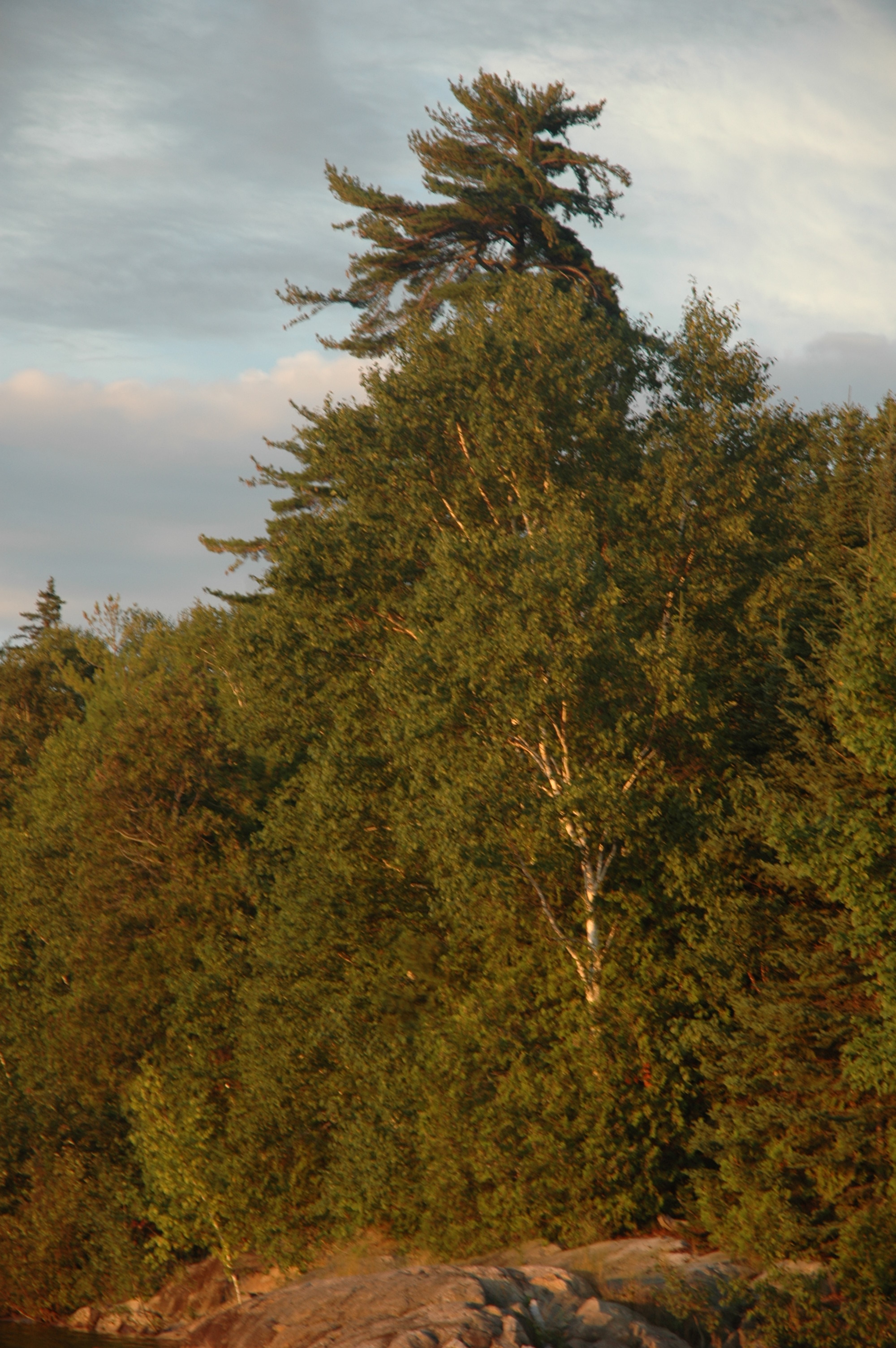
Having spent time in such serene surroundings like this:

Canada has magnificent trees.  This one looks like it's in the thralls of a wild, primal dance!

Canada has magnificent trees.

…is it not surprising that my mind had taken a break from the ‘everyday’ and slipped into a bit of philosophising?

If a tree falls in the forest, and no-one is there to hear it, would it make a sound?

In the past, when discussing this with my kids and husband, we have invariably fallen into the pitfalls like, for example, trying to define what does ‘sound’ mean:  is it simply the movement of air molecules in a particular way, or does it have to be ‘perceived’ by human ears?  (If it is recorded, then the sound we hear is made by the recorder, not the tree…and endless possibilities along these chains of thoughts.)

This year, I began so see it from a different perspective…

Richard Feynman is perhaps my favourite genius of the 20th century – and I am convinced he is an ‘Aspie’ to boot! ( Just reading his most awesome book, ‘Surely You’re Joking, Mr. Feynman!’, is an excellent lesson in how an ‘Aspie’ mind organizes thoughts and commits them onto paper – plus it is fun and curiously comforting to read).  In his Lectures (available as podcasts, and ideal for relaxing with while ‘away from it all’), specifically, in the ‘Quantum Mechanics’ lecture, he also visits this question about the proverbial tree falling in the forest… 

Dr. Feynman gives some very specific qualifications regarding this issue:  he would not be a physicist had he not done that.  He states that in the real world, even if there is no observer when the tree falls, there are still unmistakable physical signgs that it had, indeed, made a sound.  These signs, perhaps as minute as little scratches from vibrating leaves/needles as the sound energy is transferred to them, could then be observed after the event itself and the presence of such sound would be conclusively demonstrated.  Thus, he concludes that ‘in a real world, of course, a tree falling in a forest makes a sound‘.

He is, of course, absolutely correct – given the qualifications he does.  

Yet, listening to him made me think that perhaps his ‘after the fact observer’ – as our familial discussions from the past – were really missing the whole point of the question!

Whether during the act of the tree falling, or afterwards; directly or through recording devices of some sort (even leaves and needles) – this introduces an observer.   And the fact remains that if an observer is present, and the original condition (or, rather, its intent) is breeched.

Yes, I’ll gladly concede that in the real world, it might be impossible to have a ‘no observer’ scenario – but that is not the point.  The question asks us about a hypothetical situation, where no observation (during or after the event) occurred (even had it been possible). 

Let us imagine an observer who makes a direct observation that 999 trees, as they fell, indeed did make a sound.  Then the observer leaves, and our proverbial tree falls.  No observation as to the sound of any kind had been made during the event.  The scene has since been altered so much that no additional evidence can be gathered.  How can we answer the question now?  Did our proverbial tree make a sound, or not?

And this, in my never-humble-opinion, is the crux, the core, of this principle:  one can only say that one does not know.

It would be reasonable to predict that it is highly likely that the tree had made a sound, based on previous observations.  But one would not know !

This is the difference between direct observation and a guess.  Perhaps it might be an ‘educated guess’ (based on the previous 999 observations) , but it is still only a guess.  And that is the whole point:  to get us to stop and think, to learn to recognize that difference between what we know and what we are making educated guesses about (or a semi-educated guess about).

One of my sons thought this simply reduced the question to the ‘Schrodinger’s Cat’ scenario, but I think there is a difference.  This is not about probability curves and their collapses, this is about learning to recognize the blinders we all wear which let us treat guesses (whether ors or those of others) as equally valid to observed facts. 

And it is about time that some of these blinders statred coming off! 

After all, guesses, even educated ones, are not facts – and we must not fall into the easy trap of treating them as such.  Especially in cases where the guess is not based on 999 direct observations of this very event…or not on even one such event having ever happened!

Which leads me to the next question:  If the global temperatures change by 0.6 of a degree, and no well-financed lobby group is there to use it as a pretext to organize a scare-mongering, funds-transfering campaign, would anyone notice?

Perspective - we all need it!

Perspective - we all need it!

The Blogosphere is under attack!

There is so much happening in the whole wide world!  And the blogosphere makes it all so easy to access.

The internet is truly changing our society.  Not just within our town, or within our countries – it is truly allowing people from all ‘corners of the world’ to build up a common pool of knowledge.  I truly think that the blogosphere is one of the most effective tools driving this change for the better.  (As a matter of fact, that is why, few months ago, I decided to join it!)

The blogosphere is not merely a communication tool, it is a completely new ‘animal’. 

It may  facilitate the exchange of information, but it is not just the sort of ‘information’ that ‘reading the same newspaper’ or ‘watching the same newscast’ could convey.  After all, as the mainstream media (msm) had already discovered, transmitting factual information is only a part of any ‘story’.  While the msm has attempted to ‘flesh out’ their stories by including that ‘human experience’ factor, their medium is uniquely unsuitable to such a job.  Instead of adding dimension to their coverage of world events, they end up appearing to be manipulating the emotional context and reducing ‘news’ to ‘gossip’.

Add to this that many new journalists are being taught in school to put emphasis on ‘reporting the news and facts and presenting them in a manner which will indicate to the audience what their appropriate response should be’.  In other words, the very journalists whom we used to rely on to report unbiased facts only are being taught in journalism schools to be the tools of social engineers…

No wonder the msm are becoming irrelevant!

The blogosphere, on the other hand, is actually really, really good at adding a real human dimension to what is happening in the world around us. 

Why?

Because it is so highly interactive!  Because it is made up of millions of individuals!  Individuals from ALL over the world, with all kinds of backgrounds, all points of view! 

That is what makes the blogosphere so powerful!

I do not have to rely on some pretty/serious/demure/outraged face on TV to tell me how people on the other side of the world ‘feel’ about some event.  I don’t have to read a ‘cookie-cutter’ story with a preset word-count, surrounded by pointless ads, the ink of which is bound to come off on my fingers.  If I don’t like the slant of the story, or if I notice factual inaccuracies, I don’t have to be one of thousands of phone calls or emails or letters-to-editor, hoping, despite the odds, to be noticed…

Instead, I can go and look for a real live blogger (OK, I only access their virtual personnas’ posts, but I find these represent a real person, who can use the internet as a shield – and thus expose more of their ture self than they would ever dare in a person-to-preson interaction) who actually is from that part of the world.  And it is not somebody who makes a living from ‘how’ they report the event – which necessitates ‘offocial spin’.  Yes, there will necessarily be ‘personal spin’ – as in, it will reflect the person’s perceptions and understanding of what happened and thoughts and emotions about it.  But they will actually be ‘that person’s’!

And I can go to many bloggers there – and get many different individual points of view.  If I don’t understand things, I can post a comment – and usually get answers that are very useful and educational….and very personal. And if I like that blogger, I am likely to re-visit the site from time to time – just to keep in touch with what is happening in that part of the world and what is happening with that blogger

That makes a world of difference.

In a very real sense, the ‘bloggers of the world’ establish a virtual community. 

We may never meet in person, but that is not necessary to develop an empathy, an understanding – to let them into our monkeysphere!  That means we begin to perceive ‘our familiar bloggers’ as people, as individuals.  All of a sudden, should a tragedy occur in a faraway place, the body count is not just a statistic:  these are our virtual friend’s families!

It is impossible to overstate the incredible power in the combination of being able to access uncensored information and points of view along with establishing social bonds with people all over the world!

After all, it always affects us much more deeply if a wrong happens to someone we are connected to than if it happens to a stranger….

Now, we not only learn what happened, we know it happened to someone connected to our social network.  One of us.  Without these social bonds, most of us would lack the depth of desire to affect change.

During successful wars, the governments/rulers kept tight control over the flow of information – and used propaganda to dehumanize the ‘enemy’ into an abstraction!  Only then could they manipulate people into a war…  Large part of the US military failure in Vietnam was due to the fact that the American people were recieving more uncensored information from the frontlines than ever before. 

Make no mistake, this lesson has been learned by opressors everywhere!

It is not surprising, then, that censors and manipulators and social engineers are all waging a war on the blogosphere!

In Canada, it is in the gray drab of bureacratic HRCs which ban people from ‘ever expressing their opinions or thoughts or emotions’ on a subject….  They appear to follow a clear, well defined process, but use this process to bring financial ruin to those whose opinions they disapprove of, and silence them thus.

In Yemen – and, unfortunately, perhaps in Iran – this penalty could be death!

Let us hope the blogosphere is strong enough to withstand these attacks and continue to re-shape the world into a better place.

Yet another lesson… will it be learned?

All right, this clip is not from the boys down under, it is from Pen and Teller – the professional sceptics who put on the show ‘Bullshit’.

In their role as sceptics, they have gone on to challenge much – and not everyone is always pleased with them.  Here, they are teaching a lesson in how ‘environmental enthusiasm’ – a very real and honest desire to protect the Earth from harm by us, humans – can be so very easily abused by those who wish to use these honest, trusting and eager activists and subvert them and their voices for something completely different… 

In some ways, it kind of is like that ‘Trojan Horse’ idea!

More Mind Games

Yesterday, I had a fun post on how easily our perceptions can play mind games on us – looking at optical illusons.  Of course, optical illusions, at least of the ‘fun’ type, are just the tip of the iceberg!

The post showed, I hope, just how easy it is for our eyes to be tricked. 

Our brains are wonderful, comples structures.  They take the information from our eyes, and process it.  It is this processing of information which ‘tricks’ our mind.  Why?  Because our brains have developed some mightily useful ways of ‘figuring things out’ without telling us.  At least, without telling that conscious part of our thoughts we often think of as ‘us’. 

Yes, it is a form of subconscious ‘prejudice’ system – but it is precisely through this type of ‘pre-judgements’ that let humans  anticipate what is likely to happen next, so as to react in the best, most advantageour (to survival) way.  {Aside:  it is precisely because so many of our bad prejudices are also rooted this very deeply, among other survival tools, that we have a hard time recognizing our own ones… and why it is healthy for us to see other people’s ‘obvious’ prejudice openly, so we may learn to recognize our own bad/destructive/unreasonable prejucices and guard against acting on them.  But, that is for another day…}

When our brain gets some input, it matches this input to ‘past experiences’, compares patterns, looks for similarities.  It then interprets this new inputas best as it can – with respect to all the stored past experiences! And it does so quickly, without us even noticing it is doing it…

That is why we find it so hard to ‘wrap our brains’ around something completely new and outside of our experiences:  our brain has nothing to match it to, and would be just as happy ‘not noticing it’…

The immortal Douglas Adams was quite fascinated by this phenomenon.  And, as was his way, he used humour to get his point across… Please, indulge me (highly paraphrased):

The story went something like this:  A guy had a bet with some people about erecting an invisibility field on the mountain that blocked his view…  It was no easy thing, and in the end, the nay-sayers had lost, because even though the mountain could no longer be seen, there was now a suspicious new moon in low orbit, just about the size of that mountain…  Douglas Adams said that trying to generate an ‘invisibility field’ was silly, that is just so very troublesome.  It would have been much easier to simply paint the mountain pink during the nighttime and erect an S.E.P. field on it.

What is an S.E.P. field?  It simply means ‘Somebody Else’s Problem’ – anything that is ‘unusual’ or appears’ unexpected, and has this S.E.P. field on it – will be less than invisible!  People will look straight through it and not see it!  Their brain will just process it as ‘somebody else’s problem’ and refuse to acknowledge its existence…

Seems to me that this is one take on the whole ‘mind tricks’ phenomenon I am trying to get at.  Can’t relate to it – it’s not there. 

But, there are way more sinister uses of this ability we, people have, to interpret what we see according to familiar patterns.  This can be seriously abused by people with very particular – and not always honourable – aims.

Just like we can be tricked by a simple optical illusion, we can be tricked into seeing ‘things’ that never happened.  And once people ‘see things for themselves’, they accept them as true… and belieave them.

All our actions are based on what we perceive.  Not on facts – only on what we think are the acts. Not on truth, because we have no way of separating truth from our very distorted – and sometimes intentionally tricked – perceptions of the truth, on what we think the truth is.

A lie repeated often enough will eventually appear to us as the truth (it’s precisely this ‘previously encountered pattern’ matching thing in our subconsciousness that does this!). 

Conversly, a truth never heard of, will never be considered when one makes decisions.  After all, we can only decide on our best understanding of the truth…

Perhaps it is time we took a moment and re-evaluated just how easy it is for our brains to become victims of ‘mind games’…

Vaclav Klaus’ Washington CEI speech

This President is one smart cookie!

Yesterday, he delivered a speech in Washington, in which he said:

“It is interesting that you came up with the name Josef Alois Schumpeter (to intentionally use the Czech pronunciation). I don’t expect all of you to know that this great economist was born in 1883 on the territory of my country – the Czech Republic – in the small Moravian town of Třešť, belonging at that time to the Austro-Hungarian monarchy. He was part of an important group of Austrian Moravians which includes names such as Sigmund Freud, Gustav Mahler, Karl Kautsky, Ernst Mach, Robert Musil, and many others.”

“Reading his Capitalism, Socialism and Democracy, which was published in England in the 1940s along with books such as Hayek’s The Road to Serfdom and Orwell’s Nineteen Eighty Four, one comes across a slightly different story, which is his evolutionary theory of the demise of capitalism based on its very success. His main argument – as I remember it – was that innovations would become a matter of routine, progress would be mechanized, problems would be “simply solved” by means of reason and science, entrepreneurship would be replaced by mere calculation, individual motivation would subside, collectivistic mentality would prevail and the growing importance of teamwork in modern large corporations would lead to the gradual obsoleteness and at the end disappearance of the crucial player (or perhaps mover) of capitalism – of the entrepreneur. That was his vision of the end of capitalism. He regretted it, but did not see it as the end of history, progress and development.”

The first problem this theory has is its connection with the reality because the world has not followed Schumpeter’s predictions.”

The complete text is on Mr. Klaus’ blog.

This, to me, is a telling analysis:  this economist looks at the theory, evaluates its internal consistencies (or lack thereof) – and then COMPARES THE THEORY TO REAL-LIFE OUTCOMES !!!!

Not only did he do EXACTLY THIS with the IPCC-type AGW/ACC ‘theories’ (and I do use the term ‘theories’ loosely) in his book ‘Blue Planet in Green Shackles – What is Endangered:  Climate or Freedom?’, he also points out the necessary consequence of actions currently being implemented to ‘mitigate’ AGW/ACC:  establishment of world government. 

So, why would anyone think there are any dangers in establishing this ‘world government’?  Mr. Klaus warns that we just might me passing world government into the hands of arrogant elitists who are convinced that ‘they know better than the rest of us’….  He asserts that some of the same people who are advocating establishing world authorities to regulate carbon emission – with the power of enforcment (that is, world government) – that were also advocating this 30 years ago in the name of world socialism.  Just listen to Glenn Beck’s second interview with him: 

Kind of makes you pause and think, does it not?

It should!

Blue Planet in Green Shackes

Finally, there is a release date for the much-awaited English version of Czech President’s Vaclav Klaus’ book,

‘BLUE PLANET IN GREEN SHACKLES 

What is endangered:  Climate of Freedom?’

President Klaus will be presenting it on May 27th, 2008 at the National Press Club in Washington D.C..

Thanks to Lubos Motl from ‘The Reference Frame’ for the tip!