Is this a trickle of reason?

Democracy is a wonderfu ideal.  Yet, there will always be a question of how to exercise our democratic rights, while preventing a ‘tyrrany of the majority’?

To many people, the best answer is:

Protecting the rights of each and every individual, the minority of ‘one’,  is the best and only way to ensure the protection of the whole society from tyrrany by the State.

Yet, not everyone agrees.  The philosophy which seems to currently be gripping much of ‘the Western world’ turns its back to the individual, turns a blind eye to the violations of individual freedoms, in favour of collectivism.  I have wondered how much of this is a philosophical difference, how much is simply due to the attitudes inherrent in different political systems.

Many people today think that the best way to ensure peope are not discriminated against – the best way to promote tolerance and harmony within a society – is to put limits on the freedom of speech.  By instituting ‘hate speech laws’, these people argue, hate and prejudice will not be allowed to spread and will, eventually, be eliminated from our society.

I wish this would be so!

Time and time again, ‘hate speech laws’ have not only failed to reduce prejudice, I woud argue that they have allowed it to fester, until a time when it erupts in hateful and abominable acts.  What is worse, they have resulted in political institutions which are invariably used to opress, all in the name of preventing opression.  We have seen this happen many times in history, but we still seem unable to learn the right lessons from history!  

Let us consider the example of  Germany in the 1930’s.  After all, it is precisely to prevent atrocities such as the Holocaust that ‘hate speech laws’ are being instituted.  Yet, in Maclean’s, Mark Steyn (both he and Macleans are also being persecuted under ‘hate speech laws’) quotes Canada’s leading libertarian lawyer, Alan Borovoy, as saying:

“Remarkably, pre-Hitler Germany had laws very much like the Canadian anti-hate law. Moreover, those laws were enforced with some vigour. During the 15 years before Hitler came to power, there were more than 200 prosecutions based on anti-Semitic speech. And, in the opinion of the leading Jewish organization of that era, no more than 10 per cent of the cases were mishandled by the authorities. As subsequent history so painfully testifies, this type of legislation proved ineffectual on the one occasion when there was a real argument for it.”

To the contrary!  Hitler, once elected, effectively used these laws to usurp power.

Should there be ANY limits on speech?  Mr. Levant, also currently being persecuted by the thought crime police, has videotaped part of his interrogation by the Alberta HRC.  He makes the most passionate, well reasoned speech on the attributes of free speech

But, is tide turning?

For the past several years, what would appear to be illegal behaviour in both its investigations and prosecutions by the HRCs in Canada has inexplicably been tolerated.  Now, this may come to an end. This week, the Royal Canadian Mounted Police (RCMP) have announced they are opening a criminal investigatigation of some actions by the HRCs.  Ezra Levant has more information on this. 

Australia may also be changing its ideas with regard to limiting freedom of speech.  As Robert Jago writes on Dime a Dozen, Australia’s Liberal Party is calling for a change to its ‘hate speech laws’, because they have been shown to promote, not curb, divisions in their society! 

But, perhaps the best news comes from Erope! Czech Republic is a nation of reason (fully 59% of Czechs describe themselves as atheists, agnostics or non-believers) and their scepticism extends to other areas, as well.  Lubos Motl, one of the world’s leading theoretical physicists, writes that Vaclav Kaus, the President of Czech Republic, has vetoed an ‘anti-discrimination’ bill.  His justification?

“I consider the bill to be a useless, counterproductive, and low-quality bill while its consequences seem to be problematic….”

 Good on you, Czechs!

You can read the full, well reasoned and excellent speech here.  Mr. Motl writes that, ironically, “Because the bill has been “ordered” by the European bureaucrats and the country may face sanctions (let’s say it: the Czechs may be discriminated against) if the anti-discrimination bill is not approved”

Yes, the overwhelming bureacracies still want to control every aspect of society, including what we say and think.  But, little stories like this make me hopeful.  Perhaps these are the beginnings of a real change in attitudes:  one that will place more value on each and every individual, and treat all of us with the respect and equality in the eyes of the law that we deserve!

Has the dyke of opression finally sprung its first little leaks of reason?


P.S.  President Klaus’ book, ‘Blue Planet In Green Chains – What is Endangered:  Climate or Freedom’ is due for release in English this month.  

A Father with Real HONOUR!

Oppression comes in many forms, all of them disgusting and condemnable.  All of them have something in common:  the willingness to sacrifice the rights and well being of an individual, a specific human being, for some higher principle.  The principle itself is less imoportant – and it varies from ‘the good of the society’, or ‘religious piety’, or, paradoxically, ‘family honour’.

The opressors smugly wrap themselves in the ‘cloak of righteousness’.  They truly and honestly believe their ends justify the means…which they NEVER do.

I planned to write about something else today, when I came across this  article on ‘A Chocoholic’s Piece of Mind’ blog:  Rand Abdel-Qader, a 17-year-old student, was murdered by her father an brother for being seen speaking to a Brit soldier….  She worked as an aid worker, and spoke English…translated and became infatuated.  No affair, no clandestine meeting, just a schoolgirl crush…and translating for him, as part of the volunteer work she did with refugee families. 

I wonder what another Rand, Ayn Rand, would have to say about this…her father’s reaction (quoting the article linked above) was:

‘Death was the least she deserved,’ said Abdel-Qader. ‘I don’t regret it. I had the support of all my friends who are fathers, like me, and know what she did was unacceptable to any Muslim that honours his religion,’

‘I have only two boys from now on. That girl was a mistake in my life. I know God is blessing me for what I did,’ he said, his voice swelling with pride. ‘My sons are by my side, and they were men enough to help me finish the life of someone who just brought shame to ours.’

He said his daughter’s ‘bad genes were passed on from her mother’. Rand’s mother, 41, remains in hiding after divorcing her husband in the immediate aftermath of the killing, living in fear of retribution from his family. She also still bears the scars of the severe beating he inflicted on her, breaking her arm in the process, when she told him she was going.

Sources have indicated that Abdel-Qader, who works in the health department, has been asked to leave because of the bad publicity, yet he will continue to draw a salary.

And it has been alleged by one senior unnamed official in the Basra governorate that he has received financial support by a local politician to enable him to ‘disappear’ to Jordan for a few weeks, ‘until the story has been forgotten’ – the usual practice in the 30-plus cases of ‘honour’ killings that have been registered since January alone.

Abdel-Qader, 46, a government employee, was initially arrested but released after two hours. Astonishingly, he said, police congratulated him on what he had done. ‘They are men and know what honour is,’ he said.

This is not honour, and we must stop thinking that just because people come from different parts of the world, they should not be expected to treat each other – including their daughters and wives – with respect.  Thinking these attitudes are too deeply entrenched is a very insidious and destructive form or racism, and we must all work together to show it is unacceptable!

Please, indulge me with a story about an Iranian man and HIS attitude towards his teenage daughter:

When I came to Canada as a teenager, I befriended an Iranian girl who arrived at about the same time.  They were devout Muslims.  At her apartment, my friend showed me the charcoal-gray hijab she was forced to wear in Iran – the very first one I ever saw – and I tried it on.  Her father was angry at the sight of the hijab.   What he said has made a deep impression on me, and is with me still.

He told me that the hijab was not part of Islam.  Not even a little bit.  He explained that when the Koran was written, the rights it granted women were much more than women had in that society before, and that it meant that the Prophet wanted to eventually bring full equality between men and women.  It just had to happen one step at a time.

The hijab, he went on, was a symbol of opression:  not just of women, but of all true Muslims by those who wish to have power over them.  He was very angry that they would do this, when the religion itself teaches the equality of all humans.  He was also angry that many young Mulsimas were brainwashed to think the hijab was a symbol of a proudly pious Muslima – he said teaching young women that was a crime against Islam, because it was a part of a doctorine that reduced them from humans to possessions.

He explained that in Iran, he had done well, a professional with his own business…but he left because he would not allow his daughter to be brought up in a society which would only treat her as cattle, or a piece of meat!  He wanted her to grow up a good Muslima who has confidence in herself as a person, and who is not a slave to anyone…in other words, as a real human being!

Now THERE is a FATHER WITH HONOUR!!! 

If only more men – Muslim or otherwise – would have enough honour to value their daughters as much as my friend’s father valued her!

‘First they silenced…’

 The old saying says:

Those who do not learn from the past are destined to repeat it.

Perhaps we should re-phrase it to:

Those who do not learn the right lesson from history are destined to repeat it. 

After all, learning the wrong lesson could be worse than learning no lesson at all!

This all goes back to my rant on how often people do not recognize the difference between ‘symptom’ on the one hand, and a ’cause’ on the other.  Are they really so difficult to tell apart?

Many years ago, I went through a period when I was reading a lot of eyewitness books about WWII and the political atmosphere in Europe following the war.  I came across something intersting that Barbara Amiel had written:   she spent her childhood in ‘wartime London’.  Following the war, there was a determination among her relatives that nothing like this must ever be allowed to happen again.  And because Hitler was perceived as being ‘right wing’, Ms. Amiel asserts, ‘everyone’ became suspicious of – and opposed to – everything that was deemed to be ‘right wing’.

In other words, the lesson this group of people learned was:

  1. Hitler = right wing
  2. Hitler = evil
  3. ergo, right wing = evil

This is almost as sophisticated reasoning as that used for forcing women to wear a hijab, so they would not tempt men to rape them – as uncovered meat tempts cats to eat it. In other words, that is not the correct lesson.  Yet, many very intelligent people still fall into this trap in one form or another.

Yet, lots of people do learn the right lesson.  This one may be exemplified by the ‘First they came for…’ poem, attributed to Martin Niemoller:

“First they came for the Communists, but I didn’t speak up because I wasn’t a Communist.

Then they came for the Jews, and I didn’t speak up because I wasn’t a Jew.

Then they came for the Trade Unionists, and I didn’t speak up because I wasn’t a Trade Unionist.

Then they came for the Catholics, and I didn’t speak up because I was a Protestant.

Then they came for me, and by that time no one was left to speak up.”

Yet, even now, people are misunderstanding the poem!  So, please, in my never-humble way, let me pay homage to the right lesson here and write today’s version, as it could be.

“First they silenced the crackpot and nutcases, but I didn’t speak up because I wasn’t a crackpot or a nutcase.

Then they silenced the bloggers, and I didn’t speak up because I wasn’t a blogger.

Then they silenced the journalists, newspapers, magazines and books, and I didn’t speak up because I wasn’t a journalist and didn’t write newspapers, magazines or books.

Then they silenced the Christians, and I didn’t speak up because I wasn’t religious.

Then they came for me, and by that time no one was left who was allowed to speak.”

If we fail to learn this lesson, this will be in store for us!  This is NOT HISTORY!  This is now, here, in OUR WORLD! 

This is what happens when people think a political party, or a particular political bend is the problem and fail to recognize that political oppression and governments who do not follow due process of law to achieve their ends that is the problem!!!  And if you are an adult, and not afraid to see a graphic example of the result of a state not bound by its laws is, here are some pictures that were too gruesome to print in a newspaper. 

But I warn you – do not look if you are sqeemish.  It took me a while to realize what part of the human body I was really looking at…

As it is taking so many of us to realize what type of oppression it is that we are facing!

Common law vs. civil law

Humans form communities – that is one of our defining (and best) characteristics.  In order to coexist peacefully, we must agree on a set of rules to govern our interactions. Yet, different communities don’t always go about it the same way.

Some adopt ‘common law’, which takes the approach that all behaviours are permitted, except for those deemed to be harmful, which are then specificly forbidden under the law.  This suggests an underlying philosophy that each person is a free, independent individual.  People ought to be free to act according to their will, and only those behaviours that infringe upon the rights of other individuals within the community to enjoy thier freedoms are forbidden. The goal of laws is to ensure all individual members of the society are able to exercise their freedoms as much as possible.

Communities which develop one of the forms of ‘Civil law’ have a different point of view.  They specifically list the behaviours which are acceptable to the society and permits them, all others are forbidden.  This suggests a philosophy that it is ‘the society’ which is the ‘basic unit of worth’, not the ‘individual’.  As such, it is the goal for the laws to protect the society.

This is a really big philosophical difference. 

It seems to me that common law promotes individualism, while civil law seems more focused on collectivism.

Of course, this is a major simplification.  Also, there are several forms of civil law. This is not intended to be an exhaustive description…  Rather, it is meant to explore the differences in the philosophical undercurrents between societies which choose to govern themselves under civil or common law.  It is not meant to look at the specifics as they are, but at the patterns of thought that led to the differing attitudes of how we ‘ought to’ govern ourselves.

Common law (in its idealized state) sees the individual as the empowered one, the one with inherrent rights who chooses to lend some freedoms to the state in order to create a society.  The law is loath to interfere with these rights and freedoms of each one of its citizens and will only curb them with great reluctance.  It could be summed up by the sentiment: 

‘Upholding the rights of the one ensures the rights of the many.’

Civil law sees the society as the one with all the power.  ‘These are (or ‘ought to be’)  the customs of our society, thus codified here into law.  Do not stray outside of these behaviours, or you will have to answer to the state.’  And while many countries that practice civil law have accepted that an accused individual has the right to a fair trial, including a presumption of innocence, not all of them do.  It could be summed up by the sentiment:

‘Every one must adhere to these rules, because they are in the best interest of the society.’

Many modern countries do incorporate some aspects of both philosophies.  Rather than opposite sides of a coin, I see these as different ends of a continuous philosophical spectrum.  Most countries fall somewhere within this spectrum, and may move along it in one direction or another with time.

Yet, regardless where along this spectrum a particular state’s legal system lies at any specific time, these underlying philosophies will influence its attitude towards its citizens.

add to del.icio.usDigg itStumble It!Add to Blinkslistadd to furladd to ma.gnoliaadd to simpyseed the vineTailRank

A letter to my PM

For those of you not following the Canadian struggle for free speech, this letter, which I emailed my Member of Parliament today, may seem a little confusing.  Here is a REALLY quick recap:

In order to provide disadvanteged groups easy and affordable access to legal protection agains illegal discrimination, Human Rights Commissions (HRCs) were established several decades ago:  one federal (Canadian, or CHRC) and one for each province.  These HRCs have, lately, been interpreting their mandate in unforseen ways, asserting that any speech which ‘potentially could’ have negative impact on individuals or groups because of their race, creed, disablitiy, and other reasons, must be censored and that this censorship overrules any rights of freedom of speech, freedom of press, freedom of thought.

Many individuals, and some media organizations, have been going through several years long legal battles in their defense of their inalienable rights.  Even the very people who originally created the HRCs have been apalled at the misuse of their powers in recent years…  What is even worse, recently released tribunal transcripts contain admissions by some HRC employees which suggest that in their zeal to pursue (and entrap) people whom they are investigating, criminal laws are being violated.  That is a serious matter, because no government agency should be allowed to break laws in order to enforce laws…

The Minister of Justice recently said what I understand to mean that as far as the Canadian Government is concerned, all is fine…hence, my letter.

Dear Mr. [MP], 

Thank you for your kind reply, in which you say you will direct my concern over the HRCs and their actions directly to the Minister of Justice.  It arrived at about the same time as the Minister of Justice made his position on this situation known….   

How unfortunate that the official Government position is based on a brief by Mr. Tsesis, who is not regarded highly among the experts in this area and whose disregard for supportable facts required to assess causality can clearly be seen in the document he produced. 

For example, Mr. Tsesis claims:  “[Hitler fomented] a mass delusion that Jews were responsible for bad times, and as a result, a Holocaust could be perpetrated against them without general opposition.”   This displays blatant ignorance of (or disregard for) the fact that during the 1930’s, Germany did indeed have ‘hate speech’ laws, which (ironically?) were almost identical to those we have in Canada today!  Jewish leaders in Germany in the 1930’s expressed satisfaction with the protections from persecution which they and their community received under these ‘hate speech’ laws. 

Since ‘hate speech’ laws were present in Germany of the 1930, proposing (as Mr. Tsesis does) that our current ‘hate speech’ laws are the one tool necessary to prevent another Holocaust-like event is an error of judgment at best, intentionally misleading at worst.  Either way, it clearly demonstrates the unsoundness of the conclusions in this document.   Basing our national Justice policy on it would be ill advised.

How embarrassing for our Government, to reveal that this is indeed its intention!  How embarrassing for our Minister of Justice!

 Yet, my original comment was not intended to request a simple review of the policies of the Human Rights Commissions by the Government.  It is essential that the Government maintain its ‘arm’s length’ distance from judicial and quasi-judicial bodies.  That should not change.   

The HRCs answer directly to the Parliament of Canada.  It is essential that the Parliament of Canada ensures that bodies such as the HRCs do indeed perform the tasks for which they had been created, and that they conduct themselves in accordance with the laws of Canada, the very laws they were created to uphold!  

 There is a widespread perception among the citizens of Canada that employees of these commissions may have broken criminal laws of Canada while performing investigations on behalf of the HRCs.  This perception is largely based on the information in legal documents, transcripts of hearings from the HRCs themselves.  These statements were given under oath, and in them an employee of the Canadian Human Rights Commission describes actions he took while acting on behalf of the HRC which appear to be a clear and direct breech of the criminal laws of Canada, as well as a blatant breech of the very ‘hate speech’ laws the CHRC was created to uphold.

 It is not, and must never become, tolerable for an Agent of the State to break the laws of the State while acting on behalf of the State.  In order to assure the integrity of our governance structures, it is essential that a full criminal investigation be launched immediately, to determine whether laws were indeed broken, or not. 

 If it is found that criminal laws were broken, a further in-depth investigation will be required to determine whether some rogue employees broke criminal laws on their own, or if the policies of this public institutions are the root causes of criminal behaviour by its employees – in which case, a full evaluation of all the procedures and methodologies of the HRCs would need to be done.  If a criminal investigation determines that laws were indeed broken, laying criminal charges will be required against every employee who broke our laws as well as against all supervisory personnel (currently or in the past employed by the HRC’s), who, through ignorance or complicity, allowed this illegal behaviour within their department to take place. 

 If the perception that criminal laws are being broken at the HRCs is erroneous, it is important that we, the citizens of Canada, see them exonerated, so that we may again place our trust in our government agencies and institutions.  

 This determination cannot be made without a full criminal investigation of the HRCs, their procedures, methodologies and practices, as well as of the conduct all of its employees, past and present.  Therefore, I ask that you, Mr. Poilievre, as my Member of Parliament to which the HRCs report directly, channel your efforts and energies to launching a full and thorough investigation into this whole mess.

 Thank you.

If you wish to read more on this saga, please see the excellent sites Blazing Catfur, Ezra Levant, Mark Steyn, Small Dead Animals, and many, many more…

Aspergers and ‘painting music’

Over the last few decades, there have been very big changes in classroom attitudes – at least, in this part of the world.  Many teachers are of the opinion that academic rigour stifles self-expression, and in an attempt to foster creativity in their students, they have systematically dismantled structured teaching.

This might work for some students.  Yet, many students do not do well in this new environment, do not learn well using this new method.  Yes, I do focus on kids with Aspergers, but they are not the only ones who are having difficulties.  Many ‘normal’ kids find this ‘unstructured’ method of teaching makes learning more difficult.  The Aspie kids get completely lost in it.

Let me give you an example:

During a series of grade 3 art classes, the teacher played different types of music.  The assignment was to ‘paint’ the music while the students were listening to it.  I thought this was the height of idiocy:  no skills were being taught, and precious school time was being wasted.  But it was explained to me that I was being boorish, that this ‘exercise’ is scientifically designed to stimulate different areas of the brain to synthesize information, which is what kids at this age need more than anything else.

Please, do not misunderstand me.  I don’t have anything against art classes in general:  to the contrary.  My mother teaches art, and I have a deep love for it.  However, I think that kids actually get more enjoynment out of art if they are actually taught about it.  They will derive pleasure from drawing if some of the rules of proportion, or different  fun techniques are broken down into steps for them, so they can master the skills.  Once they have understood the rules, it will be more fun to ‘bend’ them to express their own artistic talents (and no, I don’t mean after years of study….rather, teach a specific skill, rules that govern it, and how to bend them and have fun with art).

Well, my son was in this particular art class.  He was in it because that teacher had gone to receive specific training on how to teach kids with Aspergers.  And then she got angry with an Aspie kid for ‘not being able to paint the music’ he was listening to????? 

Of course, what she was expecting was just non-sensicals colourful swirls – but she would never tell the students that.  With a prim smile, she insisted they ‘paint what the music makes them see’.  Questions of ‘How?’ were met with ‘That is up to YOU!’

Just before setting marks onto the report card, she called me to warn me that my son is about to fail art…  Let’s just say that I found it somewhat difficult to keep my temper.  (The problem was the frustration he experienced in being asked to complete a task he did not have the tools to perform, asking for help and being denied it, then penalized for failing by a bad mark.)

I explained to her that in that case, by her own standard, my son should have received an A+ for his artwork:  the music did not make him ‘see’ anything, so that is what he painted.  Or did not paint.  Either way, the result was accurate, and that he made a bold artistic statement by leaving the page blank.  Quite literally, he ‘drew a blank’!  In other words, I tried to ‘out-pretentious’ her.  It did not work – I’ve never been very good at it. 

However, the teacher said that if my son does 3 of these paintings and hands them in by Monday, he will not fail art.  So, we were left with the task to ‘paint music’.  My son and I talked about it, and it became clear that his frustration level was higher than usual.  But I came up with a solution I am still proud of!

Selecting a Physics textbook which had a good, simple explanation of ‘sound waves’, we read it over together and I explained all the diagrams to him.  Now, here was ‘sound’, represented visually!!!!  We were making progress.  Yet, many Aspies are sticklers for rules – my son could not paint the different types of music the same way!!!  And I was ready…

Rummaging around in the basement, I dusted off our old logic analyzer and brought it up.  Then I set up the display to emulate an oscilloscope, and we played the different types of music.  It worked!  The different sound waves made the oscilloscope display different curves.  Lifting his brush, and dipping it into the green paint (the display was green), my son went and happily painted the different types of music!

His teacher was thrilled!  She told him she knew that if he tried, he could paint music!  He told her they were ‘music waves’ and that he saw them.  I did not tell her that he saw them on an oscilloscope screen – somehow, I did not think that would please her.  Why spoil her pleasure? 

Animal-speak: squirrels

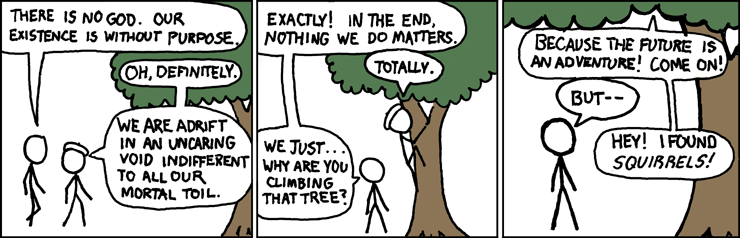
Believe it or not, I used to wear a hat like this!

nihilism - xkcd

I also am a bit of a nihilist.  And I love squirrels!!!

Yet another character shamelessly based on me…

Ego-aggrandizing jokes aside, I do love watching squirrels.  They are an easy animal to see in the city, and I love nature way too much to spoil it by stomping through it. So, urban wildlife is it for me.

Perhaps because I am not naturally good at reading people’s facial expressions and body language (as is common with Aspies), I have learned the habit of really paying attentinon these – or, at least, trying to.  But, only used it with Humans and pets, not really giving other critters too much credit.

I was quite young when I realized how mutually incompatible the ‘natural’ body language of cats and dogs is.  Yet, cats and dogs who lived together (especially if they did so from an early age) are quite capable of learning each other’s language.  Well, if cats and dogs could learn another species’ language, I should certainly be able to ‘learn’ this elusive body language of humans!!!

As I have argued before, kids with Aspergers who are having trouble discovering the ‘key’ to human communication can often decode the somewhat ‘simpler’ (or, perhaps, less complex) body/expression language of animals.  …sort of like learning to crawl before one attempts the marathon of nuances in human ‘non-verbal communication’.

Back to my main point!  As the trees matured in our neighbourhood, we began to see more and more squirrels who came to our bird feeders.  One winter, we were especially touched by ‘The Twins’.  Late in the summer, they started coming with their mom.  We suspect they must have been born later in the season, because they were very tiny.  And, before the first snow came, we stopped seeing the mom…

Yet, ‘The Twins’ stuck together.  They were very, very affectionate to each other, touching and reassuring each other often.  The smaller, bolder one would climb up the birdfeeder and throw food to the other Twin!  (  The Twins stuck together until late next summer, always together.)  Well, that winter, I started putting out food specifically for the squirrels….

Several years have passed, and one of the twins has returned here with three separate litters of her own!!!  Two of these litters were after she had become blind in her right eye, too.  Now I call her ‘One-eyed Jackie’, and she is the matriarch of the ‘Bruno’ (they are much browner than most our visitors) clan of squirrels. 

Besides the ‘Brunos’, we have two other ‘clans’ that come here.  One is called ‘Fuzzy-wuzzies’, because they have incredibly fuzzy fur, especially on their ears.  These are closely related to the ‘Brunos’, and they often mix.  The third ‘clan’ that comes here are called the ‘Zekes’ – and do not get along with the other two clans at all.  Curiously enough, they get their name from the Blue Jays that come here….

Yes, last summer, we had a family of Blue Jays come regularly, too.  And one of the adults was not at all shy!  If I was late putting our their breakfast, or if I the food I put out was not her favourite (I am guessing here that it was the female – we are more discriminating…), she would sit on a branch directly in front of the door, and in a loud, incredibly annoying voice, screech ‘Zeeeeeeke!!!’ – over and over, until she woke me up and I put out the approved food.

Believe it or not, the matriarch of the ‘Zekes’ learned to immitate that call!!!

Many times did I come out, looking for the Blue Jays that were not there, only to see her sitting on ‘the branch’.  It was not until I heard her actually make that call that I realized that it was she who was making it!  Obviously, I had underestimated the squirrel’s linguistic skills.  She has since also learned to perfectly immitate the neighbour’s little dog’s bark.  I began to pay more attention.  (It would probably have been faster to just read up on it, but I had fun watching them.) 

Soon, I identified that the clicking sounds they made were not random.  If I immitated the ‘clicks’, starting at the back of the mouth and moving forward, the squirrels took it as a ‘all safe’ sign, and would come down from the tree.  Even if the dog was nearby.  (It’s ok, he does not hunt them – he is a watchdog, so he just likes to watch!  When a squirrel once fell out of the tree and landed right in front of his nose, he started crouch-jumping up like he does when he is trying to get another dog to play with him.)

a dog who likes to watch squirrels

If I reversed the order of clicks, increasing the volume, the squirrels would panick and run!  Even if there were no danger anywhere about!  Then, seeing all was safe, they would flick their tails a lot and come back down.

Over that summer, I learned about 5 different ‘sets’ of clicks, each of which would be understood by ‘my’ squirrels.  Now I had a question:  did I really learn something of ‘their’ language, or have they learned to simply interpret my behaviour?  This was something I had to test, and an opportunity soon presented itself.

My son and I went to an event in a park about 5 km away from our house – far enough, I hoped, that I would not encounter ‘my guys’.  We were sitting in our lawnchairs, listening to some music, when a squirrel started hopping from one tree to another.  I saw my chance!

I started with my ‘all safe’ set of clicks – it was the first one I learned and I was most comfortable with it.  Plus, it is rather quiet – there were people about… 

The squirrel stopped in its tracks, as if frozen, and just listened.  Encouraged, I repeated the clicks, and added a second set (I think this one means ‘food is present’).  The poor little squirrel perked up its ears, and started looking about.  Actually, it looked a bit paranoid.  I kept up the soft sets of clicks. 

Suddenly, and with great incredulity, the squirrel realized that I was the source of this jibberish!

Well, this became one confused squirrel.  It resumed its original journey to the tree, but now, very, very slowly – and never taking its eyes off of me.  It kept turning its head, side to side, as if to confirm that it really was that human that was chatting with it.  I suppose I must have had an atrocious accent – and I fervently hope I did not say anything bad about its mother!

I guess you can predict how this story ends….  The squirrel was on a direct path to the tree, but was too shocked at the stuff coming out of my mouth to pay attention to where it was going….  Yes.  The squirrel hit the tree!

Hopped straight into it!

This was the only time ever that I saw a squirrel run into a tree.  So, I shut up.  Anyhow, I had to go and help my son up – he laughed so hard, he tipped over his lawnchair!

XKCD – Aspie Humour

Many people claim that Aspies do not have a sense of humour.  NOT TRUE!!!

We certainly do enjoy humour.  Some of us naturally find some things funny, others need to learn the rules of humour – but we certainly enjoy it.

In my never-humble opinion, teaching kids with Aspergers the rules of humour may be helpful with overall social skill development.  I have done this, and seen the improvement in their ability to interact with their peers and the resultant increased comfort level with themselves.

Here is how I might go about ‘explaining humour’:

There are several things that constitute ‘humour’ and different people will find different things funny – so there is no need to feel bad when you understand a joke, without thinking it is funny.  Some people think that anything to do with bodily functions is funny – and they will laugh when someone farts, or of they burp.  Other people think this is gross and not at all funny.  So, it is normal that not everyone finds every joke funny.

Many poeple laugh when they find themselves in situations which either do not go as expected, or when some danger is lifted.  This is done to release tension which people experience in such situations, and which is unpleasant.  It demonstrates to others that either the danger has passed, or that even though things are unexpected, the new course of actions is acceptable.

Perhaps that is why so many jokes are ‘funny’ because of an ‘unexpected’ or surprising ending.  It might even tie in with why ‘strange’ or ‘different’ or ‘unexpected’ is sometimes called ‘funny – but not as in ha-ha’.  Puns are an excellent example:  the correct (or correctly sounding) word is used, but in with an unexpected meaning.

It is not easy for Aspie kids that many cartoons rely on facial expressions to convey humour.  That is why I was so entertained when I came across this (not aimed at kids) comic, XKCD.  To me, it screams ‘Aspie Humour’!

And since along with a sense of humour, many people incorrectly describe Aspies as lacking feelings or empathy, I have selected, for your viewing pleasure, these few XKCD comics:

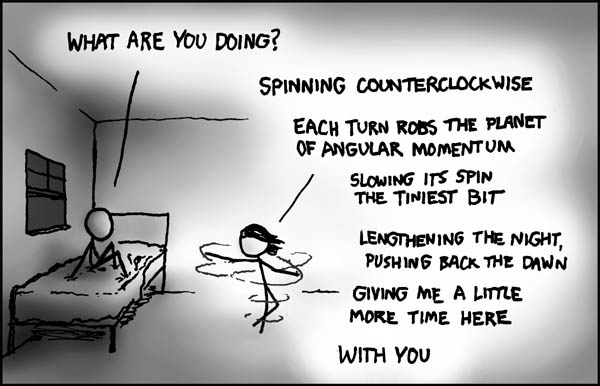
We like to spend time with our loved ones.

We love to spend time with our loved ones - XKCD


Passion reaches new levels for us!

Sharing thought - XKCD


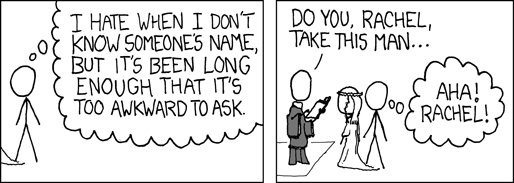
 Of course, we may have a hard time remembering names….  Nothing personal!

forgetting names - XKCD


 Yet, we can be very particular in whom we select as potential mates:

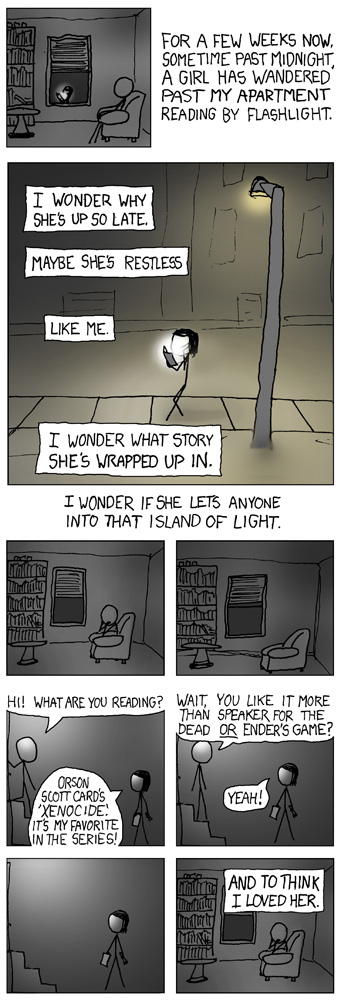
xenocide - XKCD

Personally, I could not date someone who did not thing ‘Ender’s Shadow’ was the best book in this series.  Ok, if he were cute, I might settle for ‘Shadow of the Hegemon’.  But ‘Xenocide’??? Really!

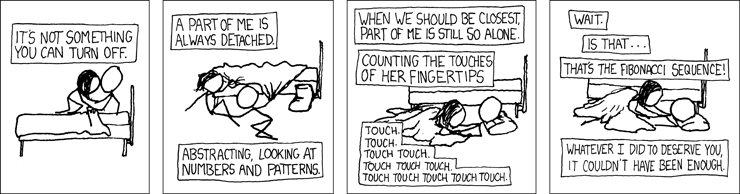
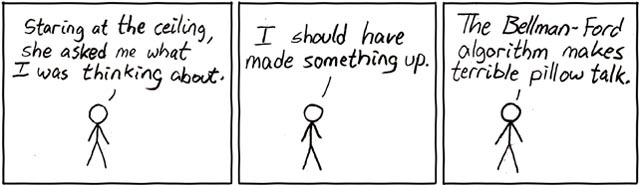
And ‘pillow talk’ is much easier if both of you are Aspies….

pillow talk - XKCD


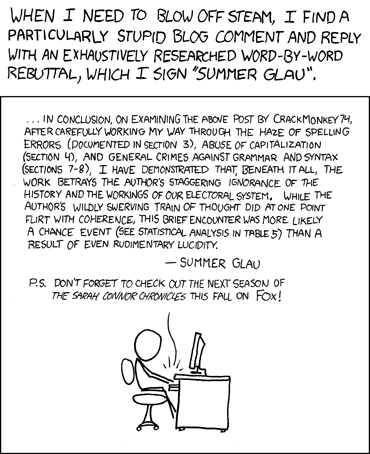
And many of us fully appreciate the advantages of online interactions with others (my husband claims this ‘has to be’ taken from one of my online comments….):

venting - XKCD


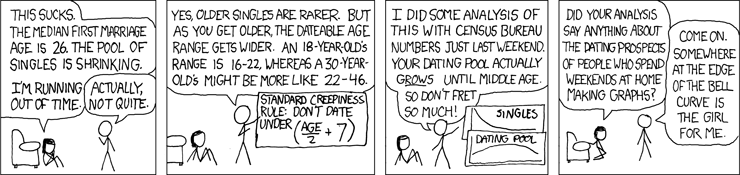
Here is a good example of how not everyone ‘gets’ every joke.  For example, in the following one, I do not understand why the characters are implying this practice is unusual.  Surely, it is the norm!  (See my posts on Old Men in the Bible)

graphs - XKCD


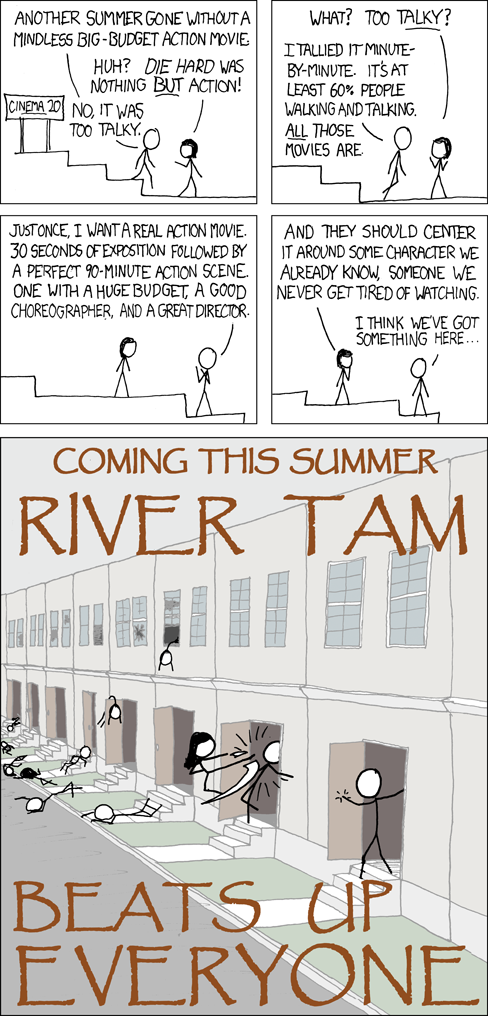
But we all enjoy good quality entertainment!  (And no, this is NOT just a cheap ploy to get ‘Papyrus font’ onto my blog!  Though, who could resist the allures or ‘Papyrus Font’???  It’s even better intelic…)

 River Tam - XKCD

 EVERYONE loves River Tam!!!

add to del.icio.usDigg itStumble It!Add to Blinkslistadd to furladd to ma.gnoliaadd to simpyseed the vineTailRank

Aspergers and writing

Writing is one of the major woes for people with Aspergers

It is difficult to describe the depth of despair most Aspies suffer when trying to put pen to paper.  And it starts very, very early on.  There appear (to me) to be at least three different ‘subsystems’ in the brain that are conspiring to make writing next to impossible for young Aspies.

The first one to be encountered is the ‘mechanics of writing’.  Many Aspies have less ‘sidedness‘ differentiation, so their ‘writing hand’ is less ‘dominant’ – and thus has less fine motor control – than most peoples.  This is often encountered early on in childhood – as a result, the kids may not enjoy drawing, or they may draw with both hands.  Regardless of drawing, however, Aspie kids usually display severe difficulties when learning the mechanics of writing.  This is more pronounced in cursive writing, where forming letters needs to be combined with smoothly moving the hand along the page, so many Aspies end up printing instead.  

I suspect this is a motor issue, and could be overcome by ‘overdoing’ the practice.  This has, to a degree, been my case:  where I went to school, we started out learning cursive, and we were marked on our handwriting.  I totally sucked at it, for the longest time.  Then, I saw what handwritings the teachers marked as the best, and shamelessly immitated them.  And yes, I spent endless hours practicing, because I was going to be *%$#*^# if those air-headed girls with ‘pretty’ handwriting got better marks than I did.  The result?  I am told I have extremely beautiful, though almost completely illegible, handwrititng!

Another problem which Aspies encounter when writing is – and this is based on my observations, not an expert assertion – a problem with short term memory.  At least six different kids with Aspergers have described it as ‘the ideas going by so fast, by the time I’m done the first letter, I don’t know what word I am writing’.  Now, this is very interesting, but worthy of a post of its own (soon, I hope).

The third major problem I have observed is a little more complicated.  I do not know how frequent it is, but again, I have observed it in very many Aspie kids.  It has to do with language, its use and the very words that make it up.  Also, many Aspies perceive there to be a big difference between what is spoken and written.   Perhaps a little explanation is needed…

Asperger Syndrome is often described as ‘verbally expressive form of Autism‘.  Now,  it is important to make a distiction here:  just because Aspergers falls under the same spectrum of disorders as Autism does, or that the spectrum itself may have the word ‘Autism’ in it, does not mean that it is nearly as crippling as Autism can be.  Comparing Aspergers to Autism (as the Ontario Government recently did, in order to deny Autistic children proper treatment) is about as accurate as comparing a sinus infection to pneumonia – both are respiratory system infections, but they are not the same in severety or affect.  It would be an inappropriate comparison.

While Aspies are usually able to speak extensively on a topic, most have a difficult time writing on a topic.  This is very curious and puzzling to many parents and educators:  it can appear as defiance! So, what is it that makes it OK to say things, but not to write them down?  Perhaps an unusual form of perfectionism could be at play here.

It is my observation that Aspeis, especially children, consider anything that is written down to be much, much more serious, important and permanent than what is spoken.  Even when practicing forming letters, some of these kids will be extremely anxious about not being able to get the shape just perfect.  Not Aspies are this extreme, but I certainly was, and so was one of my sons.  He was so terrified to commit an imperfect letter onto paper, we ended up getting him to practice writing onto clear plastic sheets (of the type you can put through the printer, to use for overhead presentations) with easy-wipe-off markers.  And even thought he could wipe off any letter he did not like, before anyone else could see it (and at first, he wiped off all of them), it was still hard for him.

It is my suspicion that in a similar way, it is difficult for Aspies to write ideas down because they are not sure if their idea is good enough to be commited to paper.  And even if they get over that, and judge the idea worthy – and this is the key here – it is next to impossible to express their idea accurately, using everyday language.

I have often wondered – and would appreciate feedback from those who have observed this – if something similar could be at play with Autism…  Many (not tall) autistic children are said to begin learning language relatively normally, but then at some point, they revert and begin to use language less and less.  Could it be possible that as they learned language, words attained ‘colouring’ – secondary, or implied meanings – unrelated to their ‘object or action definition’…. and that these words became perceived as no longer accuratley describing its original meaning, and therefore discarded?  I don’t know, but I would be curious what others think about this.

It is often asserted that Aspies use language somewhat rigidly, or sound very pedantic.  Could it be that a similar perfectionism in expressing an idea, a similar subconscious frustration with the inaccuracy of language, is at play when Aspies try to put ideas onto paper?

I love debating, and do it online.  And, people have noted, that whenever I get into a serious debate, I spend most of my time defining the specific and narrow meanings of every word I intend to use (plus a few others, that I exressly will not use).  Many people find it redundant, annoying and boring.  Some think it is a ploy to manipulate the debate.  But I do not intend it as any of these:  before I can express what I mean, I need to ensure that there is no ambiguity in the language I use to express my point.  General language simply cannot do the job!

There is no simple answer to overcoming this.  

Each Aspie may require a completely different approach, what works for one may not work for another.  It will take years.  And it will always take much more time and effort for an Aspie to write something than it would take most people.  (It usually takes me 2-6 hours to write any single post – and some, I have spent 14+ hours composing.)

Yet, Aspies can learn to write.  And when they do, the documents they produce are usually very well researched and accurately expressed!

Stop global warming now, or…

‘Global Warming’ is a problem.  As is ‘Anthropogenic Climate Change’.  And the ‘Greenhouse Effect’.  Yet, new hope is dawning on the horizon – and it may soon help all of us responsible people to solve these serious, man-made problems.  I just glimpsed it, and thought it so important I am breaking into the ‘Aspergers’ chain of posts in order to let you about it!

No, there has not been a new breakthrough in science, nor have we actually done much of the stuff the so-called ‘watermelons’ have been shrieking at us to do.  Not even a bit.  Yet, today, I glimpsed a new weapon!  A powerful weapon which has the power to make all these problems managable – if only we will have the perseverence to consistently apply it!

What is this wonderous weapon?  How can we wield it?  It is nothing less than humour!

The words “Stop global warming now“a ppeared on the TV screen, then faded.  Now the word “or” came and went, with a circle materializing about it.  “Or all the …(name of a chocolate confection)… will melt!” as the circle resolved itself into a magnificent, mouthwatering peanut-butter cup!  And just to drive the point home, it shimmered, as if ready to melt. Yuuuuum!

How shall this solve the problem of ‘Global Warming’, ‘ACC’ and ‘the Greenhouse Effect’?  The best way possible.

As I identified them earlier, these are all man-made problems.  Not natural ones, not environmental ones, even though they are global in their impact.  These things are a successful cross between a marketing campaign, a socialist income re-distribution scheme and a full blown cult.  And the only science contained within them has been taken out of context, twisted and perverted!

This manipulative watermelon chiamera has bullied scientists, hijacked political debates and intimidated journalists for years now.  But they have a real problem:  it is becoming more and more difficult to dismiss the 10 years of temperatures that show no increase, to hush up the indictments of fraud inside the very studies their holy scripture, the IPCC report, is anchored in, and to silence the ever growing number of reputable (non-oil connected) scientists, analysts and thinkers who are pointing out that the Emperor has no clothes. 

Since the watermelons’ credibility has been slipping more and more, their  hysteria has risen to a new high.  If the pun were not so horrible, I might even have said the pitch will soon be high enough to shatter the glass from the greenhouse! 

Just as ‘Harry Potter’s’ ‘boggart in the cupboard’ could only be exorcised by the incantation ‘Riddiculus!’, so these militant activists can best be stopped by frequent and consciencious application of humour.  Because all the busybodies and ‘bannies‘ who are righteously bullying ‘the human herd’ – whatever stripe or denomination they take – cannot abide being laughed at. 

So, let’s let laughter be our medicine!