Aspergers and learning: understand, not memorize

We, Aspies, each have our own, individual way of learning.  However, in my online searches of how the Aspie brain differs from others, I have come across a few things that might be helpful when designing a learning strategy for an Aspie.

These things create an environment that helps Aspies learn:

  • CLEAR GOAL – having a plan worked out (especially with the Aspie’s help) with very clear, specific goals to be achieved in each learning session and in the overall plan clearly posted or otherwise available for the Aspie to see.
  • CLEAR EXPECTATIONS before a learning session is started, the Aspie knows what will be the task, what goal will be achieved and how it will be achieved.  This is very important to Aspies – no surprises, changes in routine, and so on – even if other people cannot understand why.
  • CLEAR PROGRESS –  clearly indicating progress within each session, as well as the progress each session makes towards the overall goal is very, very comforting and motivating for us, Aspies.
  • CONSISTENT ENVIRONMENT – it may be corny, but having a ‘special place’ with ‘special tools’ used only for learning – even if it is just a simple tray with the ‘special tools’ that gets brought out for the study session and put onto the dining room table or coffee table, etc. – can be comforting and help an Aspie get into the ‘right frame of mind’ for learning.  It is the ‘little ritual’ of ‘getting down to studying’ which helps the Aspie mind ‘settle’.
  • ENGAGEMENT -whatever motivator is used, the Aspie must want to succeed – or the whole exercise is pointless.

Yet, no learning environment will be effective if the method of learning is one that the Aspie cannot master.

Many of the studies I have read have found that Aspies have very poor memory – as in, rote memory.  We are much, much worse at it than our peers of comparable intelligence.  We are even worse at remembering things ‘in order’.  (As in, if a person is shown a list of words, objects or numbers and is then requested to repeat or identify them in the same order as originally presented – Aspies rate so low, it is unbelievable.)

(Aside:  this does not mean that an Aspie cannot benefit from improving their rote memory – to the contrary!  But, that will have to be a separate post of its own…  What it does mean is that forcing an Aspie to rely on memory for learning is setting him/her up for failure, with all the emotional baggage this carries.)

Therefore, any system of learning which will rely on memorizing or sequencing or any such thing is setting an Aspie up for failure.  Be it multiplication tables or spelling/reading/writing or vocabulary or history dates – using this approach will only lead the Aspie to conclude that they are stupid and that there is no point in trying….and the Aspie will work hard to avoid these tasks, or simply refuse to perform them altogether.  This is because the internal pain of having it reinforced that ‘they are incompetent’, ‘not performing up to expectations’ and so on is so great, no amount of punishment would be worse for the Aspie.  The Aspie will either appear unwilling or unable…

This can be frustrating!  For everyone involved. 

However, there is a light at the end of the tunnel!

These same studies show that Aspies are much better than their peers at remembering things they ‘figure out on their own’.  This is very, very important – and supports the whole ‘Aspies like rules’ thing!

This is just my little hypothesis, no more than that.  Yet, I think the facts fit…  One major ‘coping mechanism’ Aspies develop to compensate for poor ‘reteniton’ using ‘memory’ is to use ‘understanding’ instead. 

And what a coping mechanism!  By understanding, instead of remembering, Aspies do not learn about a subject, they learn the subject!

Aspies like rules because when we analyze something, breaking it down into small components ‘according to rules’ helps us ‘figure it out’.  That is when ‘understanding’ (or ‘comprehension’) happens.  It has certainly been my personal experience:  I went to study Physics, because it was the only subject where I did not have to remember anything!  I could (and usually did) derive each and every equation I needed from first principles – which I understood, and therefore did not have to remember.

Many Aspies (especially male Aspies) are attracted to the science and technology fields, because this is one area of learning where ‘understanding’ is much more important to success than ‘memorizing’.  Here, the ‘coping mechanism’ gives Aspies an edge over others!

Everyone is familiar with the description of the ‘young Aspie’ as ‘a little professor’, where large amounts of information are absorbed and retained.  How can this be achieved without a good memory?  

As the Aspie learns new information, it is ‘figured out’ – what each bit means, how it fits into this ‘field’ or ‘subject-matter’.  It is not so much ‘memorized’ as it is ‘absorbed into the framework of understanding’ of that subject matter.  So, it is not ‘memory’ but ‘understanding’ that the Aspie uses to learn so much about so little!

Test it for yourself.  If an Aspie were to be simply ‘memorizing’ new information about a favorite subject, they will only be able to answer the questions that are directly answered by quotes from the new information.  Yet, I am willing to bet that if you do try this little experiment, the Aspie will have – after a single read – integrated all that is contained in the new information into everything else they know about the subject. Their young mind will have cross-referenced, catalogued and analyzed all the new information as it is being read.  The answers they’ll give will be at a much deeper level of understanding than simple memorization would permit.  (Aside:  this also explains why Aspies often have a difficulty citing their source for specific facts – all the information is ‘fused’ into the common ‘understanding’ as it is absorbed and not really ‘stored’ separately.)

This suggests that ‘figuring out’/’understanding’/’comprehension’ are essential to a successful learning strategy of an Aspie.

add to del.icio.usDigg itStumble It!Add to Blinkslistadd to furladd to ma.gnoliaadd to simpyseed the vineTailRank

My response to ‘DMCAs as an instrument of censorship’ video on YouTube

If you read this blog regularly, you may know that Freedom Of Speech is near and dear to my heart. 

It is essential that we defend our freedom of speech, because if we are not free to speak up, we cannot defend any of our other rights.  Therefore, quite uncharacteristically for me, I have gone and made a response to the video telling the YouTube community about how some groups and individuals filed fraudulent DMCA charges against a number of YouTube channels whose message they do not like. 

Instead of using their freedom of speech to challenge the messages they did not agree with, these people (and organizations) tried to curb freedom of speech….  Even though they knew that each one of their DMCA charges would be proven false, they knew that simply by having DMCAs filed against them, it will create a bad reputation for tha channel.  As a result of this ‘bad reputation’, this channel can be suspended by YouTube. 

It is a variation on the ‘lawfare’ we have seen in Canada to silence some voices….

So, here is my response:

add to del.icio.usDigg itStumble It!Add to Blinkslistadd to furladd to ma.gnoliaadd to simpyseed the vineTailRank

DMCA’s a an instrument of censorship

As 2009 opens, I am encouraged to see that more and more people are waking up to the dangers to the growing trend of censorship of free speech – with the dangers this entails!

It really does not matter who it is that is attempting to impose censorship of free speech:  it is the attempt itself that must be opposed, by every freely thinking human being, regardless of their particular world view, philosophy, religion, or whatever else they choose to call their outlook on life!

In Canada, we have seen the insultingly called ‘human rights commissions’ censoring any speech that seems to advance the Christian point of view.  Ezra Levant higlighted this when he demonstrated that publishing the very same words which got a Christian pracher, father Boissoin, a lifetime ban (!!!) on conveying his opinions on marriage and homosexuality (he was, among other things, a marriage councellor, so this, in fact, deprived him of his livelihood). Yet, when Mr. Levant – a Jew – published the very same letter that father Boission had written, he was not persecuted…. 

Thus, Mr. Levant demostrated clearly that it was the speaker’s religious affiliation – not the words he spoke (or published) – which determined his ‘guilt’….

On the other hand, we have the ‘YouTube case’ where several radicalized Christian organizations had abused the Digiatal Millenium Copyright Act in an attempt to censor areligious and anti-rligious voices.  It really is chilling!  Please, join in the fight to stop DMC abuse to impose censorship on this particular forum or free thought:

All of this is not happening in a ‘vacuum’ or in some sort of ‘isolation’.  During this time, the UN has, quietly, decided that it is reasonable to limit freedom of speech in order to suppress ANY SPEECH that would criticize any ‘religion’!  This should strike the fear of censorship into every one of our hearts!

The great philosopher Hypatia had said:

“All forms of dogmatic religions are fallatious and should never be accepted by self-respecting persons as final!”

While I agree wholeheartedly with Hypatia’s sentiment, if it would not be too presumptuous of me, I would like to ‘update’ her statement to encompass the relalities of today:

“All forms of dogmatic doctorines (religious or secular) are fallatious and must never be accepted by self-respecting persons as final – and must never be allowed to form a basis for laws and policies!”

Hypatia’s martyrdom marked the end of the classical era and the onset of the ‘Dark Ages’:  times where thought was replaced by blind obedience to dogmatic doctorine, learning was replaced by ignorance, respect for knowledge was replaced by book-burning and the destruction of all who entertained ‘opposing thought’

Are we at similar crossroads now?

Much of what is happening in the world indicates that we just might be. 

Yet, the dawn of 2009 is also bringing to us the beginning of the awareness of the danger of being at such a crossroads!  And, whether it is ‘Christian thought’ which is being censored – or which is attempting to do the censoring – the ‘dogma-affiliation’ (religious or secular dogma, it really makes little difference) is much less important than the action it takes:  censoring free speech and, by extention, free thought!  I really do not care who it is that is the censor, or who is being censored.  

Those are just the details of the larger precedent:  the desire and ability to censor!

This is something we must all stand together to oppose.  I just hope enough of us realize this and, setting aside our doctorinal differences, we lend our voices to the battle which would silence us all!

Disbelief

Perhaps it seems counterintuitive to define ‘disbelief’ before defining ‘belief’.  Yet, in this case, approaching things ‘from behind’, can allows a definition of what does not constitute belief.  Since belief is such a complex matter, it may, in fact, be effective to define ‘disbelief’ first so as to better focus on the different concepts we all lump together as ‘belief’.

Disbelief is simply ‘absence of belief’.

If I were to present you with the statement:  ‘my great-grandmother’s eyes were blue’, and if you would have no way of knowing if it is true or not (no facts are supplied along with the statement and there are no means for you to obtain the facts/you do not dig for the facts).  You would now be faced with two choices:


1. Believe

Having read some of what I have written, you could conclude that I am a reliable source and that if I say that ‘my great-grandmother’s eyes were blue’, then they truly were.  While this particular belief may not alter your life to any significant degree, you  invest your trust into me  and accept the statement at face value. 

You believe that at least one my great-grandmothers indeed had blue eyes.


2. Disbelieve

You may find that even though there is no reason for my statement to be false, without any supporting evidence, there just is not enough there for you to believe the statement. 

The following sub-categories of ‘disbelief’ are in not somehow official, scholarly, or in any way learned from any source.  Please, do not consider these divisions as somehow ‘authoritative’ or based on any specific philosophy (something I chose never to train in – but that is tangential to the issue….) – they are just my way of looking at the principle of ‘disbelief’.  Yet, I hope they will help to clarify the concept of ‘disbelief’, because it seems to me to be terribly misunderstood in current popular culture.

  • Tentative acceptance (conditional acceptance) 

You may decide that the information came from a credible source, so it is likely to be true.  You have no reason to doubt it.  Yet, you reserve committing to belief  in the veracity of the statement: if more information were to come along (like, say, a statement from several people who knew my great-grandmothers, or some other unforseen event which provided contradictory data), you would have no problem changing your mind on the matter.

On an intellectual level, in the absence of further evidence, you tentatively accept the statement as true, but you do not putt any emotional investment into its veracity.  Were you to learn that the statement is false, you might change your opinion of me as a source of information, but it would not greatly trouble you.  Though, for now, you may behave as if the statement were true, the absence of any ’emotional investment’ in its veracity means you disbelieve it.

This is why I contend that Pascal’s wager  does not constitute belief, but tentative acceptance.  Therefore, in my never-humble-opinion, it is a form of disbelief:  it is an acceptance on an intellectual level, but not on an emotional one.  The emotional investment is, in my opinion, necessary to constitute ‘belief’.

The tentative/conditional acceptance is what, in scientific terms, is termed a conclusion.  It is similar to belief, but not quite there.  It asserts that according to the best information currently available, this seems likely – it is the best conclusion from currently available information – yet, this conclusion is open to ammendment as additional information comes to light.  This is as close to belief as science ever gets….and, irritatingly (to me, anyway), many scientists refer to their conclusions as beliefs.  In reality, when a scientist replaces conclusions with beliefs, they cease being a scientist!

  • Possibility/probability assessment

Here, instead of believing the statement, or tentatively (conditionally) accepting the premise pending further data as truth, you may entertain its veracity as a distinct possibility.  Perhaps you might even give it a ‘probability rating’ – whether scientific or subjective.  Whether this probability is 1% or 99%, it is still a probability assessment – not a belief.

Back to scientists:  if a scientist assesses a conclusion to have a  high probability of being true, they may express this.  Again, this is not in any way the same as belief:  it is a probability assessment, without the emotional investment necessary to cross the boundary between possible or probable on the one hand and belief on the other.  Irritatingly, many people (including scientists – most of whom are not really all that up on liguistics and the nuances of expressions, and many of whom are rather deaf to ‘social nuances’ to start off with) erroneously lump this position in with belief when they speak about it – yet they do not, in any way, imply belief in the religious sense..

  • Absence of opinion

You may read the statement, file away in your mind that I had made it, but make no conclusion about its veracity.  You simply do not care enough to believe it.  It’s there, you can recall that this statement had been made, but that is really the end of it for you. 

  • Belief in the opposite

OK, I admit it:  I am uncomfortable including belief in the opposite into the category of disbelief.  Why?  Because unlike the other positions, listed above, it involves holding a belief.  Not a belief in the statement itself, but rather, a belief in the opposite of the statement in question.  What would be the opposite?  Here, you might believe that my great-grandmother’s eyes were green or brown, so long as you believe they were not blue.

This is disbelief=withholding belief with respect to the statement in question, even if it is not general disbelief. 

  • Belief in unknowability

Again, I am not happy to include this positive belief in the category of disbelief, but, it must be included because it constitutes disbelief with respect to this statement.  The positive belief held here is that there is no way of finding out whether or not the statement is true:  that the veracity of the statement is unknowable.


This is not a perfect division – and I am aware that not everybody will agree with the lines I have drawn up to distinguish belief from disbelief.  Yet, I have attempted to apply logic consistently throughout.  I would welcome any and all comments which would help enrich this discussion.

 Aside:

If you are interested in a great documentary on the topic of disbelief, I would recommend ‘Jonathan Miller’s Atheism: A Rough History of Disbelief’.  While I am not sure if I agree with everything he says (I’ve only been pondering it for a little over a year – and I am a slow thinker), it is interesting and thought provoking.  It is available for sale, or order over the internet in various places.

Alternately, the 3-hour series can be found many places on the web…  YouTube has many channels which feature it.  One of them has broken it up as follows:

Part 1.1,   part 1.2part 1.3,  part 1.4part 1.5,  part 1.6

Part 2.1part 2.2part 2.3part 2.4,  part 2.5,  part 2.6, part 2.7

Part 3.1part 3.2part 3.3,  part 3.4,  part 3.5part 3.6

add to del.icio.usDigg itStumble It!Add to Blinkslistadd to furladd to ma.gnoliaadd to simpyseed the vineTailRank

Corporate censorship – tip of the iceberg…

‘The Economy of Ideas’ by John Perry Barlow, the co-founder of the Electronic Frontier Foundation, is an excellent (if a little long – but well worth reading) essay published in 1994 in Wired Magazine.  I would be a visionary essay were it published today!  Here, Barlow warns us that in the coming years, corporate censorship could be the greatest danger to our freedom of speech.

A provocative – but well reasoned – position, to say the least. 

“Throughout the history of copyrights and patents, the proprietary assertions of thinkers have been focused not on their ideas but on the expression of those ideas. The ideas themselves, as well as facts about the phenomena of the world, were considered to be the collective property of humanity.”

“Notions of property, value, ownership, and the nature of wealth itself are changing more fundamentally than at any time since the Sumerians first poked cuneiform into wet clay and called it stored grain. Only a very few people are aware of the enormity of this shift, and fewer of them are lawyers or public officials.”

“Whenever there is such profound divergence between law and social practice, it is not society that adapts. Against the swift tide of custom, the software publishers’ current practice of hanging a few visible scapegoats is so obviously capricious as to only further diminish respect for the law. “

“I believe that law, as we understand it, was developed to protect the interests which arose in the two economic “waves” which Alvin Toffler accurately identified in The Third Wave. The First Wave was agriculturally based and required law to order ownership of the principal source of production, land. In the Second Wave, manufacturing became the economic mainspring, and the structure of modern law grew around the centralized institutions that needed protection for their reserves of capital, labor, and hardware.

Both of these economic systems required stability. Their laws were designed to resist change and to assure some equability of distribution within a fairly static social framework. The empty niches had to be constrained to preserve the predictability necessary to either land stewardship or capital formation.

In the Third Wave we have now entered, information to a large extent replaces land, capital, and hardware, and information is most at home in a much more fluid and adaptable environment. The Third Wave is likely to bring a fundamental shift in the purposes and methods of law which will affect far more than simply those statutes which govern intellectual property.” (my emphasis) 

Barlow makes the case that corporate interests will, if allowed, protect their investment in the ‘ideas’ which are the ‘currency’ of the Third Wave – and that could involve significant curbing of our freedom of expression.

Interestingly enough, I have come across this video (and there are many others which raise this issue) that might just demonstrate a tiny little bit of what Barlow is talking about:

It is something to ponder….

add to del.icio.usDigg itStumble It!Add to Blinkslistadd to furladd to ma.gnoliaadd to simpyseed the vineTailRank

Are we delving into dark matter?

Here is an exciting bit of news from the Fermilab’s old (and therefore not as sexy as the new Large Hadron Collider) Tevatron particle accelerator.  Apparently, some rather unusual muons have been detected – ones that were not exactly expected.  (Please, refrain from ‘leptoning’ to any ‘mesonic conspiracy theories’!)

However, (and this is the exciting bit) these muons conform rather well to some theoretical predictions about dark matter… (dramatic music, please).

Of course, the experiment has to be repeated and the same data has to be gathered for this to be conclusive, so it is too soon to tell what it is that has popped up.  However, whether it turns out to be the elusive dark matter (dramatic music, please), or if it turns out to be some sort of an error, I am guessing that science will have learned something new, either way!

Fighting opression through education: ‘hole in the wall’

The best way to make this world a better place for everyone, in my never-humble-opinion, is to make good education so accessible, everyone gets some.

The more, the better.  Why?

It may be naive on my part, but I have always thought that many injustices throughout the world are not opposed because it simply does not occur to people that they could be opposed.  One good thing that results from education is the broadening of one’s perspectives, learning about different places where things are done differently, and the realization that it is possible to ‘question stuff’

Education also teaches us how to reason.  It does not matter what we are learning, we cannot escape acquiring some formal reasoning when we ‘learn stuff’.  That is also good.

But, perhaps one of the best reasons for making education available to everyone is that it will open horizons for kids and open up possibilities for them that they never dreamt of before.

That is why I think that efforts like ‘One Laptop per Child’ are so important – and why every child, male or female, should become educated.

But many people question how children would benefit from simply having an internet-connected laptop.  What would they do with one?  How would they learn?  Many of them do not even speak English – or any of the other languages dominating the internet!  What use would such a computer be to them?

A little while ago, one of my sons came across an interesting article about a brilliant study done by a physicist named Sugata Mitra in New Delhi, India.  It was called ‘Hole in the Wall’:

An Indian physicist puts a PC with a high speed internet connection in a wall in the slums and watches what happens. Based on the results, he talks about issues of digital divide, computer education and kids, the dynamics of the third world getting online.

The results were brilliant!  The computer, connected to high-speed internet, had a touch-screen interface.  It ‘mysteriously’ appeared, cemented into a wall, in a New Delhi slum… no instructions, no manual, no rules, no help.  What happened next was, well, enlightening!

What he discovered was that the most avid users of the machine were ghetto kids aged 6 to 12, most of whom have only the most rudimentary education and little knowledge of English. Yet within days, the kids had taught themselves to draw on the computer and to browse the Net. Some of the other things they learned, Mitra says, astonished him.

If you have the time to read the whole interview with Dr. Mitra, I would greatly suggest it.  If not, here are some of the highlights:

  • Children aged 6-12 were the most avid users of the computer
  • without any instruction, they taught themselves to use a paint program and to access sites with games
  • Dr. Mitra played an mp3 file for them – a capability of the computer that had not occurred to them.  In several days, Dr. Mitra says, they knew enough about mp3 files and music online ‘he could have learned a thing or two from them’.
  • If children think something is worth learning, it is not necessary to use formal instruction (expensive in the developing countries) to teach kids – instead, it ought to build on knowledge kids can self-teach

But there was more to Dr. Mitra’s curiosity…he wondered how effective self-directed learning would be in more formal subjects…like, say, physics…

Well, I tried another experiment. I went to a middle-class school and chose some ninth graders, two girls and two boys. I called their physics teacher in and asked him, “What are you going to teach these children next year at this time?” He mentioned viscosity. I asked him to write down five possible exam questions on the subject. I then took the four children and said, “Look here guys. I have a little problem for you.” They read the questions and said they didn’t understand them, it was Greek to them. So I said, “Here’s a terminal. I’ll give you two hours to find the answers.”

Then I did my usual thing: I closed the door and went off somewhere else.

They answered all five questions in two hours. The physics teacher checked the answers, and they were correct. That, of itself, doesn’t mean much. But I said to him, “Talk to the children and find out if they really learned something about this subject.” So he spent half an hour talking to them. He came out and said, “They don’t know everything about this subject or everything I would teach them. But they do know one hell of a lot about it. And they know a couple of things about it I didn’t know.”

That’s not a wow for the children, it’s a wow for the Internet. It shows you what it’s capable of. The slum children don’t have physics teachers. But if I could make them curious enough, then all the content they need is out there. The greatest expert on earth on viscosity probably has his papers up there on the Web somewhere. Creating content is not what’s important. What is important is infrastructure and access … The teacher’s job is very simple. It’s to help the children ask the right questions.

This makes so much sense!

And, please, consider that many universities and colleges have started putting their undergraduate courses online – accessible for free!!!

Here are some examplesMIT Open Courseware, Carnegie Mellon open learning initiative, John Hopkins open courseware, and many, many more!!!  So, with a laptop, an internet connection and a healthy dose of curiosity and desire, a kid in Africa or Sri Lanka or anywhere else in the world can access world-class education.  There is still the question of accreditation, but that is only necessary to getting a job – not to actually using the education on their own! 

Just think how empowering it would be for young people, all over the world, to gain access to this kind of education!  If Dr. Mitra is correct, then self-directed learning is the most effective way to educate our children.  So, let us put the tools into their hands – and let’s watch them grow!

Of course, education is not the answer to ending oppression – but it is an important step.  It is much more difficult to oppress a society of people who are well educated and internet literate than it is to control people who don’t know how to call out for help!

Fireball – will we see it tonight?

Just a quick note:  a rather biggish (I love technical terms) bit of rock is expected to enter the Earth’s atmosphere tonight (October 6th, 2008).  It is big enough to have many astronomers anticipate a ‘fun fireball’, but not so big that it would not be expected to burn up before it can hit anything.

All right, I don’t know if it will even be visible from our part of the world, but…

If you are out about 10-ish (Eastern Daylight), keep your eyes open.  You never know – you might see a really big shooting star!

And if you know more (or if you get to see it) – please, share.

UPDATE: Hat-tip to Dvorak Uncensored :0)


Fireball during the Leonid meteor shower

Read the story here.

Aspergers and memory – part 2: rote memory vs. reasoning

In yesterday’s post, I explained that while I have not been writing about Aspergers, I have been reading up on it.  While I am interested in this topic (being an Aspie myself – and living with other Aspies), I am not an expert in this field in any way whatsoever.  What I write are personal observations and should not be taken as anything other than that.

So, in Aspergers and memory – part 1: ‘sequencing’, I described that some ‘memory’ studies found that Aspies had difficulty recalling the order in which words were placed on a list they were given to read/memorize, which lead me to wonder if the frequent occurrence of dyslexia and ‘hearing dyslexia’ (APD) might be related to some memory or brain proccessing bit that messes up ‘sequencing’. 

Other studies I looked at would also have a list of words (10, 20, or more) to read/memorize in a short period of time, then the person would be presented with a whole page of words. The goal was to identify the words from the original list – Aspie results were compared to those of their ‘neurotypical’ peers.  The Aspies also did not do as well on this test as others did.  Yet, there was something that more than one researcher found quite intriguing:  for every ‘list’ word the Aspie missed, he or she was very likely to identify another word with similar meaning!  As in, they replaced some ‘list’ words with their synonyms…

Now, that opens a whole new way of looking at things!

I even read one very interesting study (only one, but I am looking for more) which concluded that Aspies of similar IQ as their peers were much, much worse at ‘rote memory’, but much, much better than their peers at remembering things they had reasoned out. 

This study found that ‘rote learning’ was absolute torture for Aspies, and they, frankly, sucked at it.  Not that they were incapable of it – they could improve it with practice.  Yet, it was not one of those things that came easily to Aspies.   Most Aspies had better recall of things which were ‘explained’ to them, rather than simply memorized.  They slightly outscored their peers, while other Aspies were just as dismal at this as they were at rote learning.  Where all Aspies excelled far above their peers was in remembering things they had reasoned out for themselves. 

Consider the implications of this:  some Aspies will be dismal in ‘rote learning’ or even ‘comprehensive learning’ (not proper term, I mean things they were taught through ‘comprehension’), but they are extremely good at remembering things they had figured out on their own!

And I must admit, this makes sooooo much sense to me!!!

The things I remember best from school are the ones where the teacher would introduce the topic, set up what he was going to use to explain it, and – before he would even say the first sentence – I would ‘see’ the pattern and understand exactly what he was about to explain.  As in, if I reasoned it out by myself – I still remember it without any ‘time degradation’, while if I understood the teacher’s explanation, the whole things gets ‘fuzzy’ with time and I have to strain to remember it, even if at one time I understood it and knew it perfectly.

Please, consider what is seen as one ‘typical’ Aspie trait:  they acquire ‘ecyclopedic’ knowledge about some obscure subject which they become absorbed in.  Could this be related?  Perhaps not ‘an explanation’, but could this be another manifestation of the same, or very related, phenomena?  After all, their ‘encyclopedic knowledge’ is to a large degree ‘self-taught’….

What are the implications of this?

First, I think it means we have to approach teaching Aspie kids very differently.  Take spelling, for example.  Instead of teaching Aspie kids simply the sound of the letters, what letters make up the word, and so on….what if we started teaching them from a broader linguistic background?  It is what I did with my kids – and it really worked…but I did it because to me, it seemed ‘the only’ way to approach it….  It would go something like this:

“See this word?  Well, look here – this is the Latin word for …”

“Hey, they have a bunch of similar letters in them!”

“Why do you think that is?”

“Ah, this bit of the meaning is the same!  They just took a Latin word bit and stuck it to …!”

Spelling that word would never be a problem in the future!  (There would still remain the often difficult task to actually motivate and Aspie kid to look at the words in the first place…but that is a whole different topic!)

Mind you, I took this approach to teaching grammar to my older son, too.  Our school system is operating on the ‘whole language’ method, where kids are expected to ‘absorb’ the language from their surroundings.  This simply is torture for Aspies, who like very specific rules they can apply – especially with English, where the linguistic ‘rules’ of a sentence are extremely well masked!

So, I turned to Latin – no we did not memorize the vocabulary, but the words in Latin are ‘flexed’ very specifically based on the role they play in a sentence.  It is therefore easy to see the patterns of how sentences are constructed.  Just showing the rules to my older son and letting him figure out for himself how to then build a sentence with latin words ‘flexed’ properly had an incredibly positive impact on his ability to write in English. 

Perhaps this is only one example, and perhaps this may not work with other Aspies, because there are soooo many individual differences between us.  Yet, I would be curious to know if others’ experiences and observations are similar to mine…so, please, let me know!

Particularly fun day at CERN

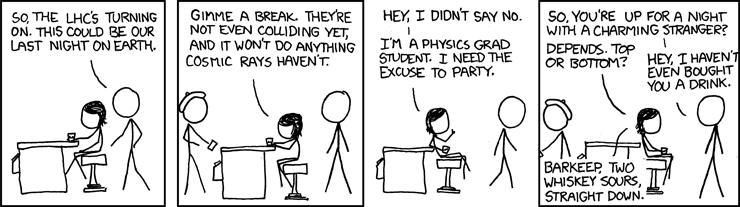
turn-on

xkcd: 'turn-on'

Today, the Large Hadron Collider (LHC) in CERN was turned on!

How exciting!

Despite the dire predictions of ‘generating black holes which will end our Universe’ – predictions which were accompanied by death threats, something most physicists are not used to and unexplicably find mildly funny – things would appear to have gone relatively well!  I guess science’s search for interactions between  Truth and Beauty continues!  (Well, at least scientists expect to see SUperSYmmetry (SUSY) ).

From today’s xkcd (above) and the ‘Scott Adams Blog’ which gives advice to all the bosons our there on ‘Nerdy pick-up lines’, it seems that events like these would appear to open up the horizons to an increase in puns among certain demographics….

Currieous!

P.S. – special mention to the person who can find all the puns in this post….there may be a few.