Student runs ‘underground library’ from her locker

What do the writers Dante, Douglas Adams, Mario Puzzo, Geoffrey Chaucer, George Orwell, John Milton, Joseph Heller, Philip Pullman, Mark Twain, the Brothers Grimm and a whole lot of others have in common?

Their books are part of the newest ‘underground library’…

OK, this is one of those bad-story/good-story things… unless it is a very sophisticated plot by a school to get kids (well, teenagers) to read books!

It seems that a school (presumably in the US) has banned a whole slew of books.  That is always bad (banning books does not stop the ideas they carry and is an evil act in itself), but some of these books are, well, books that ‘ought to’ be on the curriculum of any school worthy of educating our kids!

Many of the students are not allowed – or afraid(!) to borrow the books from the public library… 

Here comes the ‘good’ part of the story:  one of the students (currently un-named) has taken on this challenge and turned the empty locker beside her own into an ‘underground library’!

BoingBoing! dug the story up at ‘Yahoo Answers’ when the student in question described the situation, then asked:

“Anyway, I now operate a little mini-library that no one has access to but myself. Practically a real library, because I keep an inventory log and give people due dates and everything. I would be in so much trouble if I got caught, but I think it’s the right thing to do because before I started, almost no kid at school but myself took an active interest in reading! Now not only are all the kids reading the banned books, but go out of their way to read anything they can get their hands on. So I’m doing a good thing, right?”

“But is what I’m doing wrong because parents and teachers don’t know about it and might not like it, or is it a good thing because I am starting appreciation of the classics and truly good novels (Not just fad novels like Twilight) in my generation?”

You ARE doing the RIGHT THING!!!

It is never wrong to distribute ‘banned’ information, literature or ideas! And it is never wrong to oppose those who would keep you in the dark in order to control your thoughts!

Just for interest, here is a partial list of the banned books (which this student has begun to lend out from the ‘underground library’ in her locker:

  • The Perks of Being a Wallflower
  • His Dark Materials trilogy
  • Sabriel
  • The Canterbury Tales
  • Candide
  • The Divine Comedy
  • Paradise Lost
  • The Godfather
  • Mort
  • Interview with the Vampire
  • The Hunger Games
  • The Hitchhikers Guide to the Galaxy
  • A Connecticut Yankee in King Arthur’s Court
  • Animal Farm
  • The Witches
  • Shade’s Children
  • The Evolution of Man
  • the Holy Qu’ran
  • One Flew Over the Cuckoo’s Nest
  • The Picture of Dorian Gray
  • Slaughterhouse-5
  • Lord of the Flies
  • Bridge to Terabithia
  • Catch-22
  • East of Eden
  • The Brothers Grimm Unabridged Fairytales.

This person deserves a medal!!! And, her school could learn a few lessons from her…

add to del.icio.usDigg itStumble It!Add to Blinkslistadd to furladd to ma.gnoliaadd to simpyseed the vineTailRank

Warrantless searches permitted – if you have a radio at home…

This is for our US cousins – and, if anyone knows the law in Canada and other Western countries on this, I would appreciate the info:

Apparently, the FCC has the right to enter and search/inspect – without a warrant – any private home where RF devices are in use.

You know, like radio, garage-door openers, wireless router for your internet…even cordless phones, burglar alarms or baby monitors…

Wired.com has the scoop:

‘It would appear that a never-challenged, little known law from 1934…You may not know it, but if you have a wireless router, a cordless phone, remote car-door opener, baby monitor or cellphone in your house, the FCC claims the right to enter your home without a warrant at any time of the day or night in order to inspect it.’

‘The FCC claims it derives its warrantless search power from the Communications Act of 1934, though the constitutionality of the claim has gone untested in the courts.’

‘But refusing the FCC admittance can carry a harsh financial penalty. In a 2007 case, a Corpus Christi, Texas, man got a visit from the FCC’s direction-finders after rebroadcasting an AM radio station through a CB radio in his home. An FCC agent tracked the signal to his house and asked to see the equipment; Donald Winton refused to let him in, but did turn off the radio. Winton was later fined $7,000 for refusing entry to the officer.’

‘But if inspectors should notice evidence of unrelated criminal behavior — say, a marijuana plant or stolen property — a Supreme Court decision suggests the search can be used against the resident.’

So, let’s get this straight…

  • The FCC’s agents can enter any private property where they have a reason to believe someone is using any RF device.
  • Denying the agents entry is illegal
  • While the agents are on the private property, they are empowered to search it for RF devices and inspect the devices
  • If they uncover any evidence of ‘illegal activity’ of any kind, they can collect the evidence
  • This evidence can be handed over to police and can be used to prosecute the resident

Ah!

So, the US is not becoming a ‘police state’ – it is much too sophisticated for that!  Instead, the police use minions and sidekicks to do their ‘dirty work’ and remain beyond criticism…

Sweet!

Hat tip:  Dvorak Uncensored

add to del.icio.usDigg itStumble It!Add to Blinkslistadd to furladd to ma.gnoliaadd to simpyseed the vineTailRank

Union of Unions: is ‘labour’ organized a little ‘too well’?

This is just a tiny peek at Canadian ‘organized labour’ in particular, though I expect that the results will be similar for many of the ‘developed’ countries – and I am not naive enough not to understand that a supranatural organization of labour unions also exists.

This is only natural:  one just has to look at the nature of people who are drawn to ‘organized labour’ to start with!

These are usually people who are very, very good at ‘organizing’ things – and other people.  So, it is only natural that they would – well – organize themselves, too! And, there is nothing wrong with that:  freedom of association and all that.  Plus, many (perhaps most) of them are motivated by a belief that they are doing right by their members – also a commendable thing!

Where I DO have a problem is that in Canada (and many other places), this very freedom of association – something the labour unions had to fight bitter battles to win a legal right for – is now not respected BY the labour unions themselves…

As in, we have ‘closed shop‘ workplaces (or something practically indistinguishable from it), where every single employee is forced to belong to a specified labour union.  These ‘exclusively union-held’ workplaces are to be found in private industry and – perhaps this is the most troubling aspect – they have a monopoly on all levels of the civil service!  While I am very uncomfortable with all the aspects of this, that is not the topic of this rant.

Instead, I would like to demonstrate that this incredible skill at ‘organizing’, as practiced by labour unions, has – in a very real sense – led to a situation where just about every unionized employee in Canada effectively has to obey just one single boss

Unions arose because there was a need for balance:  as the industrial revolution transformed the ‘Western World’, the employer-employee relationship gave too much power to the employer and not enough to the employee.  Following the age-long adage ‘there is strength in numbers’, people refused to give in to oppression and did something to change it, both in law and in practice.  I suspect that were I living back then, I might well have been proud to be part of this movement!

But, the effects of human actions tend to act a little bit like a pendulum:  if you push hard to correct a wrong, chances are that a really successful ‘push’ will ‘swing the pendulum’ to the opposite extreme… and, with ‘organized labour’, I fear that that is exactly where we are now!  (At least, in the ‘Western world’!)

Now, we have a situation where an employer may not be allowed to hire the best people for a specific job (or, at least, the people the employer wishes to hire), but must have all their employment choices approved by a labour union.  In effect, the Unions in Canada (at the present time) form a layer of management which is NOT under the control of the employer, but whose very existence is predicated on ensuring that there is strife between the employer and the employee (as the ‘raison d’etre’ of the union is to mediate any disputes between the two, ensuring there is plenty of ‘stuff’ to mediate seems only prudent).

As in that story (sorry, I cannot find an online link, but it happened in the 1980s, so there may not be an online copy) where a lady owned a business and wanted to leave it to her grandson in her will.  To make sure that he really knew the business, from the bottom up, she wanted to hire him during his summer holidays in different departments of her company – working in the entry-level jobs of all the departments and getting to know them from the ‘bottom up’!

Frankly, I think this is commendable:  if you intend to leave a company in someone’s hands, it is only responsible that he know all the aspects of its workings!

However, not long before, this lady’s company became unionized.  AND, it was a ‘closed shop’…

And – since the labour union (I don’t know which one was involved) saw the hiring of the owner’s grandson as ‘nepotism’ and something to be opposed, they refused to grant him a memership in the union.  That meant that – whether paid or not – the grandson was not allowed to work at this company…except, perhaps, as the CEO…but he was denied the ability to ‘learn the business’ in order to become an effective manager!

The story ends sadly.  The confrontation between the owner and the labour union did not resolve the situation:  and, rather than be denied the right to hire whom she chose, the owned closed the company – putting everyone out of work.

Yes, it sounds like an urban legend:  still, at the time, it was a big story, covered by the major papers…

I guess what I am trying to say is that while 100+ years ago, the ‘strength’ was with the employers, that is no longer the case.  Now, the ‘strength’ lies with the unions who control BOTH the employer AND the employees, without any accountability to the former and with only a ‘lip-service’ level of accountability to the latter.

That, in my never-hmble-opinion, is a problem!

Because, like it or not – notice it or not – what has happened over the last 100 years (or so) is that individual workers have united to form unions, restoring balance to the ‘equation’:  but, they then went much, much further!  They created ‘unions of unions’ – until now, in Canada, there is one body – the Canadian Labour congress – which controls the vast majority of unionized employees in the land!

From their ‘about’ page:

‘The Canadian Labour Congress brings together Canada’s national and international unions, the provincial and territorial federations of labour and 136 district labour councils.’

‘With roots everywhere in Canada, the labour movement plays a key role…’

‘Active in every aspect of the economic, social and political life of Canadians…’

‘On Parliament Hill, in boardrooms, at international conferences, in media events, in demonstrations or on picket lines, the CLC supports and educates unionists in the fight for strong workplaces, pressures governments for change, builds coalitions with like-minded groups, and strengthens solidarity between workers in Canada and other countries.’

This really does seem to be an organization – perhaps with supranational strings attached – which controls a great deal of what goes on in the daily life of Canadians!

If the CLC were to decide that each one of its members (or the members of its minion organizations) were to go on strike, the whole country would come to a standstill! Industry, government, infrastructure, construction – even entertainment:  all these workers are subject to the whims of the CLC… either directly, or through the labour unions that they belong to – and which all answer to the CLC!

Is this not too much control in the hands of just one group of people – especially a group of people NOT ACCOUNTABLE to Canadians?

add to del.icio.usDigg itStumble It!Add to Blinkslistadd to furladd to ma.gnoliaadd to simpyseed the vineTailRank

Aspie humour, music and cats

Not much needs to be said:  just watch the video!

Hat tip:  Dvorak Uncensored

UPDATE: Having visited a friend who has a cat, I attempted to follow the above instructions to the best of my skills and abilities!  Alas, I failed…

I cradled the cat, as shown.  He looked very pleased, and not even a tiny bit ‘annoyed’.

I did the ‘sniffing’ – he closed his eyes, as if with pleasure.

I did the ‘serial kissing’ – after which the cat attempted to rub his cheek on me, as if asking me to show him more affection.

And, he appeared rather immune to the ‘little drop’…

After I let him down, he jumped onto my lap, asking for more – and not a peep out of him!  (Unless purring counts.)

Therefore, I am obligated to report that I have been unable to replicate this procedure successfully…

UPDATE OF THE UPDATE: Having visited another friend, I tested the methodology on her cat.  It worked PERFECTLY!  Awesome cat-yodelling was enjoyed by all!

My personal observation:  pick a slightly finicky cat!

If the cat is ‘too agreeable’ – no sound except for purring will be heard, therefore, no yodeling will result.

If the cat is ‘too finicky’ – you’ll be torn to shreds!  Therefore, the key here is to find a cat with JUST the RIGHT amount of ‘finickiness’ to ‘tell you’ when you are being annoying, but not rip your face off!

Come to think of it, more people should have ‘just’ the ‘right’ amount of ‘finickiness’, too….

add to del.icio.usDigg itStumble It!Add to Blinkslistadd to furladd to ma.gnoliaadd to simpyseed the vineTailRank

…been quiet lately…

Perhaps you have noticed that my posts have been less frequent than usual – my apologies.

There is ‘stuff’ happening in my extended family, and my attention has been there…  I will be back to my earlier frequency of posting, once my family’s needs return to their usual levels.

The ‘Liberal Dimension’ – the McGuinty clan: background to the ‘influence-peddling’ trial of Ottawa’s ‘Mayor Larry’

The ‘influence-peddling’ trial of Ottawa’s Mayor Larry O’Brien may – at first look – seem like just another sleezy politician getting what he deserves.

There is a little more to it than that…

… and, in my never-humble opinion, it involves something more than just local issues.  To understand this, we will need to take a look at a local family with more-than-local influence.

The McGuinty family is also very, very influential in the Ottawa area.  The respect the ‘father’ (professor McGuinty) had earned in the community has been cashed in by his less scrupulous sons….  Even though there is no suggestion that the McGuintys were involved in any kind of influence peddling, no look at the political landscape in Ottawa would be complete if it did not include the McGuinty clan.

Here is a VERY BRIEF look at the McGuintys:

  • ‘The father’ – professor McGuinty – was an honest man.  He served the Ottawa community locally, until he was elected to the Ontario Legislature in 1987.  He died in 1990.
  • ‘The mother’ – Elizabeth was a nurse, devoted to her family and, by all reports, a wonderful lady:  being francophone, she helped mould her children’s image of a bilingual ideal for Canada.
  • Dalton McGunity
    • ‘inherited’ his father’s seat in the provincial legislature in 1990
    • ‘young Dalton’ – a lawyer, like Bob Chiarelli – had a bright future with the Liberal Party of Ontario (LPO)
    • in 1996, with Bob Chiarelli’s support, Dalton McGuinty became the leader of the ‘provincial Liberals’ and the leader of the official opposition in Ontario’s Provincial government.
    • in 2004, Dalton McGuinty’s Liberals won the Provincial election, making Dalton the Premier of Ontario
      • Following a string of broken election promises (some in writing), Dalton McGuinty was genuinely astonished that this was a problem.  Regardless of the exact phrase he used, the image of him saying innocently “I had to lie, or the Conservatives would have ‘got in’!” had become entrenched in the public mind, branding him a ‘liar’.
      • political commentators have suggested that policies – and their timing – of Premier McGuinty seriously damaged Paul Martin and his Liberals in the federal elections
    • Warren Kinsella (aka ‘Catsmeat Kinsella‘) (a Chretien spin-doctor who was ‘frequently named’ in the Ad-Scam enquiery) is credited with helping Dalton and ‘his’ Liberals win the next (2007) provincial election (Mr. Kinsella caused a scandal during the election when he showed his misogynist streak…)
  • David McGuinty
    • federal Member of Parliament, first elected in 2004, then re-elected in 2006 and 2008
    • not quite as well known as Dalton, this McGuinty brother has more clout than is generally recognized:  for example, he was considered a possible candidate for the leadership of the Liberal Party of Canada (LPC) in 2006, but declined
    • when first elected, David McGuinty was not ‘invited’ into the Cabinet by Paul Martin (who became Liberal Leader in November of 2003) – this was regarded by many as a ‘Martin snub’, but was not unexpected:  the party was deeply divided between the ‘Chretien Liberals’ and the ‘Martin Liberals’…and this rift is still very apparent today (Mr. Ignatieff would appear to have won the endorsment of many of the ‘Chretien Liberals’)
    • known as an ‘environmental lawyer’, he worked hard to promote the ACC agenda
    • Wikipedia also says:  ‘He also was chairman of the Liberal Party’s National Capital Region Caucus.’
  • Dylan McGuinty
  • Brendan McGuinty
    • Some commentators have described him as the ‘brightest’ of the McGuinty brothers
    • worked on the election campaigns of his father and both brothers
    • worked on the election campaign of Bob Chiarelli in 2003 – becoming Chiarelli’s Chief of Staff
    • fought charges of nepotism (1996) and conflict of interest (Ottawa Hydro, 2004)
    • was Chiarelli’s Chief of staff during the critical period prior to the 2004 Provincial Election when the Mayor (and his office) were negotiating with The Province about the Choo-Choo to Nowhere, aka The O-Train.
      • some ‘confidential materials’ about the negotiations were somehow leaked
      • the LPO used these materials against the Provincial Conservatives in general, and John Baird in particular

The McGuintys are decidedly an influential family in the Ottawa area – and they are very closely allied with Mr. Bob Chiarelli.

This close tie could only be deepened by their ‘independant’ rivalries with John Baird, the very popular Ottawa conservative politician whom they have sparred against in both the provincial and the federal arena:  Bob Chiarelli was even rumoured to consider running against John Baird federally.

Now that the Editorial Board of the Ottawa Citizen is – once again – endorsing Bob Chiarelli for Mayor of Ottawa in the next election, things should get interesting…

The ‘Liberal Dimension’ – Bob Chiarelli: background to the ‘influence-peddling’ trial of Ottawa’s ‘Mayor Larry’

Larry O’Brien, the hi-tech entrepreneur-turned-Mayor of Ottawa, is facing charges of ‘influence-peddling’ stemming from his alleged actions in the 2006 Ottawa Municipal Election.

I would like to stress the words ‘alleged actions’…

The trial started this week and the first day was spent on whether to allow ‘live blogging’ (yes – don’t make rulings you cannot enforce) and CBC broadcasting (no – they asked so late, it’s insulting) of the proceedings.

On the second day, Justice J. Douglas Cunningham – who is presiding – heard arguments from both the Crown and the Defense about the rules under which ‘hearsay evidence’ ought to be allowed (or not) – it would appear that ‘hearsay evidence’ forms the bulk of the Crown’s case!

Who would have thunk it, that a highly respected judge might have to spend a whole week pondering about the admissibility of ‘hearsay’ in his courtroom – in a country where ‘hearsay’ is specifically banned from use in any judicial proceedings – with the ‘special’ exemption only for the ‘Human Rights’ Commissions!

But, that is not what this post is about…

Rather, this whole ‘mess’ is taking place in the deep dark shadow cast by the ‘Liberal Machine’!

How?

I have touched on a little bit of the ‘deep background’ by looking at the issues that dominated the 2000 and the 2003 elections in Ottawa –  and I need to cover a lot more before the pieces of this puzzle begin to form a coherent picture.

Still, in order to show the significance of the events, issues and how it all all meshes together, I think it is important to look at some ‘people connections’.  And, in the Capital of Canada, so long dominated by Liberal governments (with only a few Conservative interruptions), many of these ‘people connections’ are made through the ‘Liberal Machine’…

We have already seen that there is a ‘cross-over’ between the ‘strategists’ who advise Federal and Provincial Liberal politicians, especially during elections.  One such ‘famous crossover’ is Mr. Warren Kinsella, who is often credited with…

…but, let me back up a bit!

THE ‘big fish’ on the Ottawa scene has, for quite a while, been Bob Chiarelli: tenacious, ambitious and tough as nails…as well as a savvy, well-connected and ‘slippery’ politician.  He has lots of ‘street smarts’, too…

HIGHLY abridged bio of Bob Chiarelli – just hitting some of the highlights, with respect to ‘connections’ – and a lot of my never-humble-opinions liberally sprinkled in:

  • Born into a wealthy and prominent family in Ottawa’s ‘Little Italy’, he opened his law practice in 1969.
  • From 1987 to 1997, he held the Ottawa West seat in Ontario Provincial Legislature as a member of the Liberal Party of Ontario (LPO).
    • when first elected in 1987, the Liberals won and David Peterson (brother of the Jim Peterson, who was a federal Liberal MP under Trudeau, Turner, Chretien and Martin until his retirement in 2007 – and a supporter of both Turner and Martin) the LPO leader, became the Premier of Ontario
      • Chiarelli did not get a cabinet post in the Peterson government (rumours of resentment….)
      • during the 1987 provincial election, the seat for Ottawa South was won by a certain Professor Dalton McGuinty, Sr.
      • since the death of professor McGuinty in 1990, the Ottawa South seat has been inherited held by his son, Dalton McGuinty Jr.
    • In 1995, Peterson’s Liberals were defeated in the provincial election by the Mike Harris Conservatives and their ‘common sense revolution‘.  This put Mr. Chiarelli on the ‘opposition side’ of the House…
    • In the subsequent Liberal leadership race (1996), Bob Chiarelli supported (and helped) Dalton McGuinty’s successful bid to replace Peterson as the leader of the LPO
  • In 1997, Bob Chiarelli’s family was struck with a tragedy – his wife fell ill with cancer and succumbed to the disease.  Bob Chiarelli resigned his seat in order to be there for their kids…
  • Later on in 1997, Bob Chiarelli successfully ran for the Chair of the Region of Ottawa-Carleton:  at this time, the ‘greater Ottawa area’ was made up of a number of small communities as well as an over-arching ‘regional’ government:  it is the top position (the ‘chair’) of this over-arching government that Bob Chiarelli was elected to hold in 2007
    • The Provincial Conservatives (under Mike Harris) were big on eliminating ‘redundancy’
    • Bob Chiarelli heavily lobbied the Harris government to amalgamate all the municipalities of the Ottawa-Carleton region – as well as the regional govenrment – into one entity, The City of Ottawa.
    • He succeeded:  all the small, flexible municipalities as well as the ‘more shadowy’ regional government were amalgamated into The City of Ottawa in 2000.
  • In 2000, Bob Chiarelli was elected as the first Mayor of the amalgamated City of Ottawa
  • Brendan McGuinty was Chiarelli’s election strategist (he also acted as election strategist for his father, as well as his brothers Dalton and David – with the support of his brother Dylan – a land developer real estate lawyer and the acknowledged ‘family strategist’) and served as Bob Chiarelli’s Chief of Staff.

This is a BRIEF look at Mr. Bob Chiarelli – until the time when my narrative picks up (the 2000 municipal election – with its ‘Shawn Little affair’).  Yes, there are MANY omissions … and I will try to fill in the gaps … next post!

add to del.icio.usDigg itStumble It!Add to Blinkslistadd to furladd to ma.gnoliaadd to simpyseed the vineTailRank

The ‘2003 election’: background to the ‘influence-peddling’ trial of Ottawa’s ‘Mayor Larry’

The highly publicized criminal trial of Ottawa’s Mayor Larry O’Brien is influenced by many ‘other factors’ – ones of ‘universal interest’.

However, there are many pieces to this puzzle… once I present them all, I will make the connections between them clear.

The first post in this ‘puzzle’ was ‘The Shawn Little affair’… which showed all those interested in watching just how easy it was to render an elected official ineffective – if they are charged with even a transparently ludicrous criminal charge…. In other words, it entrenched (in all the politicians frequenting Ottawa, Canada’s capital and the seat of its parliament) the perception that ‘lawfare’ will render ‘uncomfortable’ politicians much less effective than they would otherwise be.

Not only does it tarnish their reputation (even if they are cleared of all charges – and even if the charges are as ludicrous as ‘not declaring the ‘value’ of a borrowed toilet-bowl brush! – some of the ‘dirt’, or at least, perception of ‘dirt’, will ‘stick’), it forces them to focus their energies towards their legal defense….and to how in the world they can pay their legal bills!

That post also briefly  introduced a key person:  Bob Chiarelli…. a shrewd politician with deep connections within the Liberal ‘machines’ in both the provincial and federal government levels, as well as with a deep ‘network’ of his own….. and who had been elected as the first Mayor of the amalgamated City of Ottawa in 2000.

Now, let us jump forward one election, to 2003

There were a few ‘big’ issues:

  • The smoking ban:  treatment of our veterans
    • The City Council had recently passed a ban on smoking in public.  The law was not popular.
    • Many people were offended at the way this law was implemented
    • Even private clubs – especially the Legion Halls – were not permitted to have especially constructed, fully ventilated smoking rooms…
    • Ottawa’s citizens felt the council was sicking their ‘jack-booted’ ‘By-Law Enforcers’ at our veterans, ticketing them and forcing them to endure -40 degree temperatures outside if they wanted to light up
    • While many people opposed the law itself, just about everyone was angry about the way the Chiarelli regime implemented it and how they targeted our Veterans for particular persecution.
  • The O-Train: expansion of Ottawa’s public transit
    • This is a complex and complicated one
    • At this point, ‘the mess’ was in its beginning stages…but, many people thought Mayor Chiarelli’s priority was building a legacy project to himself, not the public good/interest/etc.
    • There were unsubstantiated (but frequent) allegations that this route (popularly nicknamed ‘The Streetcar to Nowhere’) was selected as a type of ‘favour’ by Bob Chiarelli as part of land speculation by certain land developers and/or associates of Mr. Chiarelli and/or his family.  These rumours were fuelled by the fact that the route would provide awesome access to some cow pastures south of the city, while the east and west transportation corridors – insufficient to handle current levels of traffic – would not be addressed in the least…
  • Official Bilingualism
    • Ottawa is the capital of Canada – a bilingual country…  One would be hard pressed to find many cities (at least, in North America) which are functionally more bilingual than Ottawa – and that is a great thing!
    • Mayor Chiarelli wanted to entrench an ‘official bilingualism policy’ for Ottawa into Provincial law (so no subsequent Ottawa City Council could reverse it – a rather curious move)
    • The form of ‘official bilingualism‘ which the Mayor was pushing was based NOT citizen focused…  Rather than a policy which would mandate that a citizen of Ottawa ought to be able to access services in either English or French (one which would have been acceptable to everyone), Mayor Chiarelli’s bilingualism policy mandated that any City employee could work in the language of their choice (English or French), and all the managers had to accommodate their employees choices.
    • In addition, all City employees would have to be certified ‘bilingual’ according to the ‘Federal Standards’:  ones which most people consider to be highly discriminatory against non-Francophones.   (I have personal experience that this is true – will relate it, if desired….of the difference in treatment I received while applying for a ‘federal jogb’ when I was considered to be an immigrant, and the contrast when later, I was mistaken for a Francophone…if I had not experienced it personally, I would find it hard to believe!)
  • Amalgamation
    • Or, rather, de-amalgamation, as a large portion of the population of the City of Ottawa was not at all pleased with the way the amalgamation had been implemented and how the city was being destroyed transformed.
    • In particular, the rural areas of Ottawa (as well as the Western community of Nepean) were very ‘uncomfortable’ with the way the ‘amalgamated’ City Council saw their role and went about doing ‘things’…

Since Mayor Chiarelli was so vigorously pushing trough many of these issues, much of the 2003 election became about the personna of the Mayor himself!

So, when an unknown – Terry Kilrea – stepped out of the unknown to be an unlikely opponent to Mr. Chiarelli’s bid for re-election as Ottawa’s mayor, many of the disenfrenchised voters flocked to Mr. Kilrea’s ‘camp…  The ‘race for Mayor’ became a race between support for  Mr. Chiarelli, and all who opposed him – on principle

The race was heated, and pretty close… and Mr. Chiarelli won.

‘The Shawn Little affair’: background to the ‘influence-peddling’ trial of Ottawa’s ‘Mayor Larry’

Today was the first day in the ‘influence peddling’ trial of Ottawa Mayor Larry O’Brien. While this in itself may hold only limited interest, there are ‘other factors’ which are at play here: and these ‘other factors’ have implications way beyond the sleepy little town of Ottawa…

It is these ‘other factors’ which I would like to look at. Still, I ought to provide a little background of the events to date and their historical context….from my personal point of view.

  • In 2000/2001, the many municipalities of the Ottawa area and their over-arching regional government were all  amalgamated into one entity:  The City of Ottawa.
  • This created a geographically large city, with urban, sub-urban, and rural wards.
  • The former ‘Regional Chair’, Bob Chiarelli (acknowledged as a very skilled ‘political operator’), was elected to be the Mayor of the newly amalgamated city.

During that first amalgamated election (2000), an interesting thing happened…

‘The Shawn Little affair’

    • Shawn Little ran against Linda Davis, who had previously been on the Regional Council (headed by Bob Chiarelli, who was now running for Mayor)
    • The campaign got nasty.
    • Following the election, based on a complaint by Ms. Davis, Elections Ottawa investigated Mr. Little’s campaign spending.
    • The audit found that Mr. Little had not declared all of his campaign spending and made a list of the ‘undeclared items’, estimated their cost and incorporated this cost into Mr. Little’s account of the campaign spending.
    • This list included such items as a toilet-bowl brush for the campaign office washroom.  Mr. Little defended himself, saying this was not purchased but that a volunteer working in the office brought it in, and following the campaign, took it back home.  Still, the auditors said, the toilet-bowl brush had value, and he had not declared it:  this, in their eyes, was Mr. Little’s admission of guilt…
    • With the ‘estimated cost’ of the ‘omitted items’ incorporated into his spending, the auditor (after months of investigating) declared that Mr. Little had gone over his election spending cap by $2,600.00
    • Mr. Little was charged with violating the Municipal Elections Act
    • After a lengthy court battle Mr. Little was cleared of any legal wrongdoing
    • It took another legal battle for Mr. Little to get the City of Ottawa (who lost the case against him) to cover at least a part of his legal fees (he had almost lost his house…)
    • Throughout the affair, and for years following it, the press, led by The Ottawa Citizen, ran many unfavourable stories about Mr. Little.  (Perhaps these were deserved – it is true that while this was all going on, Mr. Little was not as effective a councilor as he ought to have been…)
    • An aside:  in the past, Shawn Little was a vociferous opponent of the ‘National Capital Commission’ (NCC) – a federal body which looks after ‘stuff’ in the nation’s capital region on behalf of the Federal Government.  At times, the NCC has been known to unilaterally (as in, they set the ‘market price’, no appeal process available) expropriate land – for the good of the ‘Capital Region’….only to flip the land in a few years for more than 50 times what they paid for it during the ‘expropriation’, making millions in the process…  This was not obvious during this affair, but… the majority of the directors of the board of the NCC at that time (MANY new appointments had been made, especially in 2007 – and I cannot seem to find the ‘historical snapshot’ from ealier – if anyone can find it, I will be happy to link to it here!!!  Let it suffice to say that during this era, the NCC BOD was heavily laden with ‘Chretien Liberal’ appointees…) were ‘land developers’ (or ‘urban planners’), many of them were rumoured to have had ‘ties’ with the ‘Chiarelli family’.
  • OK – this was DEEP background:  still, the important things here are:
    • ‘Lawfare’ (on this scale) was found to be a highly useful tool to render an elected councilor ineffective, both due to distraction (legal proceedings, financial issues, stress) and because it tarnished that politician’s public image.
    • ‘The Ottawa Citizen’ coverage of this election was – in my opinion – highly favourable to Mr. Bob Chiarelli.
    • Even years after this affair had been settled, ‘The Ottawa Citizen’ continued to run stories highly unfavourable of Mr. Little.

This is going really far – for ‘political memory’ of the average ‘voter’.  But, it is my never-humble opinion that ‘The Shawn Little’ affair has direct bearing on what is happening in the current trial of Larry O’Brien, Ottawa’s ‘Mayor Larry’.

If it is hard to see the connections – please, stay tuned.  I will first point out a few other ‘pieces of the puzzle’ (from my highly personal point of view), then and only then will I be able to explain just how they fit together….

My next post will look at (to be linked here, once posted) at the issues which dominated the next municipal election in 2003.

What is a vector?

So, what exactly is a ‘vector‘?

Like so many other words, it seems to mean something different in different ‘disciplines’.  But, deep down, the meanings are connected through the root of the word, ‘vector.  In Latin, it means ‘carrier’ – so, in all its uses now, it implies a direction, an increase or decrease, or another dynamic component to the basic information it, well, carries.

Recently, I have read a most excellent – clear and understandable – explanation of what it is that a ‘vector’ is.  So, with CodeSlinger’s permission (and a few illustrations and links thrown in by me), without further delay…

VECTORS: a tutorial by CodeSlinger

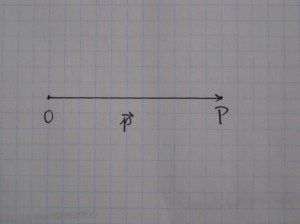
The simplest model of a vector is a directed line segment.


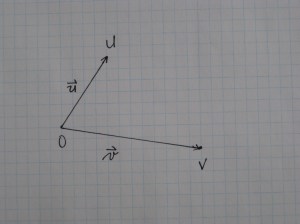
On the plane, pick any three points, not lying on the same line.  Call one of them the origin.  Call the line from the origin to the second point a basis vector in the u-direction, and call the line from the origin to the third point a basis vector in the v-direction.

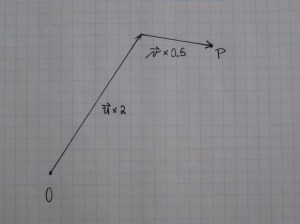
Then you can represent any point on the plane by a sum of appropriately scaled copies these two vectors.

No amount of scaling will turn either of these vectors into the other.  Thus we say they form a basis of the plane, which is what were anticipating when we called them basis vectors in the first place.

Of course, this basis is not unique.  Any two vectors which are not parallel form a basis of the plane in which they lie.

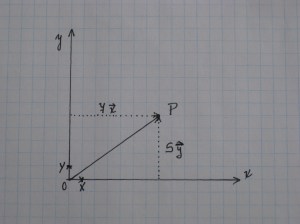
Most of us are used to selecting base vectors which form a right angle, such as the x-y axis

Most of us are used to selecting base vectors which are at a right angle to each other, such as the x-y axis.

However, it always takes two of them, so we say the plane is a  two-dimensional space.

Similarly, we can find triples of vectors which form bases of three-dimensional space, and N-tuples of vectors that form bases of N-dimensional space.

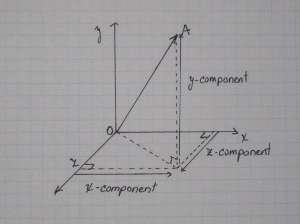
The component vectors are made up of multiples of basis vectors in that dimension

The component vectors are made up of multiples of basis vectors in that dimension: the number of basis vectors defines the number of dimensions of that space.

If a set of vectors forms a basis for a space, then we say that the basis spans the space.  The essential defining characteristic of a basis is that none of the N vectors can be obtained by any combination of scaled copies of the remaining N-1 vectors in the set.

Now, if we choose our basis vectors such that the angle between any pair of them is always 90 degrees, then our basis has the additional benefit that the directions are mutually independent.  No amount of movement parallel to any basis vector results in any movement parallel to any of the others.

When a basis has this property we call it an orthogonal basis.  Going back to our plan , for example, we now have the x and y directions familiar from graphing.

In three-dimensional space, we have x, y and z.  And the idea extends to N-dimensional space, even though there may not be standard names for the basis vectors.  So, now that we have a clear picture of the properties of basis vectors in geometric terms, let’s get a little more abstract.

We can treat any set of N mutually exclusive and jointly exhaustive properties (also called degrees of freedom) as a set of N basis vectors in an N-dimensional representation space.

A representation space is just the set of all possible combinations of these properties.  For example, red, green and blue.  Any colour visible to the human eye can be represented as a sum of appropriately scaled red, green and blue components, but neither red, green nor blue can be obtained by any scaled mixture of the other two.

http://www.satimage.fr/software/images/graphics/rgb.pngThus we say that red, green and blue are the 3 basis vectors of a 3-dimensional colour space.

add to del.icio.usDigg itStumble It!Add to Blinkslistadd to furladd to ma.gnoliaadd to simpyseed the vineTailRank