Why young kids should not be ‘institutionalized’

Perhaps I am a little bit more obsessive about ‘parenting’ than most people are.  Frankly, I think all kids (but especially MY kids!!!) are too precious for us NOT to be obsessive in learning all that we can about all various facets of ‘raising them’ before we decide to have them.

So, before I went on to have kids, I read up on it.  Obsessively.  Exhaustively – I hope.

Of course, this was a 15-20 years ago….before I became a parent.  So most of it was not ‘online’…and I would be hard pressed to remember all my ‘sources’!  Much less ‘look them up’ and post links to them…  Therefore, what follows cannot be categorized as anything other than my ‘never-humble-opinion’!

Still, this opinion is based on having done my homework…and having read a lot of studies – many of them not really popular with the current ‘educators’ – still, these were bona fide scientific studies, publishes and peer-reviewed and from all various spectra of scholarly schools.  I will do my best to put it into ‘common sense wording’, in order to get the main point across as clearly as possible.

In order to understand what ‘we need’, psychologically speaking, it is a good idea to examine how – historically speaking – children were raised.  It is, after all, the societies which ‘did OK’ that survived – so, considering the circumstances of how they raised their kids may help us understand which ‘circumstances’ are most favourable to raising adults who are most predisposed towards perpetuating the most successful societies.  To re-phrase:  let’s look at what ‘worked’ in the past, and what did not – and why.

The ‘traditional’ way of raising children is in an ‘extended family’ unit.

This is true of every race, on every continent…so, perhaps, we ought to take heed of this lesson.

Very young children are raised in small groups:  the younger the child, the smaller the social group it is exposed to.  This is very important, for various reasons:  but, it is easiest to think of it in terms of ‘attachment’ and ‘social bond’.

The very first bond a child traditionally forms is with its mother.

This is due to in-utero conditioning (when the mother experiences ‘good/pleasurable’ things, from food to sounds and so on – her ‘feeling good’ chemistry is shared by the foetus:  thus, some ‘preferences’ are being programmed into the brain even before one’s birth) as well as nursing/early care.  (We are talking pre-baby-bottle times…nowdays, a father can step in and forge a bond with an infant much earlier than it used to be possible ‘traditionally’.)

As the child grows a little older, immediate members of the nuclear family (plus the maternal grandmother – but that is a different post) begin to forge social bonds with the infant.

These are very important:  from ‘father’ (in addition to ‘mother’) to ‘older siblings’.  The infant is still the youngest, most vulnerable – and thus most protected – member of the family.  It is difficult to explain just how important this last bit is:  it is essential in forming the ‘I am special’ bit of the personality – the bit from which ‘self-confidence’ and natural (not twisted) sense of ‘self-worth’ come.

As the child continues to grow, it is more and more exposed to a social group of ‘siblings and cousins’.  The important thing about this ‘group’ is that there is a significant variation in the ages of the ‘siblings and cousins’ – the older one becomes, the ‘higher they rank’ – but the greater the responsibility for their younger siblings/cousins they have to shoulder!

This is a natural means through which children learn that ‘growing’ brings BOTH privileges/status AND responsibilities.  This process is very positive, good for the ‘psyche’.  Our own history has shown it to be so.

It is also a natural ‘drive’ enhancer:  one wants to ‘catch up’ to the skills of the older children, while working hard not to be ‘passed’ by the growing skills in the younger children… with ‘special allowances’ to individual variations being possible because of the ‘family’ nature of the structure:  the differences are seen as ‘special talents’ – most of the time…

To recap:  there are 3 significant aspects to ‘traditional family’ method of child rearing

  1. The size of the social group the young child is exposed to is closely tied to it’s age:  the younger the child, the smaller the social group – and the ‘clearer’ the ‘social order’ withing that group.  The younger the child, the smaller the group.  Since this ‘group’ was usually left in the care of one adult – plus the ‘older children’ – the size of this group usually did not exceed 10-12 (in the first decade of a child’s life).
  2. The ‘social order’ within this group was, to a great degree, dictated by the age of the individuals in it:  the group was made up of children of VARYING ages – which brought along a structured ‘social order’ of status coupled with age.
  3. Each child was motivated to ‘catch up’ to the older children and ‘not be caught up to/surpassed’ by the younger ones:  exceptional skill was recognized, and did not ‘denigrade’ others…but, this was a strong motivator to want to succeed.  It was a ‘natural’ way of teaching kids that as one gets older, the expectations of them grow:  to earn respect, they must grow to fill these expectations.

This was not ‘forced’: allowances were made for ‘special skills’….if one had shown a special talent in a specific field, their responsibilities would grow in that field and lessen in others.  That is the flexibility inherrent in a small, family-based unit.

Also, because the children were of different ages, they could compete constructively with each other…the older children could acknowledge the growth in the younger ones without being threatened and all that….(most of the time, anyways).

The ‘modern’ method of ‘early childhood education’ violates this process in several important ways:

  1. The size of the group  in ‘state-sponsored’ pre-school/kindergarten is much larger than the size of the social group a child would  traditionally be exposed to.
  2. In ‘state-institutionalized care’, the children are ‘sorted by age’. That means that there is – at most – 1 year age-difference between the oldest and the youngest child in the group!  This is justified by the commonality of the ‘age-appropriate developmental stage’ the children share. It is not possible to understate the destructiveness of this ‘grouping’ to the children concerned!!!

OK – let me rant on the second point:  if the implications thereof have not become clear by now!!!  And while they are ‘obvious’ to me, perhaps I ought to explore them in another post….

add to del.icio.usDigg itStumble It!Add to Blinkslistadd to furladd to ma.gnoliaadd to simpyseed the vineTailRank

State is Mother, State is Father…

My dog loves the sofa.  He also loves blankets.

He absolutely relishes sleeping on the sofa – and this is one dog that has elevated ‘sleeping’ into an art form. Really – I have known many dogs, and owned a few, but I have never met a dog who relishes sleep like this crazy canine does!

Also, he does not like strangers to sit on his the sofa.  He’ll watch to see if the person gets up for some reason – even for a moment, sneak in behind them, steal the spot and immediately start pretending that he’s asleep, has been asleep in that spot for a very long time, and why is everyone getting all worked up about this?

He also loves to steal blankets:  and has been known to quietly grab a corner and, slowly but steadily, sneak off with the blanket of an unwary person lying down on the sofa, watching TV late at night.

When my son and I came home Monday, he greeted us with great enthusiasm.  He slithered off the sofa, stretched slowly and thoroughly, and wandered over to the front hallway to greet us.  Honestly – this passes as ‘enthusiastic’ from him:  sometimes, he just lifts his head off the sofa’s arm-rest and wags his tail a tiny bit to show he’s noticed you came in.

So, today’s was an enthusiastic greeting!  Then, after he followed me to the kitchen and stopped in front of the fridge, hoping that his beautiful brown eyes would hypnotize me to give him a pepperette, when – suddenly and visibly – a though struck him.

Quite suddenly, he abandoned begging communicating and, with unusual swiftness, he ran to the living room.  OK, we knew when we adopted him that he was ‘special’ and, though incredibly good natured, he was no border collie in the brain department – so I thought nothing of it.

Later, when I came into the living room, I noticed that he was not lying down on the sofa, but on a chair.  And he was not really lying down in his usual way… instead, he was more ‘splayed’:  all four paws spread as far apart as possible, his centre of gravity as low as he could get it.  His head was not resting, but just slightly elevated in a high-strung sort of way.  And his eyes…

His eyes were priceless!  They were ‘big’ – his ‘vigilant look’ (well, as vigilant as he gets) – with lots of ‘white’ showing.  And they were flashing, side to side – in a particularly self-pleased way!

Had his behaviour not been so ‘obvious’, I would not have looked around too closely to see what he was doing.  But, his very demeanour gave away that he was ‘being tricky’:  that he had ‘done’ something naughty and thought he was getting away with it!

It turns out that my son – in a fit of insomnia – brought his blanket down, watched some TV, then forgot his blanket on the chair.  The dog knows ‘bed blankets’ are off limits to him:  but this blanket was not on a bed, was it?  So he lay down on it, spread his body as wide as possible to hide the fact that he was indeed occuppying a ‘bed blenket’ which was currently ‘not a bed blanket’…  The dog was very, very pleased with himself!

So, what does this story have to do with my post today?

Yes, it was a bit of a long segway, and this story took me a few days to write up, but…

Monday, Ontario Premier Dalton McGuinty made an announcement.  Some person whose makes his living ‘educating children’ released a report today, saying that ‘children need more educating’!

Why, that is almost as convincing as a ‘Cure-all’ salesman saying this potion in this here bottle will ‘cure all’!!!  Better buy a few!!!

And, Mr. McGuinty, he is so concerned about the welfare of children, he’ll have to do what is best for all of the children! (Will somebody please shut up the parents of those pesky Autistic kids?  They’re not even photogenic:  no photo-ops from that lot!)

As I was saying:  Mr. McGuinty, he is so caring, he only wants what is best for the children!  And since that report by a guy who gets rich by sticking EVERY child into a ‘one-size-fits-all’ ‘institutions of teaching’, that is exactly what this kind and caring man announced he would do!!!

Aside:  make no mistake!  Our public schools are ‘institutions of teaching’, NOT ‘institutions of learning’!!!  They are centered around the needs and desires of teachers, whose powerful union regularly holds the whole population hostage by refusing to ‘teach’ unless it is ‘on their terms’ – ONLY!  Therefore, schedules, methodology, material and just about every aspect of ‘teaching’ you can name is tailored to suit the comfort of teachers.  Students, who have no union to represent them, are just pawns to be cycled through the system – a pesky annoyance to be minimized and with which the teachers have to put up with as a minor part of this ‘education system’…

So, what is it that this caring, loving man (who is reportedly married to a teachers’ union activist) proposing to do???

He wants to institutionalize our children for 10.5 hours a day, 5-days per week, 50 weeks per year, from toddlerhood on!!!

Of course, the words he used to make his announcement were not as direct as my statement of it is – but the meaning is identical.  His version is all about ‘what is best for the children’!  And he has that ‘study’ (by a guy who, among others, will have an increased revenue stream if McGuinty institutes) this to back him up!

Here is the video – I invite you to watch the body language:

Did you notice it?

The way he shifts his eyes, the way he enunciates certain words, the way he uses his whole body to help him spit out some ‘concepts’?

It’s that SAME body language my not-so-bright (but way more lovable than McGuinty) dog used when he was trying to ‘pull one over’!

This sent me ‘looking for’ what it is that is ‘the loophole’ here:  what is this man ‘pulling over’ on us?

I’ll rant more on this tomorrow….

add to del.icio.usDigg itStumble It!Add to Blinkslistadd to furladd to ma.gnoliaadd to simpyseed the vineTailRank

Book drive for kids ‘up North’

Imagine living in a world where the nearest library or bookstore is a plane-ride away!

It gives me nightmares, just thinking about it…  (I love books, I collect books, I like to touch books – I like just about everything about them…including acquiring them!)

If you live in or near Ontario, here is a chance to have some books delivered to kids who live in Northern communities so distant, the only way to reach them is to fly!

Ontario’s Lieutenant General (the figurehead which represents ‘The Crown’ in Ontario) is actually doing something useful:  he is putting on a book drive for these Northern kids!

Between now and Sunday, 21st of June 2009 (this is an annual thing – check his website for the drive’s date in future years if this post has become stale), drop new books for readers 14 and under at any OPP (Ontario Provincial Police) station.  If you are in the GTA area, you can also drop them off at the Toronto Police Stations.

They’ll take the books and fly them to Northern communities:  heavy things like books are very expensive to ship there, so most kids cannot afford to get many.  Also I am rather glad that this politician is using his budget towards something useful!

OK – I am sucker for these ‘feel good’ things, people helping people.  (Even if some are politicians!)  And I am a reader – life without books, to me, would be torture!

So, I am already plotting (pun intended) the books I’ll get:  personally, I’ll skip the baby ones and aim towards the higher end of the 14-year-old age bracket….get the mind working, imagination soaring, ideas brewing… FUN!

‘Xanthippa on Aspergers’ – a new spot for my Aspie stuff

This blog does not have a very tight focus…to say the least!

I bounce around, from current political stuff – global, Canadian and local to me, to a bit of political theory/history (with help from others!), to philosophical/religious stuff…and just about everything in between.

Oh, and I also have a few post about Asperger Syndrome:  my experiences in living with it and some of the perspective from an Aspie point of view, as well as some things that worked when I helped my – and other – kids master their Aspieness and turn it from ‘a curse’ into ‘a gift’.

Well, it seems that some of the things which I tried and which worked for me and mine have also worked for some other Aspies!  And, it has also attracted the attention of some educators of Aspies – and, perhaps, over time, it could become an unlikely resource.

From what I hear, many professionals who work with Aspie kids have great amount of theoretical information available to them, but very little practical ‘stuff’ to go on.  So, reading the experiences of an adult Aspie – even one who is not a specialist in their field.  Perhaps they can read my experiences and see what worked for me, and interpret it at a higher level than I could hope to.

While I think that my ‘Aspie posts’ fit quite well in with my other rants, I cannot but help thinking that my other rants do not exactly fit in seamlessly with my ‘Aspie posts’, so to speak.

Therefore, I have decided to start a blog to house just my Aspie things.  It is called ‘Xanthippa on Aspergers‘.  OK – so it sounds a little pretentious:  but, I wanted the title to retain some of the keywords which get rated high on Google and help people looking for my take on Aspergers…

One advantage of this place will be that the tags/categories will be more specific, so it will be more easily searchable.  And, since none of the political or philosophical or religious rants (yes, I am a tiny bit opinionated) will be there, it will be a little more acceptable to ‘educational professionals’.

Over the next little while, I will re-post all my Aspie things on the new site – starting with the most read ones first.  (Of course, I will not take them away from here!)

In the future, I will post my thoughts on Aspergers on ‘Xanthippa on Aspergers’ – but I will still cross-post them here.

Thank you all for all the feedback and support!

Doors-open Ottawa

This is actually a really awesome thing!

Doors-open Ottawa is a weekend when all kinds of neat places open their doors and let us, the ‘unwashed masses’, peek in!

OK – so, many of the places are quite familiar:  the Hindu Temple, the Ottawa Mosque, the Gurdwara, many of the Churches….

But – a lot of the really awesome science labs are open, too!  From CANMET (see granite blocks crushed before your eyes – and get a fragment as a souvenier) to the bug labs (Canada’s ONLY nematode taxonomist explains the intricacies of his profession – on a tour guided by one of Marc Garneau’s distant cousins!)

This is a really awesome thing!

The only criticism?  Putting it on the last weekend before high-school exams keeps a lot of young people who could benefit from learning about the ‘reality’ of various choices in education/professions because they have to study – in order to have high-enough grades to make it into schools that prepare them for these types of careers!

I’ve been tagged with ‘Have you read these banned books?’

Over the weekend, I posted about a young woman – known only as ‘Kat Atreides‘ – who has turned her locker into an ‘underground library’, lending out books banned by her high school (presumably in the USA).

It seems that people are wondering about which of these banned books others have read – or why they have not read some of them.  And, it would appear that ‘tagging’ people with this question is ‘today’s internet meme’…and I’ve been tagged (The Landed Underclass ):

“Have you read these banned books?  If not, why not?”

  • The Perks of Being a Wallflower
    • This is the first time I ever heard of this book by Steven Chobsky… but, as Wikipedia claims it is ‘inspired’ by ‘The Catcher in the Rye’ – a book I REALLY tried to read, but could not wade through all the useless whining – I doubt I will pick this one up
  • His Dark Materials trilogy
    • My son owns the trilogy and gave it a 3/5, so I picked the first one up and started to read it.  I could not ‘buy into’ the ‘world’ the author tried to create….and I did not like the WAY the archetypes were being messed with.  So, to avoid frustration, I put the book down…
  • Sabriel
    • This is the first time I have heard of this book by Garth Nix.  I’m not much into the ‘fantasy’ world of this type: I have a hard time buying into it…
  • The Canterbury Tales
    • Of course – I read it in high-school… so, it’s been a while!  This is a good reminder to let my older son read it this summer.
  • Candide
    • I have some books by Voltaire, but ‘Candide’ is not one of them…
  • The Divine Comedy
    • Yes, of course – again, I’ve read this in my early teens.
  • Paradise Lost
    • I read bits… as part of a high-school curriculum…
  • The Godfather
    • Yes, I’ve read it.  I still have a copy – but it’s falling apart…so I don’t re-read it much.
  • Mort
    • I’m not big on Terry Pratchett… I find his writing too preachy and manipulative to be enjoyable.  Instead of reading something by Pratchett, why not read a GOOD book?
  • Interview with the Vampire
    • Nor an Ann Rice fan – really, I don’t get her books.  People cannot ‘buy into’ a mythological world when the mythology is so blatantly wrong…
  • The Hunger Games
    • This is the first time I’ve heard of this book – sounds like an interesting take on the old archetype.  I just might pick this one up…
  • The Hitchhikers Guide to the Galaxy
    • YES!!!
    • My hubby has the complete original radio series – taped off the radio
    • We have the complete original TV series on DVD
    • We still have the computer game – though we no longer have the Atari to run it on
    • We have the movie on DVD (that one’s really just for ‘completeness’)
    • When my hubby and I got married, we each had a complete set of the books…
    • Then we bought the hardcover copies – and got Douglas Adams to autograph them – and he got a great kick out of hearing we had met when we both took a physics course at University named for one of his books – and taught by a ‘Dr. Watson’!
    • Should I go on?  OK – I will!
    • I am also rather partial to the Dirk Gently series – I rather see myself in Svlad Cjelli (without the more clever, witty bits)… and I have no doubt that had ‘that school’ been familiar with them, they would have banned them….
  • A Connecticut Yankee in King Arthur’s Court
    • I read this one when I was very young… and not in the original English.  My memory of it is VERY sketchy….I think I’ll pick up a copy in English now.
  • Animal Farm
    • Of course…
  • The Witches
    • Presumably, this is the Dahl book (though there are other books with that title)…  No, I did not read it nor do I plan to.  I saw part of the movie – if you want to see hate-speech, the movie is a perfect fit.  I walked out.  Then again, what do you expect from a writer who thinks that twisted, creepy dystopia of ‘Charlie and the Chocolate Factory’ is somehow a story for kids….  I tried to read THAT book.  What is that saying?  ‘Fool me once, shame on you.  Fool me twice, shame on me….’
  • Shade’s Children
    • Sounds like this school really does not like Garth Nix and his books… I think I’ll pick this one up and give it a try.
  • The Evolution of Man
    • Which book is this?  There are a number with this title…  and, yes, I have read a bit about the evolution of humans….but, I don’t know if this book is one of the ones I read or not.
  • the Holy Qu’ran
    • While I do not know enough Arabic to read THE ‘Holy Qu’ran’, I do own a copy.  I also own a couple of translations of it into English – from the ‘official’ Saudi translation to a scholarly one which explains the ‘linguistic twists’ and their significance.  The translations, I have read – so, perhaps I’m pushing the envelope a little, but I turned the letters green to show I read it, even if only in translations.
  • One Flew Over the Cuckoo’s Nest
    • Did not know it was also a book…
  • The Picture of Dorian Gray
    • Yes.
  • Slaughterhouse-5
    • Just not worth the time…  Kurt Vonnegut is a skilled writer who can make his worlds and characters come to life.  Too bad his ideas don’t live up to his writing skills…
  • Lord of the Flies
    • I wanted to read it – and bought the book.  But, my hubby and older son read it first, and then convinced me that I should NOT read it, because if I did, they’d have to put up with me ranting on and on about it for weeks…they thought I’d get too much ‘into’ the book.  But, I am familiar with the contents, having helped a few people write book reports on it (obviously, I helped with the ‘mechanics’ of writing the report, not the content…but was exposed to it nonetheless).
  • Bridge to Terabithia
    • Yes. (Did not see the movie…)
  • Catch-22
    • Yes.
  • East of Eden
    • Sort of….  Steinbeck is ‘sort of’ the opposite of Vonnegut:  great ideas (plot) and sense of humour, even his ‘plot timing’ is great.  It’s just the writing that sucks!  I don’t know if it is the degree to which he attempts to inject ideology into his books (something translators can negate through the means in which they translate ‘imagery’) or if it is just a complete inability to write.  However, a good translator can do wonders:  I have greatly enjoyed reading Steinbeck’s works when translated into other languages.  But in English – sorry, I just could not slog through it… even re-reading books I LOVED in the original English poisoned the books for me for ever…
  • The Brothers Grimm Unabridged Fairytales.
    • Yes.  A MUST read!

All right – YOUR turn!

add to del.icio.usDigg itStumble It!Add to Blinkslistadd to furladd to ma.gnoliaadd to simpyseed the vineTailRank

Student runs ‘underground library’ from her locker

What do the writers Dante, Douglas Adams, Mario Puzzo, Geoffrey Chaucer, George Orwell, John Milton, Joseph Heller, Philip Pullman, Mark Twain, the Brothers Grimm and a whole lot of others have in common?

Their books are part of the newest ‘underground library’…

OK, this is one of those bad-story/good-story things… unless it is a very sophisticated plot by a school to get kids (well, teenagers) to read books!

It seems that a school (presumably in the US) has banned a whole slew of books.  That is always bad (banning books does not stop the ideas they carry and is an evil act in itself), but some of these books are, well, books that ‘ought to’ be on the curriculum of any school worthy of educating our kids!

Many of the students are not allowed – or afraid(!) to borrow the books from the public library… 

Here comes the ‘good’ part of the story:  one of the students (currently un-named) has taken on this challenge and turned the empty locker beside her own into an ‘underground library’!

BoingBoing! dug the story up at ‘Yahoo Answers’ when the student in question described the situation, then asked:

“Anyway, I now operate a little mini-library that no one has access to but myself. Practically a real library, because I keep an inventory log and give people due dates and everything. I would be in so much trouble if I got caught, but I think it’s the right thing to do because before I started, almost no kid at school but myself took an active interest in reading! Now not only are all the kids reading the banned books, but go out of their way to read anything they can get their hands on. So I’m doing a good thing, right?”

“But is what I’m doing wrong because parents and teachers don’t know about it and might not like it, or is it a good thing because I am starting appreciation of the classics and truly good novels (Not just fad novels like Twilight) in my generation?”

You ARE doing the RIGHT THING!!!

It is never wrong to distribute ‘banned’ information, literature or ideas! And it is never wrong to oppose those who would keep you in the dark in order to control your thoughts!

Just for interest, here is a partial list of the banned books (which this student has begun to lend out from the ‘underground library’ in her locker:

  • The Perks of Being a Wallflower
  • His Dark Materials trilogy
  • Sabriel
  • The Canterbury Tales
  • Candide
  • The Divine Comedy
  • Paradise Lost
  • The Godfather
  • Mort
  • Interview with the Vampire
  • The Hunger Games
  • The Hitchhikers Guide to the Galaxy
  • A Connecticut Yankee in King Arthur’s Court
  • Animal Farm
  • The Witches
  • Shade’s Children
  • The Evolution of Man
  • the Holy Qu’ran
  • One Flew Over the Cuckoo’s Nest
  • The Picture of Dorian Gray
  • Slaughterhouse-5
  • Lord of the Flies
  • Bridge to Terabithia
  • Catch-22
  • East of Eden
  • The Brothers Grimm Unabridged Fairytales.

This person deserves a medal!!! And, her school could learn a few lessons from her…

add to del.icio.usDigg itStumble It!Add to Blinkslistadd to furladd to ma.gnoliaadd to simpyseed the vineTailRank

What is a vector?

So, what exactly is a ‘vector‘?

Like so many other words, it seems to mean something different in different ‘disciplines’.  But, deep down, the meanings are connected through the root of the word, ‘vector.  In Latin, it means ‘carrier’ – so, in all its uses now, it implies a direction, an increase or decrease, or another dynamic component to the basic information it, well, carries.

Recently, I have read a most excellent – clear and understandable – explanation of what it is that a ‘vector’ is.  So, with CodeSlinger’s permission (and a few illustrations and links thrown in by me), without further delay…

VECTORS: a tutorial by CodeSlinger

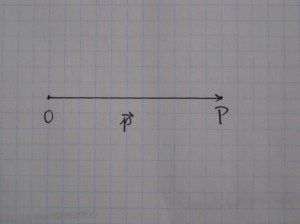
The simplest model of a vector is a directed line segment.


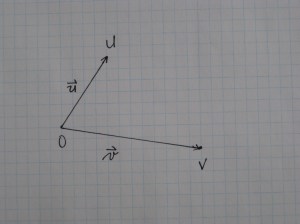
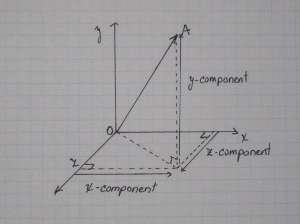
On the plane, pick any three points, not lying on the same line.  Call one of them the origin.  Call the line from the origin to the second point a basis vector in the u-direction, and call the line from the origin to the third point a basis vector in the v-direction.

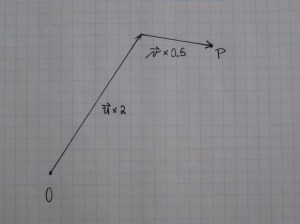
Then you can represent any point on the plane by a sum of appropriately scaled copies these two vectors.

No amount of scaling will turn either of these vectors into the other.  Thus we say they form a basis of the plane, which is what were anticipating when we called them basis vectors in the first place.

Of course, this basis is not unique.  Any two vectors which are not parallel form a basis of the plane in which they lie.

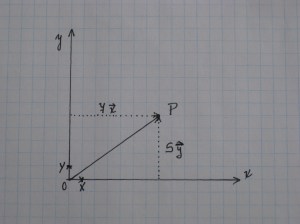
Most of us are used to selecting base vectors which form a right angle, such as the x-y axis

Most of us are used to selecting base vectors which are at a right angle to each other, such as the x-y axis.

However, it always takes two of them, so we say the plane is a  two-dimensional space.

Similarly, we can find triples of vectors which form bases of three-dimensional space, and N-tuples of vectors that form bases of N-dimensional space.

The component vectors are made up of multiples of basis vectors in that dimension

The component vectors are made up of multiples of basis vectors in that dimension: the number of basis vectors defines the number of dimensions of that space.

If a set of vectors forms a basis for a space, then we say that the basis spans the space.  The essential defining characteristic of a basis is that none of the N vectors can be obtained by any combination of scaled copies of the remaining N-1 vectors in the set.

Now, if we choose our basis vectors such that the angle between any pair of them is always 90 degrees, then our basis has the additional benefit that the directions are mutually independent.  No amount of movement parallel to any basis vector results in any movement parallel to any of the others.

When a basis has this property we call it an orthogonal basis.  Going back to our plan , for example, we now have the x and y directions familiar from graphing.

In three-dimensional space, we have x, y and z.  And the idea extends to N-dimensional space, even though there may not be standard names for the basis vectors.  So, now that we have a clear picture of the properties of basis vectors in geometric terms, let’s get a little more abstract.

We can treat any set of N mutually exclusive and jointly exhaustive properties (also called degrees of freedom) as a set of N basis vectors in an N-dimensional representation space.

A representation space is just the set of all possible combinations of these properties.  For example, red, green and blue.  Any colour visible to the human eye can be represented as a sum of appropriately scaled red, green and blue components, but neither red, green nor blue can be obtained by any scaled mixture of the other two.

http://www.satimage.fr/software/images/graphics/rgb.pngThus we say that red, green and blue are the 3 basis vectors of a 3-dimensional colour space.

add to del.icio.usDigg itStumble It!Add to Blinkslistadd to furladd to ma.gnoliaadd to simpyseed the vineTailRank

How vaccination works

One of the ways our society relies on to combat viral diseases is through vaccination.  But, how does that work?

First, let’s look at viruses:

http://medicineworld.org/images/blogs/11-2006/influenza-flu-virus-230.jpg

Diagram of an influenza virus from MedicineWorld.org

There are several important things to notice:

  • The coiled things on the inside, which look like springs or slinkies, are the genetic material of the virus.  Viruses only contain half the genetic material that a ‘normal’ living cell needs, so they cannot make more (reproduce) unless they invade another cell and hijack its reproductive system.
  • The wall of the virus (lipid envelope) is made up of two layers of lipid molecules.  This wall is an incredibly good barrier, preventing material from going through it.
  • The  yellow spikes and other bits that stick outside the wall are actually proteins which are embedded in the wall of the virus.  Because the double lipid wall is such a good barrier, these proteins are the ‘channels’ through which things can move across the wall.  All cells (not just viruses) have them:  they can move water and nutrients (and waste materials) through the bi-lipid cell wall, allowing a cell to ‘eat’, ‘breathe’ and communicate.

These proteins that ‘stick outside the wall’ are very important for another reason:  each type of virus (or other infecting cell) has a slightly different types of proteins sticking out, and they are arranged in slightly different ways.  Therefore, the ‘pattern’ and ‘shape’ of these proteins has become the easiest way to identify the virus.  (Scientists can also analyze the genetic structure of a virus, but this is not something our immune system can do!  So, our bodies recognize viruses by the ‘fingerprint’ of the proteins on their surface.)

An actual electron-microscope view of a virus looks like this:

http://blog.silive.com/health/2008/10/avian-flu-virus.jpg

Image on an avian influenza virus from Health&Fitness

As you can see, the proteins stick out on the outside of the wall of the virus, and they form a very specific pattern.  This is very important, because it is precisely by the specific proteins and the pattern they form that our immune system recognizes viruses (and other ‘pathogens‘, which cause infection).

Looking at the human immune system quickly will not be so easy, because it is much more complex than a simple virus is.  Let me give it a try…

When our body is infected by an ‘antigen‘ ( a pathogen which will cause our immune system to react and generate antibodies – as opposed to a poison, etc.), our immune system springs into action.  It follows a very specific chain of steps:

  • ‘General defense’:  the ‘generic’ cells which kill all kinds of ‘invaders’ are released by the immune system in hope of containing the infection within hours, before it can spread too far thoroughout one’s body.
  • If this does not work, the next line of defense begins:  this is when the body begins to defend itself against a ‘specific antigen’.
    • the body attempts to identify the infection by looking at the ‘fingerprint’ pattern of proteins on its skin/surface/cell membrane by comparing the current infection against its ‘memory database’ of past infections the body has successfully defeated
      • if it has no record of past infection that looks ‘like’ this one, it begins to ‘figure out’ the best way to fight it
        • once it figures out the best ‘antibody’ to produce, which would be most effective in fighting this specific infection, it will begin to produce it…but, figuring it out is a process of trial-and-error, and can take quite a while
      • if it finds a ‘match’ in its ‘memory database’ between the ‘fingerprint’ of the surface proteins – types and pattern – of this infection, it begins to produce the same antibodies which worked against it the last time
    • the body produces the antibodies which fight against this specific infection:  that is, it produces the very antibodies that it produced the last time it saw this pattern, and got better as a result
    • if these antibodies are strong enough to kill the infection faster than it can reproduce AND if the infection has not reached a critical level before the body can produce this antibody in sufficient amounts to conquer it, the person will survive the illness which is the result of the infection

So, how does vaccination fit the picture?

Vaccines are made up of either weakened viruses (viruses and bacteria are the most common forms of infection, and we have antibiotics to fight bacteria (viruses are too small/primitive to be killed by antibiotics)) or viruses that are dead and ‘ground up’.

When the the body ‘receives’ the vaccine, it perceives it as any other infection.  The vaccines are engineered to provoke the body to start manufacturing antibodies and the cells which recognize the’fingerprint pattern’ of the ‘antigen’ (weakened virus, or bits of the virus wall with the ‘fingerprint pattern’ of proteins on it which the body uses to recognize an infection).  In other words, the weak virus or bits of the wall of that virus will be fought – and catalogued for future use.

The theory is that if a virus (or another antigen) enters the body in the future, and the body will recognize it and produce antibodies which ‘recognize’ it and fight it.

By ‘recognizing’ the invader, the body can begin to produce the antibodies very quickly.  While some infections take a long time to overwhelm the body, other ones – the ones called ‘virulent‘ – can make one ill very, very quickly… faster than the body can find an antibody that would work!  (During the more virulent outbreaks of ‘black death‘, it was said that people could go to sleep feeling perfectly healthy, but die of the disease before the morning…)  This speed in the body’s ability to defend itself against an invading infection can mean the difference between life and death…or, at least, between a speedy recovery and an unpleasant illness.

Therefore, the philosophy behind vaccination is to introduce a non-lethat (not dangerous) form of a really bad pathogen to a body in order to get its immune system to figure out (without the danger of being ovewhelmed by the infecting disease) how to fight that specific germ, so that the body can store this information in its ‘pathogen database’.  Then, if it ever encounters the ‘full-strength’ germ, it will be able to ‘remember’ how to fight quickly – not giving the invading infection the time to become strong by spending valuable time trying to figure out how to fight it!

This is a beautiful theory!

And, like all such theories, it does actually work in many, many cases!  Unless a person has an atypical, stressed or diseased immune system, vaccination will be very effective in providing them with protection against a potential future infection.

add to del.icio.usDigg itStumble It!Add to Blinkslistadd to furladd to ma.gnoliaadd to simpyseed the vineTailRank

Swine flu: arm yourself with information

The best way to combat things – in my never-humble-opinion – is to arm yourself with information.

So, without further ado, here is a YouTube video – just released – by Thunderf00t (I have found him to be an accurate and reliable source of information on scientific topics in the past):

add to del.icio.usDigg itStumble It!Add to Blinkslistadd to furladd to ma.gnoliaadd to simpyseed the vineTailRank