Aspergers, Signs and What ‘Things Actually Mean’

It is a source of deep frustration for me that so often, signs are interpreted wrongly by the neurotypicals – who read meanings into them that simply are not there!  And, they get indignant when others, with better knowledge of either grammar or logic (or both), act in accordance with what the sign actually says instead of what they erroneously infer it says.

Let me give you an example:  outside of one of the parking lots at my son’s high school, there is a sign:

STAFF ONLY

PLEASE

In one way, this sign is pretty clear:  it is a request that only staff members enter the area.

It is not a statement of a rule, nor an order, because it includes the word ‘PLEASE’ – this clearly indicates that this is a request, something that is being asked of me…and therefore within my power to either grant or reject.

Right?!?!?

Yet, when I drove into the parking lot not with the intent to park there, but simply to drop my son off at the door closest to his locker, two different school employees told him off for my perceived transgression.

Outrageous!!!

The sign never stated that non-staff members are forbidden from even entering, not just parking in the area.

Of course, I am presuming that there ought to be a comma after ‘only’ and before ‘please’.  As is, the sign is a sentence fragment which indicates that the staff is in the process of pleasing some exclusive element, but does not define whom the staff are in the process of pleasing, why, or how one can get on the list of those to be pleased by the staff….much less imply any rules about the area in question!

Now, if one were to interpret the sign as meaning ‘only staff members are allowed in the area’, why are students permitted to walk there?  And, for that matter, if only staff are permitted there, why would the staff members presume that their vehicles are allowed there as well?  It certainly does not state that vehicles owned by staff members are permitted to be driven/parked there.

Really, think about it:  it says ‘staff’ – not ‘staff and their vehicles and students who are walking but not getting out of vehicles”.

I am not being silly here – this is something of a serious issue for us, Aspies.

We take a sign – or an instruction – at its literal meaning.

We do not see any ‘implied’ other meaning – yet, we are the ones who get yelled at or laughed at if we truly follow what the sign actually says.  That only ads insult to injury…

Let me give you another example, from a math test:

“Write the 3 forms of a quadratic relation that you have learned in this course this far…”

It seems obvious that if you have learned any or all of these 3 forms of quadratic relations before you started this class, they are not eligible to be put down for the answer here.   In other words, if you are good at math and already knew them, the only accurate and correct answer is to leave this blank or say ‘none’!

The corollary is that if you are still ignorant of these forms because you are bad at Math and have learned nothing in this class, your answer of leaving this blank or saying ‘nothing’ is also 100% correct:  the question does not ask what was taught, or what material was covered, but what you had actually learned.  If you had learned nothing, then your answer of ‘nothing’ would indeed be factually correct and deserving of full marks!

Yet, if you, as a student, try to point this out to a teacher, you will not be commended for your accurate interpretation of the question.  You will be singled out, put down and even perhaps punished for some trumped up ‘disrespect’ charge…

To an Aspie, this is very, very confusing.

I know – I’ve been there…

Warman vs Free Dominion and John Does – the Jury Trial (day 1)

Yet another installment in the Warman vs Free Dominion saga began today (9th of September, 2013) – and I was lucky to be there to witness it.  While I am no legal expert so I could only follow what was happening through my layman’s eyes, I am happy to share my personal observations with you.

As this was a jury trial, the first thing that had to be done was the selection of the jury.  One thing I learned was that while there are 12 jurors in a criminal case, there are only 6 in a civil case.  The process itself is interesting, if lengthy and, for the prospective jurors, I imagine it would be quite tedious and more than a little stressful.

The jury selection room at the Elgin St. Courthouse in Ottawa, where this trial is taking place, is located on the 3rd floor.  As soon as I came off the elevator, I spotted Connie Fournier from Free Dominion  with her lawyer, Barbara Kulaszka and a group of supporters standing in front of Courtroom #37.  Roger Smith, one of the John Does (who is representing himself) was seated nearby, and the highly charismatic Mark Fournier soon also joined the group.  All were either smiling hopefully or looking thoughtful.

Connie Fournier looked elegant in a pretty brown blouse with a simple silver necklace, charcoal slacks and black cardigan and understated black shoes.  Mark wore a simple dark green shirt, sporty black pants and his usual aura of immense energy, coiled  just beneath the surface!  The distinguished-looking Roger Smith wore a tan shirt, darker tan pants (brown shoes, of course),  blue blazer with a blue tie with a subtle tan stripe.  Barbara Kulaszka wore her lawyer’s robes, which drape pleasingly about her slender frame, flattering her tall figure.

Richard Warman breezed in just at the time appointed for the action to start, in his regulation crisp, flawless business suit (dark) with a light shirt and a tan-ish patterned tie.  He was accompanied by his handsome and extremely capable lawyer, James Katz (who appears to have moved from Brazeau Seller LLP to Nelligan O’Brien Payne LLP) and his assistant (grey suit) whom Mr. Katz later identified as a law student.

In the meantime, all the prospective jurors (there were to be several juries, for both criminal and civil suits, to be selected today) had gathered in a crowded room just off the Court Room #37.  When the first judge (not for our case) was ready to start selecting the jury for the criminal case he was to preside over, they (the prospective jurors) were all led in (by the bailiff) and seated in the large and comparatively plush courtroom – however, as this did not concern us and the room was quite full, we left.

We moved to Court Room #35, a much smaller one, where the presiding justice, Judge Robert Smith, wanted to go over some points of procedure with the lawyers and Mr. Smith prior to selecting the jury.

Justice Robert Smith seems very kind and good natured, explaining to the self-represented Mr. Smith that, as he (Mr. Smith) is not a lawyer himself, he (Justice Smith) will explain all the procedures to him and his rights in how to represent himself and he (Justice Smith) urged him (Mr Smith) to ask questions if he has any and he (Justice Smith) will be happy to answer them.

Then there was some amicable procedural back and forth between the judge and the two lawyers and things seemed to be going quite well.  For example, Mr. Katz explained that the 10 days set aside for the trial was spread over 3, rather than 2, weeks due to his obligation to observe some religious holidays, and so on.

Procedural stuff!

The judge asked the counsel to prepare a brief 1 to max 2 page summary not of the facts of the case, but of the positions they’ll be arguing them from, for tomorrow morning.

In addition to the Fourniers, Barbara Kulaszka is also representing one of the John Does, (Jason Bertucci, from BC, aka ‘Faramir’ – who will attend the trial next week).  Several of the John Does Mr. Warman was suing had settled out of court and he had not discovered the identity of a few more, so, as per an earlier court order, the proceedings against the  unidentified John Does was vacated.  In case Mr. Warman was to win and damages were to be awarded to him, the terms of the settlements with the John Does would be revealed so as to prevent ‘double dipping’ (my term, not the legal one) of having overlapping (again, my imperfect understanding, not the legal words) damages awarded in both the settlement and the court case.

…haggling over some late-submitted evidence, the essence of which was quite lost on me…relevance – rulings, binding so stuff can be removed from evidence books if deemed irrelevant….procedural stuff!

Once Justice Robert Smith was happy, we went back to Court Room #37 where the criminal case jury selection was just finishing up (under the watchful eye of Justice Patrick Smith).  (It seemed like metal-workers were everywhere today!!!)

As it concluded, we were told that there was to be a brief break – and all the prospective jurors had to file out of the room, back into the cramped holding room off Court Room #37.

Ten or so minutes later, we went back in to do our jury selection – and all the prospective jurors had to file back in.  It was at this time that I observed something peculiar, but very, very human!

Being in a stressful situation, as being in a jury pool, with its inherent loss of control over one’s ‘destiny’ – at least, circumstances in the short term – is much more stressful that one might imagine and which was accentuated by all this ‘group herding’ from one room to the other over and over… but this bonds people together!

And, as the prospective jurors filed in this time around, from the guy carrying his bicycle helmet to the young woman in those ridiculously high heels, these people began to form ‘familiar stranger’ social bonds.  Some sought to sit near the same people as earlier.  Others exchanged smiles and acknowledging nods.  Many began to engage in ‘familiar stranger’ social chatter…

It is exactly this ability of humans to bond under stressful situations, regardless of race or creed, that makes humanity so awesome!

But, I am rambling.  My apologies – I’ll re-focus.

Justice Robert Smith spoke of the supreme importance of jury duty to our system of governance  and I fully approved of all the wonderful, important things he said.

So, the process of jury selection, patiently explained by Justice Robert Smith, was to select 20 potential jurors by drawing their pre-assigned number from a box, which looked a lot like a Bingo drum.  They will come up if their number is called. Then, if any of them had undue hardships, they could tell the judge and he’d excuse them from jury duty.  A gray-haired woman came forward and explained her English was not good enough for her to follow the testimony properly, a young man had been booked to travel on business during trial dates, and so on.  The judge excused them, if their ‘hardship’ were genuine.

The rest of the 20 who were up then stood facing the lawyers  and the self-representing Mr. Smith, one by one, and they (the lawyers and Mr. smith) could either accept them as jury members or reject them.  Each side could reject up to 4 potential jurors, this number being split equally between Ms. Kulaszka and Mr. Smith on the defense side, giving each of them 2 rejections.  Mr. Katz rejected a computer-savvy looking man.  Ms. Kulaszka rejected a nuveau-hippie looking young woman.  That was it.  The next 6 people were sworn (on either the Bible or the Koran) or affirmed in as jurors, the next two as alternates (these were dismissed at the beginning of the trial, when it was apparent that the 6 jurors would indeed be able to serve).

Thus, the jury of 4 men and 2 women was selected!

It was not even noon, and we were free till the body of the trial would start at 2 pm, in Court Room #35.

Perhaps not as exciting a process as the trial itself, but, as I had never seen anything like jury selection before, I found it fascinating.  Hence the recounting thereof…

Promptly, at 2 pm, the Warman vs Free Dominion and John Does jury trial began.

Once the jury was brought in, Justice Smith again spoke to the importance of their role to our society and went on to explain their prospective roles:  his job was to instruct them on what the law is and their job was to listen to the evidence, all of the presented evidence (and no more or less), for themselves, and then draw conclusion on what the facts were and apply the laws, as they are and not necessarily as they think they should be, to these facts and render a decision.  They could take notes, but not take them away with them – and taking notes should not interfere with their paying attention to the testimony.

Justice Smith further instructed the jury as to how things will proceed, how the testimony and cross examination will work, and all that procedural sort of stuff.  He was very good at covering the important points and, if the jurors looked puzzled, he explained closer. Very well done.

Aside:  at some point in the proceedings, the exact moment of which I cannot right now find in my horribly scrawled notes (as I am hurrying to write this all up), Justice Smith announced that any witnesses who are to testify in the case (none for Mr. Warman, though he himself would testify, but as a plaintiff and not a witness and for the Fourniers [who would each also testify, as defendants – not witnesses], there will be four witnesses called:  Tom Kennedy, Paul Fromm, Jerry Neumann and David Icke) are to leave the courtroom and isolate themselves from any testimony before they themselves are called.  (Sorry for the convoluted sentence – it’s a lot of information condensed together, but it is important ‘stuff’.)

All right – if I go into all the details, I will not get this typed up before having to head in again tomorrow morning (I am a slow thinker and an even slower writer).  So, I’ll simply hit the headlines and explain my perceptions of what took place.

Mr. Katz, a most competent lawyer (without whose brilliant work I suspect Mr. Warman’s lawsuit record would be quite dismal – and who is, unfortunately, not sporting that sexy beard of his right now) made his rather brief opening statement.  Quite well, but not as well as I would have expected from his past performances.  (Sad … I love to see a brilliant mind at his best!)

Then, he called Mr. Warman to the stand.

Exciting!!!

But again, the testimony itself was so much lower quality than what I had expected to see that it left me faintly sad…

Mr. Warman, aided adroitly by Mr. Katz, attempted to paint himself as ‘the victim’.  The courageous human rights activist who saw wrongs being done and took up the challenge to try to make the world a better place…and got nothing but grief and abuse as a reward!

At least, that is what, to my eye and ear, he attempted to sound like.  Just a little too hard…

I don’t know if the jury bought it, but, it did not ring true to my proverbial ear.

Why?

Because even when he attempted to cloak it is ‘oh, poor me, I’m doing good and the world is picking on me’ whines, he did make some rather stark factual admissions.

For example, Mr. Warman testified that there was a detestable man in the United States of America by the name of Bill White (if I am not mistaken) who got charged by the FBI for uttering death threats against a whole slew of people – and Richard Warman got himself added to that list, somehow.  It went to trial and, that detestable, horrible person was indeed found guilty of uttering death threats against every single person on that list – EXCEPT against Mr. Warman…

Aside:  if I am not mistaken (and I might be), Mr. Warman appealed this and lost – so not one, but at least two courts found his allegations of ‘death threats’ to be less than ‘provable’.  If any of my readers have more info on this, I would appreciate your ‘hard evidence’ because I am very sketchy on this and would like the legal record to be as correct as possible!  The corollary is: this is my highly imperfect understanding of the testimony Mr. Warman gave, not a statement of fact, and it should not ever be mistaken for one!

This bit is important because one of the defamatory comments Mr. Warman is suing about, from what I understand, is that someone claimed that he (Mr, Warman) had, in the past, made false claims that he got death threats…though, the bulk of his (Mr. Warman’s) testimony today was about ‘all the death threats’ from evil and detestable ‘neo-nazis’ (not even remotely connected to any of the people he is suing here – so I can only guess he’s laying groundwork against the claim of ‘his false claim of death-threats’) that he had, over the years, received…

Ah, what a web we weave…

Another ‘fact’ that Mr. Warman had testified to today was that, while employed by the Canadian Human Rights Commission, he was also a complainant who brought cases before the Canadian Human Rights Commission…

Actually, to my untrained mind, Mr. Warman had made himself sound much worse than I suspect the facts of the matter are.  From previous information (which, I suspect, is not available to the jurors), I don’t think there is any evidence that Mr. Warman had himself investigated ‘Section 13’ (the ‘hate-speech’ section) of the Human Rights Code complaints.  Yet, the way he had phrased it on the stand, it would be easy for the jurors to misunderstand his statement to imply that he both brought the complaint to the Human Rights Commission and then investigated it himself….a clear conflict of interest, in my eyes.  A conflict of interest I do not think he is guilty of, but which the jury might misunderstand his words to suggest…

Don’t get me wrong – I am no fan of the past totalitarian actions of Mr. Warman.  But, being an Aspie, I cannot stand it if ‘the rules’ are broken and if ‘the truth’ is not clearly visible – whether that ‘advantage’ is in favour of the team I am ‘cheering for’, or against!!!  Which is why this bothers me so…

I want freedom of speech and freedom of the internet to win – but on the true facts and their merits, not on poorly given testimony which is then misunderstood!!!  That would be a hollow victory!

OK, that is my OCD speaking… sorry, I’ll move on…

Another fact Mr. Warman had testified to was that, while an employee of the Canadian Human Rights Commission, he had brought complaints to the Canadian Human Rights Commission which were investigated by it,then referred to its ‘Tribunall’  – which then awarded him tens of thousands of dollars in ‘damages’…while he was also drawing a salary from the CHRC.  Again, I can not read the minds of the inscrutable jury, but, my to mind (rightly or wrongly) this screamed ‘double dipping’ and ‘corruption’!  Yet, when Mr. Warman testified to it, he tried to make it seem like a good thing.  And, again, I cannot but suspect the appearance Mr. Warman’s testimony created was much worse than the truth of the matter…

Indeed – everything Mr. Warman testified to was couched in the ‘I am a victim – neo-Nazi’s are trying to kill me’ language.  But, the facts he himself put into evidence…to my layman’s mind, they were seriously damaging to his cause, his credibility – and in my highly imperfect comprehension, the way he had painted himself – his very own words on the stand today – were way more damaging to his reputation that anything I have, over the years, read on the internet.  Much worse than what I suspect is the actual truth of the things he had so clumsily testified to today…

It remains to be seen if the jury parsed his testimony the same way I did – most unlikely, as I am much more familiar with the background material so some things that were casually ‘slipped in’ practically ‘screamed’ at me…plus I have a very Aspie mind, and thus are much more sensitive to perceiving even camouflaged injustices/misrepresentations than the average person might be.

One final point:  during some bit where Mr. Warman was explaining just how damaging to his reputation, both as a lawyer and as a person, the posts at Free Dominion were, he flatly said (and I may be paraphrasing slightly, as I am working from notes, but not in the substance of the statement):  they might as well have said I cut heads off of babies!!!

Several jury members visibly cringed at this simile.

I have no idea if this means they had empathy with him for such damaging statements on ‘that accursed website’ or if they thought he was over-exaggerating and thus losing credibility with them…

Only time will tell!

What can neurotypicals do to communicate better with Aspies/Auties?

Recently, I received this question from Angel:

‘Hi Xan,

A friend of mine is writing a newspaper on Aspergers. She asked me what neurotypicals could do to communicate better with those on the autistic spectrum. What are your thoughts?’

After some thinking, this is what I answered:

Hmmmm – this is a difficult question because it presumes that all Aspies have identical communications problems – and we don’t, so that’s important to keep in mind. Still, there are patterns that we can work from.

1. Say what you mean – don’t ‘send signals’. We’ll likely not pick up on those signals and, if they are part of the message, we’ll miss it.

2. Be honest – we’ll take ‘little white lies’ at face value and believe that is your true opinion.

3. Don’t freak out when we’re honest.

4. If you have to ask questions like ‘Do you know what I mean?’, then we probably don’t.

5. When we ask for clarification, please, please, don’t just repeat the same sentence as before, as if that would somehow explain things – use different words, clarify and explain!

6. Don’t tell us how you feel, tell us what you think – we rely on intelligent people using their thoughts to override their feelings. Especially if the conversation is about issues and real-world stuff, if someone starts their sentence with ‘I feel that …’ – boom, we’ve tuned out.

7. Same thing with ‘beliefs’ – if you cannot support it with facts, then it’s just a prejudice and we’ll resent you imposing your prejudices on us. So, unless we are specifically discussing ‘beliefs’, sentences starting with ‘I believe that…’ are not only meaningless, they are annoying.

8. Don’t give us a choice unless you expect us to make a choice freely. If it’s a thinly veiled threat – we’ll simply see it as a choice you gave us and be bewildered if you get angry that we’ve actually made a choice, when you clearly offered us a choice.

I hope this is a good start!

Anybody else with some constructive advice?

Autism & Learning Disabilities Help – Social Communication Foundation


Thunderf00t: Feminism versus FACTS (Part 3, RE Damsel in distress II)

When I was about 14 years old, my parents hosted a dinner party.  One group of their guests was a family much like ours:  mother, father and a daughter, an only child.  Except that the other family’s daughter was about 5 years my senior and, while I was in High School, she was already attending University.

During the meal, the matriarch of this guest family, with an indulgently patronizing smile, responded to something my dad had said with:  “How can you say that, with two fine young feminists sitting at the table?”

Well, that got my hackles up!

I immediately responded with (loosely translated to English): “I am no such thing as a feminist!  Please, don’t insult my intelligence by calling me one!”

Which seemed to puzzle my parents’ guests (both of whom [the parents] held doctorates in Physics):  they could not possibly imagine a young woman who isn’t driven by her immature teenage rebellion into the foolishness that is ‘Western feminism’.  Their own daughter was, indeed, a full blown feminist and a Marxist to boot – and, to the best of my knowledge, has remained so till now…

OK, it was one of my Aspie moments, I had embarrassed my parents and all that.  Jaws dropped all around – perhaps due to the passion with which my statement was delivered – and, looking back, my parents had a hard time getting the conversation back into the ‘safe’ zone.

Yet, even at the age of 14, I recognized and despised – to the core of my being – the hypocrisy of modern-day Western feminists who, far from attempting to create a ‘level playing field’ where every individual is treated equally, regardless of where they fall in the demographics game, were all about a power/money grab for a specific snotty elite…a corruption of an ideal if there ever was one!

I, for one, considered myself ‘an equalist’ – someone who despises special privileges for anyone. for any reason.  The rules of life (aka ‘the laws of the land’) had to apply to everyone equally!

After all, that is why we came to Canada:  so my family would no longer be persecuted because of my father’s beliefs (not actions, just beliefs).  Where teachers would not regularly single me out because of my pigmentation, my pale skin and hair and eye colour – ‘just the king of kid the Nazis would have liked – unlike the rest of my classmates, whom they would have gladly have exterminated’:  a statement my grade 3-5 homeroom teacher made, in class, several times week, and which inevitably led to a school-yard beating for me…at least, until I learned how to fight back…

So, I guess I learned the hard way to wish for the rules to apply to everyone equally – even to pale freaks like me!  And, I had expected that immigrating to a country with a heritage of liberal democracy, like Canada, would provide that!

How very Aspie of me…

The Cultural Marxists – led/bullied by the ‘feminists’ – had corrupted the spirit of liberal democracy in Canada long before I got here.

It saddens me to see so many smart people fall for their scam.

Yet, I am glad Thunderf00t is not one of them!


Back…

I’m back from the conference – all went well, and I am nicely exhausted!

On the drive home, numerous deer attempted to commit suicide by jumping in front of my car, but, thanks to my extensive experience from playing MarioKarts, I avoided them all!

Normal posts should resume tomorrow.

Can having Asperger’s make someone a murderer?

Today, I received a question which deserves a post-long answer:

The question:

I am curious to know how other ‘Aspies’ think about this article.
http://www.foxnews.com/us/2012/12/19/wyo-college-killer-suicide-note-blames-asperger-for-troubles-life-as-bottom/?intcmp=obinsite

My answer:

My personal opinion is that there are troubled people from all walks of life, from all races, of all religions, in all socioeconomic groups and all that. It would be surprising if, every now and then, there were no troubled people who also have Asperger’s.

That was the ‘general’ answer. This article, however, was about a person who considered himself victimized for having Asperger’s – for having been born an Aspie. So, I will go a little deeper into this specific case.

The troubled young man wrote of his ‘right not to have been born’…I think that bit tells us a lot about him: he may have had Asperger’s, but what crippled him was depression.

Unfortunately, it is not all that uncommon for Aspies – especially adolescent and young adult Aspies – to suffer from depression. This is – and I am guessing here, not making a medical diagnoses – likely because in that stage of our lives, we learn to grow apart from our parents and begin to form our individual identity. All young people who perceive themselves to be somehow stigmatized and thus not valued by society, for whatever reason, are at at increased risk of depression during this process.

This is because they may perceive their ‘differentness’ as a serious flaw which will prevent them from having a healthy self-image…which is where the depression sets in.

That is why it is essential that Asperger’s is not treated as a disease or a disaster.

I’ll illustrate what I mean by contrasting two examples:

My friend has three kids. When her middle daughter was diagnosed with Asperger’s, the whole family took the diagnosis as a disaster. The older sister came to talk to me and was crying about the ‘horrible sentence’ her sister was dealt. The father turned more religious, and spent a lot of time praying to God to ‘fix’ his daughter and take that curse off of her….

Needless to say, the Aspie daughter took was devastated by all this and spun into a depression…would not get out of bed, flunked out of high school and lost all interest in just about everything. It took two years before she started going to a special school to try to finish her high school.

She considers herself as being victimized by having Asperger’s.

On the other hand…there is my younger son. My husband and I had been diagnosed with Asperger’s when our older son was and they did a battery of tests on all of us and all three of us came up Aspies… In addition, many of his cousins are also Aspies – including his favourite one whom he has always identified with and emulated.

So, years later, when he was ALSO diagnosed an Aspie, he was thrilled!!!

He said ‘Finally, I’m one of you guys!’

And, I even got a call from his teacher to please ask him to tone it down with his Aspie pride, because he was making the other children feel inadequate for not having a diagnosis of Asperger’s…

I suspect that the difference in attitude towards the diagnosis of Asperger’s is what makes a huge difference in how people will cope in life.

Because, cope is what we must all do – Aspies or not.

Each one of us has personal traits which are positive and negative, which make it easier and harder for us to succeed in whatever we do and how we live. It is up to each and every one of us to maximize our positive traits and minimize our negative ones – or even find a way to make them work for, instead of against us. The attitude with which we approach this will make a very real difference.

If we lament our negative attributes ans feel ourselves aggrieved and victimized by them, if we wallow in self pity, we will grow into bitter and unpleasant losers.

If we accept ourselves for who we are, but think we cannot change our selves – including our negative qualities, this will become a self-fulfilling prophesy and we will not improve ourselves.

But if we accept ourselves for who we are and understand that, for whatever reason we got our traits, each one of us is now an individual who is responsible for all of ourselves, and for what we do with our traits, we can utilize both the good and the bad to our best advantage and improve ourselves. We can develop coping mechanisms to overcome the bad traits and capitalize on our good ones.

And, we will be able to take pride in who we have become because we will understand that we have maximized our potential!

Asperger’s is not a disease or an illness – it is a set of personality traits that require specific strategies to properly integrate into society. Some Aspies despise the expression ‘being diagnosed with Asperger’s’ as they consider it stigmatizing. They prefer the term ‘being identified as an Aspie’. Perhaps this difference in attitude is more important than we know: you don’t get ‘worse’ because you were diagnosed – you will be exactly the same, except that now, you will have identified some of the tools that may be helpful to you to overcome your negative traits and maximize your positive ones.

But, I digress…back to the example at hand.

This man said he was self-diagnosed as an Aspie. This suggests that he never received specialized help in how to overcome his difficulties. Perhaps that is why he could not maximize his potential: he did well in a highly structured environment, like school (he had master’s degree in engineering – they don’t hand those out for just showing up), but could not cope with the unstructured world outside of academia. His father and his father’s girlfriend were also academics – so they would not have been particularly useful in helping him integrate into a non-academic world, which is very different indeed.

In fact, there is very little in our school system to prepare people for the non-academic world, but that is a different rant. Suffice it to say, a person who has difficulty with social integration, but who had successfully (masters in engineering) integrated into the academic world would indeed have terrible difficulties adjusting to the non-academic one…and without help, he might indeed ‘crash-and-burn’. If, in addition to this great disappointment in himself, he also has the attitude of wallowing in self-pity and not taking responsibility for himself (which are personality flaws not associated with Aspergers – they occur across all of our species), such a person might indeed commit a horrendous act…

But blaming his dad for passing on Asperger’s genes is just scapegoating, nothing more!

Guest post on Aspergers’ by Angel: Teaching the Art of Conversation

A reader, Angel, who is raising an Aspie son, has been kind enough to contribute this article on Asperger’s and teaching the art of communication.  I hope you like it as much as I do!


Teaching the Art of Conversation:

Let’s face it.  Kids don’t want to talk to the odd kid out—the dork who always says the wrong thing. This sets up a vicious cycle—those who need practice interacting the most, get it the least.  My son fell victim to this downward spiral—practically no one would talk to him, so he couldn’t get the practice he needed to talk to them.  In an essay he wrote recently, he recalls what it was like to fall into this pit:


I couldn’t understand them, these seven-year-old kids. I felt like I was the butt of every joke, and I couldn’t handle it. It seemed like I always said the wrong thing, and I couldn’t ever just roll with the punches and “play along,” the absolute skill. Embarrassment was a fire that never ceased to scorch me. It was a daily emotion, and one that I learned to hate above all else. All of this culminated in one event that I’m still unwilling to share, especially with an unknown number of strange readers. It was so embarrassing to me that I was absolutely sure that I could not go back, could not face the kids who shared the knowledge of that day.

Though he didn’t confide in me at the time, I saw something I hadn’t seen before—a dark side emerging from this loving son of mine.  I pulled him out of public school and taught him myself until he decided to return in his junior year.  To both of our amazement, when he returned, he was instantly popular with other kids.

How did talking to me about his reading and writing assignments translate into excellent social skills nine years later?  It seemed that by practicing his skills on me, he was not only able to catch up, but actually got ahead of other teens.  Why are adults so much better than kids when it comes to teaching Aspergers how to conduct a good conversation?

Adults can be skilled listeners who help children “fill in the blanks.” They will entertain any topic, shared or not.  They don’t insist on conventional turn-taking, doing most of the talking for children who barely respond and most of the listening for children who talk like the wind. Adults will also prompt for further elaboration, or provide elaboration when a child omits the details he needs to complete a story.

If you are doing what comes naturally when talking to children, you are practicing speech therapy—coaching your child in what therapists call Speech Pragmatics.  Pragmatics concerns itself with what people mean, not what they say—usually the only type of speech therapy that Aspergers need.  Pragmatics teaches three fundamental skills: contextualization, turn-taking, andelaboration.


Contextualization may be the hardest for Aspergers to learn.  If a child’s statements are irrelevant to a shared topic, he may have misunderstood or forgotten its original context—responding as if he is willfully evading a question or changing the subject.  Parents must listen carefully for this conversation killer, gently insisting that the child stay on topic.  Queues for opening and closing a conversation should be explicit.  Taking turns is also a discipline that should be gently enforced—this could mean getting your child to pipe down and listen or prompting your child to come out of his shell.  Finally, elaboration is necessary to keep a conversation going.


To slow down the action, so that an Aspergers child has the extra time he needs to rehearse each of these three vital skills, you might try what I did for my son at home—interactive reading.  With a book in hand, the context of any topic will not be forgotten or misunderstood until you are ready to turn the page.  You can practice taking turns with your child through give-and-take questions and answers, then move on to general two-way discussions.  The story also provides a springboard for further interpretation and elaboration.


If you take every opportunity to rehearse proper contextualization, turn-taking, and elaboration in a safe environment as a pace your child can handle, you’d be amazed at the way this translates to better conversation with friends.

My son, now a teenager, happily converses with friends as if he never had Aspergers.  Words are spun round and round as each speaker elaborates, thickening the context of shared information, beginning a new round of contextualization, turn-taking,and elaboration,a self-perpetuating cycle, spinning so effortlessly that it sometimes escalates into the wee hours of the morning—particularly with teenagers who are keenly interested in self-expression.

When I first took him out of school, he had a long way to go before this could happen.  He needed extra prompting to move a conversation forward. For years, we privately worked at sowing the seeds of his future success. We rehearsed the contextualization, turn-taking, elaboration, contextualization, turn-taking, elaboration, contextualization, turn-taking, elaboration “spin cycle” until it became second nature. Who could have imagined that rehearsing at home would eventually lead to popularity at school?  In my son’s own words:


So, can you successfully educate an Aspergers kid at home, then, after he has matured, send him back to public school? While I can’t say that this method will work for everyone, the answer is yes, it is possible.  At least one person has done so.

The Aspie in me…

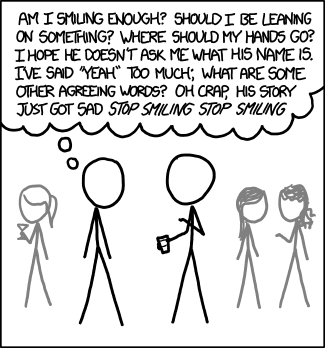
…this type of reasoning goes on all the time when I am forced to interact with other humans face-to-face:

A response to my post ‘Aspergers and Writing’

One of my most popular posts of all times is ‘Aspergers and Writing’, in which I explore some of the difficulties Aspies face when writing and, perhaps, some practical advice on how to improve this difficult-for-most-Aspies skill.

Over the years (yes, years…) since I have written it, it has received a lot of comments which update the post and keep it ‘fresh’.

Here is an example of a ‘conversation’ in the comments which shows how the comments people leave help others and keep the post relevant.

A reader called Riayn left this comment:

I’m an adult with Aspergers and what you have written rings very, very true.

As a child I had enormous problems with handwriting and had to undertake remedial handwriting classes. I never learnt how to form cursive handwriting that is legible. I even have problems signing my name that matches what I have signed on the back of my credit card as I can’t always form the letters properly. However, my printed handwriting, when I concentrate and take my time, is extremely neat.

When it comes to writing, I find there is a disconnect between my brain and the page. I know exactly what I want to say but I just can’t write it down. I blog to improve my writing abilities, but many of my posts sound fantastic in my head but come out completely different & inferior on the page.

I wish I could remove the mental block.


To this comment I replied:

I SO KNOW what you mean. I have found the same thing with my posts…

Though, I have found that if I write it – but not really finish, then I can’t get back into writing from where I stopped. Especially if I have had the chance to bounce the ideas off of someone else – to actually verbally ‘speak’ what it is I am trying to get across in the post.

Then, I find it easier to just start from the beginning again: complete different angle, and so on. The act of trying to write it, then saying it out loud (sometimes getting feedback – my poor family!), and then tackling it from a different angle seems to help me get more of my point across.

I also find it much easier to answer comments: then, it’s more like talking to a person, and it seems easier for me to type the words ‘naturally’ than if I am trying to compose a post. Perhaps that is connected to the fact we, Aspies, tend to be more verbally skilled than and less skilled at writing.

Have you tried recording yourself as you ‘speak’ your post – then transcribing it? I’ve been toying with the idea of, perhaps, doing a few of my blog posts by speaking them, instead of writing them down, just to see. Perhaps.

This exchange had been up in the comments for a while.

Then, a new reader named CD joined the conversation:

‘I’m an aspiring writer who has Asperger Syndrome. This post defines me to a “T”. 

I can spend three hours sitting down in front of a computer, trying to compose a story, with no results. 
Perfectionism is one deterrent. 
Another is over thinking. 
I don’t know what runs through other As minds, but I know my own. I over think things to death. The solution I incorporate is to write endlessly, uncontrollably, for a set time limit. 
For example: I could write “The smoke descended the stairs. Shawn was the only person who saw it. He wanted to warn people….” 
Well not my best but you get the idea. To write this simple sentence I’d begin like this: Smoke, grey, moves, stairs, horror, Shawn sees it, won’t talk, why, wants to…
Anything for an hour, like I said. Then I return a day later and piece the words together like a puzzle, trying to produce coherent meaning. 
My ideas are so insightful. I won’t allow AS to prevent me from expressing them in any damned form I see fit. My goal is to write
‘endlessly and uncontrollably’ until I complete an entire story, then return to fix it up.  After that, the process of general editing, which a normal person without As would’ve already completed, comes into play. 
Though this may be a daunting task, it has worked for me. 
Plus, taking care of your physical health is very important for an AS individual to hone and display his natural god given gifts. Just waking up everyday with AS and dealing with the world, not just writing, drains the persons health. 
Anyway, I hope this long post helped. I’d like a personal email telling me how I helped. If you find the time that is. I don’t check blogs very often. Guess I should get started creating my own blog,huh? 
Well that is another topic in and of itself. I’m rambling now so hope I was of some help.
Thanks.
CD’
I hope CD’s advice can help more people – which is why I am highligting it as a post in itself.  Thank you, CD.
And if you have found strategies which work for you, please, share them!!!  We need to try all the ideas we can get!!!