Asperger Syndrome and ‘religious belief’

Here, I would very much like to ask Aspies who consider themselves to be ‘theists’ (who believe in one or more deities) to describe the mechanics of their ‘belief’ as best as possible.  (Of course, I would like all Aspies to describe their mechanics of ‘belief’ – but theist ones in particular, because I suspect that Aspie theists are quite rare.)

Why?

I have as yet to meet one…

I do know many Aspies, most of whom have been raised in theist homes when they were children.  Yet, when I have discussed this whole topic of religion and belief, it has become clear to me that not one of them ‘believes’ in deities in the sense that neurotypicals who ‘believe’ do.  The closest to ‘belief’ these people have come is to choose to live as if this whole ‘God proposition’ were true in much the same way that people can accept that something ‘is true’ in the ‘universe of Star Trek’ and can then extrapolate ‘new ideas’ within that pre-defined frame.  Within these parameters, this is true…

But, of course, this does not really relate to reality…

I am not sure if I am explaining this in a way that non-Aspies will understand.

What I am trying to describe is akin to saying:  not that I agree with this, but let’s accept this to be true for the sake of this discussion…  I suspect that the Aspies who live as theists follow some version of this reasoning, which I understand is different from the ‘belief’ that most neurotypicals experienc.

Yes, I do understand that I am skirting the whole debate ‘what constitutes belief’  – but I hope that rather than focusing on the greater debate here, people will comment (so we can explore this discussion) on the difference between ‘religious belief’ as experienced by Aspies and non-Aspies.

Why do I think this is a topic worthy of discussion?

For the sake of the children, of course…  Let me explain.

I know that I am incapable of ‘belief’ in the traditional sense – at best, I view validity of ideas based on probabilities.  Even the ideas I hold as my ‘core views’, the ones I consider define me as me, even those ideas I cannot rate at 100% probability.

I have been this way from as far back as I can remember.  I could never understand why other children would behave as if things were ‘definite’ or ‘certain’, how they could be so sure of, well, anything…  They, on the other hand, thought that my constant qualifications of my position on anything meant I was setting things up so I could lie, or some other display of dishonesty…which, of course, was the exact opposite of what I was trying to do.  I have since learned, in most social interactions, to censor out the vast majority of the uncertainties and qualifications – yet my speech still contains much more of these than displayed in majority of neurotypicals’ conversations.

Back to ‘the children’:  I know many families where two non-Aspies have Aspie children, but I do not know of a single family where two Aspie parents would have any non-Aspie children, which is why the focus of this discussion is on Aspie children in non-Aspie households.

If I am correct in my observation that Aspies are physically incapable of ‘neurotypical belief’, what happens when theist parents are raising Aspie children?

What happens when Aspie children are sent to be educated in religious schools?

The demands made on Aspie children to ‘believe’ (in the neurotypical manner) in deities may be something these children are simply not physically capable of!

Of course, in theism, failure to ‘believe’ in just the right manner is interpreted as ‘sin’ and ‘heresy’ – a very bad thing.  Children who fail to ‘believe’ are considered defiant and disobedient, to be punished and broken until they ‘believe’.

I have observed a number of Aspie children in these situations.  In some Aspie children I have observed, this demand to ‘believe’ in a way they were physically incapable of had led to serious internal turmoil and led them to believe they were inherently bad people.  In others, it led to further withdrawal from social interactions, and in two cases I am aware of it led to serious childhood depression.  (Granted – other factors were there, but this was a big complication…)

So, we are talking about very serious effects here.

Last summer, an Aspie friend of my son joined us for our holidays:  it was his first time away from his family and his parents were thrilled that he got an opportunity to spend a week ‘with his own kind’ – in an all-Aspie household.  I think he had enjoyed himself, but there was one incident I was not certain of how to handle.

We holidayed up north, where the nature is pristine and light pollution is very low at night.  As we were going through a meteor shower, we spent one clear evening lying on our backs on the beach and watching the deep, velvety night sky bejeweled by millions of stars.  We saw some spectacular ‘shooting stars’ when our young (13) Aspie friend got quite upset:  he explained that watching the vastness of the universe in the night-time sky made him finally realize that there probably is no afterlife…

This inability to ‘believe’ – in spite of a desire to – is unpleasant in itself.  Adding to it parental and societal disapproval for ‘not believing’ – that can cause definite damage to a young person’s ability to grow up healthy and to their maximum potential.

Obviously, even though I probably know more Aspies than an average person does, my sample size is insufficient for anything more than ‘a hunch’…which is why I would welcome comments that might help us explore this issue together.
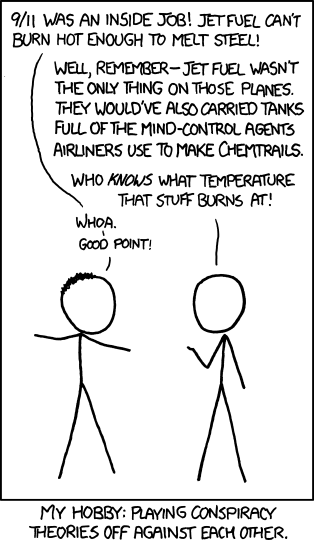
xkcd: ‘inside job’ was an inside job


Me too!

Conspiracy ‘theorists’ can be extremely entertaining.  I like to play with them.

P.S.  The word ‘theory’ in ‘conspiracy theory’ should always be in quotation marks:  let’s face it, a bunch of rantings do not a theory make!

Thoughts about ‘Anonymous’ and the #occupy protests

Why is ‘Anonymous’ so much on my ‘radar’ now?

Couple of reasons…

They are, well, enigmatic…  When a big company picks on little guys – and this appears on their radar – they kick but.  Their aims are altruistic – perhaps idealistic – at least for now.  And they are big-time fans of freedom of speech!

They are techies who are kicking some slick behinds – you have GOT to love that!  (OK, I am indulging in a bit of tribalism here – even if the ‘tribe’ is diffuse and I don’t know them personally. I suspect that most of the people behind Anonymous are Aspies or have strong Aspie tendencies:  they are, after all, techies.  And I like to think that I am rather good at playing ‘spot the Aspie’.  The rules they pick and the way they adhere to them:  very Aspie-like…)

We are still full of the #occupy news….and Anonymous was there first.  No, I don’t think that the majority of people who are there now are in any way connected to Anonymous, but, please, consider the following:

  • before anything happened, Anonymous announced the protests and said to look for them there, on Wall St.
  • when the occupation of Wall St. first started, there was an almost complete news blackout on it
  • Anonymous had hacked into some local CCTV cameras and streamed the signal – that was, at the very beginning, the ONLY coverage of the event
  • then, as time went on, the professional protesters and their media henchmen began to trickle in…and Anonymous disappeared from the picture…
  • now, the protests are creatures of the professional protesters and the big money behind them – including semi-official backing by the US President and his minions, with absolutely no role played by Anonymous (that I can discern)

It is not a coincidence that the vast majority of the people protesting in the #occupy movement have no idea what they want to accomplish with this protest:  it is not a ‘regular’ protest of the sort where people want to accomplish a specific goal, analyze the approaches to achieving this goal and then choose protesting as their tool.  Rather, I suspect, this may have been a bit of an experiment…

…an experiment to see IF Anonymous can harness the power of the professional protest organizers when they need to – and to get an idea of how it would play out.

…an experiment to see how ‘neurotypicals’ (non-techies/non-Aspies) would react and behave, to gage their intelligence, initiative and individuality – or lack thereof in this type of a situation.  How soon and how deeply would ‘mob mentallity’ set in?

…an experiment to see whether ‘if we build it, they will come’ would work with protests.

Recently, when an Islamist group doc-dropped/outed Thunderf00t and his family members and threatened them by urging ‘all Muslims to do their duty’ because he dares to criticize Islam (he criticizes all irrational belief systems – systematically and effectively), Thunderf00t dropped the name of Anonymous as his protectors….and potential avengers!

Which got me thinking:  this is not the first time Thunderf00t has talked about Anonymous in his videos.  So, I went back and looked through his earliest material.  Here it is:

Interesting, is it not?

But there is more here, here, here, here (note the Guy Fawkes mask in the background) and here.

Not just in what Thunderf00t says – and how he says it, but also in how fascinated Anonymous is by Scientology.  Remember how, a few years back, they tried to build some sort of a movement against that cult?  I wonder if this is an indication of their fascination in how brainwashed neurotypical behave in groups … or the source of this fascination.

Don’t get me wrong – I do not think Anonymous has bad intentions.  I rather suspect that they are attempting to figure out how to help neurotypicals help themselves from self-imposed servitude (if this was not a full fledged attempt of its own to get them to help themselves).

But experiments/projects can go wrong – and more people than just Anonymous are keenly watching this and taking notes.

Aspergers: the Guild – a fun Aspie show

Felicia Day, the creator of the online show The Guild, is a genius.

She herself has degrees in Mathematica and Music (which is really just one form of applied mathematics).  I do not know if she is an Aspie herself, but she certainly knows how to portray and entertain us!  I would recommend watching The Guild (which is in its 5th season) to anyone who is or loves an Aspie (or who has to interact with us and who would like to get more of an insight into our psyches).

The first season was strictly non-sponsored, made for YouTube.  It is so good and has such a following (I suspect that mostly among Aspies)

Here is the first episode of the first season:

Many parents of Aspie kids/teens have asked me if I think it is bad to let them have a lot of online time.  I do not.

To the contrary – I think online interactions are an exceptionally useful tools for Aspies (and parents of Aspies) to encourage social growth.

Let’s face it – Aspies mature differently from NT’s (neurotypicals – non-Aspies).  In some aspects, we are much more advanced than our NT peers and we find it quite offensive when NT adults treat us as idiots and simplify things to the point of error while talking to us.  On the other hand, we are much slower to mature socially – some of us find most social interactions with NTs quite disturbing.

Interaction over the internet is both simpler – the rules are simplified and usually explicitly stated – and more in our control:  if we feel a ‘melt down’ or if we want to leave the interaction for any reason, we can simply log off! That is an incredible ‘security blanket’ – being able to remove oneself from a stressful social situation rather than waiting for it to blow up.

When my younger son got a girlfriend (his first) in and MMO RPG, my older son was concerned that this might be wrong or inappropriate for his social development.  I explained that I disagreed – his brother was aware that the online persona might hide absolutely anyone, but he was having fun ‘trying out’ flirting in a completely safe environment.  When they eventually did ‘break up’, he did not ever have to log onto that particular site again.  Ever!

This avoided a lot of awkwardness.  Being in the same class/school with his ex and having to interact with her daily would have been extremely stressful and would have stifled his desire to interact with other humans.  Like this, it was a perfectly safe (and supervised!) interaction, where he got to practice his social flirting skills without the fear of consequences should he fail.

I see that as a win-win!

Aspeis need to know what their assignment actually is

Lately, I have neglected posting on the topic of Aspergers.  Still, judging by the relative traffic among my posts, there is a need for more information there:  both Aspies and educators are still looking for help.

Last December, I received the following comment:

I have an Aspie student, and when asked to produce 2 sentences about a topic in class, will just sit and think the entire period producing nothing… (I do believe that he is thinking about the topic). The topic has been given to student prior to class. Is this an unreasonable task? This is an 7th grade gifted autistic student.

I understand the perfectionism issue and that they may be unsure that it is good enough to put on paper, but in an educational setting I would like some suggestions to assist the regular Language Arts teacher. This is a graded assignment to be done in class.

Thanks in advance for any ideas you may have.

Deb Herr
Special Education Teacher

While I gave a quick reply at that time, this is a very important point which deserves a lot of attention.  So, I had attempted to write up a proper response.

It wasn’t right – so I edited t.

Then I fixed it up some.

Then t needed shortening down a bit.  So, I cut a bunch of stuff out.

Too much of the key ‘stuff’ was gone.  I started a re-write.  From scratch…

…and so on, and so on.

It is now October.  I have still not published the post – it is not ‘right’ yet!!!!

NO, I am NOT joking!

So, now, I will publish the draft I have, without re-reading it, with all the flaws, errors, sentence fragments and all – or I will NEVER publish this…

Here it goes:

Both my sons are in the gifted program.  One has gone through grade 7 several years ago, one is going to get there in not too distant a future – so, I am familiar with the level of development of a gifted Aspie of that age group.

Just to be sure, I asked my older son if he remembered being in that situation himself.  He did…and was in perfect agreement with me as to what thought-processes this student would be going through: trying to figure out what the assignment means!

Being in the gifted program means the student is smart.  By the time they get to grade 7, smart Aspies understand perfectly well that when a teacher asks for ‘any two sentences on a topic’, the absolutely last thing this means is any two sentences on a topic’!

Experience would have taught them that…by now.  And not in a nice way.

But, it would not have taught them what it is that the teacher/assignment does mean – or how to guess it….

So, I think it most likely that the student spent the time trying to figure out what the assignment actually was!  And, with so little information provided to the student, I really don’t see how anyone could figure it out!

Therefore, my answer is that yes, it is unreasonable an Aspie or an Autie gifted student, in grade 7, to complete an assignment of ‘writing 2 sentences on a given topic‘.

Reasons:

  • The assignment is non-specific.
  • The parameters are not defined.
  • The goals of the assignment are not known.
  • The expectations are unclear (or, in this case, clearly misrepresented).

BUT!!!

There IS a solution!

Aspies – and high-functioning Auties – are very good at meeting very specific goals.  I know that teachers are not used to approaching teaching this way, but, they would get WAY better results from this class of students if they were absolutely clear with them what the point of the assignment is, what the goal is, and what the evaluation criteria will be.

This worked for me – and my sons, as well as a few other kids I worked with:

First, we establish that in order to produce marks, teachers have to produce metrics:  marks which measure the student’s skill-set development in several areas.  This may seem like a game, but, because teachers have to work within such a large system, metrics were required.  And, these metrics are used to evaluate the student.

To an Aspie/Autie student, this can be an important revelation.  It is not an intuitive leap, to conclude this, because we usually believe what we are told – and from the earliest age, we are told that the point of school is to learn.  But, of course, it isn’t!  The point of school is to PROVE what we have learned… There is no place in school for ‘learning’ without proving (through earning marks) that/what one has learned.

Explaining that the point of doing assignments is to ‘earn points/marks’ can be liberating for an Aspie student.  After all, ‘getting on the high-score board’ is possible, even if one has not yet ‘defeated the boss’!

Once this groundwork has been laid, it is important to explain both the teacher’s goals for this assignment (what the teacher will be measuring for the needed metrics) and the student’s goals (what bits of what will earn points/marks).   This bit can be hard on teachers, because they have to explain both the explicit goals and the implied ones – most teachers do not go through this step explicitly themselves.

Yes – most assignments at the grade 7 level come with a ‘marking rubric’.  At least, in my area they do.  But these are so filled with vague notions and ‘weasel-words’ that they are worse than useless!  “The student demonstrated some understanding…. The student demonstrated good understanding…”  What the hell does THAT mean?

What is the difference between ‘little’ and ‘some’ and ‘good’ and ‘excellent’ in this context – and HOW is it measured?

Obviously, I can tell that ‘excellent’ will get a higher grade than ‘poor’ – but how do I know what demonstrates ‘excellent’ and what demonstrates ‘poor’ – or any of the other non-specific terms used – in this particular instance, to the satisfaction of this particular teacher?

If the teacher cannot stand there and provide a specific, accurate answer on how the grading will be done – how can the student be expected to guess what expectations to perform to?

This is so much easier for maths and sciences.  When a teacher assigns a problem, the student knows not just WHAT ‘the right answer is’ – she/he knows what form the answer is to take.

This is woefully not true of ‘soft’ subjects.  Not only do different teachers consider completely different ‘things’ to be ‘the right’ answer (try writing up interpretation of renaissance poetry for a ‘born-again’ teacher), the format itself is undefined….  Yet you are judged how your performance measures up to something the teacher cannot quantitatively define:  expectations!

It seems criminal that ‘educators’ are blind to this…

A most awesome letter from a parent of an Aspie

I am an Aspie.

I am married to an Aspie.

We have two sons – both of whom have been identified as Aspies.

Not surprisingly, I have some opinions about Asperger’s Syndrome and all the facets of life which affect Aspies.

Every now and then, I have written about the ‘Aspie experience’ and some of the tools I developed to help myself and my sons.  Judging from the bog stats, I really ought to focus more on this – aside from a few  posts (Aisha Ibrahim Dhuhulow and some of the sharia write-ups I’d posted).

Today, I got a most gratifying comment on a post I had written a while back about Aspergers and Writing.  I know, it is a serious self indulgence to wallow in praise, but, if refreshing the post with a new link to this fresh post helps more Aspies, I’m willing to take the flack!

Here is the comment:

I just found your blog.  Wow, wish I had seen this a long time ago.  It should be required reading for all special ed teachers.  My son was not diagnosed until the end of 10th grade (after failing English when previously a straight A student), and we have endured an often contentious relationship with the school’s special ed coordinator and the school psychologist during that time and since.  At the end of his 11th grade year we had the IEP meeting, during which the first one asked him, “can’t you just write something to get it done?”, and the latter called him a snob.  And this is a year down the road!!!  It’s clear that too many of the people that are supposed to be caring for our children in the public school environment are woefully undereducated, and  some also lack the empathy that the unfamiliar accuse the Aspies of not having.  We finally found a teacher in the school who undertstands Aspies (and who admitted privately that she cringed at those statements during the
meeting), and she is wonderful.  My question is why didn’t they allow us access to her last year, when my son had to be assisted by a special education “clerk,” who had no conception of his difficulties or abilites,  who badgered him with “do you want to fail?” comments, and who evidently never bothered to pick up a book and learn about it during that time.  I guarantee you, from my now huge Aspie book library, I know more about the condition than either of the people in that school that were allowed to make decisions about my son’s education, or the person that was directly working with him.  If they had read your post, which would take about 5 minutes, they would have understood.  I think you have explained exactly the problem from the Aspie side–I think this is what my son has been trying to explain to them for 2 years.  So, anyone else with problems with the school:  number one, don’t take it as long as I did, and don’t assume the people in charge will advocate for your child;
number two, print some information from this blog and give it to every teacher, the special ed department, and the principal.  You want to know a funny thing?  My son was one of about 15 kids in the county that was nominated for a National Merit Award due to his test scores on the PSAT (no writing portion, of course).  To apply for the award, the student must write an essay!!!!  He decided to write it about not being able to write essays due to the Asperger’s, and about his difficulties at school due to this.  Somehow I doubt he’ll win, but good for him.  Thanks for explaining something so difficult so well, and I appreciate the time it takes you, trust me!!!!

Aspergers and writing: ‘build’, not just ‘revise’

‘Everyone’ who is familiar with Aspies knows that most of us struggle with writing.

Not all of us – Aspergers affects each person a little differently and to a different degree.  And, it affects males and females a little differently, too.  Perhaps that is why my post  ‘Aspergers and writing’ continues to get so many hits.

Today, I got a comment on it which raises something important.  That is why I’m posting this comment – and my quick reply to it – as its own post here:

Your comments about perfectionism and the difficulty Aspies have in putting words to paper make me wonder if this is why it’s so difficult for Aspies to revise what they’ve written: that once they get something down on paper they have committed their ideas to writing and there is no other way to put it. As a writing teacher, I often run into a wall when I ask my Aspie students to revise and I wonder if you think this explanation is accurate.

My response was:

I think that you are on the right track. I would like to nuance it slightly, if I may.

There are several things going on.

It is not that the Aspie may not be able to think of different words to put things into: it may be true at some times, byt certainly not at others. For example, many Aspies are very verbal – and they can say things out loud in many, many different ways. As a matter of fact, you may have a hard time shutting them up – they’ll describe the same things in so many ways.

The problem comes whith ‘investing’ into writing the words down. They have been ‘selected’ and ‘sweated over’ – why do you want to change them?

This constant ‘revision’ most writing teachers insist is part of ‘proper writing’ reduces me to white-hot fury! It it’s worth writing down, it’s worth doing it RIGHT THE FIRST TIME!

Once an Aspie HAS written something down and you are asking them to ‘revise’ it – you are asking them to take something that is ‘right’ and change it….obviously, if you take something that is ‘right’ and change it, you make it ‘wrong’! Then, when they hand in the version you forced them to change from ‘right’ to ‘wrong’, you give them a bad mark…

No wonder we don’t want to ‘revise’!

OK – that was the ‘emotional’ response.

Now, for more ‘reasoning’….

There is a problem – an actual physical problem in the neural connections – in the brain which makes it difficult for MOST (not all – we are all individuals), especially male, Aspies to write. Physically write.

Forcing us to ‘write’ and endlessly re-write the same sentences over and over is mental torture to us. It rubs our noses in our failure. So, we avoid it like the plague. If it’s a computer file, we’ll be less freaked out by it. But asking us to hand-copy out the same bits over because other bits had changed is unreasonable.

I actually can tell – byt the style of writning – if something I ‘produced’ was first spoken and then trans-scribed/typed into the computer, or if I wrote it on a piece of paper in longhand and then typed it into the computer, or if I directly typed it into the computer. Honestly, my sentence structure and syntax are significantly different in each one of these styles of ‘writing’. Perhaps you could experiment with your students on this theme….

But!

This is the way I helped my kids ‘get over’ the whole ‘revision aversion’ (I could not very well undermine the teacher, right?).

I explain that the teacher is trying to teach them how to build a piece of writing ‘from the ground up’. It is a particular methodology to teach, and marks are awarded at each stage: sort of like when you learn to swim, they first teach you to put your face in the water and only later want to see you perform the full butterfly stroke…

So – first ‘version’ is NOT supposed to be ‘a written story’ or ‘a written essay’.

Instead, organize your thoughts and put 1-2 words for each paragraph: enough to ‘record’ the ‘main idea’ or ‘main thrust’ of what this will say. This will be handed in as ‘brainstorming’ – teacher needs to get it to keep a record of it, so they can prove what they gave you the marks for if someone audits their work.

On the next ‘version’, you go to each one of the paragraphs and put in 1-2 words for each sentence you will write in the finished piece. Check that each paragraph still has the same ‘focus’ as the ‘brainstorming’. This will be first draft – again, marks, teacher keeps for records…

In between each step, take the teacher’s feedback and incorporate it in – again, this needs to show up. It’s the teacher’s job to give you feedback, so it’s important for the records they keep to reflect it. If you don’t, they’ll think they are not teaching you right, be sad, not like your work….pick your sentiment.

On the next ‘version’, you write BARE sentences for the 1-2 word things. Make sure all ideas are there, but not really all the descriptions, and not nicely or fancily. You’re hitting the highlights. That is the next draft.

Finally, you take your draft and connect up things, dress up the sentences, and so on.

It’s a method of constructing something. Teachers must document they taught it to you.

This way, you’ll show how you built the written piece. It’s not so much ‘revision’ or ‘revising’ it – that is a very poor label for this. But, that is the label we are stuck with.

Does this help explain the thought process?

CanGames weekend is here!!!

Yes!

THE event of the year is upon us:  CanGames 2010 is ON!

I originally came across it in a somewhat unusual way…

When we first began to look for ways to help my older son (as Aspie as the rest of us) develop the tools to integrate into the greater society, we found Warhammer – the Fantasy version.

The game itself has been described as being ‘like chess, but with 100x more complex rules and no helpful grid on the play area’.  Oh – and you have to select and build/paint your own playing pieces…

We got into it as our son was interested in strategy games, and the whole building/painting of his entire ‘army’ was excellent physical therapy for his co-ordination.  He did it because he wanted the result…. I helped and got hooked on the ‘making/painting’ bit.  Years later, I still make a 1-3 pieces a year (by request only) for some collectors…

Building that first army was really fun:  I even bought a set of (much cheaper) plastic soldiers and ‘his own paints’ for my younger son:  while my older one and I worked to build his ‘army’, I would put a garbage bag over the tray of the high chair, sit my younger one in it beside me (he was the right age for it and loved his high chair), and he would ‘paint’ his very own army, too!  (Yes, I still have most of it…having been cautioned by several of the people at CanGames that once he grows up, he’ll treasure ‘his first army’!)

THE single biggest Warhammer tournament in our area was (and is) at CanGames.

That is how I first learned about it – and that is why I first went there.

My son – even though a kid (so I had to be along to supervise) – entered the all-day-long Warhammer Tournament.  My goal was simple:  to use this game to helpmy seriously Aspie son…. to use this rules-based environment to learn social skills necessary for him to integrate into society.  Like, say, not having a ‘meltdown’ if he does not win (no shame for a ‘starter’ kid to loose to ‘expert adults’ – so, knowing this ahead of time, learning that ‘loosing to the best-of-the-best’ is ‘the expectation’ and no reason for tears).

And, I must admit, the whole event outdid our expectations!

Not only did various people ‘take him under their wing’, and not only was this the main place where he learned ‘good sportsmanship’ from the example of many excellent people who were not only ‘not threatened’ by having points scored against them by a ‘kid’, but by positively delighting in his successes, congratulating him on ‘excellent moves’ as they occurred, they successfully taught him ‘sportsmanship’:  how to be both ‘a good looser’ and ‘a gracious winner’!

It worked.  Now, my older son is much in demand to ‘run gaming events’ – bot for kids and for adults.  He is regarded as having excellent sportsmanship, he appreciates – and praises – excellent moves, no matter who makes them, even against him, he is often called upon to referee disputes (he reads the rules once and know them for ever – and applies them fairly and in an unbiased way)….  Yes, I would like to take the credit for myself, but, I know a parent can only be an example so far…  It was the example of many excellent ‘expert’ gamers whom he admired at CanGames which deserves the credit!

I must admit that  my son has not been entering the Warhammer Fantasy tournaments at CanGames in the last few years.  Still, this is not a criticism of the tournament itself!  It is most excellent!

Rather, he has succumbed to curiosity…  There are SO MANY other games offered that he cannot bring himself to spend a whole day in a single tournament, when he could be learning so many new games!  After all, CanGames only runs Friday night, Saturday and Sunday…

Saturday morning, CanGames has a special program for kids.  Having watched his older brother eagerly await CanGames much as Sheldon Cooper awaits the annual Comic-Con, he was eager to join in the Saturday morning games (especially the Nintendo64 Mario-brothers-themed ones).

One year, one of his opponents was an Autistic girl – much more Autistic than my son was Aspie, if you get my drift.  The Autie’s therapist/supervisor explained to me that playing these types of games was ‘the only effective way’ her charge would socialize:  and meeting her and playing against her in the game helped my young Aspie son realize that there were others, with much more to overcome than he had… and showing that deep down, we are all a lot more similar than our ‘external-expression’ might suggest!

Now that he is older, my younger one plans to participate as fully at CanGames as his older brother does!

And, yes – I will be along!

To supervise and help, of course.  But also to have fun on my own!  Seeing the same people, once a year, is really neat in a weird sort-of way.  You can watch young people grow and develop, see familiar faces, talk to people who can out-strategize you any time they wish…  Oh, yes – and you can match your mind against some really, really awesome strategists (yeah – the political strategists ought to sit-up and take note – they could certainly use the training!)

Like I said: fun!

Autism Registry: a pilot project by Ottawa Police

If you read my blog, you are probably aware that I have a strong interest in Asperger’s Sydrome:  I am an Aspie, I am married to an Aspie, both my children are Aspies, most of my friends are, if not full-Aspies, at least ‘almost-Aspies.

Hence the interest.

Or, perhaps, obsession…

While I like to explain that Asperger’s is to Autism like ‘wearing glasses’ is to ‘being blind’, it is an Autism spectrum disorder, there is some overlap (OK – I’d have to  go on a tangent to explain this ‘right’:  let it suffice (for here) that both Autism and Asperger’s have the same ‘thing’ which affects how the brain is wired ‘differently’, but the difference is that each affects a different bit of the brain….some people have a bit of ‘re-wiring’ in both areas – thus, the overlap).  So, I am always paying attention when I hear about both…

So, I was quite interested when I heard that the Ottawa Police were doing some sort of a pilot project to do with interacting with members of our community who are Autistic or have Asperger’s Syndrome.  Thanks go to my favourite Ottawa City Councillor, Eli El-Chantiry, for getting me in touch with the people running the pilot project.

It looks excellent!

This – in a nutshell – is what it is about…

When a call comes in to the ‘911’ emergency service, the operator pulls up the info on the address where the call is coming from:

  • the address
  • map
  • other relevant info (like the much reviled gun registry, and so on)

A person who looks after an Autie or an Aspie (or the Autie/Aspie themselves) can register in this program.  When they do this, the ‘relevant information’ will include some information about the Autie/Aspie that lives there.

This can save lives!

The information can be, say, there is a small Autistic boy who fears loud noises.  If there is a fire alarm, he is likely to hide under the bed or in the closet.  Only answers to ‘Xxx’ nickname….  Touching him makes him panic.

Or, it can say something like ‘this is a group home for adult Auties.  These are their names, this is how they react to being agitated,’ and so on.

Information is power.

When emergency responders are walking into a situation where they know they will encounter a person who is not fully functional – and, the stress of emergency situations does often push ‘partially functional’ people (especially kids) into a non-functional state – they will be able to do their job better.

This Autism Registry pilot program harnesses the power of information into better helping vulnerable people in emergency situations.  Into saving live.

I liked what I learned about the program so much, I offered to help out as best I can.  And, perhaps, there may be a tiny role I can play.

One way I – and you – can help is to ‘spread the word’!

If you know someone in the City of Ottawa who would benefit from registering – tell them.

If you live outside of Ottawa, tell your police department to check out this pilot project in Ottawa.  The model is highly portable – perhaps your community would benefit from something similar!

ADD, Aspergers and the ‘cannot-put-weight-on-foot’ syndrome

This is not a ‘medical theory’ or even an ‘expert hypothesis’,  just my own thoughts and ideas.  Still, I do suspect that ADD/ADHD and Asperges are both a type of ‘cannot-put-weight-on-foot’ syndrome:

Let us do a ‘thought experiment’…

You come to see your doctor because you can’t put any weight on one of your feet, and you want your doctors to help you. They run their ‘standard tests’ and diagnoses you with ‘cannot-put-weight-on-foot’ (CPWOF) syndrome.   You are told that predicting the success of the treatment is difficult, because different approaches work for different people.
Some people are lucky and the CPWOF syndrome goes away on its own – they ‘grow out of it’. For others, there is a variety of treatments they can try, hoping one will work.

They can try icing it – perhaps even using a brace to support it.

They might try hot baths in salty water, perhaps rubbing in some antibiotic ointment.

Some people respond well to pain medication. Or, anti-inflammatory drugs…

Or other ‘stuff’.

Or nothing.

So, let’s try cycling through the treatments!

By now, you may have guessed that the ‘standard tests’ are questionnaires to be filled out by your family, perhaps teachers, for their observations of how you walk. Pages and pages of questions like:

Does he favour his foot: all the time, most of the time, some of the time, a little bit of the time, never. Circle the answer that fits best….

If they want ‘hard metrics’ – you know, ‘scientific data’ – they may ask you to put your foot on a scale and put as much of your weight on it as you can manage. That will give them ‘a hard number’ to work with!

Of course, this diagnosis does not differentiate between the ’causes’ of CPWOF syndrome.   The syndrome itself is so fascinating, they want to take a ‘whole-istic’ (chuckle at their own little joke) approach to it and not get bogged down in the details of ’causes’. (Translation: they don’t know and don’t care.  They have a ‘name’ for it and a bunch of treatments to try, and that’s enough…)

To make a long story short – whether you cannot put weight on your foot because you sprained your ankle or broke your femur or got a rusty nail stuck in your heel – or, if your foot got eaten by some piranhas that somehow got lost and ended up in your bathtub while you were soaking in it – it does not matter. You have ‘cannot-put-weight-on-foot’ syndrome!

(I also secretly suspect that many immune system diseases and disorders, limbic system illnesses and brain chemistry imbalances are also one form of CPWOF syndrome or another…a ‘label’ hung onto a collection of ‘similar’ symptoms, regardless of their root causes.  I also suspect that this interferes with proper analysis of ‘problems’ where one set of root causes can present as a very diverse variety of external symptoms.  This then would, I suspect, prevent correct diagnosis and even preclude a search for any effective treatment…)

In other words, I think that diagnosing someone with ‘ADD’ or ‘Aspergers’ is like diagnosing them with a ‘headache’ – and treating all headaches as if they were ‘the same thing’, regardless of whether it is caused by migranes, having been hit in the head by a baseball, a tumour or having over-indulged in alcohol…or any other billion possible causes for a ‘headache’.

So, what is it that this ‘headache’, this CPWOF of Aspergers and ADD/ADHD is? Instead of ‘not being able to put weight on foot’, we  have ‘malfunctioning filters’.  But, I am getting ahead of myself…

In order to be diagnosed with Aspergers, one has to first be diagnosed with ADD/ADHD. As in, everyone who has Aspergers has ADD/ADHD, but not everyone who has ADD/ADHD has Aspergers.  Therefore, it seems reasonable to see if there ‘is’ some ‘common mechanism’ to both conditions which differs from ‘the norm’.

This, then, is my hypothesis:

Both disorders/conditions could be caused by a break-down/partial development/some interference with the same ‘system’ in our brain and which could be described as: fewer ‘filters’, less conscious control over ‘filters’.

The difference is that in ADD/ADHD, only the sensory filters are broken. In Aspergers, these also don’t work, but, there are others that are also broken. And this is what leads to more pervasive disorders, problems, challenges – whatever you want to call them.

What do I mean by ‘sensory filters’?

One simple experiment that just about everyone I know has tried in one form or another is the whole putting one hand into cold water, the other into warm water. At first, we will have strong sensations that one hand is ‘cold’ and the other is ‘hot’. But, as time goes on, this will be less and less – the signal will diminish in strength over time, until we will ‘get used to’ the temperatures. Then, when we take our hands out of the water and touch them to each other, we’ll be amazed at the temperature difference between them when our brain is telling us both are ‘fine’….

That is an example of ‘sensory filters’ at work.

More simple examples:

We feel ‘clothing’ as we got dressed – but we are not consciously aware of every bit of clothing touching every bit of our skin at all times while we are wearing the clothes.

We may hear the furnace/air conditioner is on when we enter a room, but, after being in it for a while, we hardly notice its noise in the background…

People often over-apply perfume, because after they have been wearing it for a while, they do not smell it as much and keep re-applying more and more, increasing the ‘dose’ in order to get the same level of sensory input reporting it.

This is how our ‘filters’ ought to function. And, most ‘normal’ or ‘neurotypical’ people have lots of these ‘filters’, in various strengths.

In ADD/ADHD people, it is as if there were way fewer of these ‘filters’. Instead of, say, 100 (from weakest to strongest), we might have 20.

Or 3.

Or just 2:   100% ‘on’ and 100% ‘off’!

(Not all people with ADD/ADHD will have ALL their filters broken.  Some individuals may have ‘fewer’ filters in one specific area, others may have fewer ‘across the board’.  And, for some, it seems as if the ‘filters’ existed – but were only accessible at some times while totally off-line and unavailable at other times….which would drive their teachers and parents absolutely nuts about ‘inconsistencies in behaviour’! )

So, if the filter were 100% ‘on’, people might be calling your name, the fire alarm might be on, but, since you are reading a book and the rest of your ‘filters’ is ‘100% on’, you honestly do not hear any of it.

The ‘neat’ thing – the one that made me think of this as ‘filters’ rather than anything else – is that you actually DO perceive the sounds physically. It’s just that the brain sticks the information that you perceived the sound into a ‘buffer’ – and leaves it there unless you specifically try to retrieve it. Then it is a toss up as to whether the buffer has been ‘wiped’ or whether you can access the info held in it.

My younger son, for example, would not react to sounds as an infant – sometimes. Not even the ‘flinch’ which babies are supposed to have (say, when we are getting to 8 months of age and so on) when a loud sound happens directly behind them. He had absolutely no reaction. Yet at other times he obviously found even moderate sounds painfully loud…

Now, when he does not respond to what I say – not even aware of me talking to him – and I get his attention, I can ask him ‘what did I say’. He says he doesn’t know. I ask him to’ re-play it’. He does. He can repeat it word per word perfectly.

Only after he repeats it does he comprehend it!

Weird, but true.

My husband has the same thing…..as does my dad.

With Aspergers, these same malfunctions with ‘filters’ – or, perhaps ‘missing filters’ also exist. But, rather than just sensory ones (that drive one to distraction at one point while make them oblivious to their surroundings the next moment), the filters on feelings and emotions and – hormones – are similarly not all there, or broken, or whatever.  (And, having problems with ‘both sets’ it is sometimes difficult to tell where the dividing line ‘ought to lie’…)

So, it is easy for Aspies to get ‘overwhelmed’ by emotion and adrenalin, because where a neurotypical (NT) person would feel a gradual rise in these, we don’t. The floodgates are either down – and we ‘appear cold, unfeeling and un-empathetic’ or they are all the way up and we are ‘out of control’.  Total meltdown.

Many of us learn to develop various ways of ‘shutting down’ as a self-protection from this overwhelming flood….because this flood is often accompanied with adrenalin flood (we panic from being emotionally overwhelmed, which releases the adrenalin…).

This is bad.

Not only does it shut down our brain functions like, say, thinking, it also leaves us physically ill from the overpowering adrenalin rush. We get clammy and shaky and icky inside and out.

And most Aspies really, really, really do not like this feeling.  A lot.

What many people don’t understand is that  it is not just ‘negative’ stuff that can trigger this reaction.  ‘Positive’ emotions and feelings are just as dangerous to Aspies and their end-result is just as unpleasant and uncomfortable – at times quite painful, physically!

So, as we grow up and try to cope with this world (!),  we try to learn how to avoid ’emotionality’, even on a sub-conscious level.

If you know people with ADD/ADHD and/or Aspergers – or if you happen to be one yourself – please, try to see your experiences through the prism of my little hypothesis.  Then, whether it ‘makes sense’ or not – or any other observations you might have about this, please, let me know through the comments.  Pooling our observations and analysis might, perhaps, help us help each other!

(Cross-posted at Xanthippa on Aspergers)