


Criss says it all:
The petition is here.
Yet again, a few ‘spokespeople’ claiming to represent a rich (in human qualities – not wealth!) and diverse community have done a great disservice to themselves and all the people they claim to speak for. In one moment, they have erased the individuality of the members of their group, and chosen to cast them all in the role of extremists… all in the role of victims. (I will not identify this specific incident until later on in the post, because it is essential that I explain my disgust with the behaviour in general, before focusing on the specific.)
This happens so often, and in so varied groups, one could perhaps argue that it is one of the defining attributes of humanity. This one, however, is as unhelpful and counterproductive as it is predictable.
Why?
Well, first, let’s consider who usually ‘speaks for a group’ – as an unofficial spokesperson:
Let’s consider them, one at a time:
1. A professional communicator, who understands how to get their message across
Professional communicators are usually professionals, who cost a lot of money. Therefore, they tend to be ‘official’ spokespeople, not ‘unofficial ones’ when it comes to ‘unorganized groups’. Still, some sub-groups – which might wish to manipulate the rest of the ‘group’, might choose to hire professional communicators. However, the message these professionals deliver is not in the interest of the larger group, but instead only serves whatever the purposes of the sub-group that hired it. In other words, if the spokesperson IS a professional communicator, one must ask who hired him, and to what purpose.
2. A wise and respected person, who has the full backing of the ‘group’
Well – these are usually called ‘official spokespeople’ – on the grounds that they actually have the ‘backing of the whole group’. So, by definition, unofficial spokespeople do not fall into category #2.
3. A moderate, who gets along with everyone, whether members of ‘the group’ or other people, and works hard to make sure everyone understands all points, so there is no chance for a slight to arise from a misunderstanding
Well, again, not likely. Moderates usually do not have the desire – or feel the need to – speak out. It is enough for them to be secure in who they are, because they know that real bigotry is the problem of the bigot and perceived bigotry is not worth bothering with. There is, of course, an exception to this: when even the moderates within the group feel threatened, they will speak out.
However, that is not the situation I am attempting to address here: it is an essential distinction! When the whole of a group is truly threatened, then it is essential that the moderates are the ones who speak out. So, how do we tell the situations apart? It has been my experience that when moderates speak out, they speak for themselves – and they clearly state that they have no pretentions of speaking for everyone else. They will share their experiences – and only by listening to their stories will one realize that it is not just this one individual who is affected, but other members of the community, too. When people speak up and, before they even get to tell you what happened to them, personally, they start out by saying that ‘the group’ as a whole is being threatened, when they begin by claiming that they speak for ‘everyone’ – without having an ‘official spokesperson’ status – then, in my never-humble-opinion, one is justified in suspecting a manipulation.
Which kind of brings me to #4: An extremist and/or someone who wants to manipulate people within the group into feeling like they are ‘under attack’ in order to gain some amount of manipulative control over them ….
Ah, yes…I think I’ve made this point already.
Please, judge for yourself if in this instance, we are dealing with #1, 2, 3 or 4:
An MP (Member of Parliament) sent (several versions of) a brochure to his constituents, now that the Human Rights Tribunal has ruled that Section 13(1) of our Human Rights Code conravenes the Canadian Constitution. In that brochure, the MP criticized ‘radical Muslim voices’ who, in many peoples’ opinions, abused this section of the HR code.
The key word here is ‘RADICAL’!
He did not criticize Muslims, or even the majority of Muslims, or any such thing. He clearly (and, if the reports are accurate, unequivocally) specified that it was the extremists whom he was referring to.
This did not stop ‘unofficial spokespeople’ (though some claim to be official, since there is no external, universally accepted authority structure in Islam, it is not possible to actually have an ‘official spokesperson for all Muslims’ – by the very tenets of Islam!) from claiming that this MP had attacked ALL Muslim people!
Take note: this is an important distinction!
The MP specified he was referring to a few extremist voices only.
The ‘spokespeople’ claimed he had maligned ALL Muslims!
Even a cursory application of logic makes it clear that these ‘spokespeople‘ are making the extravagant patently false claim that ALL MUSLIMS ARE EXTREMISTS!
I’m sorry, but I do not believe that for a moment!
More than just ‘believe’ – I KNOW it is not true! One of my favourite cousins is a Muslima – and she is certainly not an extremist! She is a wonderful person – I wish more people were like she is, because then more of us would get along without all these manipulations and ‘stuff’!
These self-appointed loudmoths do NOT speak for her! I know, because I asked her. THEY did NOT!
And, I want those ‘spokespeople’ to be found and dragged in front of the whole world community to answer for their slanderous misrepresentation of many, many excellent Canadians!
It is THEY who is spreading hate and division and discord among us!
It is high time they were held responsible for their evil deeds!
H/T: Blazing Catfur whose site now includes the brochres which triggered this ‘outrage’.
Connie at FreeDominion has 6 pdf’s of the brochures.
P.S.: If you would like to say a few supportive words to the MP, his address is Anders.R@parl.gc.ca
The story of Aisha Ibrahim Duhuhulow – the child who was stoned for the crime of being raped – has really touched me.
The young girl grew up under one application of Sharia, where ‘justice’ meant that rapists are caught and punished. However, her local Mosque had come under ‘new management’: the ‘elders’ (Islamic scholars) who now controlled it applied Sharia very, very differently. Admitting to having been raped was interpreted by them as admitting to having had sexual intercourse outside of marriage, which is punishable by stoning. And, while stoning her, the cleric, Sheik Hayakallah, continued to praise ‘sister Aisha’ for ‘wanting Sharia and its punishment to apply’!
And THIS is why Sharia – even if it were fully compatible with ‘Western’ laws and principles (which it is not) – is UNACCEPTABLE !!!
This ‘Islamic Law’ and its applications are not consistent: the local Islamic leader has the authority to interpret it in any way he deems to be correct! (This does not even take into consideration that there is no consensus as to what training (if any) a person requires in order to be an Imam or an ‘Islamic scholar’. Currently, any man who considers himself to be knowledgeable of the Koran and the Sunnah can declare himself to be an Islamic scholar and act as an Imam.)
Thus, a simple change of Imams at a Mosque could completely change the rules under which are ‘the laws’ which govern every aspect of public and private behaviour in the local community. And, the people might remain completely unaware how the changed interpretation of Sharia will be meted out: unaware, that is, until someone like Aisha gets stoned for having been raped!
THAT, in my never-humble-opinion, is a big problem!
As for Aisha, not only was her story criminally mis-reported (at first), she herself has remained faceless: no amount of Googling has revealed any pictures online of the unfortunate girl. (If you find one – please, let me know!)
Since I could not find a picture of her, I decided to paint one… this is my impression of ‘Aisha’:
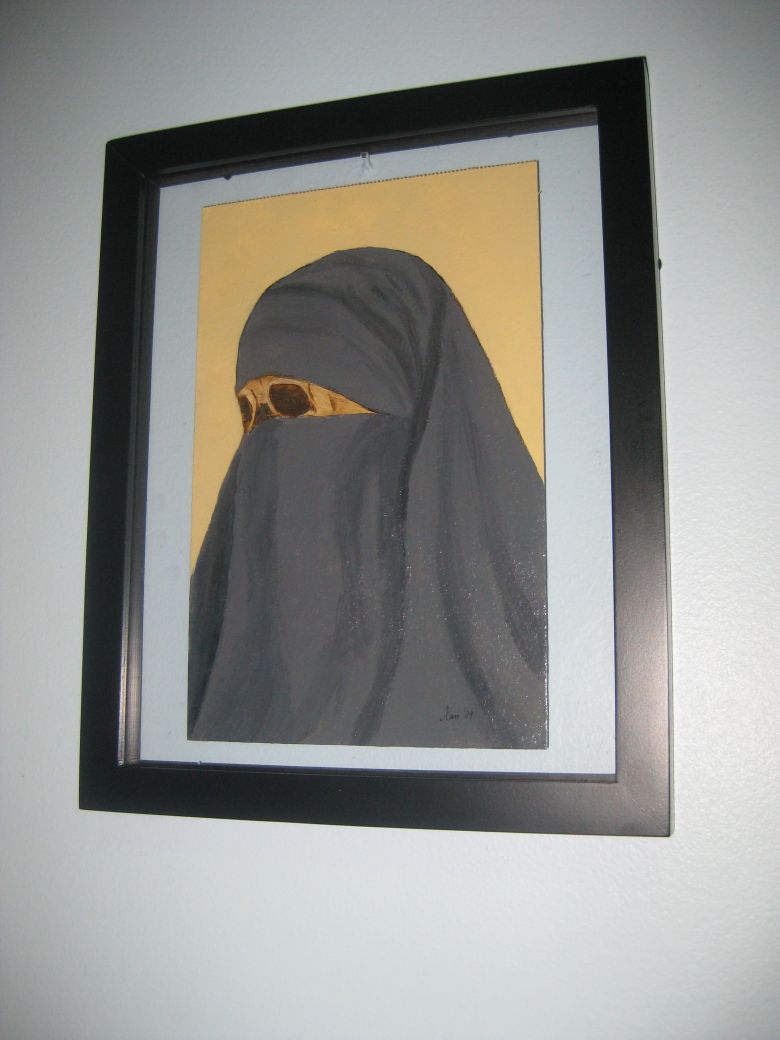
Then, someone posted this comment about Aisha:
WHITE FLOWERS FOR AISHA
I could not sleep for days after reading about Aisha’s tragedy. I would have wanted to bring flowers to her grave, but there was no grave to be reached. I felt so powerless!
But then I got the idea that we should all try and create a wave of sweetness and kindness in the love of Aisha, all over the world. May her death not have been in vain. Let us transform it into a stimulus to spread lovingkindness.
I decided to buy a bunch of white flowers and offer one of them, together with a 5 dollar bill and a piece of candy,to every homeless person I woud find at the railway station,
mentioning Aisha’s name and sending her a blessing every time.
I also made an offer to Amnesty international to honor her name.
Let us all do something, let us create a wave of white flowers and of kind actions so as to try and counterbalance the horror of her death. And let us pray for her, telling her we all love her.
Ilaria
Yes! WHITE FLOWERS FOR AISHA!
What a beautiful idea: the innocent blossom, plucked before her time!
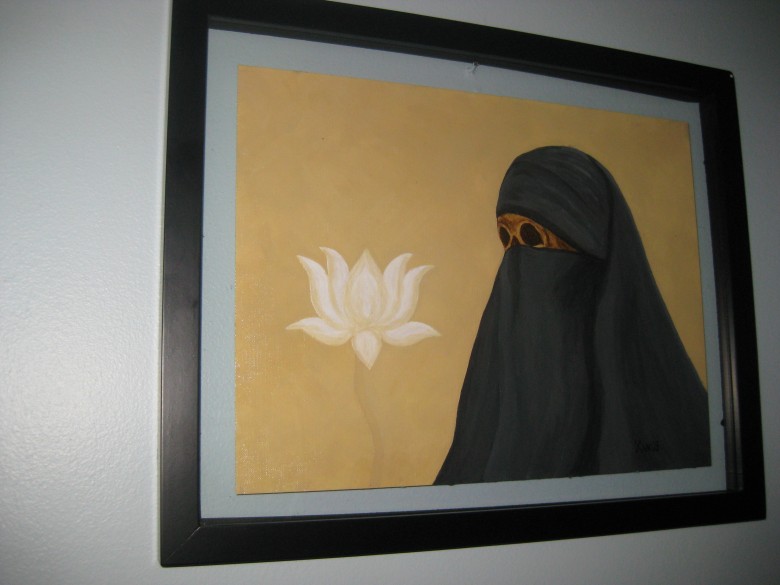
White Flowers for Aisha
This is my take on ‘White Flowers for Aisha‘! What is yours?


My first law of human-dynamics is: if a law can be abused, it will!
That is why every law must be examined very, very carefully; all the ways it can be perverted and abused must be considered and weighed. This should – preferebly – be done before such a law is accepted and before it becomes the norm in a society.
Sharia is based on the Koran and the Sunnah (the ways of the Prophet Muhammad). It governs every aspect of a person’s life. Here is the definition of Sharia from the Islamic Dictionary:
“Way to the water.” The “way” of Islam in accord with the Qur’an and Sunna, ijma’ and qiyas. Sharia is the law of Islam. It is based on the teachings of the Qur’an and the Sunna, though there are many sources outside these two, such as Arab Bedouin law, commercial law from Mecca, and the law of some conquered nations such as Roman and Jewish law. The Sharia extends beyond what Westerners consider law. It covers the totality of religious, political, social, including private life and makes no distinction between sin and law.
While there are several ‘schools’ of Sharia, they all have the same roots and tend to be considered complementary of each other, rather than in opposition to each other. And, they are in agreement on many of the most fundamental rules of human behaviour and social organization.
One thing that is troubling about ‘Sharia Courts’ is that there is no formal differentiation between these various legal interpretations of the Islamic laws: rather, it is the leadership of the local Mosque which determines what ‘school’ of Sharia applies to the congregation. If a change occurs in the leadership (or ‘elders’) in the Mosque, the legal standards are automatically changed, without any notice being given to the populace.
It is my conviction that Aisha Ibrahim Dhuhulow was a victim of such a change. She grew up under the interpretation of Sharia where rapists were caught and punished. That is why, after this 13-year-old child was raped, she went to her local officials and ‘demanded that justice be done’. Unbeknown to her, her town Mosque was recently taken over by officials who subscribed to the most extreme form of Sharia, where the rape victim is stoned to death for adultery. That explains why she kept begging for her life and calling for help, while the officials who sentenced her to death praised her for ‘demanding that justice according to Sharia be done’…
Both courses of action are possible under different schools of Sharia! How was the child to know that things could change THAT drastically?!?!?
Which brings me back to my original statement: if a law can be abused, it will!
Now, I would like to ask you to consider the rules which govern marriage under Sharia: I have posted some of the major rules here and here. And, human nature being what it is, I would like you to consider the most twisted possible interpretation of these rules which will not be breaking the letter of the rules. Because, sooner or later, that is exactly how every law will be applied. (The background information is in my two earlier posts on this, linked at the beginning of this post).
The example of Muhammad, the Prophet:
‘Age of consent’ in the Koran:
‘Bride Price’
Hmmm… is it really that difficult to see how this can be (and is) exploited for prostituting children?
In Part 1 of ‘Marriage under Sharia’, I explained the types of marriages which Sharia (Islamic law) permits: Nikah (‘permanent’ marriage), Nikah Mut’ah (temporary marriage) and Nikah Misyar (traveler’s marriage). I also explained the Mahr – the ‘marriage present’ or ‘bride price’ which is paid by the groom at the time of the marriage.
Here, I would like to look at who is and is not eligible to enter into a marriage contract well as the rules of divorce under Sharia.
3. Islamic Divorce (Koran, Chapter 65)
In Islam, divorce is not considered sinful, as it is in some forms of Christianity. To the contrary, it is perfectly acceptable and there are very specific rules under Sharia which regulate it: both the husband and the wife (through her guardian) can request a divorce.
In practice, it is much easier for the husband to obtain divorce than it is for the wife, as in some schools of Sharia, women are sometimes not allowed to address the court (and thus request divorce) without her husband accompanying her there. Other times, women may be allowed to go to court, but a a male relative intervene on their behalf or the divorce will not be granted against the husband’s wishes (this may be difficult, as in many cases, the husband is in full control of whom the wife may or may not contact – including her relatives). There are even cases where young married women are told they are too young to request a divorce: to come back when they ‘reach maturity’!
The wife must observe a ‘waiting period’ (iddah) of three menstrual cycles following the divorce, to see if pregnancy resulted from the marriage. (The ‘waiting period’ for a widow is 3 lunar months and 10 days.)
Special Case 1: Pregnancy
If the marriage resulted in pregnancy, the husband must support the wife for the duration of the pregnancy. Once the child is born, it is the father’s choice to either take custody of the infant right away, or to continue to support the mother (ex wife) while she nurses the child. Once the child is weaned (or a specific time period set by the father is up), the child will be handed over to the father and his obligations toward the mother will end. (This will also end any claim – legal (guardianship) or moral – that the mother has towards the child, including visitation rights.)
Special Case 2: Infertile wives
There is a special provision in Koran for divorce from women who are not fertile, because they are either too old or too young to have their ‘monthly courses’. Their ‘waiting period’ cannot be ‘three monthly courses’ – because they do not have them. Therefore, their ‘waiting period) is set at 3 months.
Special Case 3: Unconsummated Marriage
If the marriage has never been consummated (and this ‘consummation’ is up to the will of the husband – he has up to 1 lunar year to ‘consummate’ the marriage from the date of the marriage contract), the ‘waiting period’ following divorce is cut down to 1 lunar month.
4. Who may marry whom
There are very, very specific rules over who is – and who is not – allowed to marry whom.
A man may marry any female except those who are
In addition, a woman may never marry any man who is not a Muslim, because it is not permissible for a non-Muslim to be the ‘superior to’/’in the position of power over’ (in business, politics – or marriage, where the husband is the superior of the wife) a Muslim.
A man may re-marry his ex-wife, provided she had been married to another man in between the marriages to him.
In order to get married, the terms of the marriage must be negotiated by the groom and the bride’s guardian. The bride must then formally consent to the marriage – silence is considered to be ‘consent’. In practice, this ‘consent’ is often forced by threats – and if the bride refuses, the alternative is ‘honour killing’ or the ‘ever-growing-in-popularity’ honour suicide!
Islam does NOT set any age limits on the age of the bride or groom.
However, the Koran states that onlywomen are to be veiled: men and children (including female children, before they are ‘ready for marriage’). It is up to the father to decide when his daughter is ready for marriage. When he judges that she is available for an Islamic marriage, he signals that fact to the community by having her wear the veil (hijab) in public.
(If you take nothing else away from this post, please, understand this: when we see little girls, as young as 7 or 8, wearing hijabs to school, we are allowing their fathers to advertize that they are actively seeking a suitor for their daughters!)
There are many Islamic experts who assert that it is ‘not recommended’ that a female should ‘reach her first course [of menstruation] in her father’s house’, but rather that she should do so in her husband’s house!
There is no limit on how young a female should be upon marriage: the Ayatollah Khomeini unequivocally stated that a man may ‘enjoy’ a girl – a suckling – as young as 1 day old – he just should not ‘penetrate’ her ‘right away’…
Here is a YouTube video of an Islamic expert, being interviewed on the topic of Islamic marriage with ‘underage girls’:
What is more – Islam dictates that in order to live a righteous life, men must emulate the actions of Prophet Muhammad. He is well documented to have married his ‘only virgin wife’, Aisha, when she was 6 years old, and he consumated the marriage when she was 8 years old (sometimes reported as 9: this discrepancy is due to the use of Lunar callendar to measure age in Islam – as Allah is the name of the Arabic Lunar God, not the Arabic word for ‘God’ as it is often stated to – and the lunar and solar years do not line up perfectly).
Therefore, it is ‘pious’ for Muslim men to marry females who are as young as Aisha was when Muhammad consumated his marriage with her: 8 or 9 years old! And, a Muslim woman must submit to her husband’s sexual desires and preferences at his whim: there is no option for her to say ‘no’ to anything her husband may desire.
The Prophet Muhammad is even reported to advise one of his friends that it is better to marry a child-bride, rather than a grown woman, so he can ‘have sport with her’…
I suspect I have left out a lot that really ought to be said…but, it is a beginning at bringing about an understanding of what Marriage under Sharia truly means!
Sharia is more than a legal code. Sharia is based on the Koran and the Sunnah (the ways of the Prophet Muhammad). It governs every aspect of a person’s life. It also contains detailed rules governing marriage and divorce. In this post, I would like to explore some of the various rules and regulations over the customs and practices of marriage in Islam.
If my understanding is erroneous or imperfect, please, do comment on it: I will be very happy to have any of my misconceptions corrected. My aim is to bring the reality of marriage under Sharia forward, so that even non-Muslims may understand it and its implications.
There are several aspects of Islamic marriage which are addressed under Sharia. These are the terms of the marriage itself, the terms of any divorce (which is permitted and regulated under Sharia), the ‘marriage present’, or ‘bride price’, which is obligatory under Sharia, and who may or may not enter into a marriage contract.
1. Islamic marriage
There are several types of marriages in Islam. In all cases, a marriage is a social contract, with legal documents specifying the terms of the marriage. Here is a list of the main ones, with a brief explanation:
This is the most common Islamic marriage. It is a ‘permanent’ marriage – and somewhat similar to the ‘Western’ concept of ‘marriage’. However, instead of equal obligations among the husband and wife, the husband is responsible for the welfare of the wife, and becomes her legal guardian (as a woman cannot be emancipated under Sharia – her status is equal to that of a minor).
According to the Koran, a man may have up to 4 wives through Nikah marriage at any point in time. A wife is not permitted to have multiple husbands at the same time.
Divorce is permitted, provided it follows the proper rules under Sharia.
This is a ‘fixed term’ or ‘temporary’ marriage (mainly practiced under Shi’a form of Islam – and which is promoted in Iran as an alternative to young people having extra-marital affairs).
Even before the marriage is entered into, a time limit is specified for the duration of this marriage. This period can last years, or it can be as little as one hour. Following this period, the marriage is dissolved. The same rules and obligations now apply to the couple as under an Islamic divorce.
‘Fixed term’ or ‘temporary’ marriages do not count towards the maximum of 4 wives.
This is also termed ‘traveler’s marriage’ – and also does not count towards the maximum of 4 wives.
Under this type of marriage, the husband’s obligations are significantly reduced, as he does not have to support this wife. In return, she retains more independence. This is mostly a ‘Sunni’ practice, just as the nikah mut’ah is a mostly Shi’a practice.
The husband is not responsible for the maintanance of this wife, though he enjoys the marital privileges of ‘visiting her’ as frequently (or seldom) as he pleases.
Special Case 1: female slaves (prisoners)
If a man cannot support a wife (or multiple wives) sufficiently, it is recommended that instead of entering into a marriage, he should purchase a female slave. Sharia has very specific rules on slavery: female slaves are ‘permitted’ to a man who owns them, without binding him with the obligations a marriage entitles.
Female prisoners are considered equivalent to slaves: that is why, according to some Islamic scholars, part of the ‘punishment’ of a female prisoner is rape by her jailers. Both ‘slaves’ and ‘prisoners’ are referred to in the Koran as ‘those whom your right hand possesses’.
Special Case 1: ‘broken’ wives
It is well recognized that sexual intercourse with infants or other very young females may cause permanent physical damage to them (including sterility). Sharia has a specific rule to deal with this ‘special case’: if a young ‘wife’ becomes ‘broken’ through the husband’s sexual practices, the husband cannot divorce her and remains responsible for her maintenance for the rest of her life. She will remain ‘available’ to him – but will not count towards the maximum of 4 wives.
2. Mahr – Marriage present (bride price)
When the marriage contract is signed, the groom must give the bride a ‘present’: this is meant to be her ‘nest-egg’ and support her in case of divorce. In some traditions, the bride’s parents request a very high ‘marriage present’, in order for the groom to prove his worthiness.
Because under Sharia, a woman is not a legal person (as in, a mature person – her legal standing under Sharia is equal to that of a minor), a woman may ‘own’ property, but not control it. Just like minors in ‘The West’ who have a trust-fund, there is guardian who is appointed to oversee any property ‘owned’ by a woman and who controls it. Under Sharia, this guardian of a woman’s property is also the woman’s guardian.
So it is with this ‘marital present’: it is usually (not always) entrusted to the male guardian who authorized the marriage contract. The reasoning behind this is that in the case of divorce, this man will again become the guardian of the ‘bride’, and will therefore be able to use this ‘marriage present’ to maintain her until he can arrange another marriage for her.
In my next post, I will explore the rules of divorce under Sharia as well as who may or may not enter into a marriage contract… and some of the real-life implications of these rules.
Sometimes, it takes us a while to recognize things for what they are.
For example, when Britain adopted Sharia as a parallel, not state-controlled legal system, the publicity spin on the whole thing was – to some people – palatable.
Not to me – I consider it a matter of principle that a government must exercise control over its judiciary, just as the judiciary must exercise control over the government: the two are parts of the ‘checks and balances’ of our legal system. Therefore, I consider any legal system parallel t0 – yet independant – of the government and its judiciary to be a serious breech of our governance structures, and therefore unacceptable. It is a threat to the very foundations of the way we govern ourselves!
Nor can I ever accept the principle that there ought to be different classes of citizens, with different sets of laws for each class. To me, that very concept is highly repellent! No longer are citizens equal to each other in the eyes of the law – they no longer even share the same law… NO! A person’s a person, no matter how small! (or of which religion…)
These are two very powerful reasons why I could never support a judicial apartheid: whatever form it may take!
These two reasons alone would make any parallel legal system 100% unacceptable to me – no matter how good they might be. Yet, my rant has not even touched on what I find unacceptable about Sharia…
Yet, the outrage many of us expresses at Britain’s official acceptance of Sharia as the legal system for its Muslim citizens was shrugged off by much of the MSM who assured us that Sharia was just a traditional way of doing things, that it really was a question of cultural preference, and that Muslims in Britain want it anyways, so we ought to butt out and shut up.
It’s not really all that long ago that Ontario’s Premier, Dalton McGuinty (his name – and track record – always makes me think of ‘bodymaster McGuinty’ from ‘The Valley of Fear’), almost instituted Sharia in Ontario. And, before he considered it, he had commissioned a study, to make sure that Sharia would not be harmful to any Ontarians. Marion Boyd, a lifelong feminist (as well as an environmentalists) and former NDP member of provincial parliament, authored the study which found that Sharia law was just fine, and fully compatible with feminist principles…
And let’s not even mention France… Muslim feminists, like Wafa Sultan advise women who are attempting to escape from oppression under Sharia law not to go to France, as they would not be safe there.
And Barak Obama, the higly popular US President, had (August 2006) campaigned in Kenya for his kinsman, Raila Odinga, whose election platform included the imposition of Sharia!
It seems to me that we have rather normalized the idea that ‘Muslims want to live under Sharia’ and that it is not our place to interfere…
In the last few days, many of us (myself included) have sharply criticized the new proposed law in Afghanistan, which would strip women (among other things) of parental rights, the freedom of movement and would legalize marital rape. This ‘new law’ would govern the Shi’a minority (about 20%) of the Afghani population.
Please, indulge me in a chain of logic here:
Perhaps we ought to thank the Afghani President, Hamid Karzai, for actually spelling out in this new Afghani law exactly what Sharia truly means!
As the following video shows: women’s rights must never be subject to a referendum:
I never thought this would have to state this so specifically: rape is not acceptable, ever, ever, ever – not even within marriage!
Yet, not everyone seems to understand that!
Let me explain: the new law proposed in Afghanistan would make rape within marriage perfectly legal – at least among its Shi’a minority. In addition, it would strip mothers and grandmothers of all parental rights, and deny the women freedom of movement (they could only leave their houses with their husband’s permission).
That is bad – very bad. It is a law that contravenes human rights – obviously – and it contravenes the treaties to uphold these human rights which the Afgahni government has entered into.
What is even worse is how so many people here, in ‘The West’, have reacted to this proposal. From radio call-in shows to all kinds of other fora where people express their opinions, the reaction I hear is rather frightening!
So many of ‘us’ are saying things along the lines of:
‘Well, it is their democratically elected government which is passing this law, so we must not interfere!’
‘It’s their culture, and if they democratically decide to make these rules, it would be wrong for us to stop them.’
‘We must not criticize this law. We brought them democracy, and they are democratically choosing to do this, so to criticize this law would be hypocritical of us.’
These sentiments are SO outrageous, I don’t know where to start…
Fist and foremost, let me start with ‘democracy’, as it was originally concieved of by the ancient Greeks:
Brought to us by Athenians in the 4-5th century BCE (though there were earlier proto-democracies as far back as perhaps 2000 BCE), democracy was a straight ‘rule of majority’. Only free males were considered citizens (women and slaves were excluded), and could vote. This was a major advance over the previous systems, but…
The problem with this type of democracy is that majority opinion rules. It can easily become a ‘tyranny of the majority‘ – and tyranny in any form is a bad thing. (Sad that I have to even state that…but, it seems, in today’s world, I do.)
Let me give an example:
Imagine there is a small village of only 5 farmsteads. They have an ‘absolute democracy’ – meaning, whatever the majority votes, goes. On one of these farmsteads, there live 4 beautiful, very intelligent young women – their father has saved and scrimped, and is proudly planning to send them off to the big city to get a University education.
This is not to the liking of the other 4 farmers, each of whom has a son – and each of whom would like to see his son marry one of these beautiful, intelligent women. So, they hold a vote: unsurprisingly, the vote is 1 for letting the girls go to school, and 4 for letting the 4 young men marry them instead.
Majority rules!!! Instead of buying textbooks, the funds are used to celebrate 4 weddings…
That WAS democracy in action!
Or, let’s consider another example:
A country has ‘absolute democracy’. Most of the people in this country are Christian. About 40% of the population belongs to other religions: Islam, Judaism, Hinduism, Budhism, Sikhism, or some other religion. Some of this 40% may practice no religion at all.
Still, 60% of the population is Christian. One day, a radical preacher introduces a bill which would force the conversion of every one of those 40% of the population to become Christian – no more Mosques, Synagogues, or any other temples. No more questioning of the Christian dogma – by anyone, anywhere!
It’s put to the vote: and, surprisingly enough, 59% of the population votes to pass this bill into law! Now, everyone is forced to become a practicing Christian.
Again, majority rules!!! This was decided democraticly!
I sincerely hope that you found both of these outcomes unacceptable!
Why?
Because they oppress a part of the populace!
That is why we do not practice ‘absolute democracy’. Instead, we have improved on this ancient concept in some very, very important ways. I suppose it started with the Magna Carta… (Or, if you are a history buff, with Cyrus the Great!)
Cyrus the Great (even more than King John – who was forced into it) recognized and stated a really important principle – later paraphrased by my favourite philosopher, Theodor Seuss Geisel:
‘A person’s a person, no matter how small!’
In other words, Cyrus brought us the idea that there are some rights which are inherrent to each individual – and which no ruler – monarch or democrat or anyone else – has the right to strip from him or her. Considering that at that time, Cyrus was an absolute monarch, that is a rather enlightened thing to say.
Yet, Cyrus did not just say it – he codified it. We have ‘the cylinder’ which was Cyrus’s constitution: individual rights are inherent to the individual, and nobody can strip one of them!!! Oh, how we need ‘a Cyrus’ now!!! It was in the very area where Afghanistan and Iran is now, that this cradle of democracy and human rights was located. So, please, do not let anyone tell you that recognition of and respect for inherrent human rights is not part of the Afghani cultural heritage: it originates there!!!
From the first declaration of human rights by Cyrus the Great, to the US constitution, to the UN’s Universal Declaration of Human Rights and Freedoms – we all recognize that while we may be ruled by a democracy, it is a constitutional democracy: it is only allowed to pass laws which do not violate basic human rights!!!
If you are up on the UN’s document, you will see that my first example violates Article 16.2 of the UN’s declaration, while my second example violates Article 18. That is what makes these scenarios unacceptable to us – and rightly so!
Now, the proposed Afghan law also violates a few of these – specifically, it violates Article 1, Article 2, Article 3, Article 4, Article 5, Article 6, Article 7, Article 13, Articles 16.1 and 16.2, Article 18, Article 20.1, all 3 sections of Article 21, perhaps Article 22, Article 23.1 and 23.4, perhaps Articles 25 and 26, Article 27.1 and 27.2, and, finally, Article 28.
That is quite a score – for a single law!!!
Please, I invite you to follow the link to the UN’s declaration of Universal Human Rights and Freedoms, and verify that I have indeed listed the breeches of the UN’s declaration accurately: if anything, I erred on the side of not listing an Article or two which might also be breeched!
And, the fledling Afghani government HAD signed a treaty, which binds it to respect and not breech these human rights! Therefore, any laws it DEMOCRATICALLY passes MUST NOT BREECH these basic human rights and freedoms.
This is not a question of denying the Afghanis the right to rule themselves democratically. This is a question of demanding that they only pass laws which respect the basic rights and freedoms of its citizens – something the Afghani government has legally bound itself to do!
Hiding behind the word ‘democracy’ does not permit ‘tyranny of the majority’ – yet, that is what those who would accept this Afghani law which strips its Shi’a female citizens of their fundamental rights and freedoms are willing to accept. People in our own culture lack the ability to differentiate between ‘tyranny of the majority’ and a ‘constitutional democracy’!
Shame on us all!!!
Khamisa Sawadi is a 75-year-old woman – and a widow.
Since she is, under Saudi law, allowed to leave her house without a male guardian (who must be a close relative), she had often asked neighbours to help her get food. This time, she had asked her nephew, Fahd al-Anzi, for help.
Fahd al-Anzi and his friend and business partner Hadiyan bin Zein did indeed bring several loaves of bread – Khamisa Sawadi’s one week’s supply of food (!!!) to the old woman. Most normal people would consider this to be a good act, demonstrating kindness and respect to one’s elders. Right?
Well, not according to all people.
Someone in the neighbourhood saw the two young men enter the old woman’s presence – and dissapproved. This busybody then went and reported to the ‘religious police’ (what a concept, eh? ‘religious police’!!!), properly called ‘Commission for the propagation of virtue and prevention of vice’, who promptly arrested the young men…
It seems that the young man’s father, brother of the widow’s late husband, had also complained to the police that his sister-in-law is ‘corrupting’ his son!
Here is where things get a little sketchy: the woman was her nephew’s ‘milk-mother’ (being a child’s wet-nurse, under Sharia, gives a woman an equivalent status to that of its ‘mother’, when defining ‘close male relatives’) and should therefore, under strict Sharia interpretation, be innocent of any wrongdoing. Yet, the AP news report cryptically states:
“Because she said she doesn’t have a husband and because she is not a Saudi [Sawadi was born in Syria], conviction of the defendants of illegal mingling has been confirmed,” the court verdict read.
So, a woman’s marital status and place of birth are the determining factors of her guilt???
And, what was the punishment the court ordered for this 75 year old woman for asking her surrogate son to bring her food?
40 LASHES, 4 months in prison and deportation!!!
Both young men will also be lashed…
I cannot wrap my brain around this! Truly: I got a bad headache when I first heard of it, and it has been getting worse all day. I really, really get worked up about these types of things! Do you know why? Here is a picture of ‘whipping’ as administered in Saudi Arabia…
Can a 75-year-old woman survive this? And then, 4 months in prison (instead of hospitalization)?
But of course, that is not of interest to the very people who have made up – and now enforce – these laws! After all, they would have been perfectly willing to see her starve to death – which is why the ‘religious police’ got ‘tipped off’ by someone in the neighbourhood that this ‘immoral act’ of bringing an old widow her weekly supply of food is happening!
That is pretty scary!!!
Yet, there is hope: the AP article reports that unjust and downright ridiculous rulings such as this one are alienating some of the population.
“Others have also spoken out against the case against Sawadi, accusing the religious police of going too far”
And, if this Saudi woman rights activist, Wajiha Al-Huweidar is correct, there is indeed hope. Not in the near future, but hope!
“Look, the early signs that a wrong ideology is dying are fanaticism and extremism. This is obvious.
Have you ever seen a dead body that is soft? When the body dies, it goes rigid. Similarly, this ideology will become increasingly rigid, and will reach the height of fanaticism, but it is constantly in the process of dying.
Take a look at history.
Let’s examine what happened to the Church in Europe. It became rigid and persecuted ideologies, killing and burning scientists, until people rebelled against it and this led to its collapse.
History tells us this holds true for all ideologies…”
In today’s National Post, John Ivison has an interesting piece of information:
It’s well known that the president of the Canadian Arab Federation recently called Jason Kenney, the Minister of Immigration, a “professional whore” for supporting Israel and criticizing the presence of Hamas and Hezbollah flags at a recent protest, prompting Mr. Kenney to say he would review the CAF’s federal funding.
But it is less well known that Mr. Mouammar spent the 11 years prior to February, 2005, sitting as a member of the Immigration and Refugee Board, deciding whether refugee claimants from such North African countries as Morocco, Egypt, Algeria and Somalia should be allowed to stay in Canada.
Is this true?
If so, we are in deeper trouble than we realized. I’d like to write more right now, but – I am speechless!!!
(P.S. – ‘Islamist’ does not equal ‘Muslim’. Mr. Mouammar may be an ‘Orthodox Christian’, yet he supports and actively works to promote the interests of militant, political interpretation of Islam: that makes him an Islamist.)
 Xanthippa's Chamberpot