This speech is worth listening to in its entirety:
Part 1:
Part 2:
This speech is worth listening to in its entirety:
Part 1:
Part 2:
Having just returned from a holiday (away from internet, phones, all news and other distractions), I have just turned my computer on and realized I have quite a backlog of comments that have piled up during my absence…and I have not yet even had the chance to find out what has been happening in the great big wide world over the last 9 or so days….
So, while I try to catch up a little, here are a few of the sights that have been healing my soul:
A loon at sunrise:

The lake:

On a related note…
I admit freely, I simply do not understand it: with so much opportunity for factual learning, why do so many people insist on submitting their minds to dogma – whether secular or religious?
Spirituality is one thing. But imprisoning one’s spirituality (and/or intelligence) within the cage of any dogma – that is not just shameful, it is immoral.
When is the last time you went to a restaurant – and did not leave a tip?
Chances are – never.
Or the service was so poor, you were ‘making a point’…
Why?
Because we all understand that servers rely on tips for their income.
And we wish to encourage good service and so on and so on.
Nobody has the right to force you to tip. You may not like the practice, but chances are, you still do tip ‘good service’.
This same principle also ought to apply to taxes!
Governments would be much more careful with their revenue if they did not usurp onto themselves the power to extort taxes from its citizens. Any government caught in corruption (AdScam, e-Health, Sewardship Ontario and on and on), that government’s revenue would dry up – and rightly so!
This, in my never-humble-opinion, is the best (if not only) means through which citizens can keep governments ‘honest’ and fiscally responsible!
Perhaps this sounds extreme – and perhaps it is.
Still, ask yourself why is it that ‘tax collectors’ have powers much greater than police officers or the military. Why is it that in the name of ‘collecting taxes’, governments create personal files about each and every citizen, where they collect and access decades very private information?
Governments only have the powers we delegate to them.
If you do not have the right to do something, you cannot delegate that right to anyone else (including the government) to do it on your behalf.
You do not have the right to demand to know the financial details of your neighbour’s life. Since you do not have it, you cannot ‘delegate’ this ‘right’ onto the government. Therefore, demanding to know the details of our financial circumstances is not a power any government can legitimately exercise on behalf of its citizens.
Again, please ask yourself: why is it that when governments cannot seem to catch ‘careful’ lawbreakers, they try to ‘get’ them on ‘tax evasion’?
That alone should make us pause.
I know this sounds extreme – it is meant to.
The reason I am raising this point is not because I am advocating any sort of a tax revolt – at least, not on a practical level.
Rather, I am saying is that we ought to think very hard about exactly how we got into the current state where we consider it ‘normal’ that the State suspends our civil liberties in order to take from us whatever amount of money it has unilaterally set.
All right – this is a difficult issue to tackle. Still, it is an important one. So, if I go off on a tangent – please, comment and re-focus me!
The G8/G20 event cost over 1 Billion dollars in ‘security’ costs. Many people complained – yet, though I thought the figure high, I did not complain because I thought that if the people in positions to know thought the security costs were that hight, I was unwilling to double-guess them. In no way ought this event have been turned into a showcase for ‘unlawful people’ – if that was going to be the cost of upholding the rule of law, I was willing to pay the bill and not grumble (too much).
I am, if such a thing can be said to exist, a ‘pro-law libertarian’: it is my deeply held conviction that it is only through the rule of law that our rights can be respected and our liberties can be exercised.
I take a poor view of each and every individual who breaks the laws – even ‘bad laws’ (two ‘wrongs’ do not make a ‘right’), provided citizens have a recourse through their ability to lobby to change or otherwise get rid of ‘bad laws’. Even living in a totalitarian state, (though young) I thought that leaving everything behind and running away (not so bravely) was preferable to taking the law into my own hands: it would take a lot, including absence of any other course of action, to get me to break the laws or to condone others to do so.
Having explained my philosophical bend, I also ought to explain my attitude towards the police (and, yes, I am volunteering with the Ottawa police because I think cops ought to be ‘the good guys’).
Police officers occupy a very unique position in our society: they are the ‘Agents of the State’ whom we entrust with upholding the rule of law in our society. As such, they occupy a position of trust unlike those of most other people in society: trust which has to be continuously earned by their behaviour, because the alternative is too terrible to contemplate. (Yes – I still have the nightmares…)
Unfortunately, ‘the police’ have recently been entrusted with two completely different goals: one is to ‘uphold the law’, the other is to ‘maintain order’. These two tasks are not necessarily in ‘extreme’ opposition to each other – but neither are they completely congruous with each other, either!
Example (from the past – to keep the current tempers even):
A large number of militant anti-Israeli protesters sees an Israeli flag in the window of an apartment and threaten to break into the building to get rid of it (presumably looting, or at least ‘damaging’ the building in the process). The police, ‘in order to maintain public order’, illegally enter the apartment and remove the ‘offensive’ flag in order to appease the mob which is threatening lawless violence.
These individual police officers chose to break the law, in order to ‘maintain public order’, instead of waiting for law-defying individuals to break the laws, then arresting them in order to uphold the laws of the land!
That is only one such example where the police chose to ‘maintain public peace’ rather than to ‘enforce the laws of the land’: had they enforced the laws, they would have waited for individuals to damage the property, then and only then arrested these individual lawbreakers and brought them to justice.
We have also seen a parallel to this in Canada, when a lone pro-Israeli protester (not breaking any laws) faced a large number of anti-Israel protesters in Alberta: the police threatened the lone, law-abiding, not-violence-threatening individual with arrest in order to ‘not provoke’ the violence-threatening (and thus law-breaking) mob because the law-abiding man’s ‘presence’ was a ‘provocation’ and thus a threat to ‘public order’. (Sorry, I can’t find the link – if you can, please, do so in the comments: yet, this is so common, most of us are aware of many parallel incidents!)
George Jonas (a fellow escapee from a totalitarian police state) phrases his observation of the role the police in our society are increasingly choosing to play:
‘The only group exhibiting Canadian-style restraint was the police. They cast a calm eye on the pandemonium, took a balanced view and chose no sides between people trying to exercise their rights and bullies trying to prevent them.’
These occurrences are not isolated: over and over, in much of the ‘free world’, we have seen police preferring to aid law-breakers (who are ‘difficult-to-handle’) in oppressing the population… instead of upholding the laws of the land.
Just consider the going-ons and race-based policing in Caledonia!!!
So, how does this relate to the G8/G20 situation – and the ‘split’ on the ‘right’?
In how the people usually considered ‘little-c-conservatives’ perceive what happened and how we evaluate the role the police played…
Let me first get a few things off my mind: it was idiotic to hold the G20 meeting in the middle of downtown of Canada’s largest city. Ensuring the security of the participants was going to be a nightmare. It was a situation where just about every possible outcome was going to draw serious – and ‘warranted’ – criticism. In other words, it was likely to be a ‘no win’ situation…
The police who were entrusted with the task of providing security for this event were in an unenviable position: ‘ensuring security’ necessarily put them into conflict with their primary role – that of ‘upholding the laws’!
Why?
Because ‘ensuring security’ meant the police were responsible for preventing any law-breaking which would result in ‘breeches of security’ at the summit.
However, the actual and proper role of the police is to uphold the laws: this means that they are only permitted to intervene AFTER a law has been broken!
How can a person (or collection of persons) possibly prevent a crime – when they are, by law, permitted to intervene only after a crime has been committed?!?!?
(Continued in ‘Part 2’ and ‘Part 3’)
Recently, a post I had made a long time ago where I was looking at the definitions and nature of religion received a comment which raised a very important point. It was something that I had attempted to get across – and failed. Here, I hope, to remedy this!
Context: Having used the Jungian definition of ‘religion’, I argued that ‘freedom to practice one’s religion’ must never be given greater weight in our society than ‘secular laws’.
Permit me to recall ‘Xanthippa’s First Law of Human Dynamics‘ -IF there is a potential for ANY law (rule) to be applied IN EXTREME ways – never foreseen when the law was first formulated – eventually, it WILL BE!!!’. In other words, every potential law or rule must be subjected to scrutiny of its effects when (and it is a question of when, not if) it will be applied to a ridiculous extreme.
Therefore, in that post, I used an extreme example: ‘If there is a blanket protection for actions based on religious belief, even such extreme acts as ritualized murder would be protected’.
The comment:
‘I cannot agree with your definition of religion. Since I am Catholic, I will use my understanding of it to explain my position. At the core of Catholicism, is the belief that there are some things that, with regards to morality, are objectively wrong- wrong in every time, place, and situation. I believe that you yourself would assent to this, since you already have identified objective moral truths (human sacrifice, polygamy, ritual rape, paedophilia (child-brides), ritual cannibalism, genital mutilation).
Now, it is not enough to believe that human sacrifice is wrong, rather, one must also behave in accordance with that belief. If one does not have the freedom to act in accordance with that belief, of what value is the belief? None. It is nothing but an illusion of freedom which the state allows to placate the people.
The crux of the issue, however, lies in the contradiction between the constitutionally granted “freedom of religion” and the secular law- a contradiction that is only truly resolved if religious belief and secular law both conform to objective moral truth. You seem to assume, though, that secular law is ipso facto closer to objective moral truth and therefore has primacy, but that is a false (and sometimes dangerous) assumption. Our laws were not created in a vacuum, but created by people who drew from their religious beliefs, cultural backgrounds, and own understanding of morality. There is nothing to suggest that they inherently knew better and we should accept their moral code a priori.’
I am not, in any way, shape or form, convinced that there is such a thing as an ‘objective moral truth’.
This does not mean I don’t think some things are wrong. Yet, I recognize these for judgments based on my observation of the collection of impressions I will, for lack of a better-defined term, call ‘life’. I would be loath to have pretensions to any absolutes, even if I became convinced ‘absolutes’ could be defined.
First things first…. Sequentially, I suppose.
The commenter self-identifies as a ‘Catholic’ (Roman Catholic Christian, I presume).
He/she then asserts that ‘objective moral truths’ exist, and as a proof cites me that, among other things, ‘ritual cannibalism’ is wrong. However, where I say these acts cannot be justified by ‘exercising one’s religious freedoms’ IF they contravene the secular laws of the land, the commenter goes further, calling this wrong in every time, place and situation and equating this condemnation with an ‘objective moral truth’.
HOW can a Catholic possibly assert that?
Is it not one of the core beliefs of Catholicism that the priests’ blessing physically transforms a wafer of bread into the actual flesh of Christ, wine into the actual blood of Christ? Is the consumption of these not part of their worship rituals?
This is, by definition, ritual cannibalism.
Don’t be dismissive of its importance! Either the person truly believes they are eating Christ’s flesh, or they are heretics to their faith and not a Roman Catholic Christian. These definitions are not mine… One cannot possibly be both a practicing Roman Catholic Christian and believe that it is an ‘objective moral truth’ that ‘ritual cannibalism’ is wrong in every time, place and situation – unless one believes their religion demands behaviour contrary to ‘objective moral truths’!
No, I am not trying to pick on the commenter: rather, I am attempting to illustrate of just how quickly things get muddled when we enter the realm ‘theological principles’ and ‘objective moral truths’… No society of free people could hope to form effective laws which respect core human rights and freedoms on such a tenuous foundation.
This is precisely why ‘secular laws’ must ‘trump’ religious ones whenever there is a conflict: ‘secular laws’ do not and must not legislate morality. To the contrary: the primary role of secular laws must be the protection of individual rights and freedoms against the oppression by other peoples’ ‘morality’!
Justifying a proposed law by an appeal to ‘morality’ or ‘greater good’ or ‘public interest’ (all of these are the same thing at their core, they just wear different cloaks) should sound our ‘alarm bells’ that something dangerous is afoot and requires close scrutiny.
Why?
Passing laws on these grounds necessarily permits the morality of some to over-rule or abridge the rights of others. Than, in my never-humble-opinion, is always a bad thing!
The commenter says:
You seem to assume, though, that secular law is ipso facto closer to objective moral truth and therefore has primacy…’
No, not at all. I am sorry if I gave that impression. To the contrary!
Secular laws are not created in a vacuum – not even the vacuum of some ‘alternate dimension’ where rule-making deities reside. Rather, they are a negotiated contract among the citizens of a country how to best keep from infringing on each other’s rights as we strive to coexist and thrive. It is a living contract, not set in stone, but continuously evolving to reflect the changes in our society – and it must be supreme because by the virtue of accepting citizenship (or residency), one voluntarily chooses to abide by them. Or, at least, that is what the meaning of accepting citizenship (or residency) ought to imply…
Because it is a negotiated contract of ‘minimum interference’, if you will (OK – let me just say that it ‘ought to be’ as we see laws becoming more and more intrusive and ‘moralistic’….), it will necessarily reflect the moral ideals of the majority of the members of the society. That is how it should be – provided that the core rights and freedoms of each and every individual are not infringed.
Our laws must permit every person to exercise their rights and freedoms as fully as possible – but not past the point where this activity would violate the rights of another person. Sort of like that right to swing one’s arms stops just short of hitting someone else’s nose…
In other words, a man – say, my father – must be free to believe (or not) in whatever Gods he wants. And, he must be free to worship (or not) them as best as he can – but the limit on his freedom to practice his religion must stop short of the right to kill me because I offended his God by wearing the wrong kind of polka-dots on Sunday!
April 22, 2010 is the 40th anniversary of the Earth Day!
And, while I think that just about everyone who lives on Earth would like it to be a nice, happy, comfortable little planet – have you paused to think what Earth Day is really about?
Oh, sure – we are being told that it is a reminder ‘not to pollute’ and ‘to be good to the Earth’ and not to forget ‘Mother Earth’….
But, things have a way of being more than they seem.
No – this is not ‘yet another conspiracy theory’ – mostly because I think that even though conspiracies are ‘fun’, most people are simply not disciplined enough to carry them out….
What I mean is that every message has its ‘obvious’ meaning – the one we perceive easily. In addition, it also has a deeper message: sometimes intentional, at other times it is just ‘stuff’ that ‘piggie-backs’ on that message…the transmisssion of ideas the originators of the message ‘took for granted’ and which ‘snuck in’ without them (and/or their audience) even being aware of it. Once these subtle and sub-conscious bits are part of the message, any message, they necessarily affect the subconscious attitudes of the people who hear and accept the message’s ‘obvious’ meaning.
And, in my never-humble-opinion, the deep, subconscious message behind Earth Day is this:
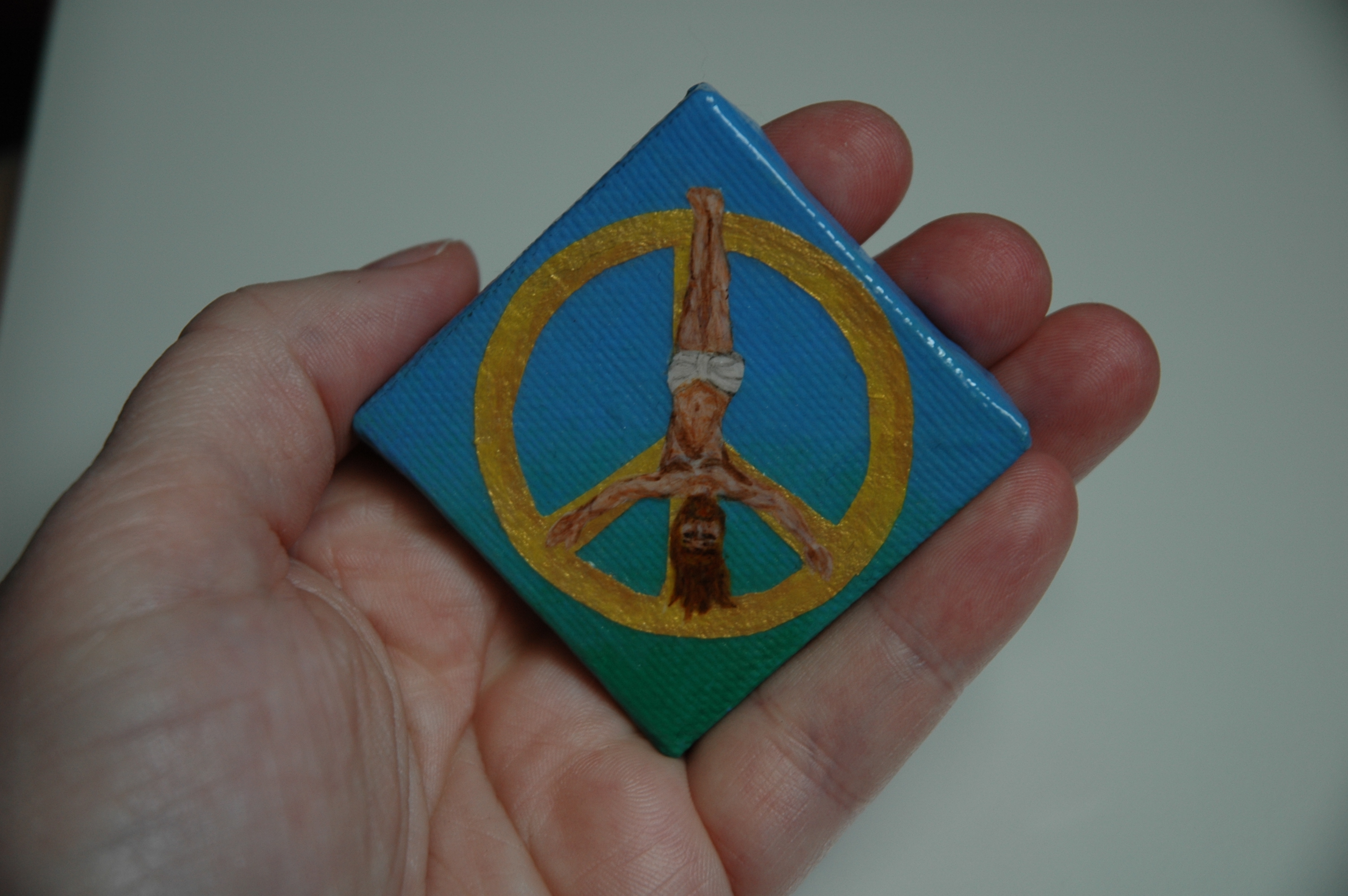
‘Anthropocentrism’ and ‘theocentrism’ are mutually exclusive…
Well, well, well…
The 77-year-old chef, Beppe Bigazzi (OK – I could not make up a funnier name if I tried…. the jokes about cats and cat lovers ‘Bepping’ his ‘Big-Azz-i’ pracally write themselves) used his show to give out a recipe for a cat casserole. He advised that the skinned cat ought to be soaked in spring water for 3 days, to ensure the meat is tender….and that it tastes even better than rabbit!
As a person with a pet rabbit, I’d tan his hide for that crack about rabbits, but…
Mr. Bigazzi went on to say that it is hypocritical for people to eat some meat, then turn around and criticize people who eat dog or cat meat. He claims that ‘cat’ is a traditional Italian dish, which he himself has eaten many times, and that it is delicious!
He may have some point: cats have, historically, been eaten in Italy and considered a delicious white meat. But now, eating cat is illegal in Italy and Mr. Bigazzi’s big mouth-y got him into a lot of hot water….there is even talk of criminal investigation of his eating habits as a result of his comments – which he now claims were ‘a joke’.
OK – I can see that ‘eating pets’ thing happening in times of famine. Our rules for what is acceptable and not tend to be ‘stretched’ when we see our kids starving. But, I also know of people who would eat cat and dog meat when they had other choices: the cultural taboo made it that much more appealing to them.
So, are we hypocrites?
Is eating cat or dog meat the same as eating beef or chicken? Are we hypocrites if we indulge in one while condemning those who partake of the other?
This question goes much deeper than many people give it credit. It is very closely tied to things I’ve been ranting about, on and off – like, say, that various cultures interpret the concept of ‘murder’ quite differently. Something very similar is at the heart of this, too.
It’s about ’empathy’ and ‘drawing lines’…
As much as we think of ourselves as gentle, caring creatures, our empathy is not limitless. The more affluent we are, the more empathy we can afford to have. That is the nature of empathy – and that the nature of humanity!
We can only empathize with someone or something if we can, in some way, on some level, identify with them.
Actually, this is something which comes up with the whole ‘Aspergers’ thing, too. That is when I first started to think about the nature of empathy…
Some doctors – and some books ‘out there’ by ‘experts’ claim that Aspies are not empathetic. This could not be further from the truth! Aspies ARE empathetic. They just do not think that empathy is warranted in the same instances that neurotypicals (non-Aspies) do!
Plus, most Aspies find it embarassing when others display empathy towards us, so, we usually attempt to suppress any show of empathy on our part, in order not to add to the other person’s discomfort. Still,the more important thing here is that Aspies will often feel empathy when neurotypicals do not think it warranted, but do not see any reason to feel empathy in many instances where people around them expect an overt show of it.
So – why do we feel empathy, and when?
When I wrote about the different interpretations of the concept of ‘murder’ (we consider ‘killing of another human being’ to be ‘murder’, while some cultures do not consider the killing of an unfamiliar human to be ‘murder’ – but killing a familiar animal that shares their dwelling is considered ‘murder’), our reaction depends on where we draw ‘the defining line’ of ‘expectation of non-aggression’. In other words, just about every culture considers ‘murder’ to be killing someone or something which has an expectation of protection or non-aggression from the one doing the killing. If that expectation of ‘safety’ is not there, it is ‘killing’, not ‘murder’.
Similarly, when we take animals into our homes and them an expectation of safety/non-aggression from us, we have now drawn the line of ’empathy’ with them solidly on ‘our’ side of the dividing line. They share our homes and we identify with them. Therefore, we have empathy for them.
That is the big difference between a ‘pet animal’ and a ‘food animal’. And that is why it is not hypocritical to eat the meat of a ‘food animal’ while being upset that someone would eat a ‘pet animal’.
A really good example of this are rabbits….
My parents grew up in a culture where rabbits were 100% in the ‘food animal’ category. When we got my son a pet rabbit, they were scandalized! They thought it wrong to keep a rabbit in the same rooms as we live in! It was just ‘wrong’!
Of course, they have come to accept him. Sort of. They still seem shocked to see him play with their dogs as if he were a dog himself…
But it was hard for them!
When growing up, of course, they saw many rabbits. And, as kids tend to be, they were attracted to them – rabbits, especially baby rabbits – are uber cute! But, because these were `food’, there were strict prohibitions against ‘playing with them’ and turning the rabbits into pets: having to eat one’s pet is traumatic!
Here, in North America, rabbits are ‘mostly’ in the ‘pet animal’ category. My kids are scandalized at the idea of eating rabbits!
And rightly so!
Because it does not matter what the species of the animal is: if it is in the ‘pet animal’ category somewhere deep in our brain, we identify with it as our companion (or potential companion) and we ought to be scandalized at the thought of it being slaughtered and turned into a piece of meat!
Unfortunately, ‘food animals’ (and ‘food plants’ are on the ‘ far side’ of our ’empathy line’. They have to be. We can take steps to only purchase food from places where food animals had a good life and were treated with the least amount of cruelty possible at the end: small farmers where you can see the living conditions yourself, and so on. These days, so many people have this as their priority, it is easier to do than many people think. Do the least amount of harm – that is the best we can do for now.
This does not make us hypocrites: until we have Star Trek style food synthesizers, we cannot afford to move that ’empathy’ line to embrace all living things!
A few days ago, Walker Morrow had a fun, humorous bit : Is there evidence for the existence of Richard Dawkins?
In it is embeded this link to a video (scroll down a little) which, in what I am told is a humorous manner, mocks Dawkins’s way of questioning the existence of God to question the existence of Richard Dawkins himself!
The flippant answer would be, of course, that I’ve seen a YouTube video where Thunderf00t interviews Richard Dawkins, and, when I see a video of Thunderf00t interviewing ‘God’, I’ll believe in ‘God’, too!
But, of course, my real answer is a little wordier….and weirder!
OK – perhaps this is the Aspie in me, or perhaps it is the scientist in me – or, some combination thereof. But, by the time I was 13 (I grew up behind the Iron Curtain, so I had no access to philosophical or theological writing of any kind – this was just my simple, peasant-brain reasoning), I realized that I could not objectively prove that I myself exist!
My original formulation was very clumsy and I have not really refined the wording much, just shortened it a bit (OK – a lot) :
OK – so the argument is a bit ‘rough-around-the-edges’, but, you get the gist of it.
Some people think this is pointless prattle – nothing but what Scott Adams would have called ‘mental masturbation’…
I beg to disagree!
Before a scientists makes any observation, she/he calibrates the instruments to be used. This is important, because it sets the ‘baseline’ against which any results can be evaluated: how good were the instruments, the accuracy of any measurements, the error margins, and all that. If, for example, a thermometer measures temperature to the nearest degree, it will not reliably show variations of one-thousandth of a degree, and so on.
Similarly, if we are aware that all our perceptions are subjective and that we cannot even prove that ‘we’ are the bit we think of as our ‘self’, that we cannot objectively prove anything ‘absolutely’, not even our own existence as we perceive ourselves to be, it ‘calibrates’ our credulousness of what we perceive – so to speak!
Thus, if we are ‘objective’ in our reasoning, we are forced to admit that we lack the capacity to ‘accept anything as absolute truth’ – or, if you will, as a tenet of faith. To do so regardless would be irresponsible, to say the least.
Therefore, I ‘do not believe that Richard Dawkins exists’, any more than I ‘believe that I exist’!
It is essential that we understand that this ‘calibration’ does not mean that I can assume any such foolish thing as ‘I do not exist’ or ‘I do not need to behave as if I exist’ – not in the least. The absence of belief in something does not imply the belief in the non-existence of it! That is an important distinction – one too often lost on people not trained in logic.
It simply alerts me that everything has an ‘error margin’ and that nothing ought to be accepted ‘absolutely’, without reservations, without an implied error-margin.
Perhaps this is the manifesto of the ever-questioning skeptic…. Still, it prevents me (and many others like me) from being able to just ‘believe’ things, to have ‘religious faith’ – of any kind.
Again, I apologize for the lack of new posts lately: it seems that just before I manage to actually recover from some bug, I catch another…. This last one included high fevers, so while I did a lot of ‘philosophising’, I didn’t even open up my computer for days on end. And while there is a real danger in trying to post before all the fever is fully gone (things make WAY more sense in my feverish brain than when I read them later), there is SO much that needs to be ‘caught up’ on, I do not quite know where to start.
I’ll just try to touch on at least a few diverse topics…
1. January, 2010, the new Irish anti-blaspemy law came into force. This one is straight out sur-real…. Just months after the Irish representative stood up in the UN to lecture the Islamic nations on the fundamental incompatibility of laws against blasphemy with our Western culture, rooted in the freedom of speech, thought and religion, Ireland goes and imposes just such a law….and, not to appease Christians, but from fear of Islamist retribution!
I have been very, very restrained when commenting on the whole swine-flu thing: from the fear-mongering, partial information, the vaccines released before the results of the studies to see if they are safe were even collected – much less analyzed, the recall of ‘ineffective’ vaccines most of which had already been administered to hundreds of thousands of children…. Well, the list of outrageous ‘stuff’ is long – and, I was very, very good and restrained myself from commenting on almost all of it while it was happening.
Why?
I was waiting for the inevitable!
OK – one day, may be, I’ll write a little bit of what I know about the serious decline of proper scientific procedures in medical research: the scope of it is truly, well, shall we say, ‘uncomfortable to contemplate’…. This ‘swine-flu swindle’ thing is just a little pimple on its bottom.
If you are unfamiliar with the events, you may find it difficult to believe the depths of depravity that this affair had sunk to. A native group disputed some land, claiming that despite a valid deed, the land ought to be theirs – fine, that is their right. What followed – not so nice. The native terrorists – that IS what this particular group of thugs was, and is – occupied the disputed land AS WELL AS NEIGHBOURING AREAS. As in, areas which were not disputed to be their land. And, they terrorized the inhabitants, limited their access to their homes – well, the details are unbelievable….but, testified to in courts!
What was, perhaps, the most shameful chapter in this has been the conduct of the OPP. They failed, over and over, to uphold the law. They refused to answer 9-1-1 calls for help from residents in the occupied territories. And, when law-abiding citizens who happened to be white-skinned wanted to go to their homes against the wishes of the occupying forces, they arrested the citizens, instead of upholding their right of free travel to their property!
My husband and I have had heated discussions about the role of individual OPP officers in this situation: while he thinks that if the order comes not to interfere with the native protesters, their hands are tied into inaction, I maintain that any order not to uphold the laws of the land is an illegal order, and every single police officer who obeys an illegal order is guilty as hell and MUST be prosecuted to the fullness of the law…
Now, the OPP commissioner himself, Julian Fantino, has been charged with trying to influence elected officials (bully the town council)… What a nightmare!
This is the `Canadian`story, not the ‘American’ one….
Perhaps what we need – before we engage in a constructive discussion on this topic – to define what ‘torture’ means….here, there, everywhere…. Because until we do, this discussion will be nothing but a peeeing contest between the various parties, with our troops stuck in the middle. And, when someone gets stuck in between a few sides having a peeing contest, they are bound to get wet!
There is SOOOO way much more that I ought to be commenting on and bringing up….there is correspondence and comments I ought to be replying properly to…. Yet, it seems that whenever I have long bouts of fevers, I start to go all philosophical.
All in its time!

 Xanthippa's Chamberpot