Should taxes be mandatory?

When is the last time you went to a restaurant – and did not leave a tip?

Chances are – never.

Or the service was so poor, you were ‘making a point’…

Why?

Because we all understand that servers rely on tips for their income.

And we wish to encourage good service and so on and so on.

Nobody has the right to force you to tip.  You may not like the practice, but chances are, you still do tip ‘good service’.

This same principle also ought to apply to taxes!

Governments would be much more careful with their revenue if they did not usurp onto themselves the power to extort taxes from its citizens.  Any government caught in corruption (AdScam, e-Health,  Sewardship Ontario and on and on), that government’s revenue would dry up – and rightly so!

This, in my never-humble-opinion, is the best (if not only) means through which citizens can keep governments ‘honest’ and fiscally responsible!

Perhaps this sounds extreme – and perhaps it is.

Still, ask yourself why is it that ‘tax collectors’ have powers much greater than police officers or the military.  Why is it that in the name of ‘collecting taxes’, governments create personal files about each and every citizen, where they collect and access decades very private information?

Governments only have the powers we delegate to them.

If you do not have the right to do something, you cannot delegate that right to anyone else (including the government) to do it on your behalf.

You do not have the right to demand to know the financial details of your neighbour’s life.  Since you do not have it, you cannot ‘delegate’ this ‘right’ onto the government.  Therefore, demanding to know the details of our financial circumstances is not a power any government can legitimately exercise on behalf of its citizens.

Again, please ask yourself:  why is it that when governments cannot seem to catch ‘careful’ lawbreakers, they try to ‘get’ them on ‘tax evasion’?

That alone should make us pause.

I know this sounds extreme – it is meant to.

The reason I am raising this point is not because I am advocating any sort of a tax revolt – at least, not on a practical level.

Rather, I am saying is that we ought to think very hard about exactly how we got into the current state where we consider it ‘normal’ that the State suspends our civil liberties in order to take from us whatever amount of money it has unilaterally set.

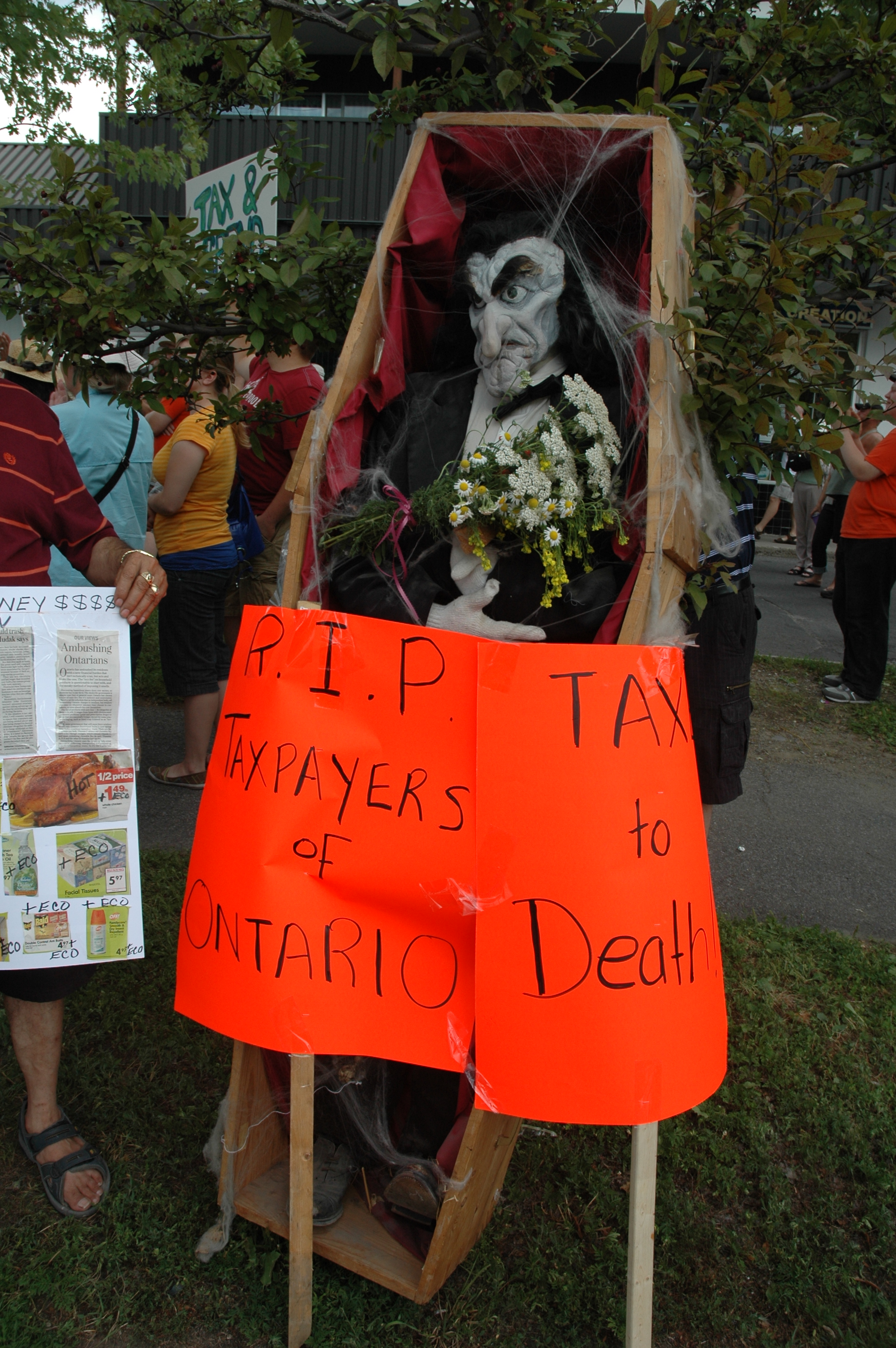
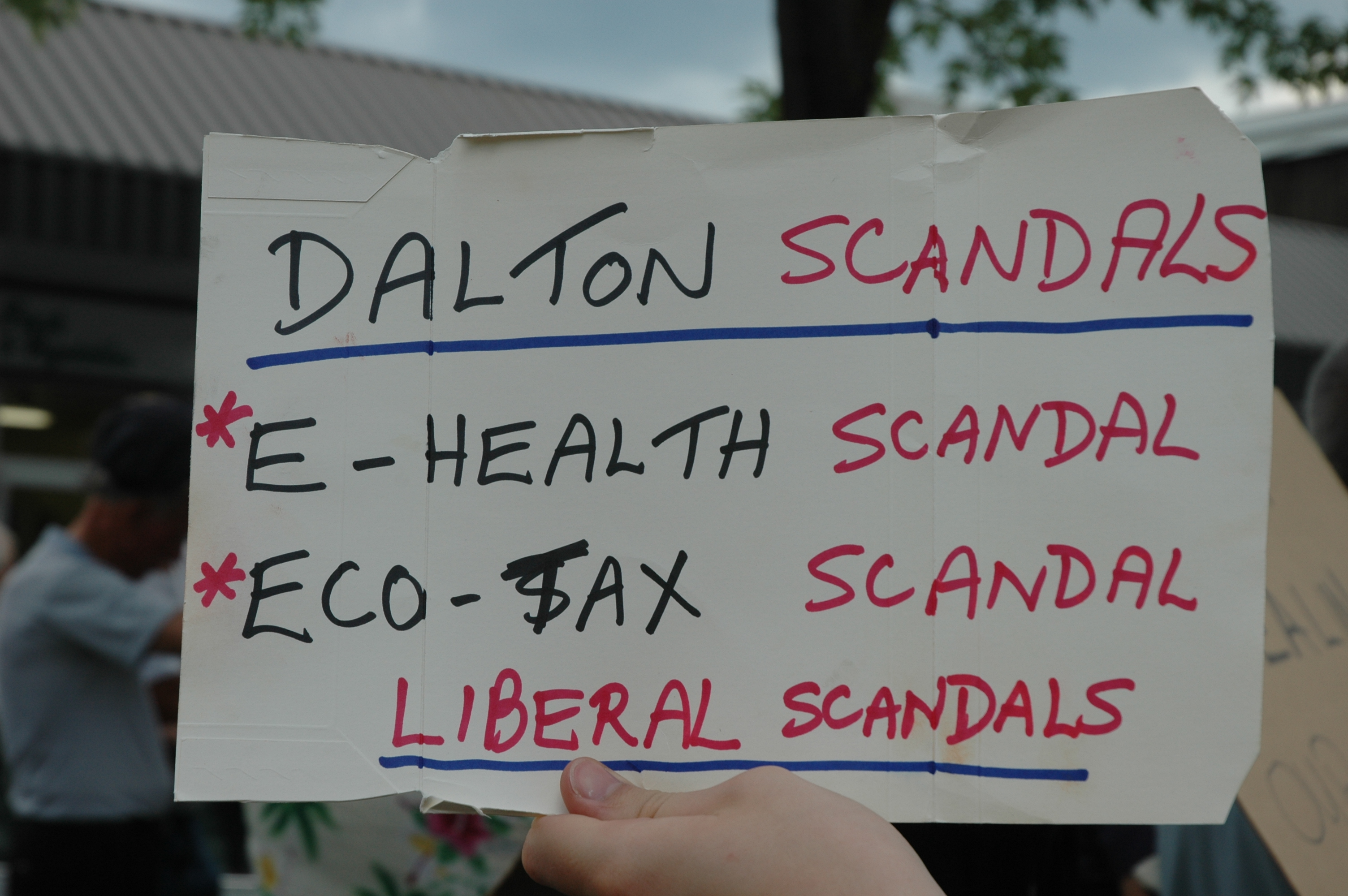
Photos from ‘McGuinty eco-tax’ protest, Ottawa

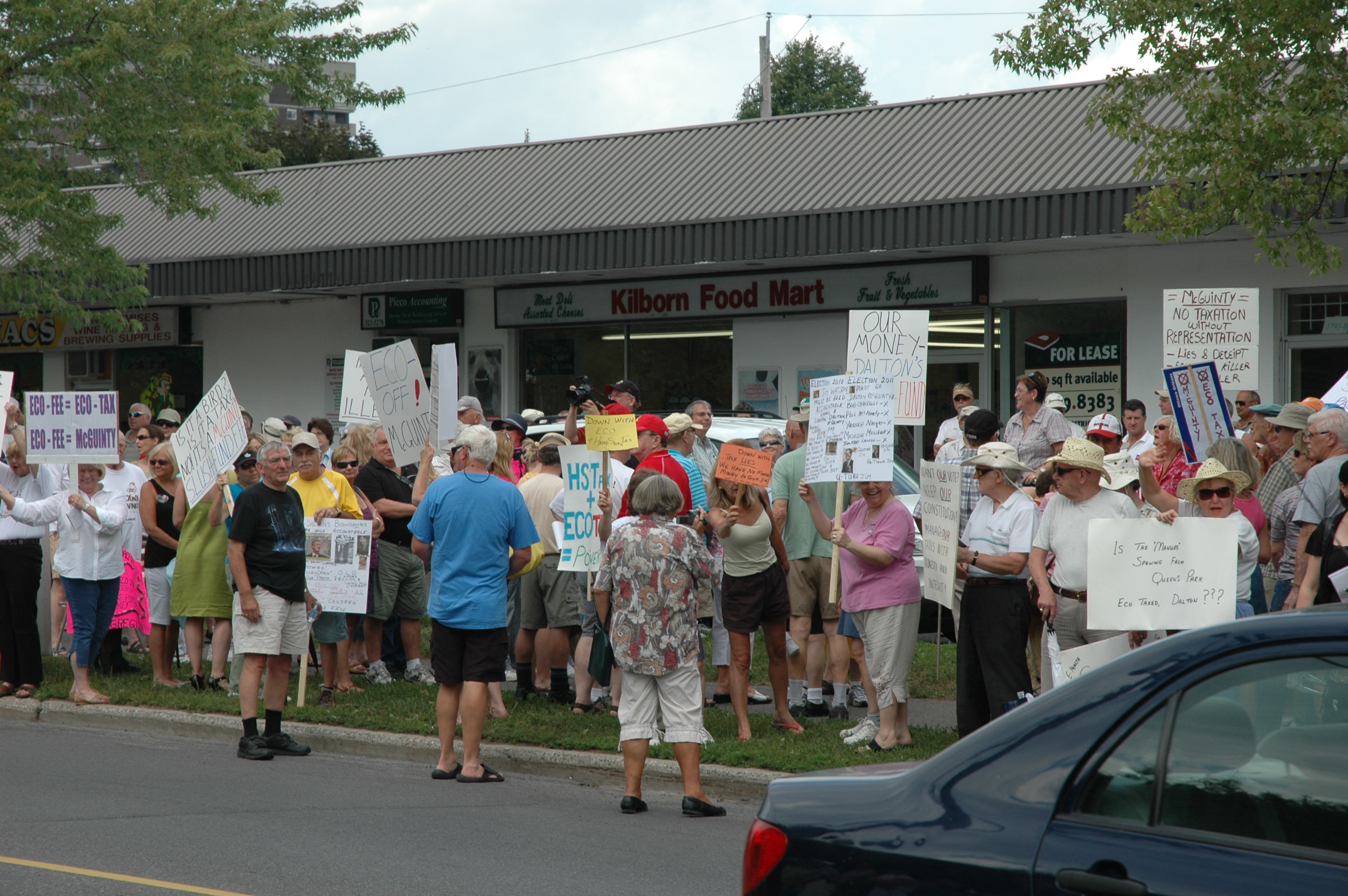
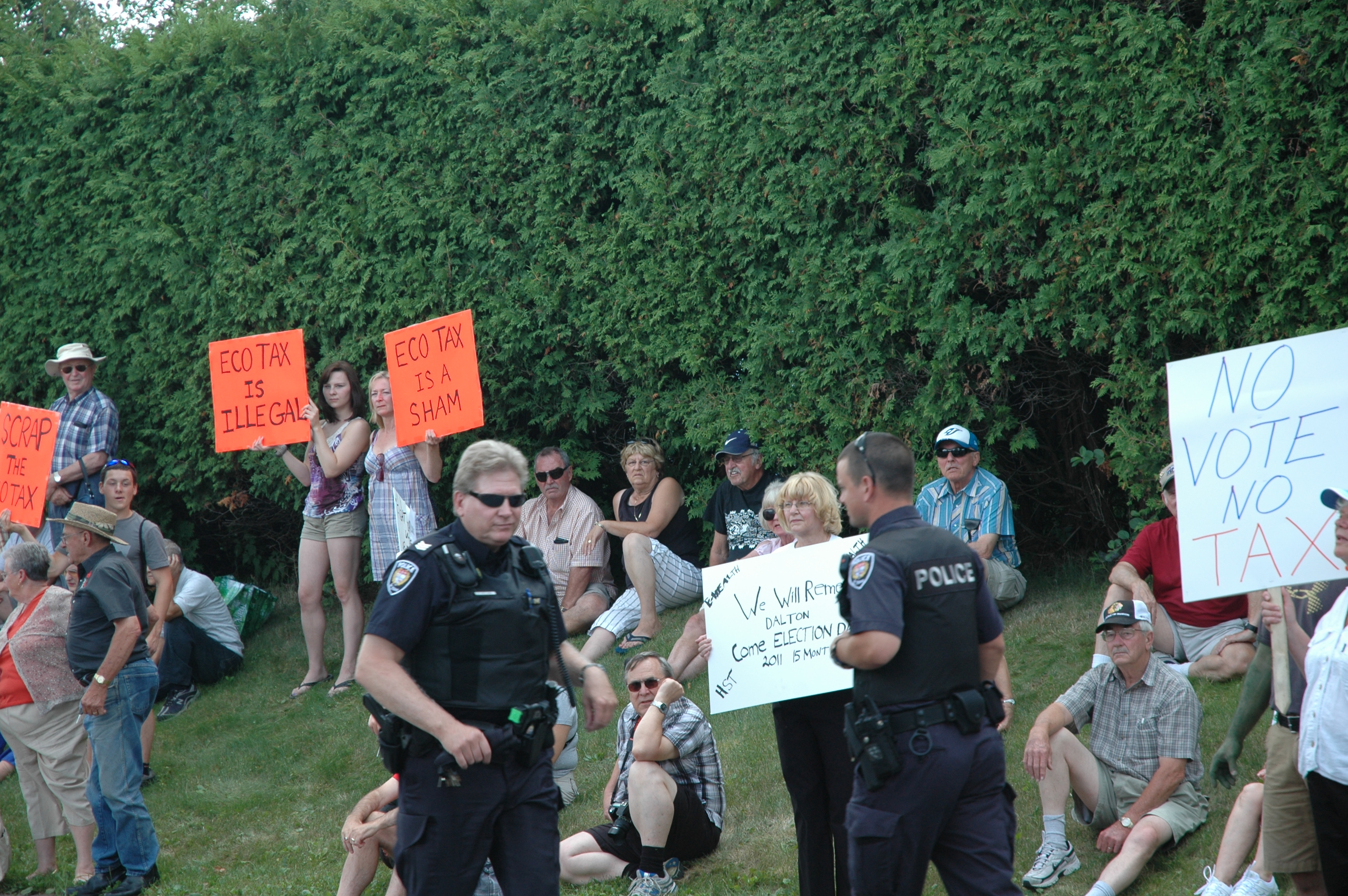
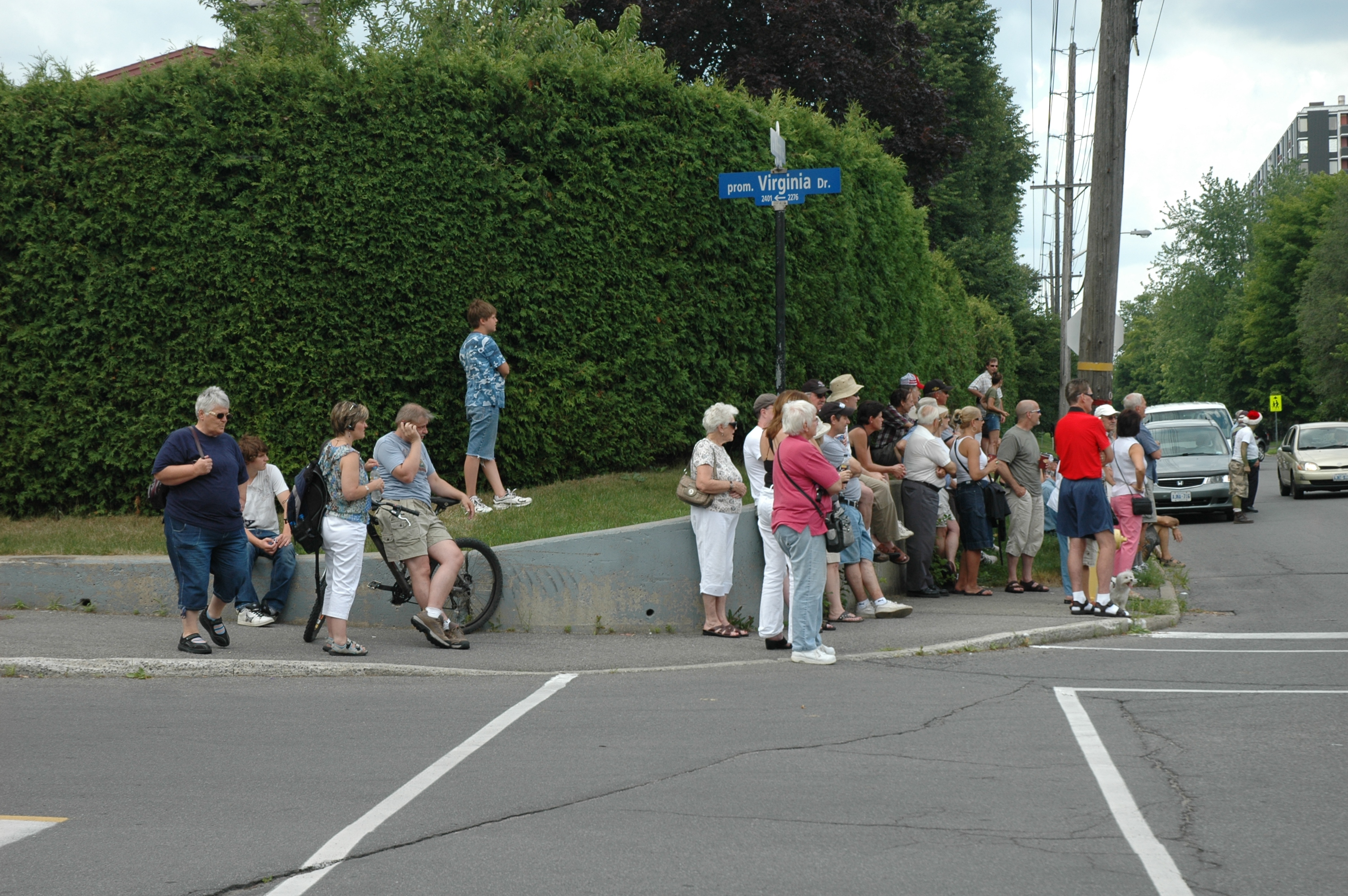
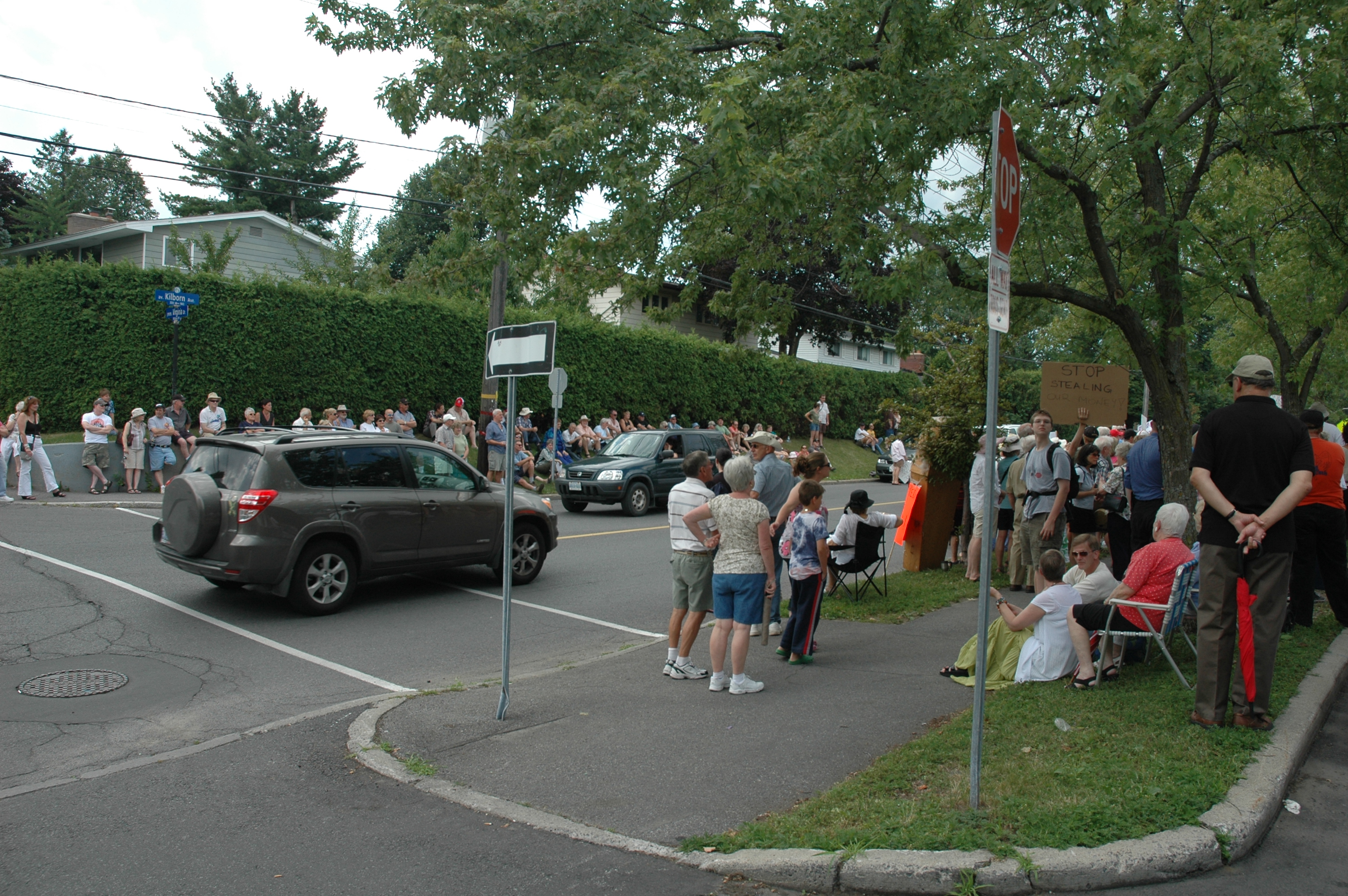
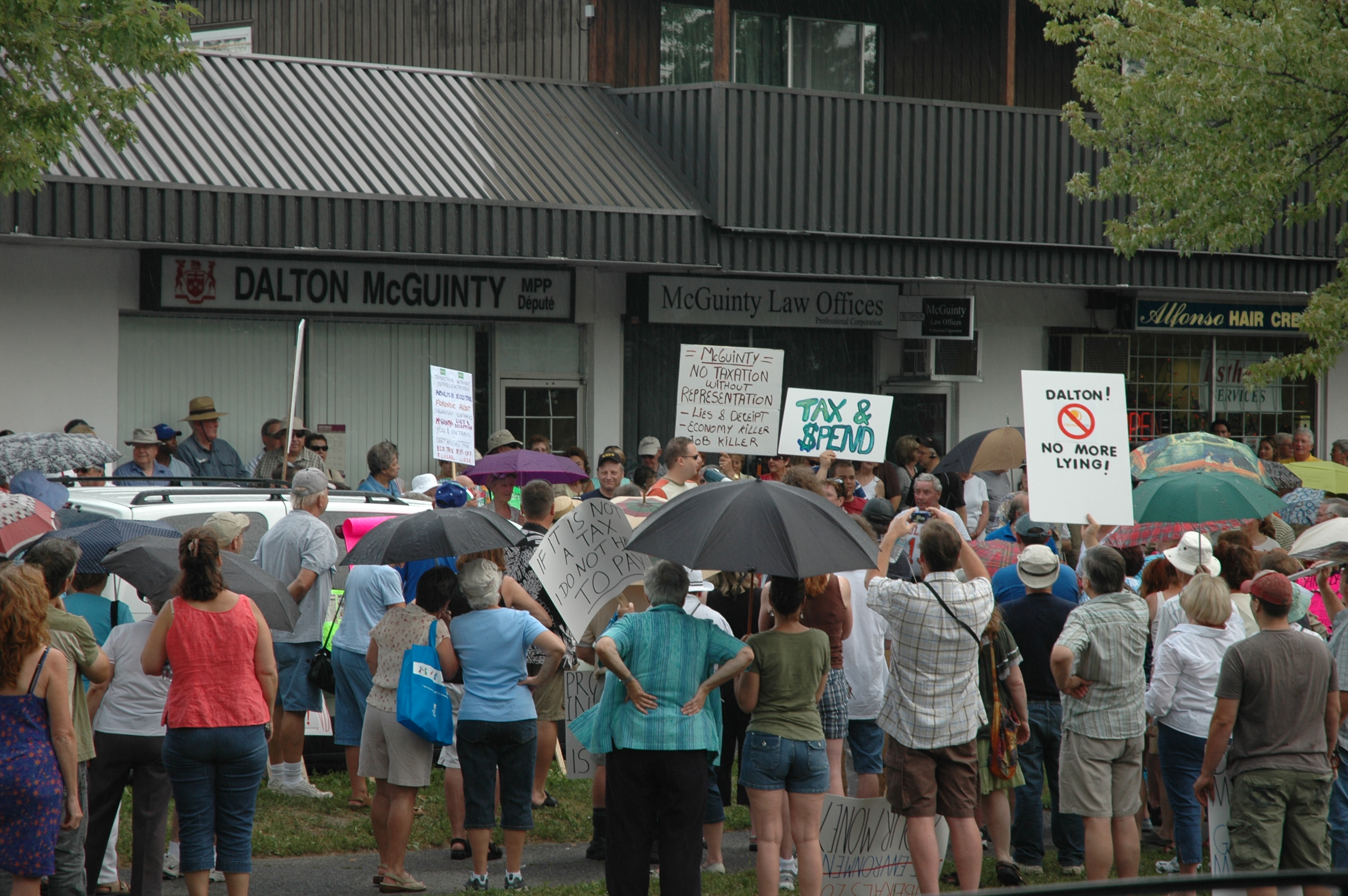
Today, a crowd of several hundred people had gathered in front of Premier Dalton McGuinty’s constituency office to protest the illegal taxes he has imposed on Ontario taxpayers, disguised as ‘eco-fees’.

The photos speak for themselves:

There was a visible – put very polite and respectful police presence.  Their only concern seemed to be that nobody got run over by the many cars driving by (and mostly honking).  One could not help but get the impression that they kind of agreed with the protesters!

The above picture is across the street from Dalton McGuilty’s office – the parking lot in the ratty-little strip mall where he has his office was too small to hold the protest, so it spilled across the street (no sidewalk there) and even into the near side street!

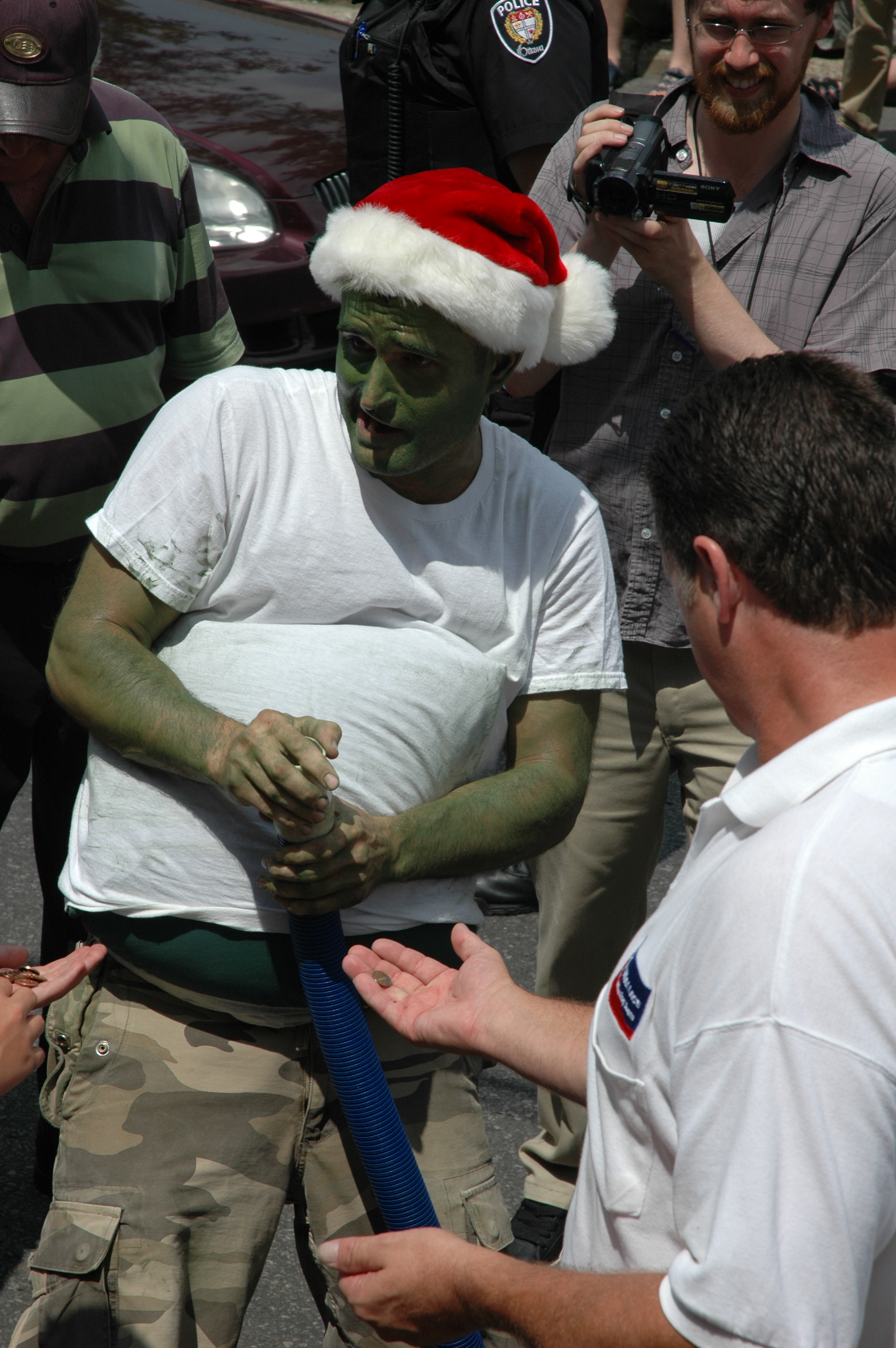
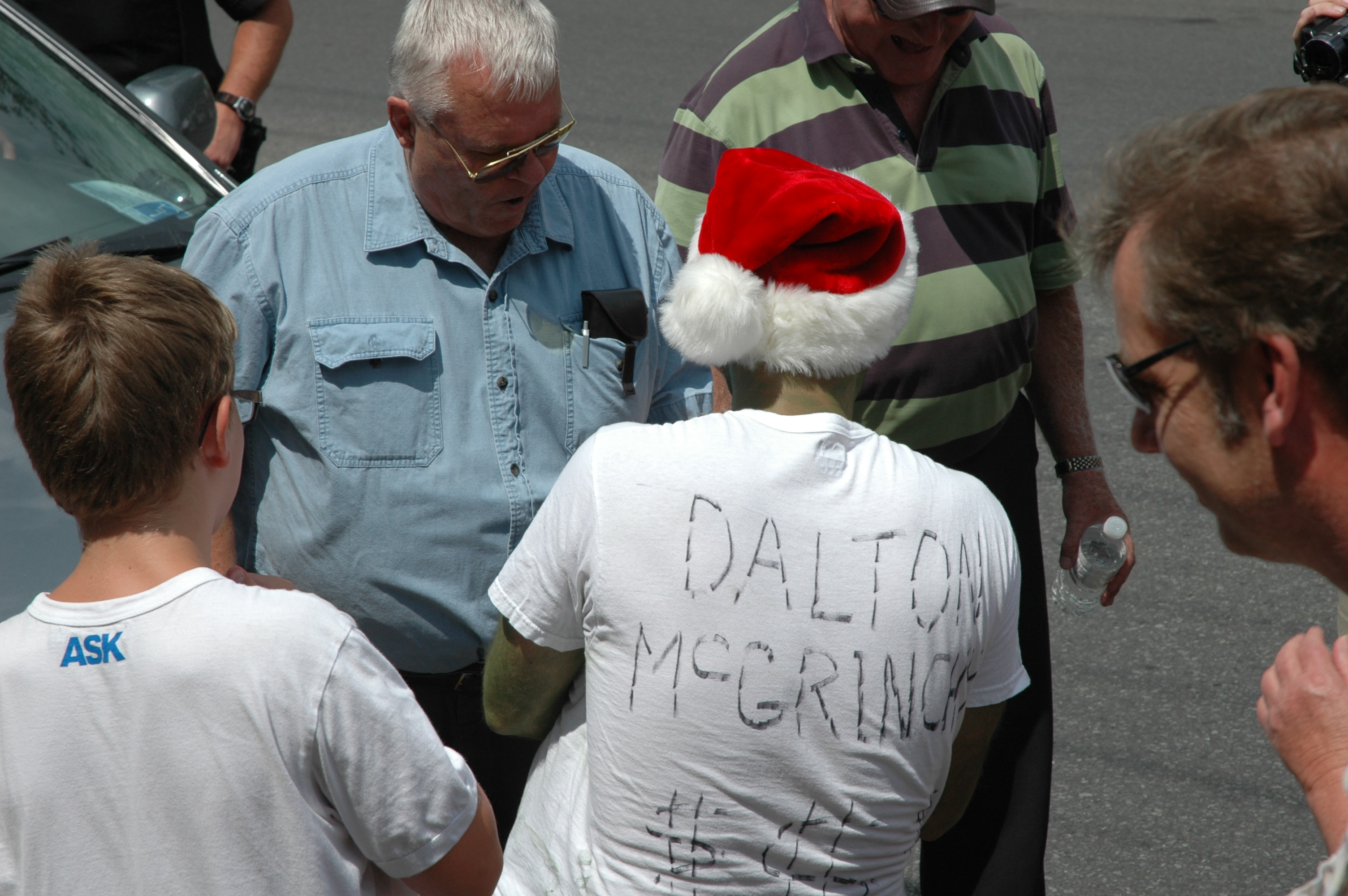
Dalton McGrinchy himself made an appearance!

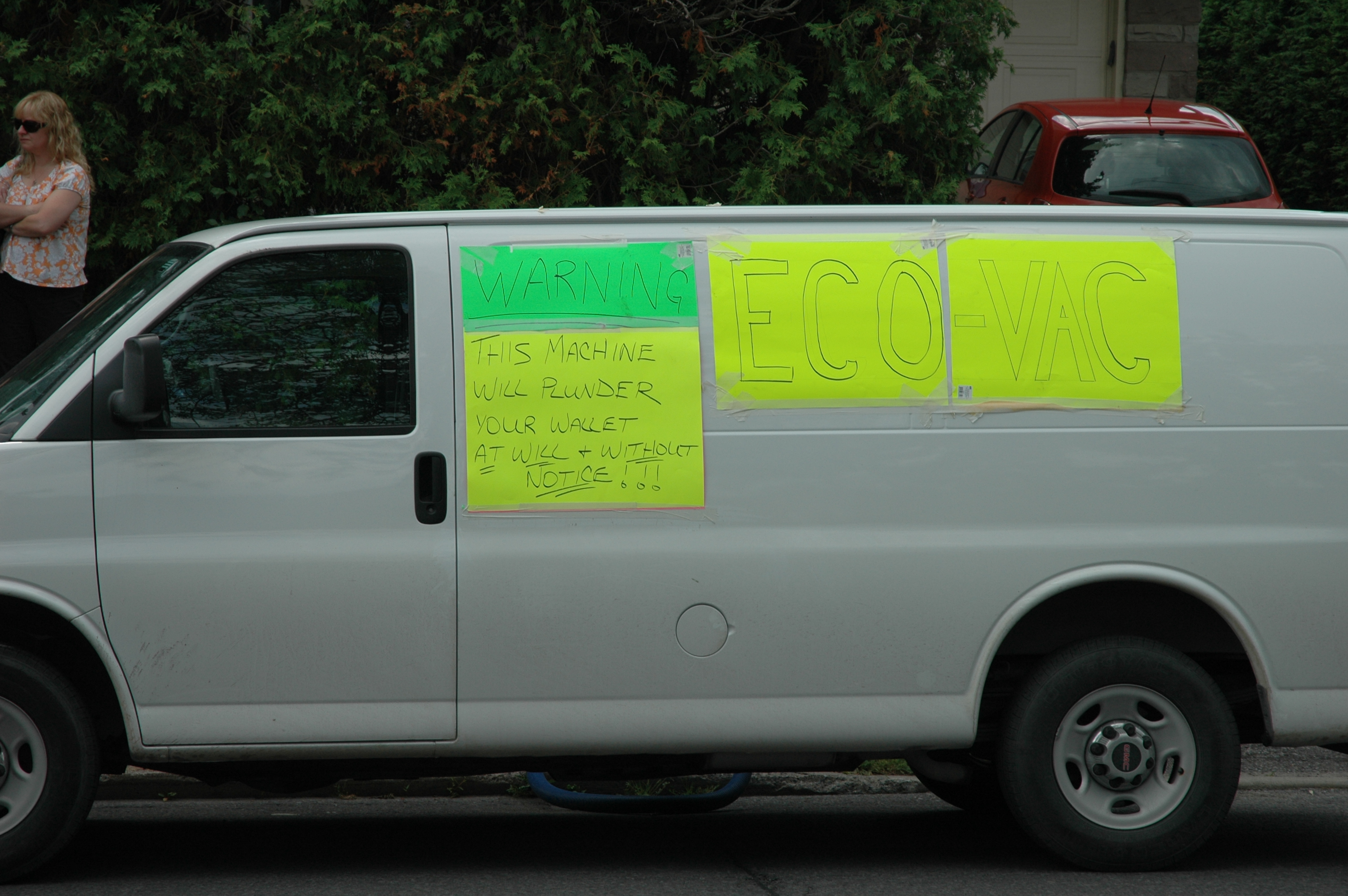
With his trusty ECO-VAC, he was vacuuming everyone’s money!

The  reporters/media just LOVED  Dalton McGrinchy!

OK – I am a really really bad reporter – I don’t even know the names of the people who organized it , or most of the speakers.  However, I did recognize CFRA’s popular Rob Snow, who really got the crowd whipped up!

By this point, it had begun to rain – a little.

Then, somebody (OK, Jessica) made a discovery:  David McGuinty, Dalton’s brother and a Liberal MP for this riding, was sitting in his car in the parking lot!

While we all concluded that even Dalton’s brother supports this protest, once his identity had been revealed, he drove away bravely.  Due to the rain, the picture I got turned out too foggy to use…  Sorry!

Anyhow…

It was quite a crowd:  young and old and in-between!

Dalton McGuinty was unavailable for comment:  rather than coming to the protest and facing the music, he chose to go on holiday….on our dime!

Update:  even more photos.

Banning ‘the veil’: the end does not justify the means

France is just one of a growing number of European countries which have been passing laws which forbid wearing veils that cover one’s face in public.

While I loath all forms of this apparel, I loath this law even more – and have said so often and loudly.

Here is my take on it:

OK – I’m not a fan…

For many reasons.

The origin of veiling women’s faces is in the practice of owning wives as a class of slaves.  This is the history.  Not good – and nothing rooted in this tradition will likely meet with my approval.

Today, some women are forced to veil their faces in public, either through physical or emotional coercion.  This, of course, is unacceptable.

In many instances, the facial veil is being used as a means of isolating a woman from the greater culture:  this form of isolation prevents her from forming social bonds of her own among the greater community – and prevents her from building a support mechanism which would help her escape from any potentially abusive situation.  I’m going to be repeating myself:  this, of course, is unacceptable.

Yes, many women today do wear the full facial veil of their own free will, as a symbol of their ‘identity’.   This, I find even more offensive!  Setting aside the whole psychoanalytical thing of women choosing to self-identify with cattle, this is an act of haughty contempt for everyone else individually and the society as a whole.  It is an aggressive assertion that they are better, worthier, more holy, than the rest of us… It is, in no uncertain terms, an outward expression of self-aggrandization and bigotry.

At the same time, it is often worn by some women as a not very subtle method of intimidation and aggression towards the greater society.  These women are themselves Islamists who understand perfectly well the fear many have of having Sharia forced upon them by the Islamits:  they wear the veil as an arrogant reminder of the threat they are posing to us all.

So, a woman wearing the ‘Islamic veil’ can either be a victim or an aggressor – either way, I don’t like it!  And that does not even touch on the whole ‘security’ issue, where criminals use the face-veil to disguise their identity…

In other words, I would be very happy never to see anyone hiding their true face!

BUT…

The ends never justify the means.

In fact, the means often undermine and invalidate the end.

I got into a somewhat heated discussion about this with Trupeers over in the comment section of BCF‘s post on this.  I think I was not very clear about it and confused the issue by poorly expressing what I mean.  Still, it helped me ‘distill’ the essence of what I mean better.

My ‘first law of human dynamics’ states that eventually, every law will be abused and stretched into unforeseen ridiculousness.  Therefore, whenever we pass laws, we must consider more than their immediate effect.  It is our responsibility to examine the not-so-obvious implications of any law and to really really foresee any potential ways in which the law could be abused.

THAT is my problem with a law that bans ‘wearing a face-covering veil in public’.

The larger implications:  we are permitting a government to legislate what people may or may not wear in public.  You know, like they do in Iran

It is always easier to give some power to a government than it is to take it back.   Once we legitimize the practice of governments  legislating and enforcing dress codes, that aspect of our existence will be at the mercy of some  future government’s whims!

G20, police behaviour and the ‘split’ on the ‘right’: part 2

In part 1, I pointed out that increasingly, the police have been given two goals which are not always congruent:  that of ‘maintaining public order’ and of ‘upholding the laws’.  And, increasingly (in ‘the West’), the police have been choosing to ‘maintain public peace’ – even at times breaking laws themselves in the process, instead of upholding them.

This has become very clear during the G8/G20 circus downtown Toronto.

Not only were the police given extraordinary powers to ‘maintain public order’ within the designated, fenced-off area, they had usurped even greater powers for themselves.  I use the term ‘usurped’ advisedly, because that is what they did.  The police chief admitted he had intentionally lied about what the powers police had been granted were.

Bill Blair’s justification of the lie is telling: ‘I was trying to keep the criminals out.’

It would appear that in this Police Chief’s view, all the people on the streets of Toronto were to be treated like criminals, until proven otherwise – may be!  Perhaps Chief Blair thought that he was on a crusade:  ‘Arrest them all – God will know his own!’  The police officers under Blair’s command certainly appeared to behave as if they took this adage to their hearts, as they often exercised powers never lawfully granted them – even going well past the police chief’s unlawful claims. (I will return to this later)

Following the ‘event’, the police continued to lie to the public!

The reason for this seems clear:  the evidence of police misconduct had been published and publicized, so the police attempted to magnify the ‘perceived threat’ in order to justify their conduct.  By displaying ‘confiscated weapons’ (some of which were toys – taken from a gamer who made them safe for kids to play with) and lying about what they were and where/how they were ‘confiscated’, the police hoped to portray the ‘protesters’ as a bunch of lawless anarchist thugs who were a threat to every decent human being.  Once this effort succeeded (as it mostly did), they could then dismiss any person who criticized their conduct by tarring her/him with the same brush.

That is a dangerous precedent!

First of all, it is not safe for anyone – law breaker as well as each and every law abiding citizen – to live in a society where the police arbitrarily usurp powers onto themselves and use threats, intimidation, arrests and, yes, violence, while exercising these usurped powers!

Whatever you think about the G8/G20 Toronto thing, just think about the implications of that!

We would live in a society where police are permitted to make the rules ‘on the go’ – and get rid of (through intimidation or arrest) anyone whom they perceive as challenging them…

If you think this is impossible in Canada (or another Western democracy), think again:  a few years ago, a study of downtown Vancouver policing practices documented searches, intimidation and various forms of detention of individuals on the fringes of society (least credible victims…) took place without any official records of the events – without these records, no effective legal action could be taken against the police officers.

Yes, the police were in a difficult situation.  Still…

While the evidence is very circumstantial, the police behaviour captured on video does suggest that at least some of the ‘violent protesters’ were indeed agent provocateurs – a tool which the police in Canada are known to have employed in past protests. (It evens appears that, prior to the G20, a Toronto Police representative was asked directly whether the police will be using agent provocateurs – only to be told that they are unwilling to reveal that type of information.)

I do not wish to get hung up on this agent provocateur thing.  The charges that the police utilized them have been made – along with claims that the worst of the violence and destruction was not committed by the protesters, but rather by the police agents themselves.  While I have seen some circumstantial evidence that lends credence to these claims, I am not yet convinced either way.

Why do I even raise the issue?

The police are in a unique position in our society.  In order to do their job – and do it right – they need people to trust them.  This trust is not a trivial thing – it must be earned, over and over.  Yet, having seen so many videos of police misconduct, having read so many reports of it, I fear this trust has been seriously compromised.

Do I believe all the charges against the police?

No, I don’t.  A few fake videos, perhaps.  A few trumped up charges – I’m willing to entertain that they are not as accurate as the ‘victims’ claim.

But some of the charges of misconduct come from sources I consider reputable (I know some of these people personally and they have earned my trust through their past behaviour).

Yet, I would like to give the police the benefit of the doubt.  And… had the police not been caught in so many lies, it would be easier to believe them…

Even if we completely set aside the issue of the agent provocateurs, there are serious problems with the police failing to enforce the law!  There are numerous videos (including some I linked above) where the police witness violent or destructive behaviour by specific individuals – yet do nothing to stop it by arresting, or even interrupting, the law-breakers!

That is not right.  It is abdication of their duty at best –  actively aiding the law-breakers at worst.

Even if there had not been an ‘over-reaction’ by the police on the Sunday and Monday (the arbitrary-seeming arrests of close to a thousand innocent people as well as all the other reported abuses of their powers), the police behaviour on Saturday, their failure to act and to apply the laws (which, according to some sources, came as ‘an order from above’) would be sufficient to shake the public trust in the police.

Sorry – I truly am sorry that this is so –  but that is the truth!

Oh – and as for labeling all the protesters as violent anarchists, who break the laws and have no respect for private property or the businesses along the protest route:  watch this and weep!  Not all protesters condoned lawless behaviour.  Some protested, hoping to talk sense into the violent thugs in their midst.  Others, like this guy, did more to stop lawless behaviour than the police did!

(Continued in ‘Part 3’)

‘Consensus-building’ and ‘leadership’

From our schools to our media to our bureaucracies, every aspect of our society is so infested with Cultural Marxism that ‘Newspeak’ has seriously corrupted not just our language, but our very ability to think clearly.  We no longer even recognize it when we hear it.

One such example is the currently popular claim that ‘leadership’ requires one to be skilled at ‘consensus building’.

First, let’s look at the meaning of ‘leadership’ and what constitutes ‘a leader’:

‘Leadership’ is the ‘ability to lead’, fulfilling the role or function of a ‘leader’.

‘To lead’ means to ‘show way by going in advance’, ‘to guide’, ‘to direct’, ‘to inspire’.

So, whom do we, as a society, regard as the greatest leaders of all times?  I did a little bit of googling on this – please, do the same.  While the leaders ‘closest’ to us necessarily dominate our cultural memory, there were some names that consistently keep being mentioned, by educational sites, journalistic/populist opinion sites and discussion boards alike.

In no particular order, these are just some of these names that keep cropping up over and over when people discuss ‘great leaders’:

  • Martin Luther King Jr.
  • Elisabeth I of England
  • Gengis Khan
  • Epicurus
  • Alexander the Great
  • Ghandi
  • Margaret Thatcher
  • Golda Meir
  • George Washington
  • Cyrus the Great
  • Winston Churchill
  • Muhammad
  • Constantine
  • Samudragupta
  • Wu Ti
  • Ivan III
  • Napoleon
  • Thomas Jefferson
  • Abraham Lincoln
  • C. D. Howe
  • Ronald Reagan
  • Bismarck

So, how many of these were known as ‘consensus builders’?

If I may quote from ‘What is ‘Cultural Marxism’?’, a guest-post on this blog by CodeSlinger:

Another example is the concept of intersubjective rationality, developed by Habermas, which replaces the individual process of reaching a conclusion based on the objective criterion that it follows from valid reasoning and known facts, on the one hand, with the social process of establishing a consensus supported by the subjective criterion that the group feels good about it, on the other hand. In today’s schools, those who do the former are maligned for being judgmental and demanding, while those who do the latter are praised for being good team players.

‘Consensus’ literally means ‘coming together’ (con) ‘of feelings’ (senses, sentiments).  Dictionaries typically define ‘consensus’ as an opinion or position reached by a group as a whole.

In other words, ‘consensus building’ is a form of governance a group of people will resort to when it lacks ‘leadership’.

How does this translate into the political world?  We are constantly bombarded with the message that great political leaders ought to be skilled at ‘consensus building’…

Our ‘Western’ societies have built-in safeguard mechanisms to ensure that ‘governments’ remain accountable to the citizens who elect them.  Perhaps the most important single element in this mechanism is that our elected bodies are based on the adversarial principle.

It is precisely because the political adversaries of those who propose a particular policy or course of action bring public scrutiny to it by publicly pointing out the flaws or shortcomings of this proposal that the issue is brought to public attention and thoroughly examined.  It is certainly not a pleasant process (nor is it meant to be pleasant), but it is one through which at least some light is shed onto what is being proposed – in as much detail as possible – and which engages the electorate in the debate (at least a little bit).

This is the method through which, in our system, we the citizens keep our elected politician accountable to us.  It is therefore important that we do nothing which would minimize this process!

What would happen if, before proposing a new law or introducing a new project, the head of the group that is proposing it went to all the elected representatives and put just enough of an ‘incentive’ into the proposal for each an every one of the representatives to not want to loose that ‘carrot’?

Certainly, any such project would be significantly costlier, because in addition to the core cost, it would now have to also bear the cost of a ‘carrot’ for each of the elected representatives – the bit that got them to ‘go along’ with it.

Of course, any such law or rule would be significantly more convoluted because it would now have to accommodate/fulfill/have exemptions for/’bundle in’ all the ‘carrots’  for each of the elected representatives – the ‘incentives’ that would be built in to it to ‘facilitate the building of the consensus’.

Every ‘quid’ would have a ‘quo’.

All policy would be shaped by back-room deals, where ‘consensus builders’ would be busy building ‘accommodations’ and ‘incentives’ into everything that would placate or mollify any potential dissent….among the elected representatives.

Once this process was done, the product would be presented to the public as a ‘done deal’.  I imagine the ‘dialog’ with the electorate would go something like this:

We have worked it all out, the proposal is so awesome that we all agree on it!

What?  You want to see the details?

Why?

We, your elected representatives all agree on this so this must the best course of action.  We have examined it in detailed and built a consensus – you needn’t worry your pretty little heads about it!

What?  You don’t like it?  You want to vote us out?

And replace us with whom?  EVERYONE agrees with this!

In other words, if there is a consensus among our elected representatives on a proposed course of action, if each and every one of them considers it in his or her best interest to proceed with it as is, it is very unlikely that the voters, the citizens, will have any opportunity to learn much about it before it is implemented.  There is another word for this type of ‘consensus’:  collusion!

In an environment like this, an environment of back-room-deals and political collusion, where there is little controversy which leads to public debate or scrutiny of proposed policies, corruption can be very easily hidden.

In my never-humble-opinion, ‘consensus-building’ among elected representatives is not just anathema to responsible government and an abdication of leadership, it is an active attempt to corrupt our governance structures and eliminate accountability of elected officials to the citizenry.

I would even go further than that:  politicians who tout governing through ‘consensus-building’ are openly admitting they intend to rule through corruption!

Why ‘secular laws’ must rank above ‘religious laws’ in every society

Recently, a post I had made a long time ago where I was looking at the definitions and nature of religion received a comment which raised a very important point.  It was something that I had attempted to get across – and failed.  Here, I hope, to remedy this!

Context:  Having used the Jungian definition of ‘religion’, I argued that ‘freedom to practice one’s religion’ must never be given greater weight in our society than ‘secular laws’.

Permit me to recall ‘Xanthippa’s First Law of Human Dynamics‘ -IF there is a potential for ANY law (rule) to be applied IN EXTREME ways – never foreseen when the law was first formulated – eventually, it WILL BE!!!’.  In other words, every potential  law or rule must be subjected to scrutiny of its effects when (and it is a question of when, not if) it will be applied to a ridiculous extreme.

Therefore, in that post, I used an extreme example: ‘If there is a blanket protection for actions based on religious belief, even such extreme acts as ritualized murder would be protected’.

The comment:

‘I cannot agree with your definition of religion. Since I am Catholic, I will use my understanding of it to explain my position. At the core of Catholicism, is the belief that there are some things that, with regards to morality, are objectively wrong- wrong in every time, place, and situation. I believe that you yourself would assent to this, since you already have identified objective moral truths (human sacrifice, polygamy, ritual rape, paedophilia (child-brides), ritual cannibalism, genital mutilation).

Now, it is not enough to believe that human sacrifice is wrong, rather, one must also behave in accordance with that belief. If one does not have the freedom to act in accordance with that belief, of what value is the belief? None. It is nothing but an illusion of freedom which the state allows to placate the people.

The crux of the issue, however, lies in the contradiction between the constitutionally granted “freedom of religion” and the secular law- a contradiction that is only truly resolved if religious belief and secular law both conform to objective moral truth. You seem to assume, though, that secular law is ipso facto closer to objective moral truth and therefore has primacy, but that is a false (and sometimes dangerous) assumption. Our laws were not created in a vacuum, but created by people who drew from their religious beliefs, cultural backgrounds, and own understanding of morality. There is nothing to suggest that they inherently knew better and we should accept their moral code a priori.’

I am not, in any way, shape or form, convinced that there is such a thing as an ‘objective moral truth’.

This does not mean I don’t think some things are wrong.  Yet, I recognize these for judgments based on my observation of the collection of impressions I will, for lack of a better-defined term, call ‘life’.  I would be loath to have pretensions to any absolutes, even if I became convinced ‘absolutes’ could be defined.

First things first….   Sequentially, I suppose.

The commenter self-identifies as a ‘Catholic’ (Roman Catholic Christian, I presume).

He/she then asserts that ‘objective moral truths’ exist, and as a proof cites me that, among other things, ‘ritual cannibalism’ is wrong.  However, where I say these acts cannot be justified by ‘exercising one’s religious freedoms’ IF they contravene the secular laws of the land, the commenter goes further, calling this wrong in every time, place and situation and equating this condemnation with an ‘objective moral truth’.

HOW can a Catholic possibly assert that?

Is it not one of the core beliefs of Catholicism that the priests’ blessing physically transforms a wafer of bread into the actual flesh of Christ, wine into the actual blood of Christ?  Is the consumption of these not part of their worship rituals?

This is, by definition, ritual cannibalism.

Don’t be dismissive of its importance!  Either the person truly believes they are eating Christ’s flesh, or they are heretics to their faith and not a Roman Catholic Christian.  These definitions are not mine…  One cannot possibly be both a practicing Roman Catholic Christian and believe that it is an ‘objective moral truth’ that ‘ritual cannibalism’ is wrong in every time, place and situation – unless one believes their religion demands behaviour contrary to ‘objective moral truths’!

No, I am not trying to pick on the commenter:  rather, I am attempting to illustrate of just how quickly things get muddled when we enter the realm ‘theological principles’ and ‘objective moral truths’…  No society of free people could hope to form effective laws which respect core human rights and freedoms on such a tenuous foundation.

This is precisely why ‘secular laws’ must ‘trump’ religious ones whenever there is a conflict:  ‘secular laws’ do not and must not legislate morality.  To the contrary:  the primary role of secular laws must be the protection of individual rights and freedoms against the oppression by other peoples’ ‘morality’!

Justifying a proposed law by an appeal to ‘morality’ or ‘greater good’ or ‘public interest’ (all of these are the same thing at their core, they just wear different cloaks) should sound our ‘alarm bells’ that something dangerous is afoot and requires close scrutiny.

Why?

Passing laws on these grounds necessarily permits the morality of some to over-rule or abridge the rights of others.  Than, in my never-humble-opinion, is always a bad thing!

The commenter says:

You seem to assume, though, that secular law is ipso facto closer to objective moral truth and therefore has primacy…’

No, not at all.  I am sorry if I gave that impression.  To the contrary!

Secular laws are not created in a vacuum – not even the vacuum of some ‘alternate dimension’ where rule-making deities reside.  Rather, they are a negotiated contract among the citizens of a country how to best keep from infringing on each other’s rights as we strive to coexist and thrive.  It is a living contract, not set in stone, but continuously evolving to reflect the changes in our society – and it must be supreme because by the virtue of accepting citizenship (or residency), one voluntarily chooses to abide by them.  Or, at least, that is what the meaning of accepting citizenship (or residency) ought to imply…

Because it is a negotiated contract of ‘minimum interference’, if you will (OK – let me just say that it ‘ought to be’ as we see laws becoming more and more intrusive and ‘moralistic’….), it will necessarily reflect the moral ideals of the majority of the members of the society.  That is how it should be – provided that the core rights and freedoms of each and every individual are not infringed.

Our laws must permit every person to exercise their rights and freedoms as fully as possible – but not past the point where this activity would violate the rights of another person.  Sort of like that right to swing one’s arms stops just short of hitting someone else’s nose…

In other words, a man – say, my father – must be free to believe (or not) in whatever Gods he wants.  And, he must be free to worship (or not) them as best as he can – but the limit on his freedom to practice his religion must stop short of the right to kill me because I offended his God by wearing the wrong kind of polka-dots on Sunday!

Vigna vs Levant: first installment on the last day

What a day today has been!

I admit, I am a little overwhelmed by all that has been happening.

And, I will try very, very hard to put down what happened, as best as I can with my very very limited legal background (which consists solely of watching ‘Jurisprudence’ on TV whenever I can).  But, most of it will not come tonight.

As those of you who read my blog on and off, I have some long term health issues.  These last two days have seen me more up and about than I have been in months, and I admit that I am exhausted.  Yeah, I know, I am a wimp….

Still, I really don’t want to try to give an exhaustive report while I am not in a serene state of mind.

I will only offer the briefest of observations… (well, brief for my standards!)

Mr. Levant appeared more patient today.  Now, I don’t know how Mr. Levant felt – he didn’t tell me.  But, it seemed to me that he had moved past the exasperation (not completely, and with a few re-lapses, of course, but he seemed less ‘overall’ exasperated ‘much’ of the time – perhaps because he was not having to explain over and over and over how his ‘sainted father’ felt bullied by Mr. Vigna’s representative(s) trespassing on his (the father’s, not Mr. Ezra Levant’s) property for reasons Mr. Vigna claims are legitimate) and, if you can believe it, I think Mr. Levant actually pitied Mr. Vigna.

Mr. Levant’ lawyer sounded every bit as good as I had hoped for, from having watched his demeanor yesterday.  I have to admit, I really like him – he has a way of understating things that permits the listener to draw his own conclusion without ‘beating him/her over the head with it’ (if you know what I mean), but which is ‘louder than shouting’…

Mr. Vigna continued in a manner similar to the one I observed yesterday.  Much of the time (when standing up) he would rest his hands on the desk and lean forward in a bullishly aggressive manner (at least, it looked so from my point of view).  At one point the judge requested him (and it almost seemed to me that the judge was a little exasperated at having to do so) to not lean so far forward because he was so close to the microphone, it was interfering with the microphone’s proper function.

(Aside:  I think Mr. Vigna was using one of the new super-awesome Sharpie pens – guaranteed not to bleed through to the next page. There are two types of this new pen – the ‘click’ type and the ‘cap’ type.  To the best of my observations, Mr. Vigna was using the ‘cap’ type, blue, if I am not mistaken.  I rather like these ones, and used the same kind (Sharpie, cap-type, blue ink) to record my notes from today between the first break and the lunch break (approximately 12:20 and 13:00 hours… I always switch pens and ink colours between breaks….  These ‘cap’ type Sharpie pens come in black, blue, red, green and purple – but, as far as I know, you can only get the purple and green ones if you buy a multi-pack.  The GTEC-C4 pen multi-packs include the same colours – but also add orange, which the Sharpie ‘cap’-type multipack does not have.)

At other times, when Mr. Vigna was not leaning against the desk, he seemed (in my layman’s eyes) to have had difficulty containing his ‘energy’ – or, in other vernacular, one could say he seemed to have had ‘too much sharp chi’, if you will.

He kept shifting his weight from one foot to the other.  Even in between ‘weight shifts’, he kind of bobbed up and down on the balls of his feet.  In addition, he kept making small little nervous movements with his hands.  And, yes, he did pull his pants up a few times – but aside from a few little glances he threw Richard Warman who sat in on part of the morning proceedings (and one glare at me that started by looking over his left shoulder, than turning about 345 degrees and finishing the glare over his right shoulder), he did not seem to pay much attention to the audience.

While I’m on the topic of ‘audience’…

When I wrote my initial observations on the ‘Warman vs Free Dominion’ appeal hearing (yeah, I know – I never DID finish my write up….I’m still thinking over some bits of it, especially the broader implications of the Irwing case), I noted that there was a pretty young blond woman with awesome shoes in the audience who looked like she had had a tooth ache,  She arrived just after things would get under way and leave just before the breaks, preventing me from saying ‘hi’ and complimenting her on her shoes (I like shoes almost as much as I like pens).

Well, that same young woman was in the audience yesterday.  You’ll be relieved – she no longer looked like she had a tooth ache.  That made me feel glad for her.  I would not have noticed her, because she sat behind me, except that her manner of arrival and departure jogged my highly imperfect memory.

And while I’m on the topic of the audience…

At just about 10 am, Mr. Richard Warman walked in and sat down in the front row in front of me.  During this time, Mr. Vigna was cross-examining Mr. Levant, and they just happened to be talking about the part of the suit where Mr. Vigna believes his reputation was damaged by Mr. Levant’s claim that he (Mr. Vigna) ‘had access to’ a neo-nazi  website.

Now, here, I have got to be careful in how I word things…. This was one of those things ‘under dispute’ and at the heart of the lawsuit – and I freely admit, I am not trained in the legal profession.  So, please, do take this as a lay person’s highly imperfect impressions and observations and nothing more.

The issue which was discussed was what Mr. Levant had written regarding the ‘Jadewar’ membership in a neo-nazi site, and its role in ‘stuff’.  And, I do not want to get into the ‘nitty gritty details’ of the case while I am tired and before I have had a chance to think it through.

Still, it is a fact that Mr. Levant specifically said under cross examination that he believed Mr. Vigna was much better a person than to join a neo-nazi group/party/site/whatever.  He (Mr. Levant) did not believe Mr. Vigna WAS a neo-nazi at all,  All he (Mr. Levant) wrote and asserted (and, I presume, still believes to be true, based on the sources he cited) was that Mr. Vigna ‘had access to’ it – as in, was aware of and could, if he so wanted, have looked up the password or found some other means (like asking Mr. Dean Stacey) to access it (because the information and password were contained ‘in the files’ which he, Mr. Vigna, presumably had access to – at least, that is my highly imperfect understanding of the testimony).

On several occasions, Mr. Levant said he did not think Mr. Vigna himself was a neo-nazi, like ‘Richard Warman’ or ‘like that man there’ – while he indicated Mr. Warman….

More to come tomorrow!

Ezra Levant and Giaccomo Vigna ‘cross swords’ inside a courtroom

Ezra Levant is a colourful character – to say the least.

He is the Canadian lawyer who became a household name as the guy who is willing to put his money where his mouth is when it comes to defending the most important and fundamental of all the human rights – the right to freedom of speech.

Because of his responsible self-conduct as both a human being and a journalist (he was the editor of Western Standard),  he had become the target of the Human Rights Commissions – both the Canadian federal version as well as its various provincial tentacles.

It is difficult for most of us, reasoning human beings, to understand just how badly twisted things have become in our society, just how endangered our rights as human beings have truly become, until this Kafkaesque nightmare Mr. Levant found himself in brought it to our awareness.  Once there, there was no going back.

Even kids could figure it out!

What is the best way to fight injustice?

Expose it – so everyone can see it for what it is and judge for themselves.  Most people are actually much smarter than the ‘Nanny State’ gives them credit for!

What is the best way to take power away from a bully?

Humour.

Mr. Levant has, over the years, combined these two weapons very, very effectively.  Which is what got him in trouble with Mr. Vigna….

Mr. Vigna is a fascinating person.

He is (or was – I don’t know his current employment status) a lawyer for the Canadian Human Rights Commission.  His one and only claim to fame (to the best of my knowledge) so far has been to be the lawyer who, during the Mark Lemier case, asked for the court to adjourn because he was ‘ not feeling serene’ and thus unable to argue the case…

Today (thanks to email by BCF alerting me to this), I went to watch what happened during the court case where Mr. Vigna is suing Mr. Levant for defamation or libel (I can’t keep those two things straight…), based on what Mr. Levant wrote about Mr. Vigna on his blog.  It was the second last scheduled day of the trial:  Mr. Levant finished his testimony and Mr. Vigna began his cross-examination of him.

Tomorrow were supposed to be the closing arguments only, but Mr. Vigna was unable to finish his cross examination today.  The judge suggested another day be added to the proceedings:  this seemed (in my never-humble-opinion) to throw Mr. Vigna into a panic!  He promised to be more focused and brief – he already has his closing argument written up (he said).  To a non-lawyer type person like me, the level of Mr. Vigna’s agitation at the suggestion that another day be added to the proceedings seemed rather out of proportion.  What do I know!

Anyhow, after Mr. Vigna swore up and down that he’d be brief (sic!), the judge just said we’d start earlier in the morning so we could hope to get through it…

So, what went on today?

I am a notoriously slow thinker.  It will take me a while to mull this through – so, these are really really really preliminary observations.  I’ll do a better write-up, with the proper links and all, later.

What I WOULD like to focus on, though, are the ‘big things’.  The major topics, true, but even more than what was said, I’d like to focus on how it was said and the body language that went on.

Why?

Because I think that our brains are very curious organs.  They process information on many levels – and they don’t always tell us all of what they are doing.  But, they DO tell our bodies…which is why body language can tell us more about what is going on (at times) than words can.  And, Mr. Vigna seemed so delightfully unaware of what his body language was projecting, it made quite an impression on me…

Even before things got underway, the two main characters in the trial presented very different demeanor.

Mr. Vigna was first nervously arranging numerous boxes of ‘stuff’ he had wheeled in (in those ‘Staples’ boxes that hold many bundles of printer paper).  Then he sat at his desk/table, leaned forward over papers, head resting on the tips of the fingers of his right hand (which also held a cheap pen) as if thinking hard through a headache (we’ve all been there!).

Mr. Levant was  full of excited energy – sort of like what you see in an athlete before a race.  He was busy telling his lawyer about Atatürk and analyzing his policies – including his take on the whole freedom of speech and libel ‘stuff’:  it seemed to me Mr. Levant had gone to quite a lot of depth as well as breadth to prepare for this issue!

When the case resumed, Mr. Levant was giving testimony.  Then, after he finished, Mr. Vigna began to cross examine him.

While he testified, Mr. Levant’s body language was pretty natural.

Mr. Vigna, at times, objected:  during the objections, his body language varied between frustrated and aggressive:  lots of little ‘fussy’ movements with his hands, head tilts and so on.  Otherwise, his body language suggested to my layman’s eyes that he was still ‘working through a headache’.  I ought to mention:  he did wear a lovely tie with beautiful, serenely blue stripes on it.

The judge’s (the Honourable Mr. Justice Smith)body language was ‘carefully neutral’.

Mr. Levant’s lawyer (remind me not to play cards against him) had non-existent ‘natural’ body language, but maintained the ‘professional blankness’ that seems the preferred body language of the most highly paid lawyers (from my limited observation

OK – this is getting long.  I wish I had the ability (like this consise write up by thenice dude who sat next to me) to percolate the pertinent facts into a brief article…. while I’m getting ‘up there’ in the word count…

During the cross examination, Mr. Vigna rested his hands on the edge of his desk and really, really leaned forward with his upper body, giving him a very ‘bull-like’ aggressive body language – until Mr. Levant answered (in response to one of Mr. Vigna’s questions)  asserted that he thought Mr. Vigna WAS a ‘political bully’.  It was at exactly THAT point that Mr. Vigna’s body language ‘softened up’….

Mr. Vigna seemed to think that the ‘best’ way to cross examine Mr. Levant was too, at times, fire several questions with mutually contradictory answers at once – and hoping Mr. Levant answers one of them in a way Mr. Vigna could ‘paraphrase’ (as, in, twist).  Another approach he also seemed to take was to fire ‘statements’ at Mr. Levant – without a question – and waiting…..if Mr. Levant responded, he’d say ‘THAT’ was ‘NOT the question he asked’ – until even the judge began to point out to Mr. Vigna that he had failed to ask an actual question….

Mr. Levant’s body language went from ‘anticipation-excited’ to ‘passionate’ (freedom of speech bits) to frustrated (having to repeat himself 7-8 times).

The judge’s body language?

Hard to read.

In my never-humble-opinion, the judge’s body language went from ‘guardedly impartial’ to ‘suppressing the giggles’ to ‘bored’ to ‘mildly frustrated’ to ‘seriously disturbed’ by Mr. Vigna’s behaviour (which, at one point, included Mr. Vigna actually physically pulling up his pants as he shot a self-satisfied ‘we got him now’ look to his only supporte in the audience over something that was NOT a ‘goth-cha’ moment, but rather another demonstration of how Mr. Vigna just ‘did not get’ what was happening around him….)

OK, I am not a lawyer or any kind of legal mind….  These are just my personal observations.  But, today was the first time I saw Mr. Vigna in any circumstances whatsoever.  Yet, I was forced (by his dmeanour as wll as his behaviour) to conclude that he is not really aware of what he is doing, how he comes across or just how irrelevant his arguments to the court are…

Sorry to quit before I told the whole story – I plead fatigue and hope (not certainty) that I’ll make it back to the  courthouse tomorrow….

Either way – more to come later!

Today’s earthquake

The last week of school before the summer break begins is always hectic – at least, for us, parents.  We had extra excitement today:  a bit of an earthquake.

Here are the ‘hard data’ particulars on it.

This got me thinking….

Could this quake, perhaps, have been caused by some people  who are not feeling in a serene state of mind ‘quaking in their boots’ at the prospect of having to cross-examine Mr. Ezra Levant?

Obama to get power to turn off the internet – worldwide

Sit up and pay attention.

I have been ranting on and on, that we need to set up a parallel system to the internet:  one so diffuse that it could not be controlled by any authority.

Why?

Because various governments have been attempting to strangle the freedom to exchange information which people all over the world have been exercising:  and which has been a powerful weapon against suppressing information that various governments would rather not make public.

This coming Sunday will be the first anniversary of the murder of Neda Agha-Soltan.  If her death was not caught on video and posted on the internet for all the world to see, would we know as much as we do about the protests against the rigged elections in Iran?  (On this note – the demonstration which is taking place in London, England, to mark the anniversary of her death this Sunday has had its location moved by the police at the last minute:  instead of Trafalgar Square, it will be held at Richmond Terrace junction with Whitehall opposite Downing Street.)

Of course, this is just the tiny tip of a huge iceberg!

It’s EVERYTHING!!!

It usually starts with ‘protecting children’ – after all, who could be against protecting our children?!?!

So, filters and tracking traps go on.

Then it’s pornography.

And black lists.

Of course, history has shown us (the last revelations were from Australia, were they not?) that most of the sites that are blacklisted and censored do not actually have anything to do with paedophilia or even pornography.  Rather, most have been political sites critical of the ruling government and/or the censorship bodies.

After these two biggies comes ‘security’.

Again, it is an emotional appeal that precludes any reasonable argument without being accused of siding with terrorists and criminals and other ‘enemies’.

And it is exactly this reasoning that lies behind the PCNAA (Protecting Cyberspace as a National Asset Act) that Joe Lieberman, with vigorous support from Jay Rockefeller (the guy who thinks the world would be better off without the internet) is pushing through!

This bill – once law – would give Obama the power to shut down the internet.

Everywhere.

Remember that saying – the one about people who are willing to give up freedom for security not deserving either?

So, any ideas on an alternate method of connecting up?

If we get a few good ideas, we can take this off-line:  you know, before the line goes dead….