Union of Unions: is ‘labour’ organized a little ‘too well’?

This is just a tiny peek at Canadian ‘organized labour’ in particular, though I expect that the results will be similar for many of the ‘developed’ countries – and I am not naive enough not to understand that a supranatural organization of labour unions also exists.

This is only natural:  one just has to look at the nature of people who are drawn to ‘organized labour’ to start with!

These are usually people who are very, very good at ‘organizing’ things – and other people.  So, it is only natural that they would – well – organize themselves, too! And, there is nothing wrong with that:  freedom of association and all that.  Plus, many (perhaps most) of them are motivated by a belief that they are doing right by their members – also a commendable thing!

Where I DO have a problem is that in Canada (and many other places), this very freedom of association – something the labour unions had to fight bitter battles to win a legal right for – is now not respected BY the labour unions themselves…

As in, we have ‘closed shop‘ workplaces (or something practically indistinguishable from it), where every single employee is forced to belong to a specified labour union.  These ‘exclusively union-held’ workplaces are to be found in private industry and – perhaps this is the most troubling aspect – they have a monopoly on all levels of the civil service!  While I am very uncomfortable with all the aspects of this, that is not the topic of this rant.

Instead, I would like to demonstrate that this incredible skill at ‘organizing’, as practiced by labour unions, has – in a very real sense – led to a situation where just about every unionized employee in Canada effectively has to obey just one single boss

Unions arose because there was a need for balance:  as the industrial revolution transformed the ‘Western World’, the employer-employee relationship gave too much power to the employer and not enough to the employee.  Following the age-long adage ‘there is strength in numbers’, people refused to give in to oppression and did something to change it, both in law and in practice.  I suspect that were I living back then, I might well have been proud to be part of this movement!

But, the effects of human actions tend to act a little bit like a pendulum:  if you push hard to correct a wrong, chances are that a really successful ‘push’ will ‘swing the pendulum’ to the opposite extreme… and, with ‘organized labour’, I fear that that is exactly where we are now!  (At least, in the ‘Western world’!)

Now, we have a situation where an employer may not be allowed to hire the best people for a specific job (or, at least, the people the employer wishes to hire), but must have all their employment choices approved by a labour union.  In effect, the Unions in Canada (at the present time) form a layer of management which is NOT under the control of the employer, but whose very existence is predicated on ensuring that there is strife between the employer and the employee (as the ‘raison d’etre’ of the union is to mediate any disputes between the two, ensuring there is plenty of ‘stuff’ to mediate seems only prudent).

As in that story (sorry, I cannot find an online link, but it happened in the 1980s, so there may not be an online copy) where a lady owned a business and wanted to leave it to her grandson in her will.  To make sure that he really knew the business, from the bottom up, she wanted to hire him during his summer holidays in different departments of her company – working in the entry-level jobs of all the departments and getting to know them from the ‘bottom up’!

Frankly, I think this is commendable:  if you intend to leave a company in someone’s hands, it is only responsible that he know all the aspects of its workings!

However, not long before, this lady’s company became unionized.  AND, it was a ‘closed shop’…

And – since the labour union (I don’t know which one was involved) saw the hiring of the owner’s grandson as ‘nepotism’ and something to be opposed, they refused to grant him a memership in the union.  That meant that – whether paid or not – the grandson was not allowed to work at this company…except, perhaps, as the CEO…but he was denied the ability to ‘learn the business’ in order to become an effective manager!

The story ends sadly.  The confrontation between the owner and the labour union did not resolve the situation:  and, rather than be denied the right to hire whom she chose, the owned closed the company – putting everyone out of work.

Yes, it sounds like an urban legend:  still, at the time, it was a big story, covered by the major papers…

I guess what I am trying to say is that while 100+ years ago, the ‘strength’ was with the employers, that is no longer the case.  Now, the ‘strength’ lies with the unions who control BOTH the employer AND the employees, without any accountability to the former and with only a ‘lip-service’ level of accountability to the latter.

That, in my never-hmble-opinion, is a problem!

Because, like it or not – notice it or not – what has happened over the last 100 years (or so) is that individual workers have united to form unions, restoring balance to the ‘equation’:  but, they then went much, much further!  They created ‘unions of unions’ – until now, in Canada, there is one body – the Canadian Labour congress – which controls the vast majority of unionized employees in the land!

From their ‘about’ page:

‘The Canadian Labour Congress brings together Canada’s national and international unions, the provincial and territorial federations of labour and 136 district labour councils.’

‘With roots everywhere in Canada, the labour movement plays a key role…’

‘Active in every aspect of the economic, social and political life of Canadians…’

‘On Parliament Hill, in boardrooms, at international conferences, in media events, in demonstrations or on picket lines, the CLC supports and educates unionists in the fight for strong workplaces, pressures governments for change, builds coalitions with like-minded groups, and strengthens solidarity between workers in Canada and other countries.’

This really does seem to be an organization – perhaps with supranational strings attached – which controls a great deal of what goes on in the daily life of Canadians!

If the CLC were to decide that each one of its members (or the members of its minion organizations) were to go on strike, the whole country would come to a standstill! Industry, government, infrastructure, construction – even entertainment:  all these workers are subject to the whims of the CLC… either directly, or through the labour unions that they belong to – and which all answer to the CLC!

Is this not too much control in the hands of just one group of people – especially a group of people NOT ACCOUNTABLE to Canadians?

add to del.icio.usDigg itStumble It!Add to Blinkslistadd to furladd to ma.gnoliaadd to simpyseed the vineTailRank

‘The Shawn Little affair’: background to the ‘influence-peddling’ trial of Ottawa’s ‘Mayor Larry’

Today was the first day in the ‘influence peddling’ trial of Ottawa Mayor Larry O’Brien. While this in itself may hold only limited interest, there are ‘other factors’ which are at play here: and these ‘other factors’ have implications way beyond the sleepy little town of Ottawa…

It is these ‘other factors’ which I would like to look at. Still, I ought to provide a little background of the events to date and their historical context….from my personal point of view.

  • In 2000/2001, the many municipalities of the Ottawa area and their over-arching regional government were all  amalgamated into one entity:  The City of Ottawa.
  • This created a geographically large city, with urban, sub-urban, and rural wards.
  • The former ‘Regional Chair’, Bob Chiarelli (acknowledged as a very skilled ‘political operator’), was elected to be the Mayor of the newly amalgamated city.

During that first amalgamated election (2000), an interesting thing happened…

‘The Shawn Little affair’

    • Shawn Little ran against Linda Davis, who had previously been on the Regional Council (headed by Bob Chiarelli, who was now running for Mayor)
    • The campaign got nasty.
    • Following the election, based on a complaint by Ms. Davis, Elections Ottawa investigated Mr. Little’s campaign spending.
    • The audit found that Mr. Little had not declared all of his campaign spending and made a list of the ‘undeclared items’, estimated their cost and incorporated this cost into Mr. Little’s account of the campaign spending.
    • This list included such items as a toilet-bowl brush for the campaign office washroom.  Mr. Little defended himself, saying this was not purchased but that a volunteer working in the office brought it in, and following the campaign, took it back home.  Still, the auditors said, the toilet-bowl brush had value, and he had not declared it:  this, in their eyes, was Mr. Little’s admission of guilt…
    • With the ‘estimated cost’ of the ‘omitted items’ incorporated into his spending, the auditor (after months of investigating) declared that Mr. Little had gone over his election spending cap by $2,600.00
    • Mr. Little was charged with violating the Municipal Elections Act
    • After a lengthy court battle Mr. Little was cleared of any legal wrongdoing
    • It took another legal battle for Mr. Little to get the City of Ottawa (who lost the case against him) to cover at least a part of his legal fees (he had almost lost his house…)
    • Throughout the affair, and for years following it, the press, led by The Ottawa Citizen, ran many unfavourable stories about Mr. Little.  (Perhaps these were deserved – it is true that while this was all going on, Mr. Little was not as effective a councilor as he ought to have been…)
    • An aside:  in the past, Shawn Little was a vociferous opponent of the ‘National Capital Commission’ (NCC) – a federal body which looks after ‘stuff’ in the nation’s capital region on behalf of the Federal Government.  At times, the NCC has been known to unilaterally (as in, they set the ‘market price’, no appeal process available) expropriate land – for the good of the ‘Capital Region’….only to flip the land in a few years for more than 50 times what they paid for it during the ‘expropriation’, making millions in the process…  This was not obvious during this affair, but… the majority of the directors of the board of the NCC at that time (MANY new appointments had been made, especially in 2007 – and I cannot seem to find the ‘historical snapshot’ from ealier – if anyone can find it, I will be happy to link to it here!!!  Let it suffice to say that during this era, the NCC BOD was heavily laden with ‘Chretien Liberal’ appointees…) were ‘land developers’ (or ‘urban planners’), many of them were rumoured to have had ‘ties’ with the ‘Chiarelli family’.
  • OK – this was DEEP background:  still, the important things here are:
    • ‘Lawfare’ (on this scale) was found to be a highly useful tool to render an elected councilor ineffective, both due to distraction (legal proceedings, financial issues, stress) and because it tarnished that politician’s public image.
    • ‘The Ottawa Citizen’ coverage of this election was – in my opinion – highly favourable to Mr. Bob Chiarelli.
    • Even years after this affair had been settled, ‘The Ottawa Citizen’ continued to run stories highly unfavourable of Mr. Little.

This is going really far – for ‘political memory’ of the average ‘voter’.  But, it is my never-humble opinion that ‘The Shawn Little’ affair has direct bearing on what is happening in the current trial of Larry O’Brien, Ottawa’s ‘Mayor Larry’.

If it is hard to see the connections – please, stay tuned.  I will first point out a few other ‘pieces of the puzzle’ (from my highly personal point of view), then and only then will I be able to explain just how they fit together….

My next post will look at (to be linked here, once posted) at the issues which dominated the next municipal election in 2003.

From Persia to Iran: a tutorial by CodeSlinger

Iran – and its colourful president Ahmadinejad – are in the news a quite lot these days…

But how many of us really know that much about how Iran became what it is today – a hard-line, fascist theocracy with a decidedly apocalyptic fetish?

While I do know a little bit of their history, my interest in the region kind of waned when they stopped building ziggurats, so I’m a little bit out of touch…  (Aside: soon, I’ll be putting up a video with instructions on how to build a model of a ziggurat, inspired by the Ziggurat of Ur – I’m in the process of preparing kits of it for a class-full of eager grade-5-ers!  Fun!)

In other words, I needed a bit of a tutorial on the more recent (say, 20th century) history of Iran.  CodeSlinger was happy to oblige!

Originally, he posted this as a part (!) of a comment to an earlier post of mine, in which he was answering several of my questions – including What is ‘Cultural Marxism’? (which became a post of its own).

With his permission, here is CodeSlinger’s tutorial on the 20th century events, through which Persia became the Iran of today:

Now that we have all that out of the way , we can see what I mean when I say that the manner in which the Pahlavi Shahs went about modernizing Iran subjected the country to the destructive effects of cultural Marxism.  I’m certainly not saying the Shah of Iran was a Marxist.  I’m pretty sure he was nominally Muslim, though he vigorously pursued the policy of secularization begun by his father, so what they really believed is hard to say.

But I don’t think either of them deliberately set out to harm their country, though the father was clearly the shrewder and more ruthless of the two.  The sense I get from reading about them is that they meant to rule well, if at all possible, but they meant to rule in any case.  The social reforms they introduced were being put into practice everywhere in the modern world at the time, but nowhere had they been in place long enough to allow the tree to be known by its fruit.

The father first appears on the stage of history as Reza Khan, commander of the Persian Cossack Brigade, which he used to seize control of Persia and put and end to the Qajar dynasty in 1923, upon which he became Reza Shah and took the surname Pahlavi.  Being broke, in danger of being swallowed by the Russians, and in danger of being overthrown by the Shiite Imams, Reza Shah implemented a strongly anti-communist police state and gave carte-blanche to the British.

To weaken the Shiites, he mandated European dress for men and supported the so-called Women’s Awakening, which included allowing women to work outside the home and banning the chador (!) in 1931.  Another move calculated to weaken the Imams was finalizing the release of the Jews from the ghettos and repealing restrictions on their entry into the professions.  Anyone in government who seriously opposed him was killed.  In the process, he became one of the richest men in Persia, became loved by the city dwellers but alienated the majority of the population, who were still country folk and devout Muslims, and got into a major confrontation with the Imams.

When he felt strong enough, he turned on the British and broke their stranglehold on the country’s infrastructure.  He cancelled the Anglo-Persian Oil Company’s concession, took control of the currency away from the British Imperial Bank, and nationalized the telegraph system.  He encouraged trade with Germany and Italy to further weaken British and Russian influence.  He also changed the name of the country from Persia to Iran, which means Land of the Aryans in Farsi.  Even so, he declared neutrality when World War II broke out, and allowed neither the Axis nor the Allies to operate on Iranian soil.

Not that it helped him.  In 1941, the British and the Russians, whom he had so far successfully played off against each other, joined forces and occupied Iran — ostensibly because they needed a route by which the Allies could supply war materiel to the Russians, but recouping losses was definitely part of the agenda.  The first thing the British did was force Reza Shah to abdicate in favour of his son, who, they correctly assumed, would be easier to handle.  So Prince Mohammad Reza Pahlavi became Shah of Iran at the age of 22.

In any case, Anglo-Persian Oil Company resumed operations under the new name of Anglo-Iranian Oil Company, and carried on until 1951, when Mohammed Mosaddeq got the Iranian parliament to vote him in as Prime Minister after engineering a coalition that nationalized the company.  In response, Anglo-Iranian pulled all of its people out of Iran and the British navy blockaded the Persian Gulf, which cut off oil revenues and turned Iran into a pressure cooker.

Mosaddeq assumed emergency powers, stripped the Shah of money and authority, and broke off diplomatic relations with Britain.  The Shah fled the country.  All kinds of factions emerged and before long, everybody was stabbing everybody else in the back.  Mosaddeq’s manoeuvrings became increasingly desperate and totalitarian, and this gave the British MI6 what they needed to convince the American CIA that Mosaddeq might get in bed with the communists in a last-ditch effort to keep himself in power.  The CIA mounted Operation Ajax in cooperation with MI6.

To make a long story short, the CIA threw a lot of money around, played everyone against everyone and engineered a coupe that deposed Mosaddeq and put the Shah back on the throne in 1953.  All the gory details of Operation Ajax can be found <a href=”http://web.payk.net/politics/cia-docs/” rel=”nofollow”>here</a>, if you’re interested.  In the end, Anglo-Iranian became British Petroleum, took the lead of a consortium of oil companies, and resumed production.  To consolidate his power, the Shah created a new secret police called SAVAK, whose agents were trained by the CIA and the Israeli Mossad (!) and beefed up the Iranian army, which was funded and equipped by the Americans.  Then he proceeded with his White Revolution in 1963, which we have already touched on.

All of this, of course created the perfect set-up for the backlash that dethroned the Shah for the second and last time in 1979 and put Khomeini firmly in control of Iran.  And for all the reputation that SAVAK had for brutality and torture, its replacement, called VEVAK, has a reputation for being a hundred times worse — of course, not much hard information is available outside Iran, since VEVAK operates without government supervision, but instead answers directly to the Supreme Leader, currently Ayatollah Ali Khamenei — in any case, the stories that are told are perfectly consistent with the methods known to be used by their friends and neighbours, the Taliban.

So, who are the good guys in this story?  I’ll be damned if I can find any.  If I had to pick anybody as the least bad, I guess it would have to be the Shah, but that isn’t saying much.  Not much at all.

However, it’s interesting to note the speculations that the CIA has backed every player in this game since the 1940’s, including Khomeini–!  Why would they do that?  Because it gives them leverage no matter how the balance comes out.  And in the present circumstances, that means leverage to manipulate the level of tension in the region to whatever level they need to set the price of oil where they want it, while justifying whatever level of military presence they deem necessary to keep control of Persian Gulf oil fields out of Russian and Chinese hands.  At the same time, it breeds terrorism, which they can use as a scourge of fear to justify increasingly repressive measures against their own population, back home in America.

As Baron Harkonnen said to Muad D’ib, “there are feints within feints within feints.”

add to del.icio.usDigg itStumble It!Add to Blinkslistadd to furladd to ma.gnoliaadd to simpyseed the vineTailRank

Holocaust Rememberance Day

Let us not forget:  never again!

We all have the responsibility – as individuals and as members of the human race – to never again let this happen!  It does not matter who the victims are:  if they are a specific race, or religion, or whatever!   Because, as my favourite philosopher says:

A person’s a person, no matter how small!

So, as we ponder and remember this horrible thing that happened – the Holocaust – we must not lie to ourselves about HOW something like that could possibly occur.

Some people are quick to point out that the Holocaust did not begin with actions – and they are right.  The Holocaust began with the BANNING OF FREE SPEECH!

Pre-Hitler Germany had very strong ‘hate-speech laws’ – ones which were eerily similar to the ‘hate-speech’ laws we, in Canada, much of the EU, and other ‘Western countries’, have now.  And, the Jewish community in Germany then was quite ‘satisfied’ with the way these laws were used to prosecute people who SPOKE anti-semitic sentiments.  Just as many Jewish groups say they are ‘satisfied’ with the ‘hate-speech’ laws here, now…

These very same ‘hate-speech’ laws were used in 1930’s Germany to muzzle anyone who spoke up against the ACTIONS and government policies which brought about the Holocaust!  Remember my first law of human dynamics:  if a law CAN be abused in any way – IT WILL.  Do people really not see the danger how laws which allow governments to silence people on topics of their choice can be abused?  Or that they are indeed being abused now…that the seeds of abuse of these very laws have already been sown in our society and are beginning to sprout?

Look around yourself now:  we are seeing more and more people becoming muzzled (even including lifetime bans to speak or communicate in any way on a whole topic!) for speaking up against certain government policies!!!

This is ONE lesson we MUST learn from history – because the Holocaust is something we must never allow to be repeated!

Never again!
add to del.icio.usDigg itStumble It!Add to Blinkslistadd to furladd to ma.gnoliaadd to simpyseed the vineTailRank

White flowers for Aisha

The story of Aisha Ibrahim Duhuhulow – the child who was stoned for the crime of being raped – has really touched me.

The young girl grew up under one application of Sharia, where ‘justice’ meant that rapists are caught and punished.  However, her local Mosque had come under ‘new management’:  the ‘elders’ (Islamic scholars) who now controlled it applied Sharia very, very differently.   Admitting to having been raped was interpreted by them as admitting to having had sexual intercourse outside of marriage, which is punishable by stoning.  And, while stoning her, the cleric, Sheik Hayakallah, continued to praise ‘sister Aisha’ for ‘wanting Sharia and its punishment to apply’!

And THIS is why Sharia – even if it were fully compatible with ‘Western’ laws and principles (which it is not) – is UNACCEPTABLE !!!

This ‘Islamic Law’ and its applications are not consistent:  the local Islamic leader has the authority to interpret it in any way he deems to be correct!  (This does not even take into consideration that there is no consensus as to what training (if any) a person requires in order to be an Imam or an ‘Islamic scholar’.  Currently, any man who considers himself to be knowledgeable of the Koran and the Sunnah can declare himself to be  an Islamic scholar and act as an Imam.)

Thus, a simple change of Imams at a Mosque could completely change the rules under which are ‘the laws’ which govern every aspect of public and private behaviour in the local community.  And, the people might remain completely unaware how the changed interpretation of Sharia will be meted out:  unaware, that is, until someone like Aisha gets stoned for having been raped!

THAT, in my never-humble-opinion, is a big problem!

As for Aisha, not only was her story criminally mis-reported (at first), she herself has remained faceless:  no amount of Googling has revealed any pictures online of the unfortunate girl.  (If you find one – please, let me know!)

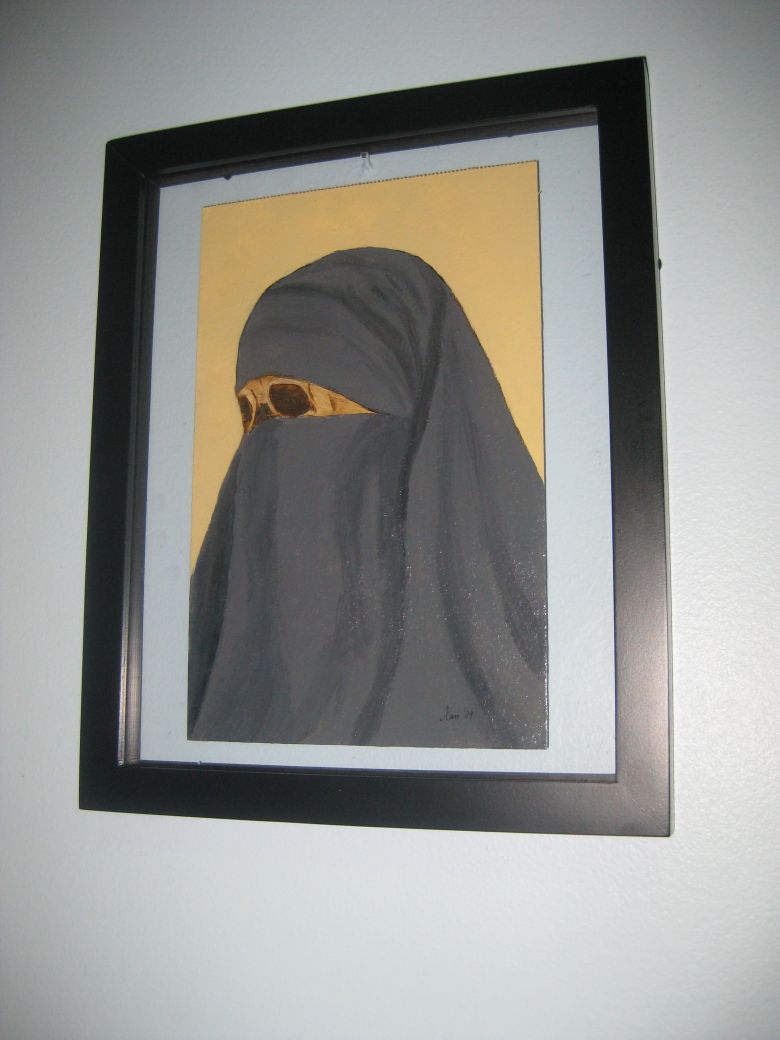
Since I could not find a picture of her, I decided to paint one…  this is my impression of ‘Aisha’:

Aisha

Then, someone posted this comment about Aisha:

WHITE FLOWERS FOR AISHA
I could not sleep for days after reading about Aisha’s tragedy. I would have wanted to bring flowers to her grave, but there was no grave to be reached. I felt so powerless!
But then I got the idea that we should all try and create a wave of sweetness and kindness in the love of Aisha, all over the world. May her death not have been in vain. Let us transform it into a stimulus to spread lovingkindness.
I decided to buy a bunch of white flowers and offer one of them, together with a 5 dollar bill and a piece of candy,to every homeless person I woud find at the railway station,
mentioning Aisha’s name and sending her a blessing every time.
I also made an offer to Amnesty international to honor her name.
Let us all do something, let us create a wave of white flowers and of kind actions so as to try and counterbalance the horror of her death. And let us pray for her, telling her we all love her.
Ilaria

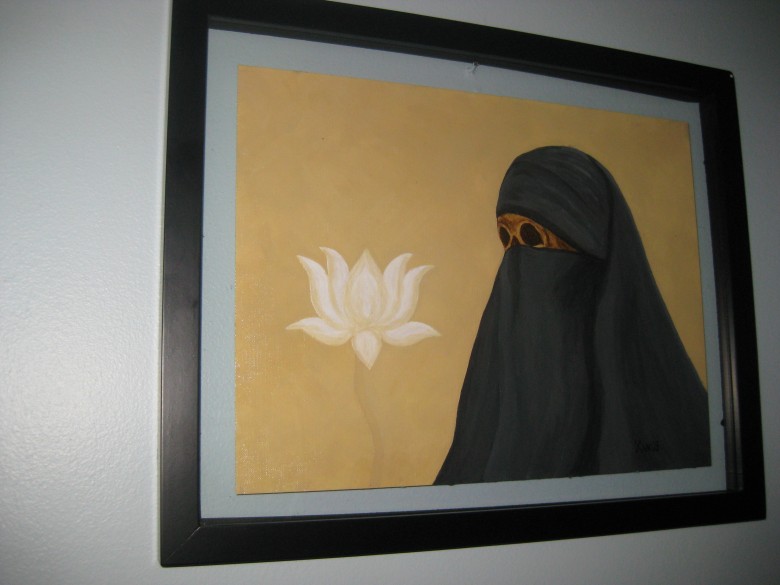
Yes!  WHITE FLOWERS FOR AISHA!

What a beautiful idea:  the innocent blossom, plucked before her time!

White Flowers for Aisha

White Flowers for Aisha

This is my take on ‘White Flowers for Aisha‘!  What is yours?

add to del.icio.usDigg itStumble It!Add to Blinkslistadd to furladd to ma.gnoliaadd to simpyseed the vineTailRank

‘Marriage under Sharia’ permits child prostitution

My first law of human-dynamics is:  if a law can be abused, it will!

That is why every law must be examined very, very carefully; all the ways it can be perverted and abused must be considered and weighed.  This should – preferebly – be done before such a law is accepted and before it becomes the norm in a society.

Sharia is based on the Koran and the Sunnah (the ways of the Prophet Muhammad).  It governs every aspect of a person’s life.  Here is the definition of Sharia from the Islamic Dictionary:

“Way to the water.” The “way” of Islam in accord with the Qur’an and Sunna, ijma’ and qiyas. Sharia is the law of Islam. It is based on the teachings of the Qur’an and the Sunna, though there are many sources outside these two, such as Arab Bedouin law, commercial law from Mecca, and the law of some conquered nations such as Roman and Jewish law. The Sharia extends beyond what Westerners consider law. It covers the totality of religious, political, social, including private life and makes no distinction between sin and law.

While there are several ‘schools’ of Sharia, they all have the same roots and tend to be considered complementary of each other, rather than in opposition to each other.  And, they are in agreement on many of the most fundamental rules of human behaviour and social organization.

One thing that is troubling about ‘Sharia Courts’ is that there is no formal differentiation between these various legal interpretations of the Islamic laws:  rather, it is the leadership of the local Mosque which determines what ‘school’ of Sharia applies to the congregation.  If a change occurs in the leadership (or ‘elders’) in the Mosque, the legal standards are automatically changed, without any notice being given to the populace.

It is my conviction that Aisha Ibrahim Dhuhulow was a victim of such a change.  She grew up under the interpretation of Sharia where rapists were caught and punished.  That is why, after this 13-year-old child was raped, she went to her local officials and ‘demanded that justice be done’.  Unbeknown to her, her town Mosque was recently taken over by officials who subscribed to the most extreme form of Sharia, where the rape victim is stoned to death for adultery.  That explains why she kept begging for her life and calling for help, while the officials who sentenced her to death praised her for ‘demanding that justice according to Sharia be done’…

Both courses of action are possible under different schools of Sharia!  How was the child to know that things could change THAT drastically?!?!?

Which brings me back to my original statement:  if a law can be abused, it will!

Now, I would like to ask you to consider  the rules which govern marriage under Sharia:  I have posted some of the major rules here and here. And, human nature being what it is, I would like you to consider the most twisted possible interpretation of these rules which will not be breaking the letter of the rules.  Because, sooner or later, that is exactly how every law will be applied.  (The background information is in my two earlier posts on this, linked at the beginning of this post).

The example of Muhammad, the Prophet:

  • Muslims emulate the behaviour of Prophet Muhammad, because Islam teaches that they are supposed to do that in order to lead good and pious lives.
  • Muhammad had married his ‘only virgin wife’, Aisha, when she was 6 years old (thought he waited until she was 8 (or 9 – the lunar year calculations are a little different from the solar ones)).  Therefore, that is the example that all Muslims are taught to emulate.
  • Therefore, most countries governed by Sharia allow – nay, encourage – marrying girls of  ‘Aisha’s age’.

‘Age of consent’ in the Koran:

  • Neither the Koran, nor the Sunnah, specify what is the minimum age for a person (male or female) to enter into marriage.  Therefore, there is no prohibition against very young people entering into marriage.
  • In order to ensure adequate protection of the ‘fair sex’, females – both children and adult women – have male guardians to look after them.  A girl/woman’s first guardian is her father, then her husband, her brother, and, eventually, her son.  As such, this guardian represents the girl/woman’s interests in all legal matters, such as management of property and conracts, like marriage and divorce.
  • The Koran has very specific laws about divorce.  IVery specific rules are set out in order to ensure that a husband retains control of any offspring sired – but not yet born – at the time of divorce.
  • Among these rules are ‘special cases’ for widdows, as well as for divorce from women who are no longer fertile because they have reached menopause or because they have not yet reached sexual maturity.
  • Putting these things together, the majority of Muslim scholars support the marriage of pre-pubescent girls, provided her father/guardian permits the marriage.  Some assert that ‘sexual enjoyment’ is permitted with females as young as one day old, though penetration is not ‘recommended’ (but not forbidden).
  • Following a divorce, the guardianship of the girl/woman reverts back to her father – or her closest male relative, who is free to (and encouraged to) arrange the next marriage for the girl/woman in question.

‘Bride Price’

  • Many Muslim scholars do not like the term ‘Bride Price’ – it is supposed to be a ‘nest-egg’ to support the wife in the case of divorce, until her guardian can arrange another marriage for her.  In practice, however, that is exactly what it is.
  • The size of this ‘present’ is usually set by the bride’s father or guardian, who arranges the marriage.

Hmmm…  is it really that difficult to see how this can be (and is) exploited for prostituting children?

add to del.icio.usDigg itStumble It!Add to Blinkslistadd to furladd to ma.gnoliaadd to simpyseed the vineTailRank

Marriage under Sharia

Sharia is more than a legal code.  Sharia is based on the Koran and the Sunnah (the ways of the Prophet Muhammad).  It governs every aspect of a person’s life.  It also contains detailed rules governing marriage and divorce.  In this post, I would like to explore some of the various rules and regulations over the customs and practices of marriage in Islam.

If my understanding is erroneous or imperfect, please, do comment on it:  I will be very happy to have any of my misconceptions corrected.  My aim is to bring the reality of marriage under Sharia forward, so that even non-Muslims may understand it and its implications.

There are several aspects of Islamic marriage which are addressed under Sharia.  These are the terms of the marriage itself, the terms of any divorce (which is permitted and regulated under Sharia), the ‘marriage present’, or ‘bride price’, which is obligatory under Sharia, and who may or may not enter into a marriage contract.

1.  Islamic marriage

There are several types of marriages in Islam. In all cases, a marriage is a social contract, with legal documents specifying the terms of the marriage.  Here is a list of the main ones, with a brief explanation:

Nikah

This is the most common Islamic marriage.  It is a ‘permanent’ marriage – and somewhat similar to the ‘Western’ concept of ‘marriage’.  However, instead of equal obligations among the husband and wife, the husband is responsible for the welfare of the wife, and becomes her legal guardian (as a woman cannot be emancipated under Sharia – her status is equal to that of a minor).

According to the Koran, a man may have up to 4 wives through Nikah marriage at any point in time. A wife is not permitted to have multiple husbands at the same time.

Divorce is permitted, provided it follows the proper rules under Sharia.

Nikah Mut’ah

This is a ‘fixed term’ or ‘temporary’ marriage (mainly practiced under Shi’a form of Islam – and which is promoted in Iran as an alternative to young people having extra-marital affairs).

Even before the marriage is entered into, a time limit is specified for the duration of this marriage. This period can last years, or it can be as little as one hour.  Following this period, the marriage is dissolved.  The same rules and obligations now apply to the couple as under an Islamic divorce.

‘Fixed term’ or ‘temporary’ marriages do not count towards the maximum of 4 wives.

Nikah Misyar

This is also termed ‘traveler’s marriage’ – and also does not count towards the maximum of 4 wives.

Under this type of marriage, the husband’s obligations are significantly reduced, as he does not have to support this wife.  In return, she retains more independence.  This is mostly a ‘Sunni’ practice, just as the nikah mut’ah is a mostly Shi’a practice.

The husband is not responsible for the maintanance of this wife, though he enjoys the marital privileges of ‘visiting her’ as frequently (or seldom) as he pleases.

Special Case 1:  female slaves (prisoners)

If a man cannot support a wife (or multiple wives) sufficiently, it is recommended that instead of entering into a marriage, he should purchase a female slave.  Sharia has very specific rules on slavery:  female slaves are ‘permitted’ to a man who owns them, without binding him with the obligations a marriage entitles.

Female prisoners are considered equivalent to slaves:  that is why, according to some Islamic scholars, part of the ‘punishment’ of a female prisoner is rape by her jailers.  Both ‘slaves’ and ‘prisoners’ are referred to in the Koran as ‘those whom your right hand possesses’.

Special Case 1:  ‘broken’ wives

It is well recognized that sexual intercourse with infants or other very young females may cause permanent physical damage to them (including sterility).  Sharia has a specific rule to deal with this ‘special case’:  if a young ‘wife’ becomes ‘broken’ through the husband’s sexual practices, the husband cannot divorce her and remains responsible for her maintenance for the rest of her life.  She will remain ‘available’ to him – but will not count towards the maximum of 4 wives.

2.  Mahr – Marriage present (bride price)

When the marriage contract is signed, the groom must give the bride a ‘present’:  this is meant to be her ‘nest-egg’ and support her in case of divorce.  In some traditions, the bride’s parents request a very high ‘marriage present’, in order for the groom to prove his worthiness.

Because under Sharia, a woman is not a legal person (as in, a mature person – her legal standing under Sharia is equal to that of a minor), a woman may ‘own’ property, but not control it.  Just like minors in ‘The West’ who have a trust-fund, there is guardian who is appointed to oversee any property ‘owned’ by a woman and who controls it.  Under Sharia, this guardian of a woman’s property is also the woman’s guardian.

So it is with this ‘marital present’:  it is usually (not always) entrusted to the male guardian who authorized the marriage contract.  The reasoning behind this is that in the case of divorce, this man will again become the guardian of the ‘bride’, and will therefore be able to use this ‘marriage present’ to maintain her until he can arrange another marriage for her.

In my next post, I will explore the rules of divorce under Sharia as well as who may or may not enter into a marriage contract… and some of the real-life implications of these rules.

add to del.icio.usDigg itStumble It!Add to Blinkslistadd to furladd to ma.gnoliaadd to simpyseed the vineTailRank

‘Democracy’ is not an absolute

I never thought this would have to state this so specifically:  rape is not acceptable, ever, ever, ever – not even within marriage!

Yet, not everyone seems to understand that!

Let me explain:  the new law proposed in Afghanistan would make rape within marriage perfectly legal – at least among its Shi’a minority. In addition, it would strip mothers and grandmothers of all parental rights, and deny the women freedom of movement (they could only leave their houses with their husband’s permission).

That is bad – very bad.  It is a law that contravenes human rights – obviously – and it contravenes the treaties to uphold these human rights which the Afgahni government has entered into.

What is even worse is how so many people here, in ‘The West’, have reacted to this proposal.  From radio call-in shows to all kinds of other fora where people express their opinions, the reaction I hear is rather frightening!

So many of ‘us’ are saying things along the lines of:

‘Well, it is their democratically elected government which is passing this law, so we must not interfere!’

‘It’s their culture, and if they democratically decide to make these rules, it would be wrong for us to stop them.’

‘We must not criticize this law.  We brought them democracy, and they are democratically choosing to do this, so to criticize this law would be hypocritical of us.’

These sentiments are SO outrageous, I don’t know where to start…

Fist and foremost, let me start with ‘democracy’, as it was originally concieved of by the ancient Greeks:

Brought to us by Athenians in the 4-5th century BCE (though there were earlier proto-democracies as far back as perhaps 2000 BCE), democracy was a straight ‘rule of majority’.  Only free males were considered citizens (women and slaves were excluded), and could vote.  This was a major advance over the previous systems, but…

The problem with this type of democracy is that majority opinion rules.  It can easily become a ‘tyranny of the majority‘ – and tyranny in any form is a bad thing. (Sad that I have to even state that…but, it seems, in today’s world, I do.)

Let me give an example:

Imagine there is a small village of only 5 farmsteads.  They have an ‘absolute democracy’ – meaning, whatever the majority votes, goes.  On one of these farmsteads, there live 4 beautiful, very intelligent young women – their father has saved and scrimped, and is proudly planning to send them off to the big city to get a University education.

This is not to the liking of the other 4 farmers, each of whom has a son – and each of whom would like to see his son marry one of these beautiful, intelligent women.  So, they hold a vote:  unsurprisingly, the vote is 1 for letting the girls go to school, and 4 for letting the 4 young men marry them instead.

Majority rules!!!  Instead of buying textbooks, the funds are used to celebrate 4 weddings…

That WAS democracy in action!

Or, let’s consider another example:

A country has ‘absolute democracy’.  Most of the people in this country are Christian.  About 40% of the population belongs to other religions:  Islam, Judaism, Hinduism, Budhism, Sikhism, or some other religion.  Some of this 40% may practice no religion at all.

Still, 60% of the population is Christian.  One day, a radical preacher introduces a bill which would force the conversion of every one of those 40% of the population to become Christian – no more Mosques, Synagogues, or any other temples.  No more questioning of the Christian dogma – by anyone, anywhere!

It’s put to the vote:  and, surprisingly enough, 59% of the population votes to pass this bill into law!  Now, everyone is forced to become a practicing Christian.

Again, majority rules!!!  This was decided democraticly!

I sincerely hope that you found both of these outcomes unacceptable!

Why?

Because they oppress a part of the populace!

That is why we do not practice ‘absolute democracy’.  Instead, we have improved on this ancient concept in some very, very important ways.  I suppose it started with the Magna Carta…  (Or, if you are a history buff, with Cyrus the Great!)

Cyrus the Great (even more than King John – who was forced into it) recognized and stated a really important principle – later paraphrased by my favourite philosopher, Theodor Seuss Geisel:

‘A person’s a person, no matter how small!’

In other words, Cyrus brought us the idea that there are some rights which are inherrent to each individual – and which no ruler – monarch or democrat or anyone else – has the right to strip from him or her.  Considering that at that time, Cyrus was an absolute monarch, that is a rather enlightened thing to say.

Yet, Cyrus did not just say it – he codified it.  We have ‘the cylinder’ which was Cyrus’s constitutionindividual rights are inherent to the individual, and nobody can strip one of them!!!  Oh, how we need ‘a Cyrus’ now!!!  It was in the very area where Afghanistan and Iran is now, that this cradle of democracy and human rights was located.  So, please, do not let anyone tell you that recognition of and respect for inherrent human rights is not part of the Afghani cultural heritage:  it originates there!!!

From the first declaration of human rights by Cyrus the Great, to the US constitution, to the UN’s Universal Declaration of Human Rights and Freedoms – we all recognize that while we may be ruled by a democracy, it is a constitutional democracy:  it is only allowed to pass laws which do not violate basic human rights!!!

If you are up on the UN’s document, you will see that my first example violates Article 16.2 of the UN’s declaration, while my second example violates Article 18.  That is what makes these scenarios unacceptable to us – and rightly so!

Now, the proposed Afghan law also violates a few of these – specifically, it violates Article 1, Article 2, Article 3, Article 4, Article 5, Article 6, Article 7, Article 13, Articles 16.1 and 16.2, Article 18, Article 20.1, all 3 sections of Article 21, perhaps Article 22, Article 23.1 and 23.4, perhaps Articles 25 and 26, Article 27.1 and 27.2, and, finally, Article 28.

That is quite a score – for a single law!!!

Please, I invite you to follow the link to the UN’s declaration of Universal Human Rights and Freedoms, and verify that I have indeed listed the breeches of the UN’s declaration accurately:  if anything, I erred on the side of not listing an Article or two which might also be breeched!

And, the fledling Afghani government HAD signed a treaty, which binds it to respect and not breech these human rights!  Therefore, any laws it DEMOCRATICALLY passes MUST NOT BREECH these basic human rights and freedoms.

This is not a question of denying the Afghanis the right to rule themselves democratically.  This is a question of demanding that they only pass laws which respect the basic rights and freedoms of its citizens – something the Afghani government has legally bound itself to do!

Hiding behind the word ‘democracy’ does not permit ‘tyranny of the majority’ – yet, that is what those who would accept this Afghani law which strips its Shi’a female citizens of their fundamental rights and freedoms are willing to accept.  People in our own culture lack the ability to differentiate between ‘tyranny of the majority’ and a ‘constitutional democracy’!

Shame on us all!!!

add to del.icio.usDigg itStumble It!Add to Blinkslistadd to furladd to ma.gnoliaadd to simpyseed the vineTailRank

What is ‘Cultural Marxism’?

One of the best things about life is that as long as we are breathing, we can continue to learn!

One of the best things about blogging is that the comments I receive are often insightful, well thought out and I can learn from them.  Usually, these just point out the ‘holes’ in my education/knowledge base:  something I appreciate because it points me in the direction of things I need to learn.

Yet, every now and then, there are comments which are an education in themselves!  Below is an excerpt (!) from one such comment:  I thought it so important and informative that I wanted to share it with everyone.  And, having received permission from the author, here is the answer to my question ‘What is ‘Cultural Marxism’?’:

CodeSlinger says:

Cultural Marxism is not Marxism-Leninism (which we usually just call Communism).

Marxism-Leninism is a system of political economics, which results from applying the so-called Marxist dialectic, developed by Karl Marx and Friedrich Engels, in a process called critical analysis, which uses it to deconstruct Western democracy and capitalism, and to rewrite history in terms of economic class struggle (and we all saw how that turned out).

In the 1920’s, Antonio Gramsci and György Lukács adapted the methods of the Marxist dialectic and critical analysis to the cultural sphere and applied it to the task of undermining Western science, philosophy, religion, art, education, and so on. The result is called the quiet revolution, the revolution from within, the revolution that cannot be resisted by force. This is cultural Marxism.

Now, that was quite bad enough, but then along came a group of sociologists and psychologists — chief among whom being Max Horkheimer, Theodor Adorno, Herbert Marcuse, Erich Fromm, and Jürgen Habermas — and they combined the Marxist dialectic with Freudian psychology to produce an exceptionally corrosive concoction called Critical Theory, which they use to deconstruct Western culture and values, and to rewrite history in terms of sexual and racial power struggles (and we can all see how that is turning out).

Collectively, these guys are called the Frankfurt School, because they originally got together under Horkheimer at the Institute for Social Research (Institut für Sozialforschung), which was domiciled in a little brick building belonging to the University of Frankfurt am Main in the early 1930’s. They all published their work in the Journal for Social Research (Zeitschrift für Sozialforschung), edited by none other than Horkheimer himself.

Then Hitler consolidated his control of Nazi Germany, so, seeing as they were all Jewish, they fled to the USA, more or less as a group, in 1934. In America, they affiliated themselves with Columbia and Princeton Universities. The Zeitschrift für Sozialforschung was renamed Studies in Philosophy and Social Science, and they really got down to business.

Horkheimer’s key idea was that Critical Theory could be used actively, to change society, in contrast to the traditionally passive role of sociology, which had been merely to understand society. These guys were not your typical academics, whose main interest is the pursuit of knowledge. On the contrary, these guys pursued an agenda: they wanted to find out why the Marxist revolution had failed in the West, and they wanted to remedy that situation. To that end, the group’s research addressed what to attack, how to structure the attack, how to deliver the attack, and how to measure the results of the attack.

Thus, for example, Adorno joined up with Paul Lazarsfeld, founder of the Bureau for Applied Social Research at Columbia, and began studying the effect of mass media on the population, and how to measure it. Starting in 1937, they collaborated on the Radio Project (bankrolled by the Rockefeller Foundation) which, among other things, produced the 1938 War of the Worlds broadcast so they could measure its effects, and the Little Annie Project, which pioneered methods that quickly evolved into the Nielsen Ratings and the Gallup Polls.

Another example is the concept of intersubjective rationality, developed by Habermas, which replaces the individual process of reaching a conclusion based on the objective criterion that it follows from valid reasoning and known facts, on the one hand, with the social process of establishing a consensus supported by the subjective criterion that the group feels good about it, on the other hand. In today’s schools, those who do the former are maligned for being judgmental and demanding, while those who do the latter are praised for being good team players.

But, rather than go into pages and pages of detail right here and now, I’ll just list the titles of some of the major works of the Frankfurt School. Given the context, this combination of titles will make the hair stand up on the back of your neck:

Authority and the Family, Horkheimer, 1936
Escape from Freedom&amp, Fromm, 1941
Sex and Character, Fromm, 1943
The Authoritarian Personality, Adorno et al., 1950
Eros and Civilization, Marcuse, 1955
Repressive Tolerance, Marcuse, 1965
Communication and the Evolution of Society, Habermas, 1976

These are just a few of the core works; some are papers, some are books. The total volume of work by these guys, and their followers, is huge. The combined result, as I outlined in my very first post on this blog*, is something like the following:

It includes not only censorship of various kinds, but also the erosion of privacy, the debasement of the schools and the neutralization of the church. It includes the destruction of the family by setting wives against husbands and children against parents. It includes the disarmament of the public, the invalidation of self-defence and the incitement of fear. It includes the promulgation of the culture of victimhood, the promotion of immaturity and the reduction of society to a mob of narcissistic adult children. It includes the dogmatization of the universities. It includes the concentration of wealth, the concentration of ownership of corporations and the concentration of control of the media.

In sum, your description of all this as a descent into a new dark age** is exactly correct. And since you put it in those terms, I highly recommend an article by Michael J. Minnicino, called The New Dark Age: The Frankfurt School and Political Correctness. It speaks your language, and it will make the big picture very much clearer! Another good place to start is The Origins of Political Correctness, which is a transcript of a talk given by Bill Lind at the Accuracy in Academia Conference in 2000.

Update: The reference list above has been updated to also include the following: Escape from Freedom, Fromm, 1941

Xanthippa’s  footnotes:

*  ‘first post on this blog’= ‘first comment’… on my post  ‘Limiting our freedoms – making sense of the ‘big picture’

** reference to my post:  ‘Fight the ‘Forces of Darkness’!

add to del.icio.usDigg itStumble It!Add to Blinkslistadd to furladd to ma.gnoliaadd to simpyseed the vineTailRank

I see a black (car) door and I want it painted red?!?!?

California is seriously considering banning ‘black and dark-coloured cars’, on the grounds that since they heat up faster, their carbon footprint is unnecessarily high.

If that were not enough, apparently, they have already done so with their buildings!

All right: I am seriously considering banning California, on the grounds that since they are passing laws like these, their ‘idiot footprint’ is unnecessarily high!

Hat tip:  Dvorak Uncensored